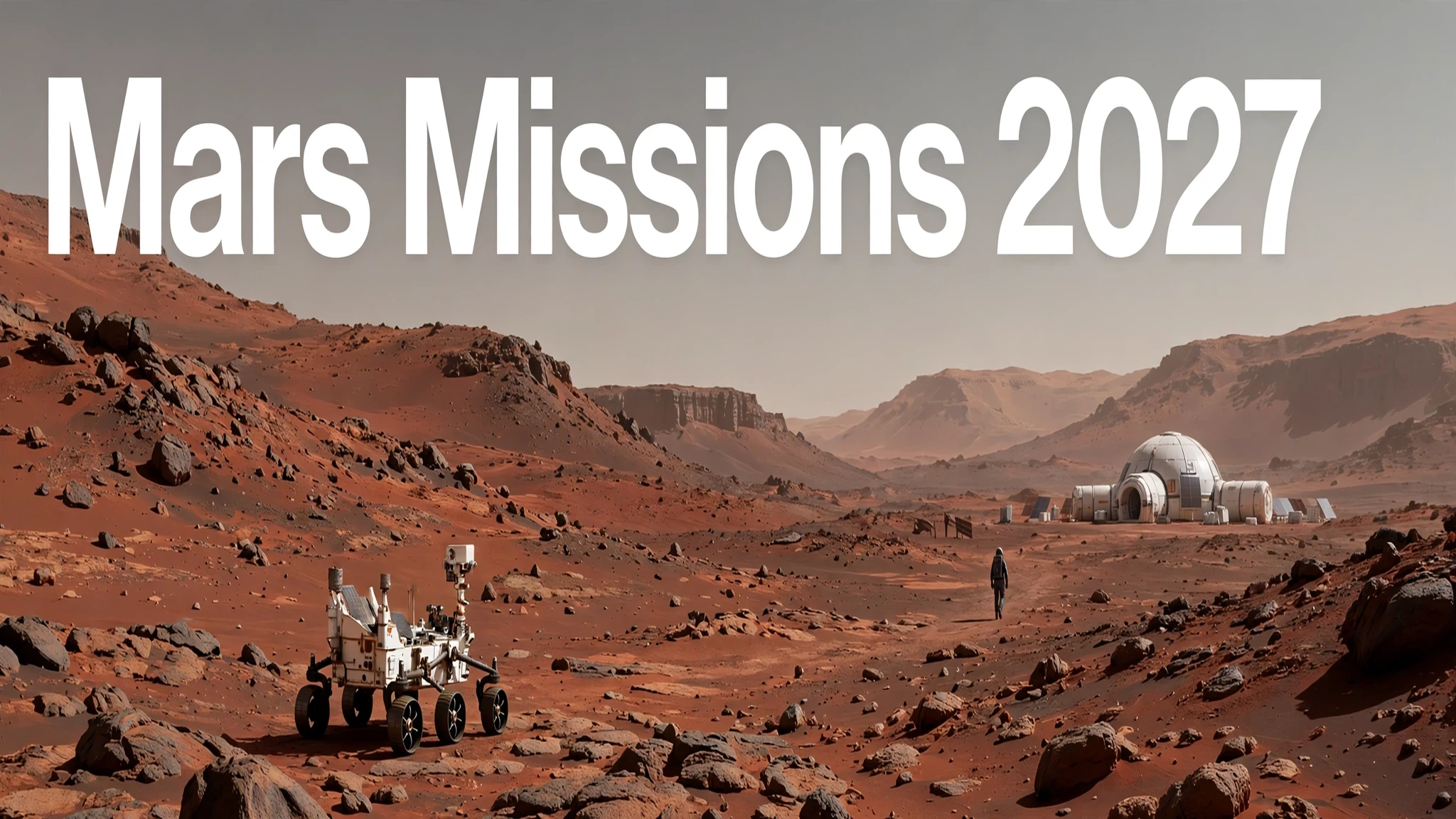
Mars Missions and the Future of Humans 2027
In this post
- Why Mars, Why Now, and Why 2027 Is a Useful Marker
- What Rovers and Orbiters Are Doing Right Now
- Sample Return: The Most Ambitious Robotic Plan
- From the Moon to Mars: Artemis as a Stepping Stone
- Living on Mars: Air, Water, Food, Radiation and Gravity
- Robots First, Humans Later: A Realistic Sequence
- What Could Go Wrong, and What Success Would Look Like
- My Take:
Why Mars, Why Now, and Why 2027 Is a Useful Marker
Mars has held human imagination for more than a century, because it is the most Earth-like planet in the solar system that we can actually reach, and because it may once have had liquid water on its surface. It is cold, dry and thin-aired today, but its valleys, lake beds and minerals tell a story of a warmer, wetter past. If life ever started on Mars, its traces may remain in ancient rocks. If life never started there, Mars still teaches us how a planet can lose its habitability, a warning for Earth. Those two reasons, the search for past life and the lesson of planetary change, drive almost every modern Mars mission.
The year 2027 is not a magic date when humans will land on Mars; no credible agency timeline promises a crewed landing that soon, and readers should distrust any claim that does. Instead, 2027 is a useful marker for the next wave of robotic missions, technology tests and planning decisions that will decide whether human missions in the 2030s or 2040s are realistic. By 2027, several missions already launched or in development will have returned data, new launch windows will have opened, and agencies will have to choose which architectures to fund. Thinking in terms of 2027 therefore means thinking about preparation, not arrival.
Launch windows also shape the calendar. Earth and Mars align favourably for a transfer roughly every 26 months, when a spacecraft can take a relatively efficient path between them. Missing a window means waiting more than two years, or spending much more fuel. Mission planners therefore work in window cycles, not calendar years, and a delay of a few months can become a delay of years. That rhythm explains why Mars news arrives in bursts, and why a mission announced for one window may slip to the next without any failure of technology, simply because testing was not ready in time.
What Rovers and Orbiters Are Doing Right Now
The current Mars fleet is a mix of orbiters, landers and rovers from several space agencies, and it is worth naming the main players without exaggerating their roles. NASA’s Perseverance rover, which landed in Jezero Crater in 2021, is collecting rock samples in sealed tubes for a future return mission, and it carried the Ingenuity helicopter, which proved that powered flight is possible in Mars’ thin atmosphere before its mission ended. NASA’s Curiosity rover, in Gale Crater since 2012, continues to study ancient habitability and climate. Orbiters from NASA, the European Space Agency and other agencies map the surface, study the atmosphere and relay data from the surface to Earth.
Other nations have added important pieces. China’s Tianwen-1 mission placed an orbiter around Mars and the Zhurong rover on the surface in 2021, a notable first-attempt success. The United Arab Emirates’ Hope Probe, in orbit since 2021, studies the Martian atmosphere and its daily and seasonal changes. Europe and Russia’s ExoMars programme has had mixed fortunes, with an orbiter in place and a rover delayed by geopolitical and technical issues. India’s Mars Orbiter Mission, which operated from 2014 to 2022, showed that a low-cost mission could reach Mars orbit and return useful science. Together, these missions mean Mars is no longer explored by one country alone, and data sharing, while imperfect, is broader than in the early space age.
The science return is already substantial. Rovers have found evidence of ancient lakes, river deltas, organic molecules in rocks, and minerals that form only in water. They have measured radiation levels, seasonal methane variations whose source remains debated, and the composition of the thin atmosphere. None of this proves past life, and scientists are careful to say so: organic molecules can form without life, and methane can come from geological processes. The value of the current fleet is that it narrows the search, identifies the most promising rocks, and tests the technologies, such as sample handling and autonomous driving, that future missions will need.
Sample Return: The Most Ambitious Robotic Plan
Mars Sample Return is the most ambitious robotic plan in development, and also the most troubled by cost and complexity. The idea is simple to state and hard to do: Perseverance collects samples, a future lander retrieves them, a small rocket launches them from Mars into orbit, an orbiter captures them, and a capsule brings them to Earth for laboratory study. Each step has been done separately in other contexts, except for launching from Mars and for autonomous rendezvous in Mars orbit, which have never been done. Combined, they form a chain in which a failure at any link could lose the samples or delay the mission by years.
Cost growth and schedule slips have forced redesigns. Independent reviews have warned that the original architecture was too expensive and too complex, and agencies have studied simpler approaches, including fewer launches, different lander designs and revised timelines. As of recent reporting, the programme is being restructured, and its landing and return dates remain uncertain, with return likely in the 2030s rather than the late 2020s originally hoped for. Readers should treat any single date for sample return as provisional, because the programme’s history shows that dates move when engineering reality meets budget reality.
Why pursue such a difficult mission at all? Because laboratory instruments on Earth are far more powerful than anything that can be flown to Mars. A rover can identify minerals and organic molecules, but a laboratory can date rocks precisely, examine them at atomic scale, and search for microscopic structures that a rover cannot resolve. Sample return is therefore the best available test for past life on Mars short of sending humans, and it is also a technology rehearsal for human missions, which will need to launch from Mars, rendezvous in orbit and return safely. Even if sample return slips, its technologies will shape human plans.
From the Moon to Mars: Artemis as a Stepping Stone
NASA’s Artemis programme, which aims to return astronauts to the Moon and build a sustained lunar presence, is often described as a stepping stone to Mars, and that description needs unpacking. The Moon is three days away, Mars is months away, so the Moon is not a dress rehearsal for distance. What the Moon does offer is a place to test deep-space life support, radiation protection, surface habitats, spacesuits and operations with a time delay, in an environment where a rescue or abort, while still difficult, is far more feasible than from Mars. Lessons learned on the Moon, especially about living and working on another world, can be adapted for Mars, even though Mars has different gravity, atmosphere and day length.
Artemis also tests the launch and spacecraft systems that a Mars mission would need in evolved form: a heavy-lift rocket, a crew capsule for deep space, a lunar station called Gateway, and commercial landers. Delays and cost overruns in Artemis have already shown how hard sustained deep-space exploration is, even for the Moon, and those lessons should temper Mars timelines. If returning to the Moon, a place humans visited more than fifty years ago, takes a decade of effort, then sending humans to Mars, which no one has visited, will take longer and cost more, regardless of enthusiasm. That is not pessimism; it is arithmetic based on distance, risk and engineering.
Other countries have their own lunar and Mars plans, and commercial companies, most visibly SpaceX with its Starship vehicle, propose faster, cheaper paths. Starship is designed to be fully reusable and to carry large payloads, and its test flights have progressed, but it has not yet demonstrated the full set of capabilities a Mars mission would need, including long-duration life support, in-space refuelling at scale, and safe landing and return from Mars. Commercial ambition is valuable, because it can lower costs and speed innovation, but it should be judged by demonstrated flights, not by presentations. A vehicle that has flown to orbit is not yet a Mars ship, just as a lunar capsule is not yet a Mars habitat.
Living on Mars: Air, Water, Food, Radiation and Gravity
A human Mars mission faces five linked problems, and solving one without the others is not enough. The first is radiation. Mars has no global magnetic field and only a thin atmosphere, so astronauts on the surface and in transit would receive far more cosmic radiation than on Earth or on the International Space Station, which is partly protected by Earth’s magnetosphere. Shielding with Martian soil, water or thick habitat walls can help, but it adds mass, and long stays increase cancer and other health risks in ways that are still uncertain. Radiation is not a showstopper, but it is a dose that must be managed, not ignored.
The second problem is air and pressure. Mars’ atmosphere is about one percent as dense as Earth’s and is mostly carbon dioxide, so humans need pressurised habitats and suits at all times outside. A suit leak or habitat breach on Mars is far more dangerous than on the Moon, because rescue is months away. The third problem is water and food. Mars has water ice, which can in principle be melted for drinking, oxygen and rocket propellant, but extracting it reliably, in the right place, at scale, has not yet been demonstrated. Food must be brought or grown in greenhouses, and a Mars greenhouse must cope with low light, cold and radiation, while recycling water and nutrients.
The fourth problem is gravity. Mars gravity is about thirty-eight percent of Earth’s, which is better than weightlessness, but we do not know whether it is enough to prevent the bone loss, muscle weakening and other effects seen in long spaceflights. No human has lived in partial gravity for months, so a Mars mission would be an experiment in human physiology as well as engineering. The fifth problem is time and psychology. A Mars mission would last roughly two to three years, including transit and surface stay, with communication delays of up to about twenty minutes each way. Astronauts would be isolated, unable to return quickly, and dependent on systems that cannot be repaired from Earth in real time. Selecting and supporting a crew for that duration is as important as building the rocket.
Robots First, Humans Later: A Realistic Sequence
A realistic sequence for the coming decade puts robots first and humans later, and that order is a strength, not a delay. Robotic missions will continue to map resources, especially water ice, test oxygen production from carbon dioxide, as Perseverance’s MOXIE experiment already did on a small scale, and demonstrate landing of heavier payloads. Future rovers and landers may test construction with Martian soil, power systems for night and dust storms, and autonomous operations that reduce dependence on Earth commands. Each success reduces risk for a later human mission, and each failure teaches a lesson without risking lives.
Human missions, when they come, are likely to be short surface stays at first, not permanent settlements. A first landing might involve a small crew, a pre-landed habitat and supplies, a stay of weeks or months, and a return on a window that was planned before departure. Permanent settlement, with children born on Mars and a self-sustaining economy, is a far later idea, requiring breakthroughs in life support, medicine, construction and governance that do not yet exist. Popular culture often jumps from first landing to Mars cities, but the engineering gap between those stages is larger than the gap between current rovers and a first landing.
International cooperation and commercial partnerships will shape who goes and how. The International Space Station showed that rival nations can cooperate in orbit, and the Artemis Accords, a set of principles for lunar exploration signed by many countries, aim to extend that cooperation, though not all major space powers have signed. Mars missions may follow a similar pattern: a lead agency, commercial providers for transport, and international partners for habitats, science and crew. The alternative, a race in which each nation builds its own Mars system alone, would be slower and more expensive for everyone, and would duplicate the most difficult work.
What Could Go Wrong, and What Success Would Look Like
The risks of a human Mars mission are not only technical. A launch failure, a landing failure, a life-support failure or a medical emergency far from Earth could end a mission and a crew, and the public and political reaction to such a loss could halt Mars exploration for a generation, as past accidents have slowed other programmes. Planetary protection is another risk, in both directions: Earth microbes carried to Mars could contaminate the search for Martian life, and any Martian material returned to Earth, while judged low risk by scientists, must be handled with strict containment until it is proven safe. These are not reasons to avoid Mars, but they are reasons to proceed in steps, with abort options and quarantine plans, rather than in a single heroic leap.
Success in the 2027 window would look modest from the outside, and that modesty should be celebrated. It could mean a new orbiter mapping water ice in detail, a lander testing oxygen and propellant production at scale, a sample-return architecture finally funded and on schedule, or a lunar mission that proves a habitat system Mars will need. It could also mean a commercial vehicle completing orbital refuelling tests or a long-duration crewed flight beyond the Moon. None of these is a footprint on Mars, but each is a necessary step toward one, and together they would show that the programme is moving from promises to hardware.
The longer-term success, a safe human landing and return, would be a scientific and human achievement comparable to Apollo, but with a different meaning. Apollo proved humans could visit another world and return. A Mars landing would prove humans can live and work on another planet, even briefly, and return with samples, data and experience that robots alone cannot provide. It would also test whether humanity can sustain a multi-year, multi-nation effort for a goal with no immediate economic return. That test, of patience and cooperation, may be as important as the landing itself.
My Take:
My take is that Mars exploration is in its most honest phase right now: the phase where robots do the hard, unglamorous work and humans learn how little they know. I like that phase, because it replaces fantasy with measurement. We now know where ancient lakes were, how much radiation a surface crew would face, and how hard it is to bring a rock back from Mars. Those facts are less exciting than a Mars city poster, but they are the facts on which a real mission will be built. A programme that respects those facts, even when they force delays, is more trustworthy than a programme that promises a landing date and then quietly moves it.
I also think we should be careful about who Mars is for. Talk of Mars as a backup planet for humanity can sound inspiring, but it can also sound like an excuse to neglect Earth. Mars will not save us from climate change, pollution or conflict in any relevant timescale, and a Mars colony that cannot feed itself would depend on Earth for centuries. I see Mars not as an escape, but as a mirror: a planet that lost its water and atmosphere shows what planetary change can do, and studying it should make us more serious about protecting Earth’s habitability, not less. The best reason to go to Mars is curiosity and science, not abandonment.
My worry is about timelines driven by marketing rather than engineering. A company or agency that announces a Mars landing date to attract funding or attention, and then misses it repeatedly, does not just disappoint fans; it erodes trust in space exploration as a whole. When the real mission finally flies, the public may greet it with cynicism rather than wonder, because they have heard the promise too many times. I would prefer fewer dates and more demonstrations: a vehicle that refuels in orbit, a habitat that runs for a year on the Moon, a sample that actually returns from Mars. Demonstrations build trust in a way that dates do not.
On the hopeful side, I think the international and commercial mix of current Mars work is a genuine strength. No single country now monopolises Mars science, and that diversity means a setback in one programme does not end exploration. A rover from one nation, an orbiter from another, and a commercial launcher from a third can combine into a capability that none could afford alone. If that cooperation survives political tensions, Mars could become a model for how humanity handles shared frontiers, from oceans to Antarctica to space. That model matters, because the next frontiers will also be shared, and we will need rules for sharing them fairly.
Finally, I keep returning to the samples Perseverance is collecting. Those small tubes of rock, sitting on Mars waiting for a return mission, are a promise to the future: that we will finish what we started, even if it takes a decade longer than planned. A tube of Martian rock in an Earth laboratory will not look dramatic, but it may contain the first evidence that life once existed beyond Earth, or the strongest evidence that it did not, in that place at that time. Either answer would be historic. And if humans one day follow those tubes to Mars, they will not be going to a fantasy planet from a poster. They will be going to a real place, mapped by robots, measured by orbiters, and understood well enough that their landing is a calculated risk, not a leap of faith. That, to me, is the future of humans on Mars worth waiting for.
There is one more thought I want to add, about patience as a virtue in spaceflight. The public often treats a delay as failure, but in Mars exploration a delay that prevents a failure is a success. A launch window missed because a test found a flaw is better than a launch that fails because the flaw was ignored. The engineers who say not yet are protecting the crew who will one day say go. I hope readers will learn to respect that not yet, and to judge Mars programmes not by how soon they promise, but by how carefully they prepare. The first human footprint on Mars, whenever it happens, will be more meaningful because it was delayed until it could be safe, and because it stands on a decade of robotic work that made it possible.
One more consideration should shape Mars planning: the ethics of sending people to a place that may contain traces of past life, or even, remotely, present microbial life in sheltered subsurface environments. Planetary protection rules exist to prevent Earth microbes from contaminating Mars before we have searched properly, and to prevent any Martian material from posing a risk on Earth, however low that risk is judged. A human mission complicates those rules enormously, because humans carry trillions of microbes and cannot be sterilised like a rover. That does not mean humans should never go, but it means the first human landing site, the handling of samples, and the design of habitats should be chosen with contamination in mind, not as an afterthought. Science and exploration must be balanced, and the balance should be decided openly, before boots touch regolith, not after.
I also think about the crew as people, not as symbols. A Mars crew will face isolation, danger, boredom, conflict and homesickness on a scale no previous crew has faced, with no quick return and no real-time conversation with family. Selecting for technical skill alone would be a mistake; selecting for emotional resilience, humour, teamwork and the ability to live in a small group for years matters just as much. The history of polar expeditions, submarine service and long space station missions offers lessons, but Mars will test them further. If we send humans, we owe them not only a safe vehicle, but a humane mission design: meaningful work, private communication, recreation, medical care and a plan for what happens if someone becomes seriously ill far from Earth. A mission that treats its crew as heroes in a poster, rather than as people in a habitat, will fail them, however good its rocket is.
Frequently Asked Questions
Will humans land on Mars by 2027?
No credible agency timeline promises a crewed Mars landing by 2027. The year is better understood as a marker for robotic missions, technology tests and planning decisions that prepare for human missions in later decades.
What is Mars Sample Return?
It is a planned multi-mission effort in which Perseverance’s collected rock samples would be retrieved, launched from Mars, captured in orbit and returned to Earth for detailed laboratory study. Its schedule has slipped and its architecture is being restructured.
Why is Mars hard for humans to live on?
Mars has thin, mostly carbon dioxide air, high radiation, cold temperatures, low gravity and long communication delays with Earth. Habitats must be pressurised and shielded, and water, food and fuel must be produced or brought reliably.
How does Artemis help Mars missions?
Artemis tests deep-space life support, habitats, suits and operations on the Moon, where rescue is more feasible than from Mars. Those lessons, plus heavy-lift and crew systems, can be adapted for Mars, though Mars remains far more distant and difficult.
Has Mars ever had life?
No confirmed evidence of past or present Martian life has been found. Rovers have found ancient lake beds, organic molecules and water-formed minerals, which show Mars was once more habitable, but those findings alone do not prove life existed.
How often can spacecraft launch to Mars?
Favourable Earth-Mars transfer windows open roughly every 26 months. Missing a window can delay a mission by more than two years or require much more fuel, so planners work around these cycles.