How Do Volcanoes Form Islands
In this post
The Short Answer: Lava That Refuses to Stay Underwater
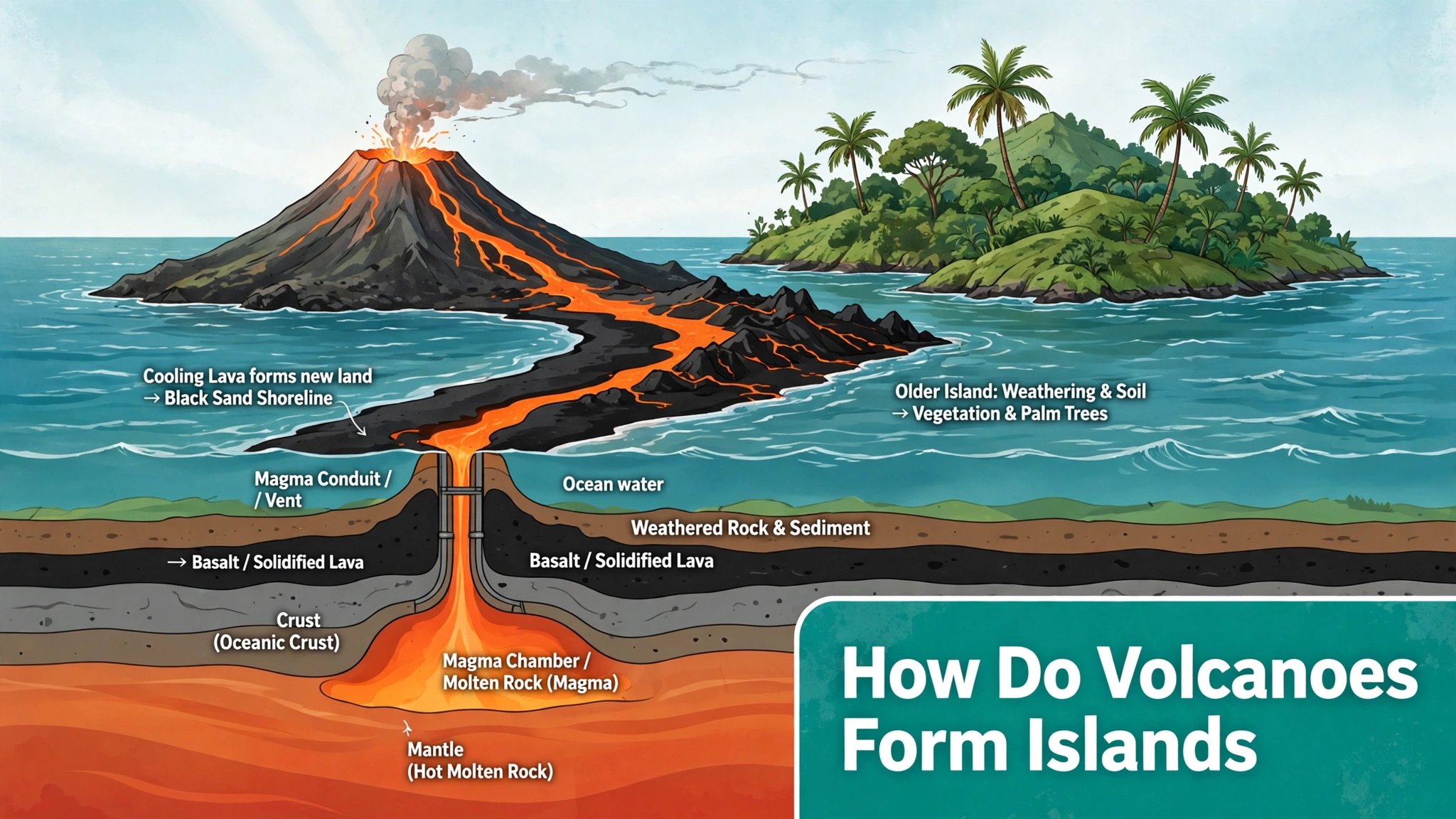
A volcanic island forms when molten rock from inside the Earth erupts on the ocean floor, cools, hardens, and piles up until it rises above sea level. That simple sentence hides a long, violent, and patient process. A single eruption rarely creates an island. Instead, thousands of eruptions over thousands or millions of years build a mountain from the seafloor upwards, layer by layer, like a tower constructed in darkness. Most of that tower remains underwater, invisible to anyone on the surface. Only when its summit finally breaks through the waves does it become an island, and even then, it may be little more than bare black rock, with no soil, no plants, and no fresh water. The green, inhabited island that people picture comes much later, after weathering, soil formation, and the arrival of life.
The key material is magma, molten rock beneath the Earth’s crust, which becomes lava when it erupts at the surface. When lava meets seawater, it cools rapidly, forming a hard outer crust while its interior may still flow. Repeated flows stack on each other, creating a broad, gently sloping volcano, especially when the lava is fluid and runny. That shape matters: fluid lava can travel far from the vent, building a wide shield, while thick, sticky lava piles up steeply near the vent, building a taller, narrower cone. Oceanic volcanoes are often shield volcanoes, built from fluid basalt lava, which is why many volcanic islands have gentle slopes rather than sharp peaks, at least in their early stages. The chemistry of the lava, the rate of eruption, and the depth of water all influence how quickly an island grows.
It is important to understand scale. An island that rises a few hundred metres above sea level may stand several kilometres above the ocean floor. The visible island is only the tip of a much larger mountain, most of which is hidden beneath the waves. That hidden base also explains why volcanic islands can be so isolated: they rise from deep ocean basins, far from continents, built entirely by volcanic activity rather than by a piece of continent breaking away. That isolation shapes their ecology, because plants and animals must arrive by wind, water, or flight, and then evolve in separation, often producing species found nowhere else. A volcanic island is therefore not only a geological product. It is a new, isolated laboratory for life.
Inside the Earth: Magma, Mantle, and the Crust
To understand volcanic islands, it helps to picture the Earth’s structure in simple terms. The outermost layer, the crust, is thin compared with the planet as a whole, and oceanic crust, beneath the oceans, is thinner and denser than continental crust. Beneath the crust lies the mantle, a thick layer of hot, mostly solid rock that can flow very slowly over geological time. Magma forms when mantle rock partially melts, usually because temperature rises, pressure falls, or water and other materials lower the melting point. That molten rock is less dense than surrounding solid rock, so it tends to rise, collecting in a magma chamber beneath a volcano, until pressure forces it upwards through cracks towards the surface.
Plate tectonics, the theory that Earth’s outer shell is divided into plates that move slowly over the mantle, explains where most volcanoes form. Many volcanoes occur at plate boundaries, where plates move apart or one plate slides beneath another. At divergent boundaries, plates pull apart, pressure falls, and mantle rock melts, creating new crust and volcanic activity. At convergent boundaries, where one plate sinks beneath another in a process called subduction, water carried down with the sinking plate lowers the melting point of mantle rock above it, generating magma that rises to form volcanoes. Island arcs, chains of volcanic islands near a subduction zone, form in this way, and they often have more explosive eruptions, because their magma can be richer in silica and gas than the fluid basalt of oceanic shield volcanoes.
Not all volcanic islands form at plate boundaries, however, and that exception is crucial. Some of the world’s most famous volcanic islands form in the middle of a plate, far from any boundary, above a hotspot. A hotspot is a place where a plume of hot mantle material rises towards the surface, melting rock and feeding volcanoes over a long period. As the tectonic plate moves slowly over a relatively fixed hotspot, a chain of volcanoes forms, with the youngest, active island above the hotspot and older, extinct islands trailing behind, gradually sinking and eroding as they move away. That process explains island chains that run in a clear line across the ocean, with age increasing in one direction, a pattern that puzzled early geologists until plate tectonics and hotspots provided an explanation.
Hotspots and the Birth of an Island Chain
The Hawaiian island chain is the classic example of hotspot island formation, and it illustrates the process clearly, even though similar chains exist elsewhere. Beneath the Pacific Plate, a hotspot supplies magma that builds volcanoes on the ocean floor. The youngest island, at the southeastern end of the chain, sits above the hotspot and remains volcanically active, while older islands to the northwest are extinct, having moved away from the hotspot as the plate drifted. Over millions of years, those older islands erode, subside as the oceanic crust beneath them cools and sinks, and may eventually become flat-topped seamounts below sea level, known as guyots, or coral atolls, where a reef has grown upwards to stay near the surface as the volcanic island beneath it sinks.
The life cycle of a hotspot island can be divided into stages. First, a submarine volcano grows on the ocean floor, erupting lava that cools in water to form pillow-shaped lavas. Next, eruptions become more frequent and vigorous as the volcano nears the surface, with steam explosions where lava meets shallow water. Then, the volcano breaks the surface, forming a new island of bare lava, which may grow rapidly during active eruptions. In the shield-building stage, fluid lava flows build a broad, gently sloping island, often with a caldera, a large depression at the summit formed when a magma chamber empties or collapses. Later, as the island moves away from the hotspot, eruptions become less frequent, erosion cuts valleys and cliffs, and the island begins to sink. Finally, if conditions allow, coral reefs may fringe the island, and in some cases, only an atoll remains after the volcanic rock has sunk below the surface.
That life cycle takes millions of years, which is why a volcanic island chain is like a timeline laid out across the ocean. Each island represents a different stage in the same process, from active youth to eroded old age. Visitors to a young volcanic island may see fresh lava, black sand, and steam, while visitors to an older island in the same chain may see deep valleys, waterfalls, beaches, and rich soil, with no active volcano at all. That contrast is not a contradiction. It is the same island at different ages, and it shows why geology requires thinking on timescales far longer than a human lifetime. A process that seems sudden during an eruption is, in geological terms, part of a slow, continuous story.
From Bare Rock to a Living Island
A new volcanic island is a harsh place for life. Fresh lava rock is hard, dark, and poor in nutrients, with no soil, no shade, and often no fresh water, since rain runs quickly off bare rock or sinks through cracks. The first colonists are usually hardy organisms that can survive those conditions: lichens, which can grow on bare rock and slowly break it down, algae, and wind-blown spores. Their growth, death, and decay, combined with weathering by rain, wind, and waves, gradually create a thin layer of soil. That soil, though poor at first, allows small plants to take root, which in turn provide shelter, shade, and organic matter, improving the soil further. This gradual process, called primary succession, can take decades to centuries for simple plant cover, and much longer for forest.
Animals arrive by different routes, depending on size and ability. Birds may fly to a new island, carrying seeds in their feathers or digestive systems. Insects and spiders may arrive on wind currents or floating debris. Small reptiles, plants, and invertebrates may raft on logs or vegetation washed out to sea. Larger mammals, unless introduced by humans, rarely reach isolated oceanic islands on their own, which is why many volcanic islands have unique bird, insect, and plant life, but few or no native large land mammals. Once arrived, species evolve in isolation, adapting to the island’s climate, food, and predators, or lack of predators. That isolation is why volcanic islands are famous for endemism, species found nowhere else, and why they are both scientifically valuable and ecologically vulnerable to introduced species, which can outcompete or prey on island species that evolved without them.
Human arrival changes an island’s story again, sometimes rapidly. People bring crops, animals, building materials, and trade, transforming soil, water, and ecosystems within decades, a blink in geological time. Fresh water, which is scarce on a young volcanic island, becomes crucial: rain may collect in crater lakes, seep into porous lava to form underground reservoirs, or be captured from streams in older, eroded valleys. Agriculture depends on soil depth and fertility, which increase with age and weathering, so older volcanic islands often support larger populations than young ones. Understanding that link between geological age, soil, water, and habitability helps explain why some volcanic islands are densely populated and green, while others remain barren and uninhabited, even within the same chain.
Erosion, Sinking, and the End of an Island
No volcanic island lasts forever in its original form. Once eruptions stop, erosion and sinking begin to win. Rain cuts valleys into soft volcanic rock, waves undercut cliffs, and landslides, sometimes enormous, can remove whole sections of an island in a single event, although most erosion is gradual. As the oceanic plate beneath the island moves away from a hotspot, or as the volcanic load cools, the crust beneath the island sinks slowly, a process called subsidence. That sinking, combined with erosion, lowers the island over millions of years, even as sea level itself changes with climate and ice volume. An island that once stood high and rugged may become low, flat, and fringed by reefs, before disappearing below the waves entirely.
Coral reefs play a fascinating role in this later stage. In warm, clear, shallow water, corals grow upwards as the island sinks, maintaining a ring of reef near the surface. If the island sinks completely, the reef may remain as an atoll, a ring of coral islands surrounding a central lagoon, with no volcanic rock visible above water. That transformation, from high volcanic island to low atoll, was recognised by Charles Darwin in the nineteenth century, and it remains a powerful example of how biology and geology interact over long timescales. Not all sinking islands become atolls, because coral growth requires warm water, sunlight, and low sediment, but where conditions suit, atolls preserve the outline of a vanished island in living coral.
Erosion also creates the dramatic landscapes that many people associate with older volcanic islands: steep cliffs, deep valleys, waterfalls, black sand beaches where lava has been ground down by waves, and fertile plains where eroded material has accumulated. Those landscapes are not only beautiful. They are evidence of the island’s history, showing where lava flowed, where water cut through rock, and where the sea has advanced or retreated. Geologists read that evidence like a book, using rock layers, valley shapes, and beach composition to reconstruct past eruptions, climates, and sea levels. For a visitor, understanding that a beach’s black sand is crushed lava, or that a valley was carved by rain over millions of years, turns a scenic view into a story about deep time, which is one of the most rewarding ways to experience a volcanic island.
Living With Volcanoes: Risk, Benefit, and Monitoring
Volcanic islands offer benefits, including fertile soil, geothermal energy, tourism, and unique ecosystems, but they also carry risks, especially where volcanoes remain active. Eruptions can produce lava flows, ash fall, toxic gases, landslides, and, in some cases, tsunamis if a flank collapses into the sea or an eruption occurs underwater. Those hazards vary greatly by volcano type, eruption style, and location. A fluid lava flow may move slowly enough for people to evacuate, while an explosive eruption with fast-moving hot gas and ash, known as a pyroclastic flow, can be far more dangerous and much faster. Living on a volcanic island therefore requires understanding local hazards, monitoring, and evacuation planning, not only appreciating the landscape.
Modern monitoring helps reduce risk, although it cannot eliminate it. Scientists track earthquakes, ground deformation, gas emissions, and thermal changes, which often, but not always, signal rising magma before an eruption. Satellite data, ground instruments, and field observations allow volcanologists to issue warnings, close areas, and advise evacuations, saving lives in many cases. However, prediction remains uncertain: some eruptions occur with little warning, while some periods of unrest do not lead to eruption. Residents and visitors should therefore follow local official guidance, respect closed areas, and avoid assuming that a quiet volcano is safe forever, or that a visible eruption is safe to approach for photographs. General information in articles like this one is not a substitute for local warnings or emergency instructions.
The benefits of volcanic islands are also tied to their geology. Weathered volcanic rock produces rich soil, especially for crops, because it contains minerals that plants need. Geothermal heat, where it is accessible, can provide energy and hot springs, although developing it requires care to avoid environmental harm. Tourism, drawn by dramatic landscapes, beaches, and unique wildlife, supports many island economies, but it also brings pressure on water, waste, and fragile ecosystems. Sustainable use of a volcanic island therefore requires balancing human needs with the island’s geological and ecological limits. That balance is easier when residents and visitors understand how the island formed, how old it is, and how quickly its ecosystems can be damaged compared with how slowly they formed.
My Take:
My view is that volcanic islands are one of the clearest examples of how the Earth creates, rather than only destroys, through processes that seem violent in the short term and creative in the long term. An eruption that looks like pure destruction, with lava, ash, and steam, is also the first step in building new land, new soil, and eventually new ecosystems. That dual nature, destruction and creation in the same event, challenges a simple view of nature as either benign or hostile. Volcanoes are neither. They are expressions of a planet that is still active, still moving, and still reshaping its surface, and islands are the visible proof that geological change is not only something that happened in the distant past. It is happening now, on timescales that are slow for humans but fast for the Earth.
I also think volcanic islands teach a useful lesson about time. Human lives are measured in decades, but island formation is measured in millions of years. A young island that looks barren today may become green and inhabited in a future that no living person will see, while an old island that looks permanent today will eventually sink beneath the sea. That perspective does not make human concerns unimportant. It puts them in context, reminding us that landscapes we treat as fixed are temporary, and that our impact on an island, through introduced species, pollution, or development, can happen far faster than the natural processes that built it. That asymmetry, slow creation versus fast damage, is a strong argument for care, especially on isolated islands where species and ecosystems cannot easily recover elsewhere.
Another point I feel strongly about is the importance of local knowledge alongside scientific monitoring. Scientists provide crucial data about magma, earthquakes, and gas, but residents often notice small changes, know evacuation routes, and understand how their community responds to warnings. Effective volcanic safety depends on both: scientific monitoring that is communicated clearly, and communities that trust, practise, and act on that information. Visitors, too, have a responsibility to respect warnings and closed areas, rather than treating an active volcano as a backdrop for photographs. Admiration for a volcano should include respect for its power, and that respect is shown by following guidance, not by getting closer for a better view.
Finally, I believe volcanic islands deserve to be visited, studied, and discussed with wonder, but also with humility. Wonder comes from seeing new land rise from the sea, from walking on rock that was molten in recent history, and from meeting species that evolved nowhere else. Humility comes from recognising that those wonders took millions of years to form, that they can be damaged in a lifetime, and that they will outlast, in geological form, any human presence on them. My advice to readers is to learn the basic story, magma rising, lava cooling, island growing, life arriving, erosion and sinking, before visiting a volcanic island, because that story transforms a holiday landscape into a living lesson in Earth science. Once you see an island as a stage in a long life cycle, rather than as a fixed postcard, you will never look at a coastline, a beach, or a mountain in quite the same way again.
Another fascinating angle is how volcanic islands influence climate and ocean currents in their local region, even though a single island is small compared with an ocean. A high volcanic island can block trade winds, forcing moist air to rise, cool, and release rain on one side, while the other side remains dry in a rain shadow. That pattern creates very different ecosystems within a few kilometres: wet forest on the windward side, dry scrub on the leeward side, and distinct farming conditions for communities on each side. Ocean currents, too, are deflected by an island’s submerged slopes, creating upwellings that bring nutrients to the surface and support rich marine life. An island is therefore not only a product of geology. It actively shapes weather, water, and life around it, long after its eruptions have stopped.
I also think it is worth discussing how scientists study islands that are still forming, because that research is both exciting and difficult. A new island may appear suddenly, in a remote ocean location, with no infrastructure, no fresh water, and ongoing eruptions that make landing dangerous. Scientists may observe it from ships, aircraft, and satellites, collecting samples only when it is safe, and tracking how life colonises it from the very beginning. Those studies are rare opportunities to watch primary succession in real time, rather than reconstructing it from older islands. They also require patience, because a new island may erode away within months or years if eruptions stop, before a stable ecosystem can develop. That fragility is a reminder that island formation is not a guaranteed success story. It is a contest between building and erosion, and erosion often wins in the short term.
A further point concerns human settlement on young versus old volcanic islands, which follows a pattern that is easy to overlook. Young islands, with thin soil and little fresh water, are hard to live on, even if they are close to other inhabited places. Older islands, with deep soil, valleys that collect water, and harbours formed by erosion, are easier to settle and farm. That difference explains why population density, agriculture, and infrastructure vary so much within a single island chain, and why some islands remain nature reserves while others become cities. It also explains why archaeological and historical records differ: older islands have longer human histories, with more time for culture, language, and trade to develop, while younger islands may have been settled only recently, or not at all. Geology, in this way, shapes human history, not only natural history.
Finally, I want to emphasise the value of visiting volcanic islands, or learning about them, with a sense of deep time and responsibility. A beach of black sand, a cliff of layered lava, or a valley carved by rain are not only scenic features. They are records of eruptions, erosion, and life over millions of years, and they are fragile in ways that are not obvious. Collecting rocks, disturbing nesting sites, or introducing non-native species can damage an island’s ecosystem far more quickly than natural processes can repair it. Responsible visiting, following local rules, staying on marked paths, and supporting conservation, allows people to enjoy these remarkable places without harming them. That care is part of appreciating how islands form: recognising that a landscape built over geological time deserves protection on a human timescale, even if its eventual fate, sinking and erosion, is already written into its geology.
Frequently Asked Questions
How long does it take for a volcano to form an island?
It usually takes thousands to millions of years of repeated eruptions to build a submarine volcano up from the ocean floor to above sea level. A single eruption rarely creates a lasting island, although new land can appear quickly during an active eruption and then erode just as quickly if eruptions stop.
What is a hotspot volcano?
A hotspot is a place where hot mantle material rises and melts rock, feeding volcanoes in the middle of a tectonic plate, far from plate boundaries. As the plate moves over the hotspot, a chain of islands forms, with the youngest active island above the hotspot and older islands trailing behind.
Why are volcanic islands often isolated and unique?
Volcanic islands rise from deep ocean basins, far from continents, so plants and animals must arrive by wind, water, flight, or rafting. That isolation, over long periods, leads to evolution of species found nowhere else, a pattern called endemism.
Do volcanic islands eventually disappear?
Yes, in geological terms. Once eruptions stop, erosion and sinking, as the crust cools and subsides, gradually lower an island. In warm seas, coral reefs may grow upwards as the island sinks, sometimes leaving an atoll after the volcanic rock has disappeared below water.
Are volcanic islands dangerous to live on?
They can be, especially where volcanoes remain active, because eruptions can produce lava, ash, gases, landslides, and tsunamis. Monitoring, official warnings, and evacuation planning reduce risk, but they cannot eliminate it, and local guidance should always be followed.
Why is volcanic soil often fertile?
Weathered volcanic rock contains minerals that plants need, and over time, weathering and organic matter create rich soil. That fertility, combined with rainfall and climate, helps explain why many older volcanic islands support agriculture, even though young lava fields are initially barren.