How to Budget on a Low Salary Without Feeling Poor
In this post
- Know Your Real Take-Home Pay and Fixed Costs
- Build a Payday Routine That Protects Essentials First
- Cut Food Costs Without Eating Poorly
- Handle Debt, Emergencies, and Irregular Expenses Honestly
- Save Something Small, Consistently, Without Guilt
- Live Well on Less: Dignity, Joy, and Social Pressure
- When Income Rises, Protect the Gain Before Lifestyle Rises
- My Take:
A low salary does not mean a low-quality life, but it does mean every rupee, dollar, or pound has to be given a clear job before the month starts. Most budgeting advice fails on a small income because it assumes surplus money that simply is not there. It tells people to invest, save twenty percent, and cut lattes, while the real problem is rent, transport, food, and an unexpected bill arriving in the same week. Budgeting on a low salary is therefore not about restriction for its own sake. It is about protection: protecting essentials first, protecting a small emergency cushion second, and protecting your dignity and choices third, so money stress does not decide everything for you.
The first shift is psychological before it is mathematical. Feeling poor often comes less from the bank balance itself and more from comparison, unpredictability, and shame. When money runs out before the month ends, it feels like personal failure, even when wages, prices, and hours are outside your control. A written plan changes that feeling because it replaces vague worry with visible decisions. You can see what is covered, what is delayed, and what is genuinely impossible this month. That clarity does not increase income overnight, but it stops small leaks, prevents panic borrowing, and gives you a reason to say no without guilt. A budget is not a punishment document. It is evidence that you are managing what you have with intention.
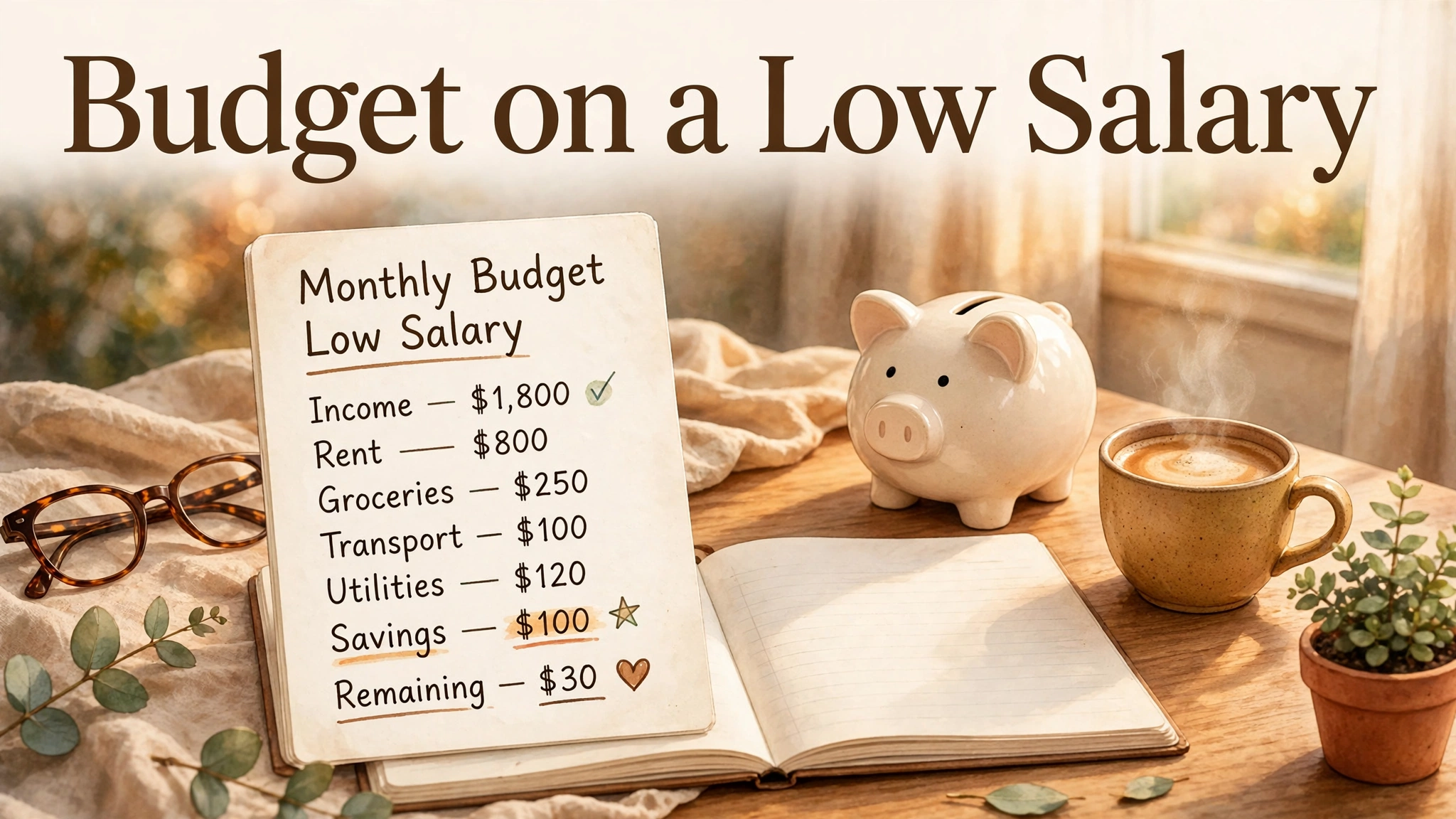
Start with real numbers, not ideal numbers. Write down your actual take-home pay after deductions, averaged over the last three months if your hours vary. Then list fixed costs that do not change much: rent or housing share, utilities, transport pass or fuel, phone bill, loan minimums, and essential subscriptions. Next list variable essentials: groceries, cooking gas, household cleaning, personal care, and work-related costs. Only after those are covered should you allocate money for enjoyment, gifts, and savings. Many people do this backwards, spending first and hoping essentials fit later. On a low salary, that order is the main cause of month-end crisis. Pay essentials on payday, not at month-end, and move even a small savings amount on the same day, before discretionary spending can absorb it.
Know Your Real Take-Home Pay and Fixed Costs
Your salary on paper is not your budget. Taxes, pension or social contributions, loan deductions, and irregular overtime can make one month very different from the next. Take your last three payslips or bank credits and calculate the lowest reliable monthly figure. Budget to that lower figure, not the best month. If extra income arrives, treat it as a bonus for debt or savings, not as permission to raise everyday spending permanently. This conservative baseline prevents the common trap where a good month creates new commitments that a normal month cannot support.
Fixed costs deserve a separate review because they are the hardest to change but the most powerful to reduce. Housing is usually the largest cost, and on a low salary even a small reduction matters enormously. That does not always mean moving. It can mean sharing costs fairly, negotiating rent at renewal with a record of on-time payment, checking whether a cheaper utility tariff, shared internet plan, or off-peak transport pass is available, or asking an employer about travel support. Review each fixed bill once every three months and ask one question: is there a legal, safe, cheaper version of the same essential service? Cancel duplicate subscriptions, downgrade unused tiers, and remove auto-renewals you forgot. A saving of a small amount on five bills together can equal a meaningful weekly food budget.
Keep a simple one-page monthly sheet, on paper or in a free notes app, with four columns: expected, actual, difference, and note. Do not build a complicated spreadsheet you will abandon. The goal is a habit you can repeat in fifteen minutes on payday. If a cost rises, note why: a price increase, extra travel, a family event. Patterns become visible within two months. You will learn whether food, transport, or small daily purchases are the real leak, rather than guessing and blaming yourself generally.
Build a Payday Routine That Protects Essentials First
A payday routine turns budgeting from willpower into a system. On payday, in this order, first set aside rent and utilities money in a separate account or envelope if possible, so it cannot be spent accidentally. Second, pay minimums on debts to avoid penalties. Third, move a fixed small savings amount, even if it is only the price of two takeaway meals, into a separate place that is slightly harder to reach. Fourth, load your grocery and transport budget for the month or week. Fifth, decide a clear fun amount and spend it without guilt. This order matters because willpower weakens during the month, while systems do not.
Weekly budgeting often works better than monthly budgeting on a low income. A month feels abstract; a week feels manageable. Divide grocery, transport, and personal money into weekly envelopes or weekly transfers. If one week goes over because of a birthday or illness, you can adjust the next week immediately, instead of discovering a large shortfall on day twenty-five. Weekly checks also catch bank errors, double charges, and subscription renewals early, when they are still fixable.
Use cash or a separate card for variable spending if digital spending feels invisible. Many people do not overspend because they are careless; they overspend because card payments do not feel like money leaving. A visible weekly limit, a daily balance check, or a simple rule such as no unplanned purchase above a set amount without waiting twenty-four hours can cut impulse spending without making life joyless. The waiting rule is especially useful for online shopping, sales, and social media offers that create artificial urgency.
Cut Food Costs Without Eating Poorly
Food is the most flexible essential, which makes it both the easiest place to save and the easiest place to feel deprived. The answer is not skipping meals or living on instant noodles. It is planning meals around cheap, filling, nutritious staples: rice, lentils, beans, eggs, seasonal vegetables, potatoes, oats, and bread, supplemented by whatever protein or fresh produce is affordable locally. A weekly meal plan built around what is already in the cupboard, what is on sale, and what can be cooked in bulk will save more than any coupon app alone.
Cook in batches when time and storage allow. A large pot of lentils, beans, soup, or curry can provide several meals, reduce daily cooking time, and prevent expensive last-minute takeaways after a long workday. Freeze portions in labelled containers if you have freezer space. Pack lunch for work on most days, keeping one planned takeaway day if that matters to you, rather than buying lunch daily by default. Drink water as the default, carry a bottle, and treat sugary drinks and snacks as occasional choices, not daily habits.
Shop with a list, after eating, and compare unit prices rather than package prices. Larger packs are not always cheaper per kilogram. Store brands often match name brands for staples such as rice, flour, oats, and cleaning products. Buy seasonal fruit and vegetables, check local markets near closing time where discounts are sometimes offered, and avoid shopping as entertainment. If food waste is a problem, plan leftover meals deliberately: roast vegetables become soup, rice becomes fried rice, bread becomes toast or breadcrumbs. Every wasted meal is money already spent and thrown away.
Handle Debt, Emergencies, and Irregular Expenses Honestly
Debt on a low salary needs a calm, written plan, not avoidance. List every debt with its balance, minimum payment, interest rate or fee, and due date. Pay minimums on all debts first to protect your credit record and avoid penalties, then put any extra payment toward the highest-cost debt, unless a very small debt can be cleared quickly for motivation and to free up a monthly payment. If interest or fees are high, contact the lender and ask about hardship options, lower payments, or a payment plan; many lenders have formal processes, though outcomes vary and should be confirmed in writing. Avoid taking new high-interest borrowing to pay old borrowing, because that cycle is how a manageable debt becomes unmanageable.
Irregular expenses are what break most budgets: school costs, medical needs, vehicle repair, festival gifts, winter clothing, and home repairs. They are not surprises if you expect them once a year. Create a small sinking fund for each predictable category, even a tiny weekly amount, so a known expense does not become a crisis loan. For true emergencies, a starter emergency fund of one week of essential expenses is a realistic first goal, followed later by one month. That fund should be separate, boring, and only used for genuine urgency, not sales or wants. Rebuilding it after use is part of the plan, not a failure.
If income is irregular, build a buffer month gradually. In good months, hold back part of the extra income to cover a future slow month, rather than spending it all. If work hours drop suddenly, cut discretionary spending immediately, contact bill providers early before arrears grow, and prioritise food, housing, utilities, and transport to work. Early communication usually gives more options than silence. Keep copies of bills, agreements, and payment confirmations, because clear records protect you in disputes.
Save Something Small, Consistently, Without Guilt
Saving on a low salary is often dismissed as impossible, yet small consistent saving changes both finances and confidence. The amount matters less than the habit and the separation. Save a fixed amount on payday, even if it seems too small to matter, because twelve small deposits become a useful cushion, and the habit survives when income rises. If saving a percentage feels impossible, save a fixed small sum, round up purchases where your bank allows it, or save windfalls such as tax refunds, cashback, or gift money before they blend into daily spending.
Separate savings from spending money physically or digitally. If savings sit in the same account as daily money, they will be spent. A separate savings account without a linked spending card, or a labelled envelope for cash savers, creates friction that protects the goal. Name the fund for its purpose: rent safety, medical, transport repair, or family support. A named fund is harder to raid for a vague want than an unnamed balance.
Do not compare your savings rate with high earners online. A person saving five percent of a low wage with discipline is doing harder financial work than a person saving twenty percent comfortably. Celebrate milestones that matter to you: first week of expenses saved, first debt cleared, first month without borrowing for food. These milestones are not trivial. They prove the system works and make the next milestone believable. Financial progress on a low salary is usually slow and uneven, not a straight line, and that is normal.
Live Well on Less: Dignity, Joy, and Social Pressure
Budgeting fails when it removes all joy, because no one sustains a life of pure restriction. Plan joy deliberately and cheaply: a weekly walk with friends, a home-cooked meal shared with family, a library book, a free community event, a park picnic, a skill learned online for free. Low-cost joy is not second-class joy. In fact, chosen simple pleasures often feel better than expensive spending done to impress others or to escape stress. The key is that joy is planned and guilt-free, not accidental and followed by regret.
Social pressure is a real budget cost. Weddings, birthdays, outings, and group meals can strain a low income, especially when saying no feels embarrassing. Prepare honest, brief responses in advance: you have a set budget this month, you would love to join for a free part, or you can contribute in time and cooking rather than money. True friends respect a boundary; pressure to spend beyond your means is not generosity. For gifts, set an annual gift budget, make gifts, buy early during genuine discounts, or agree with family on simpler celebrations. Generosity is measured by thought and effort, not price.
Comparison through social media distorts what normal life looks like. Online lifestyles are curated highlights, often funded by debt, sponsorship, or income very different from yours. Limit comparison by unfollowing accounts that consistently trigger spending or shame, and by tracking your own progress instead of someone else’s purchases. Feeling poor decreases when you measure life by stability, health, relationships, and small freedoms you have protected, rather than by luxury items you do not own. A clean home, cooked food, paid rent, and a small safety fund are real wealth on a low salary, even if they photograph less dramatically.
When Income Rises, Protect the Gain Before Lifestyle Rises
A pay rise, extra hours, or a new opportunity can disappear surprisingly quickly if lifestyle spending rises at the same speed. This is often called lifestyle creep, and it affects low earners most because the relief of extra money feels so deserved after tight months. The wiser move is to capture the gain deliberately for at least three months before changing everyday spending. Send the extra amount, or most of it, to debt repayment, emergency savings, or a sinking fund for a known future cost, and let your daily budget stay at its previous level while you observe the new income’s stability. If the rise is permanent, you can then raise spending in a planned way, for example by improving food quality, adding a small leisure budget, or funding a learning goal, rather than by drifting into subscriptions and habits that are hard to reverse.
A practical rule is to split any lasting increase into three parts: one part to financial security, one part to a meaningful quality-of-life improvement, and one part held back until the increase proves stable. A temporary overtime boost should be treated differently from a permanent salary rise, and a one-off bonus should not fund a monthly commitment such as a more expensive phone contract or rent. Write down the split when the increase arrives, so the decision is made calmly, not in the excitement of payday. Protecting a gain in this way does not mean denying yourself reward. It means choosing a reward that lasts, such as cleared debt or a safety cushion, over a reward that quietly raises your break-even point and leaves you feeling just as stretched at a higher income.
My Take:
I have watched too many budgeting guides treat low income as a character flaw to be corrected with discipline alone, and that approach is both unfair and useless. In my view, the real skill on a low salary is not heroic saving. It is designing a month that cannot fall apart from one ordinary problem. If rent is safe, food is planned, transport to work is covered, and one small emergency does not force a loan, that month is a success, even if the savings balance looks modest to an outsider. I would rather see a person protect those four pillars every month than chase an impressive savings percentage for three weeks and collapse in week four.
My strongest opinion is that payday order matters more than budgeting apps, spreadsheets, or motivation. Most people do not fail because they lack knowledge; they fail because money is spent in the wrong sequence. When essentials and a small saving are moved first, the remaining money has a clear limit and spending decisions become easier. When everything stays mixed in one account, every purchase feels affordable until suddenly nothing is. I think anyone on a low salary should adopt a payday routine before downloading another finance tool, because tools amplify a system but cannot replace one.
I also believe weekly budgeting deserves far more respect than it gets. Monthly budgets look neat on paper but hide problems for weeks. A weekly check is honest, quick, and forgiving: if you overspend in one week, you can recover in the next, without waiting for a new month to feel in control again. I would recommend weekly grocery and personal limits to almost every low earner, especially people with variable hours or cash income. It turns budgeting into a short, repeatable conversation with yourself, not a large monthly exam you dread and avoid.
On food, my take is simple: dignity comes from planning, not from expensive ingredients. A well-planned meal of lentils, rice, seasonal vegetables, and bread, eaten at home without stress, is a better life than an unplanned expensive takeaway eaten with guilt. I do not admire diets that punish low earners for enjoying food, and I do not believe health requires premium products. What matters is regularity, variety within budget, home cooking most days, and enough food to work and think clearly. If a food plan leaves you hungry, exhausted, or ashamed, it is a bad plan, no matter how cheap it looks on paper.
Debt is where I urge the most calm and the least shame. I think people should separate moral judgment from debt mathematics. A debt is a contract and a cost, not proof of worthlessness. Paying minimums, asking for help early, and avoiding new high-cost borrowing are practical acts of self-respect. I would never advise hiding from lenders or borrowing from informal high-interest sources to appear solvent. A smaller, honest plan that you can actually follow beats a grand repayment promise that collapses. Progress here is measured in months of steady payments, not in dramatic overnight clearance.
I also hold a firm view on fixed costs that many guides underplay. People are told to focus on small daily coffees while a high rent, an expensive phone contract, or a costly commute quietly consumes hundreds each month. I think the largest, least frequent decisions deserve the most attention, because one successful renegotiation or one smarter housing or transport choice can save more in a year than a hundred guilty small sacrifices. That does not mean moving house is always possible or wise, and I would never suggest unsafe housing to save money. It means reviewing big bills calmly, asking for better terms, sharing costs fairly where possible, and refusing to let automatic renewals decide your budget for you.
Another point I feel strongly about is language. Calling a low salary a failure, or calling careful spending cheap, damages confidence and makes good decisions harder. I prefer to describe this work as stewardship: you are looking after limited resources with care, skill, and foresight, often under pressure that higher earners never face. That is not a small achievement. When someone keeps rent paid, children fed, work transport covered, and debt from growing, they are practising financial management in its hardest form. I think society, and budgeting content, should recognise that difficulty instead of offering only lectures about lattes and willpower.
I also believe emergency planning should be taught as emotional protection, not only as a number. A small emergency fund does more than pay a bill; it prevents a crisis from becoming a cascade. Without it, a broken phone, a medical cost, or a missed shift can lead to borrowing, penalties, missed work, and more borrowing. With even a modest cushion, the same event remains an inconvenience rather than a disaster. I would therefore protect a starter fund before pursuing investments, premium products, or ambitious savings targets. Stability first is not unambitious. It is the foundation that makes every later goal possible.
Finally, I believe joy must be budgeted, not banned. A life without any planned pleasure will eventually rebel through impulse spending, because human beings do not live by spreadsheets alone. I would protect a small fun budget even in tight months, and I would defend it without apology. A walk, a shared meal, a book, a celebration within limits — these are not wastes of money. They are the reason money management matters at all: to keep life stable enough that you can enjoy it, connect with people, and keep going. If your budget makes you feel poor every day, change the budget, not your worth.
I also want to stress one final distinction that I think changes everything: a tight budget is not the same as a failed life. A tight budget is a temporary financial condition, often caused by wages, prices, and circumstances beyond one person’s control. A failed life would be giving up on stability, relationships, and learning because money is tight. I have seen people with very little money live with remarkable order, generosity, and calm, because they planned, shared, and protected what mattered. I have also seen people with far more money live in constant anxiety because spending had no limit or purpose. The budget is a tool, not a verdict, and its purpose is to buy steadiness, not to prove worthiness.
Frequently Asked Questions
How much should I save on a low salary?
There is no universal percentage that fits every low income. A practical starting point is a small fixed amount on payday that does not endanger essentials, then increase it gradually when income rises or a debt is cleared. Consistency matters more than the starting amount, and a starter emergency cushion is usually more useful than chasing a high percentage immediately.
What is the best budget method for low income?
The best method is the one you will actually repeat. Many low earners do well with a simple payday routine plus weekly limits for food and personal spending. Envelope budgeting, a separate account for bills, and a one-page monthly sheet are all effective because they are visible and easy to maintain without complicated software.
How do I budget when my income changes every month?
Budget to your lowest reliable recent income, not your best month. Cover essentials from that baseline, treat extra income as a buffer for slow months or debt, and review spending weekly so changes are caught early. A buffer fund built in good months is the key protection against irregular pay.
Should I pay debt or save first on a low salary?
Do both in a balanced order: pay all minimums first to avoid penalties, keep a very small emergency cushion so a minor problem does not force new borrowing, then put extra money toward the highest-cost debt. Once high-cost debt is under control, increase savings toward one month of essential expenses.
How can I stop feeling poor while budgeting?
Separate your worth from your spending level by tracking stability rather than luxury. Note paid bills, planned meals, and growing safety savings as progress. Limit social media comparison, plan low-cost joy deliberately, and set social boundaries so celebrations and outings do not force spending beyond your plan.
Is cash budgeting better than using a card?
Cash can help some people because spending feels more visible, but it is not safer for everyone and may be impractical for bills. A useful middle path is to use a bank account or card for fixed bills and a separate weekly limit, in cash or on a separate card, for variable spending. Choose the method that makes overspending visible to you personally.