How to Build Good Habits That Actually Stick in 2027
In this post
- How Habits Actually Form: The Science in Simple Terms
- Start Tiny: The Two-Minute Rule
- Habit Stacking: Attaching a New Habit to an Old One
- Tracking, Environment, and Making It Easy
- Motivation, Identity, and the Days You Want to Quit
- Breaking Bad Habits and Keeping Good Ones for Life
- Habits for Health: Sleep, Movement and Water
- The Year View: Habits That Compound Over Time
- Habits and Health: Sleep, Food, and Movement as Foundations
- My Take:
Everyone knows what a good habit is. Exercise, read, eat well, sleep enough, save money, learn something new. The problem is not knowing. It is doing, day after day, when motivation fades, when life gets busy, and when the old habit pulls you back. Most people try to change everything at once, they rely on willpower, and they give up after a week. The science of habits shows a different way: start small, make it easy, attach it to something you already do, and track it. A habit that is small enough to do on your worst day is a habit that will stick.
This guide explains how to build good habits that actually stick in 2027, based on what research and real experience recommend. It covers the science of how habits form, the methods that work, and the mistakes that cause most people to quit. Whether you want to exercise, read, meditate, save, or learn, these methods will help you. A good habit is not built in a day. It is built in small, daily steps, and it is the small steps that matter most.
How Habits Actually Form: The Science in Simple Terms
A habit is a behaviour that has become automatic, through repetition in a consistent context. The science is simple: a habit has three parts, a cue, a routine, and a reward. The cue is the trigger, such as a time, a place, or an existing habit. The routine is the behaviour itself, such as going for a walk, or reading a page. The reward is the benefit, such as feeling better, or the satisfaction of ticking a box. When the same cue leads to the same routine, and the same reward, repeatedly, the behaviour becomes automatic, and it requires less willpower. That is how a habit forms, and it is why willpower alone is not enough.
Research suggests that forming a habit takes, on average, about two months of daily repetition, though the range is wide, from a few weeks to many months, depending on the habit and the person. The popular idea that a habit takes 21 days is a myth, and it sets people up for disappointment. A habit takes as long as it takes, and the key is to keep going, even when it does not feel automatic yet. Understanding the cue, routine, and reward is useful, because it lets you design a habit, rather than hoping it will happen. Choose a clear cue, make the routine small, and give yourself a reward, and the habit will form faster.
Start Tiny: The Two-Minute Rule
The most effective way to start a habit is to make it tiny, so small that you cannot fail. If you want to read more, start by reading one page a day. If you want to exercise, start by putting on your running shoes and walking to the end of the street. If you want to meditate, start by sitting quietly for two minutes. That is the two-minute rule: scale a habit down until it takes two minutes, and do that, every day. A tiny habit is easy to do, even on a bad day, and it builds the identity of a person who does that thing. A person who reads one page a day is a reader. A person who walks to the end of the street is someone who exercises.
Once the tiny habit is established, you can grow it, gradually. Read one page, then two, then a chapter. Walk to the end of the street, then around the block, then for twenty minutes. The growth should be slow, and it should feel easy, because a habit that feels hard is a habit you will quit. The mistake most people make is starting too big: they decide to run five kilometres, or to read a book a week, or to meditate for thirty minutes, and they fail on day three, because the habit was too large. Start tiny, grow slowly, and the habit will stick. Small is not a compromise. It is the strategy.
Habit Stacking: Attaching a New Habit to an Old One
Habit stacking is a simple method: attach a new habit to an existing one, so that the old habit becomes the cue for the new one. After I brush my teeth, I will meditate for two minutes. After I make coffee, I will write in my journal. After I eat lunch, I will go for a ten-minute walk. The formula is: after I do this existing habit, I will do this new habit. That works because the existing habit is already automatic, and it provides a clear, reliable cue, at the same time, in the same place, every day. You do not need to remember to do the new habit. The old habit reminds you.
To use habit stacking, choose a habit you already do daily, without thinking, such as brushing your teeth, making coffee, or eating lunch. Choose a new habit that is small, and that fits naturally after it. Be specific: after I brush my teeth in the morning, I will do ten push-ups. After I sit down at my desk, I will write the day’s top task. The more specific the stack, the more likely it is to work. Habit stacking is one of the most reliable methods in habit science, because it uses a cue you already have, rather than relying on willpower or memory. Stack one habit at a time, and let it become automatic before you add another.
Tracking, Environment, and Making It Easy
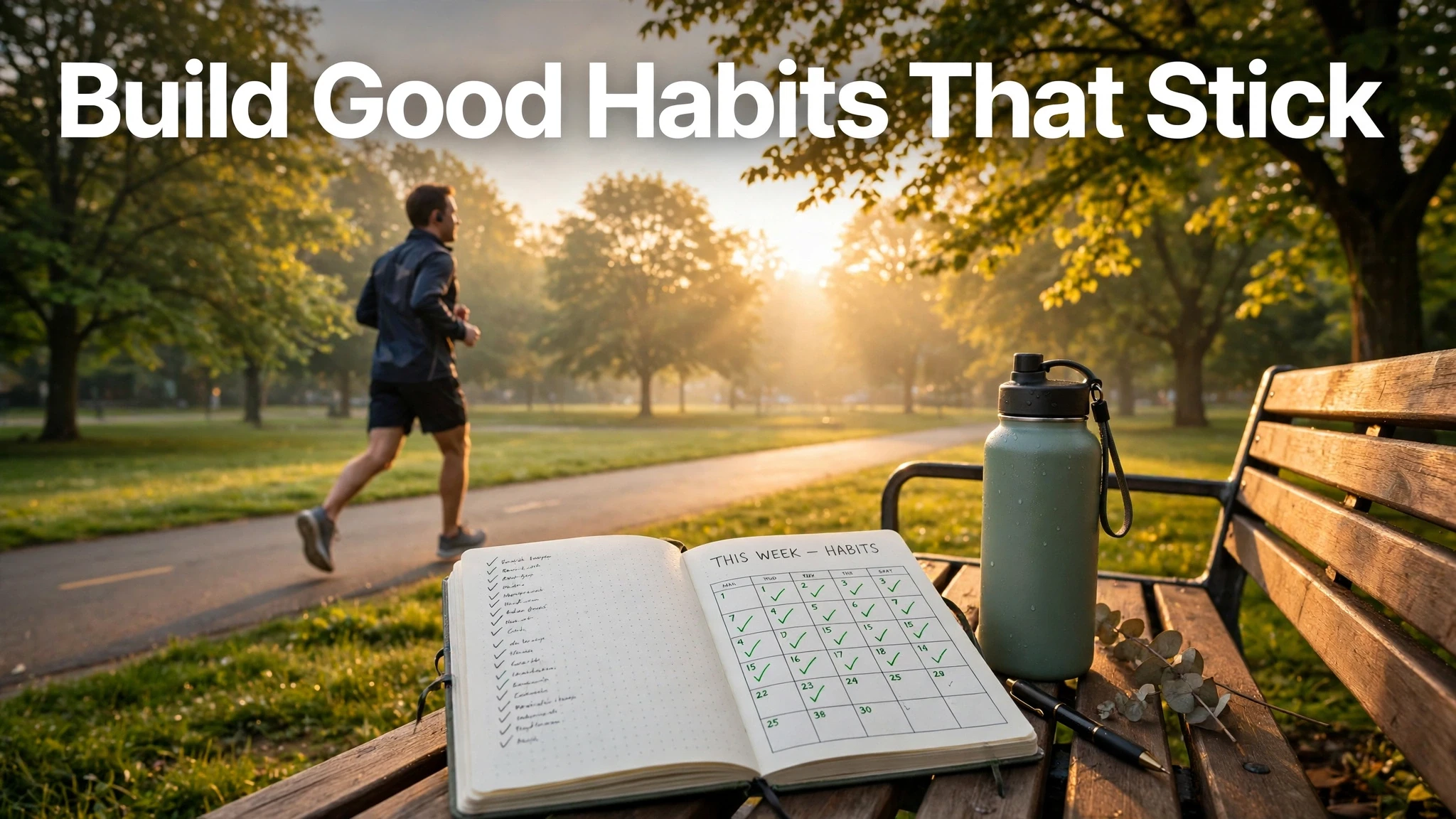
Tracking a habit, by marking a calendar, using an app, or ticking a box, is a powerful motivator, because it makes progress visible. A streak, a row of ticks, is satisfying, and breaking it feels like a loss, which motivates you to continue. Keep the tracking simple: a calendar on the wall, with a cross for each day you do the habit, is enough. Do not track too many habits at once, because that becomes a chore. Track one, or at most two, and focus on not breaking the chain. If you miss a day, do not give up: the rule is never miss twice. One missed day is an accident. Two missed days is the start of a new, bad habit.
Your environment matters more than your willpower. If you want to read more, put a book on your pillow. If you want to exercise, put your shoes by the door. If you want to eat better, keep fruit on the counter and biscuits out of sight. Make the good habit easy, and the bad habit hard. That is design, not discipline, and it works better than relying on motivation, which is unreliable. A person who designs their environment to support a habit will succeed more often than one who relies on willpower alone. Change your surroundings, and your behaviour will follow.
Motivation, Identity, and the Days You Want to Quit
Motivation is unreliable, and it will fade. That is normal, and it is why a habit should not depend on it. A habit depends on a system: a small routine, a clear cue, and an environment that supports it. On the days when you do not feel motivated, do the tiny version of the habit: read one page, walk for two minutes, meditate for one minute. That keeps the streak alive, and it reminds you that you are a person who does this thing. Identity is powerful: a person who sees themselves as a reader, a runner, or a meditator will act in line with that identity, even on a bad day. Each small action is a vote for the person you want to be.
It also helps to plan for failure. Decide in advance what you will do when you miss a day, when you are ill, or when you travel. Have a minimum version of the habit, for bad days, and a plan to return the next day. Do not let a single missed day become a reason to quit, because that is the most common cause of failure. The people who build lasting habits are not the ones who never miss a day. They are the ones who miss a day and return the next day, without drama. Be kind to yourself, be consistent, and remember that a habit is built over months, not days. The days you want to quit are the days that matter most, because they are the days when the habit becomes real.
Breaking Bad Habits and Keeping Good Ones for Life
Building a good habit is only half the story. The other half is breaking a bad one, and the same science applies, in reverse. A bad habit also has a cue, a routine, and a reward, and to break it, you must change the cue, or replace the routine, or remove the reward. If you scroll on your phone in bed, remove the phone from the bedroom. If you snack in the evening, replace the snack with a walk, or with a cup of tea. Do not rely on willpower to resist a bad habit, because willpower is limited, and the environment will win. Change the environment, and the habit becomes easier to break.
Keeping a good habit for life requires maintenance: review your habits regularly, celebrate your progress, and adjust as your life changes. A habit that worked when you were single may need to change when you have children, or when you change jobs. That is normal, and it is not failure. A habit is a living thing, and it should adapt. The goal is not perfection. It is a life in which good habits support you, quietly, every day, without effort, because they have become who you are. That is the reward of building habits that stick, and it is worth the small, daily effort it takes to build them.
Habits for Health: Sleep, Movement and Water
Health habits, are the foundation, for all other habits, because sleep, movement, and water, affect, your energy, your mood, and your ability, to think, clearly, and to make, good decisions. Sleep, is the most important, of the three: most adults, need, seven to nine hours, a night, and a consistent, sleep schedule, with a regular, bedtime, and wake time, will improve, your sleep, more, than, any other change. A dark, cool bedroom, and a wind-down routine, without screens, in the last hour, before bed, will help, you, to fall asleep, faster, and to sleep, more deeply.
Movement, is the second, health habit, and it does not, need, to be, intense, or long: a walk, of thirty minutes, a day, is enough, to improve, your health, and your mood, and it can be, broken, into, short walks, throughout, the day, if that is easier. Water, is the third, habit, and it is, the simplest: keep, a bottle, of water, nearby, and drink, regularly, throughout, the day, rather, than, waiting, until you are thirsty. Those three habits, sleep, movement, and water, are simple, they are, free, and they will improve, your life, more, than, any other, habits, you could build. Start, with them, and the rest, will follow.
The Year View: Habits That Compound Over Time
The Year View: Habits That Compound Over Time is where many people form their lasting opinion of building good habits, so it pays to understand what is really going on here instead of guessing.
Tracking a habit with a simple tick on a calendar often comes up first when people discuss building good habits, and the reason is simple: it is easy to understand, easy to try, and easy to explain to someone else. A good way to judge tracking a habit with a simple tick on a calendar is to ask what it does well and what it leaves out, since every part of building good habits makes trade-offs and naming them sharpens judgement. A common mistake is rushing past tracking a habit with a simple tick on a calendar, so slowing down and giving it a fair try usually leads to a better judgement about building good habits than a quick first impression.
What makes a streak that grows one day at a time worth studying inside building good habits is the way it balances simplicity and depth, because beginners can use it at once while experienced readers still find something new. Sharing a streak that grows one day at a time with a friend or reading what others noticed about it can open up angles that were missed, and discussion is one of the fastest ways to deepen a grasp of building good habits. Choosing a streak that grows one day at a time over a flashier option is often the wiser move, because substance lasts longer than novelty, and building good habits is best enjoyed when quality comes before hype.
With the year view: habits that compound over time understood, the next part of building good habits becomes easier, because you now have a reference point to compare new ideas against.
Habits and Health: Sleep, Food, and Movement as Foundations
Good habits are often thought of as productivity, or self-improvement, but the most important habits are the foundations of health: sleep, food, and movement, because without them, no other habit can thrive. Sleep is the foundation, because it affects memory, mood, energy, and health, and a person who does not sleep well cannot think clearly, cannot learn, and cannot sustain other habits. The habit of sleeping well is simple, but it requires discipline: a regular bedtime, a dark, cool room, no screens before bed, and no caffeine late in the day. Those habits are not glamorous, but they are powerful, and they will improve every other part of your life, more than any productivity hack.
Food is the second foundation, because what you eat affects your energy, your mood, and your health, and a habit of eating well is one of the most valuable you can build. Eating well does not mean a strict diet, or expensive food. It means regular meals, with vegetables, protein, and whole grains, and less processed food, sugar, and alcohol. It means drinking water, and eating mindfully, without rushing, or eating in front of a screen. Those habits are simple, and they are sustainable, and they will give you steady energy, throughout the day, rather than the highs and crashes of sugar, and caffeine. A good food habit is not about perfection. It is about consistency, and about choosing well, most of the time.
Movement is the third foundation, and it does not require a gym, or a sport, or a great deal of time. It requires regular activity, such as walking, stretching, or cycling, for a short time, every day. A daily walk, of twenty or thirty minutes, is one of the most effective habits you can build, because it improves mood, energy, sleep, and health, and it is accessible to almost everyone. Movement does not need to be intense, or impressive. It needs to be regular, and enjoyable, and it should be built into your day, rather than added as a chore. Walk to work, take the stairs, or go for a walk after dinner, and you will be building a habit that supports every other habit you want to build.
These three foundations support each other, in a virtuous circle. Good sleep makes it easier to eat well, and to move. Good food gives you energy to move, and to sleep well. Movement improves sleep, and mood, and makes it easier to eat well. When one improves, the others improve too, and when one suffers, the others suffer. That is why it is best to start with the foundations, rather than with a more ambitious habit, such as learning a language, or writing a book, because a person who is tired, hungry, and sedentary will struggle to sustain any habit, however motivated they are. Build the foundations first, and the rest will follow, more easily, and more sustainably.
Finally, remember that health habits are not a luxury, or a vanity project. They are the basis of a good life, and they deserve attention, and care, however busy you are. A person who sleeps well, eats well, and moves regularly will have more energy, more clarity, and more resilience, and they will be better able to build other habits, and to achieve their goals. Start small, with one habit, such as a regular bedtime, or a daily walk, and build from there, slowly, and patiently. The foundations are simple, they are powerful, and they are available to anyone, starting today, with a single, small step. That step is the beginning of every good habit, and it is worth taking.
My Take:
I’ll start with the habit that taught me everything I know about habits, and it’s not an impressive one. It’s flossing. One tooth, every night, after brushing. That was the rule, and it sounded ridiculous, but it worked, because one tooth was too small to skip. Some nights I flossed one tooth and stopped. Most nights I flossed them all, because once I’d started, it was easier to continue. That tiny start, one tooth, is the whole science of habits in miniature. Start so small you can’t fail, and let the momentum do the rest. If flossing one tooth can teach you that, imagine what it can do for exercise, or reading, or anything else.
Here’s the idea I wish someone had told me years earlier. Motivation is not the engine of a habit. It’s the spark, and sparks die. The engine is the system: a clear cue, a tiny routine, and an environment that makes it easy. After I brush my teeth, I floss one tooth. The toothbrush is the cue. One tooth is the routine. The floss by the sink is the environment. None of that requires motivation. It requires design, and design is reliable in a way that motivation never will be. If your habit depends on feeling motivated, it will fail on the first bad day. If it depends on a cue and a tiny step, it will survive.
I’ll be honest about the 21-day myth, because it’s everywhere and it’s wrong. A habit doesn’t take 21 days. Research suggests it takes about two months on average, and the range is wide, from a few weeks to many months. That myth sets people up to quit on day 22, when the habit still doesn’t feel automatic, and they conclude they’ve failed. They haven’t. They’re just in the middle, and the middle is where most habits are built. Give yourself two months, not three weeks, and you’ll be kinder to yourself, and more likely to succeed. Patience is part of the method.
What surprised me was identity, and how much it matters. When I started saying, I’m a person who reads every day, even when I’d only read a page, I started acting like that person. Each small action was a vote for the identity, and the votes added up. That’s not positive thinking. It’s a practical mechanism: we act in line with how we see ourselves, and a tiny daily action changes how we see ourselves, one vote at a time. Don’t aim to be perfect. Aim to be the kind of person who does this thing, even in a tiny way, every day. The identity follows the action, not the other way round.
So my advice is simple, and it’s the advice I’d give a friend who wants to change. Pick one habit, not five. Make it tiny, two minutes or less. Attach it to something you already do. Put what you need where you can see it. Track it on a calendar. And never miss twice. That’s it. One habit, tiny, stacked, visible, tracked, and forgiven when you miss. Do that for two months, and you’ll have a habit that sticks. Then, if you want, add another. That’s how a life changes: not in a single dramatic decision, but in a hundred tiny ones, repeated daily, until they become who you are.
Habits stick when they fit who you want to be, not when they are imposed from outside, and that is the difference between a habit that lasts and one that fades. A person who runs because they see themselves as a runner will run on a bad day, because running is part of who they are, while a person who runs because they feel they should will stop, as soon as the motivation fades, because the habit was never theirs. The question to ask, before you start a habit, is not whether it is a good habit, but whether it fits the person you want to become, and if it does, the habit will have a reason to survive, even when it is hard.
The rule that helps most, when a habit is new, is never miss twice. Missing once is normal, and it happens to everyone, and it does not matter, as long as you return the next day. Missing twice is the start of a new pattern, and it is the pattern of not doing the thing, and once that pattern is established, it is hard to break. So when you miss a day, do not punish yourself, and do not give up. Simply do it the next day, even if you do it badly, or briefly, because the act of returning is what keeps the habit alive. A habit is not a perfect record. It is a practice, and a practice allows for mistakes, and for bad days, and for starting again, and the people who succeed are not the ones who never miss. They are the ones who always come back.
The foundations are where I would start, and where I would end, because too many people try to build habits on a shaky base, and they wonder why they fail. A person who does not sleep, who eats poorly, and who never moves, will struggle to meditate, to study, or to exercise, however motivated they are, because the body does not have the energy, or the clarity, to sustain the effort. I would urge anyone who wants to build good habits to start with sleep, food, and movement, because those three are the foundation, and when they are solid, everything else becomes easier. Sleep well, eat well, move daily, and you will be surprised by how much else falls into place. That is not a shortcut. It is the long, honest way, and it works.
I also think we should be honest about the fact that health habits are not glamorous, and that they do not make good stories, or impressive goals. A regular bedtime, a daily walk, and a simple, healthy meal are not exciting, but they are powerful, and they are the habits that will change your life, more than any ambitious project. Do not chase the impressive habit, and neglect the basic one. The basics are the basics for a reason: they support everything else, and without them, nothing else will last. Start with the foundations, build them slowly, and be patient, because they take time, but they are worth it, and they will repay you, every day, for the rest of your life.
Another point I would make is about the virtuous circle, because sleep, food, and movement support each other, and improving one will improve the others, and that makes the task easier, not harder. A good night’s sleep makes it easier to eat well, and to move. A walk improves your sleep, and your mood. A healthy meal gives you energy, to move, and to sleep. That circle is a gift, because it means that a small change, in one area, can lead to improvements in others, and that progress can build, gradually, and naturally. Start with the easiest change, and let the circle work for you, rather than against you. That is the smart way to build habits, and it is the kindest way, too.
And the final thing I would say is to start today, with a single, small step, because a habit is not built in a day, but it is started in a day, with a choice, to go to bed a little earlier, to take a walk, or to eat a little better. That choice, repeated, becomes a habit, and that habit becomes a life, and that life is yours to build, one small step at a time. Do not wait for the perfect moment, or the perfect plan. Start small, start today, and trust that the small steps will add up, into something large, and meaningful. Good habits are not built by willpower alone. They are built by small, consistent actions, repeated daily, and supported by sleep, food, and movement. Start now, and see where it takes you. You may be surprised by how far a single step can go.
Frequently Asked Questions
How long does it take to build a habit?
Research suggests forming a habit takes about two months on average, though the range is wide, from a few weeks to many months. The popular 21-day idea is a myth, so give yourself time and keep going even when it does not feel automatic yet.
What is the best way to start a good habit?
Start tiny, using the two-minute rule: scale the habit down until it takes two minutes, such as reading one page or walking to the end of the street. A tiny habit is easy to do even on a bad day, and it builds the identity of someone who does that thing.
What is habit stacking?
Habit stacking attaches a new habit to an existing one, so the old habit becomes the cue. For example, after I brush my teeth, I will meditate for two minutes. The existing habit provides a clear, reliable trigger every day.
How do I stay motivated to keep a habit?
Do not rely on motivation, which fades. Rely on a system: a small routine, a clear cue, and an environment that makes it easy. On low days, do the tiny version, and follow the rule of never missing twice.
How can I break a bad habit?
Change the cue or the environment, and replace the routine. Remove the phone from the bedroom if you scroll at night, or replace an evening snack with a walk. Willpower alone is limited, so design your surroundings to support the change.
Should I track my habits?
Yes, tracking with a calendar or an app makes progress visible and motivates you to continue. Keep it simple, track one or two habits, and focus on not breaking the chain. If you miss a day, return the next day without drama.