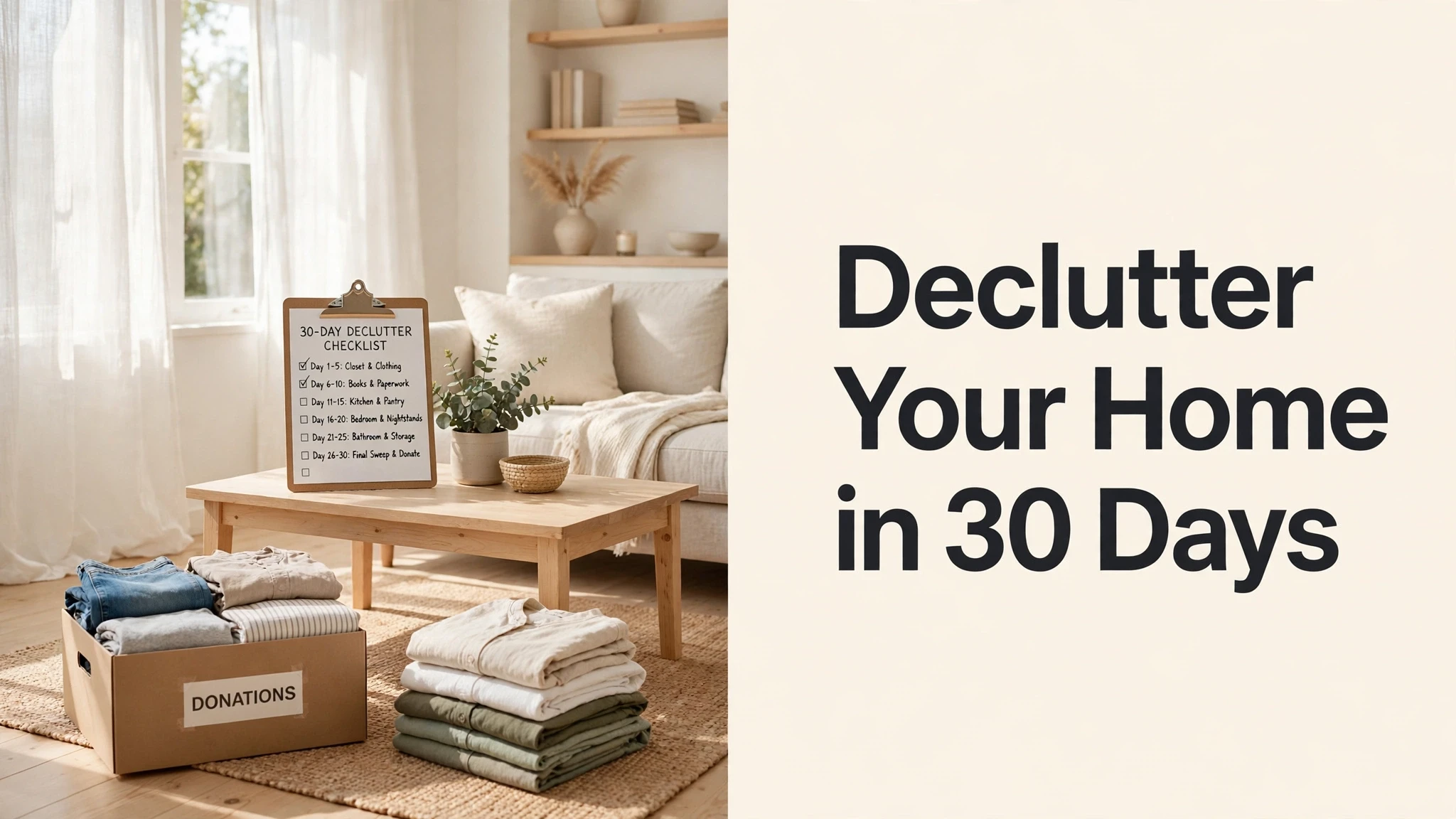
How to Declutter Your Home in 30 Days
In this post
- Week One: The Easy Wins and the Daily Habit
- Week Two: The Kitchen, Bathroom, and Daily Spaces
- Week Three: Bedrooms, Wardrobes, and Paper
- Week Four: Storage, Sentimental Items, and the Final Push
- What to Do With Everything You Remove
- Keeping It Clear: Habits That Stop Clutter Returning
- The Daily Fifteen Minutes That Keeps a Home Clear
- Decluttering With Children and Shared Spaces
- Decluttering With Children and Family: Doing It Together
- My Take:
Clutter has a way of growing quietly. A drawer fills, a shelf fills, a cupboard fills, and one day the house feels crowded, even though nothing dramatic happened. The effect is real: a cluttered home is harder to clean, harder to relax in, and harder to find things in. The solution is not a single heroic clear-out, which is exhausting and rarely lasts, but a steady plan: a little each day, one area at a time, for thirty days. By the end, the house is different, and so is the way you think about what you own.
This guide is a practical 30-day decluttering plan, room by room, with simple daily tasks that take fifteen to thirty minutes. It covers how to decide what to keep, what to do with what you remove, and how to keep the house clear once the month is over. You do not need special supplies, expensive organisers, or a whole weekend. You need a bag, a box, and a willingness to let go of things that no longer serve you. Thirty days from now, your home will feel calmer, and you will know why.
Week One: The Easy Wins and the Daily Habit
The first week is about momentum, not perfection. Start with the easy wins: the surfaces. Clear the kitchen counter, the dining table, the hallway, and the bathroom shelf, and put everything away, throw it away, or put it in a bag to leave the house. Surfaces are the most visible clutter, and clearing them makes the whole house feel different, which motivates you to continue. Each day, spend fifteen minutes on one small area: a drawer, a shelf, or a cupboard. Set a timer, work until it rings, and stop. A short, daily habit is more effective than a long, exhausting session, because it is sustainable.
Use three containers for every session: one bag for rubbish, one box for donations, and one box for things that belong elsewhere in the house. When a container is full, deal with it immediately: take the rubbish out, put the donation box by the door, and return the misplaced items. Do not create a pile of maybe, because a maybe pile is clutter in another form. If you have not used something in a year, and it has no strong emotional value, it can go. The first week is about proving to yourself that you can let go, and that the house feels better when you do.
Week Two: The Kitchen, Bathroom, and Daily Spaces
The second week focuses on the rooms you use every day. In the kitchen, clear the cupboards one at a time: remove expired food, duplicate utensils, and gadgets you never use. Keep only what you use weekly, and store the rest, or let it go. A kitchen with fewer tools is easier to cook in, because you can find what you need. In the bathroom, remove old medicines, expired cosmetics, and products you bought and never used. Check the dates, and be honest about what you will actually use. A bathroom shelf with five products you love is better than one with twenty you ignore.
In the living room, clear the shelves, the drawers, and the surfaces, and ask whether each object earns its place. A book you will read again, a photograph you love, and a lamp you use are worth keeping. A pile of magazines, a broken remote, and a decoration you do not like are not. The goal is not a bare room. It is a room where every object has a purpose or a meaning, and where there is space to breathe. By the end of the second week, the daily spaces should feel lighter, and the habit of fifteen minutes a day should feel natural.
Week Three: Bedrooms, Wardrobes, and Paper
The third week is the hardest, because it involves clothes and paper, the two categories that most people struggle with. For the wardrobe, take everything out, and try on or hold each item. Keep what fits, what you wear, and what you love. Let go of what does not fit, what you have not worn in a year, and what you keep out of guilt. A wardrobe with fewer clothes that you actually wear is better than a wardrobe full of clothes you avoid. Fold or hang what you keep neatly, so that you can see it, and donate the rest promptly, so that it does not creep back.
Paper is the other challenge: old bills, letters, manuals, and magazines accumulate in drawers and boxes. Go through one pile at a time, and sort it into keep, shred, and recycle. Keep only what you need for legal, financial, or sentimental reasons, and scan or photograph anything you want to keep but do not need on paper. Most manuals are available online, most bills can be found digitally, and most magazines can be recycled. A home with less paper is a home with less to manage, and the sense of relief when a drawer is empty is worth the effort.
Week Four: Storage, Sentimental Items, and the Final Push
The fourth week is for storage areas and sentimental items, the categories that need the most care. Go through the garage, the loft, the spare room, and the storage boxes, one at a time, and apply the same rule: keep what you use, what you love, and what you need. Storage areas often hold things that were put away and forgotten, and many of them can go. Be honest about the things you are keeping just in case: if you have not used something in two years, and it is not valuable or sentimental, it is unlikely you will need it.
Sentimental items deserve a different approach. Do not declutter them in a rush, and do not let someone else decide for you. Choose a single box for the most precious items, photographs, letters, and keepsakes, and keep only what fits in that box. Photograph the rest before you let it go, so that the memory is kept even if the object is not. A single box of treasured things is more meaningful than a loft full of boxes you never open. By the end of the fourth week, the house should be clearer, and you should have a donation pile, a rubbish pile, and a home that feels like yours again.
What to Do With Everything You Remove
Removing clutter is only half the job. The other half is getting it out of the house, promptly, before it creeps back. Donations should go to a charity shop within a week, and the bag should be by the door, not in a corner. Rubbish should go out on the next collection day. Items to sell should be listed within a week, or donated, because a pile of things to sell is clutter with a plan. If you have items that belong to someone else, return them. If you have items that are broken, recycle or dispose of them, rather than keeping them for a repair that will never happen.
It helps to have a system: a bag by the door for donations, a box in the car for the charity shop, and a weekly trip to drop things off. Do not let the donation pile grow, because it becomes a new source of clutter. And be honest about selling: most household items sell for very little, and the time spent listing them is often worth more than the money. Donating is faster, kinder, and it clears the house sooner. The goal is not to make money from clutter. It is to remove it, and to enjoy the space that remains.
Keeping It Clear: Habits That Stop Clutter Returning
Decluttering for thirty days is an achievement, but keeping a home clear is a habit, and it needs a system. The most useful rule is one in, one out: when you buy something new, remove something old. That keeps the total amount stable, and it makes you think before you buy. Another useful habit is a daily reset: spend five minutes each evening putting things away, clearing surfaces, and returning the house to order. A house that is reset daily never becomes cluttered, because clutter is cleared before it accumulates.
It also helps to be careful about what comes into the house. Before you buy something, ask whether you need it, whether you have space for it, and whether you will use it in the next month. If any answer is no, leave the item on the shelf and walk away. Unsubscribe from marketing emails, avoid impulse purchases, and give gifts that are experiences or consumables, rather than objects. A clear home is not a one-time project. It is a way of living, and it is maintained by small, daily choices. Thirty days of decluttering will show you what a clear home feels like. The habits that follow will keep it that way.
The Daily Fifteen Minutes That Keeps a Home Clear
Fifteen minutes a day is enough to keep a home clear, once the main declutter is done, because it is a small, daily habit, that prevents clutter from building up again. Set a timer, for fifteen minutes, at the same time each day, perhaps after dinner, or before bed, and use that time to tidy one small area: a drawer, a shelf, a countertop, or a pile of papers. Do not try to do more, and do not try to do the whole house, because fifteen minutes is enough, if you do it every day, and it is the consistency, not the duration, that matters.
It helps to have a system: a basket for things that belong elsewhere, a bag for things to give away, and a bin for rubbish, so that you can sort quickly, and without thinking. And it helps to end each session by putting everything back, and by admiring the cleared space, so that you can see the result, and feel motivated to continue. Over a week, fifteen minutes a day adds up to almost two hours of tidying, and over a month, it is seven hours, which is enough to keep a home clear, without ever needing another big declutter. The habit is small, but its effect is large, and it is the secret to a home that stays clear, long after the thirty days are over.
Decluttering With Children and Shared Spaces
Decluttering with children is different from decluttering alone, because children have their own attachments, and their own sense of what matters, and they need to be involved, not overruled. Start by explaining why you are decluttering, in simple terms: to make space, to find things easily, and to give away toys, and clothes, that are no longer used, to other children, who will enjoy them. Let children choose what to keep, and what to give away, and respect their choices, even if you would choose differently, because a child who feels heard will cooperate, and a child who feels overruled will resist.
It helps to make it a game, with a timer, and a reward, and to declutter one small area at a time, such as a toy box, or a drawer, rather than a whole room, at once. For shared spaces, such as a living room, or a bathroom, agree on the rules together, as a family: what belongs there, where it goes, and who is responsible for keeping it clear. And be a good example: if you declutter your own things, and you keep them tidy, your children will learn, by watching you. Decluttering with children is slower, and messier, than decluttering alone, but it is worth it, because it teaches them a skill, and a habit, that will last their whole lives.
Decluttering With Children and Family: Doing It Together
Decluttering with children is different from decluttering alone, because children have their own attachments, their own sense of what matters, and their own pace, and forcing them to get rid of things will cause distress, and resistance. The key is to involve them, to explain why you are decluttering, and to give them choices, rather than orders. A child who is asked, Which toys do you still play with, and which could we give to another child who would enjoy them? is more likely to cooperate than a child who is told, We are throwing away your toys. That language matters, because it frames decluttering as a positive act, as sharing, rather than as loss, and it teaches the child generosity, as well as tidiness.
It helps to make decluttering fun, and to do it together, rather than as a chore imposed from above. Set a timer, play music, and make it a game: who can find ten things to give away, or who can fill a box fastest? Celebrate the progress, and show the child the space you have created, and how much nicer it feels. It also helps to start small, with one drawer, or one shelf, rather than a whole room, because a small success is encouraging, and a large task is overwhelming. And be patient, because a child will not declutter at the same speed as an adult, and they will need time to decide, and to say goodbye to things that matter to them.
For teenagers, the approach needs to be different, because they value privacy, and autonomy, and they may resist what feels like interference. Talk to them, explain why you want to declutter, and ask for their help, rather than telling them what to do. Give them control over their own space, and respect their decisions, even if you disagree. A teenager who is allowed to choose what to keep, and what to give away, is more likely to cooperate than one who feels that their belongings are being taken. It also helps to focus on the benefits: more space, a tidier room, and a clearer mind, rather than on the act of getting rid of things. Frame it as gaining, not losing, and you will get a better response.
For the whole family, it helps to have a shared system, and shared rules, so that decluttering is not a one-time event, but an ongoing habit. A rule such as one in, one out, where a new item means an old one must go, can work well, if it is applied fairly, and to everyone, including adults. A regular clear-out, perhaps once a season, can keep clutter from building up, and it can become a family ritual, rather than a dreaded task. And be honest with yourself: adults often have more clutter than children, and decluttering your own things first, and visibly, is the best example you can set. Children learn from what they see, and a parent who declutters their own belongings is teaching more than any lecture.
Finally, remember that the goal is not a perfect home, but a home that works for the family who live in it, and that is comfortable, functional, and calm. A home with children will never be as tidy as a home without them, and that is fine. The goal is to reduce the clutter to a manageable level, to create space for what matters, and to teach children the skills of letting go, of sharing, and of caring for their belongings. Those skills will serve them for life, and they are worth teaching patiently, kindly, and together, as a family.
My Take:
I’ll be honest with you: I used to think decluttering was about willpower, about being the kind of person who could face a messy house and fix it in a weekend. It isn’t. It’s about a system so small you can’t fail at it. Fifteen minutes, one drawer, one bag. The weekend clear-outs I attempted always ended the same way: exhausted, half-finished, and with a pile of bags in the hallway that sat there for a week. The fifteen-minute version worked, because it was too small to dread. That’s the whole secret, and it’s not dramatic. It’s just true.
The week that changed things for me was the wardrobe week, and not for the reason I expected. I thought the hard part would be letting go of clothes. It wasn’t. The hard part was admitting how many things I owned that I’d kept out of guilt. The gift I never liked. The expensive coat that didn’t fit. The dress I bought for a person I no longer am. Letting go of those wasn’t about the clothes. It was about letting go of the guilt, and that felt like a weight lifting. If you have a wardrobe full of guilt, start there. It’s the most freeing drawer in the house.
Here’s what nobody tells you about the thirty-day plan: the house is not the point. The point is the decision-making muscle you build. Every time you hold something and ask, do I use this, do I love this, does it earn its place, you get better at answering. By week three, the decisions are faster. By week four, they’re almost automatic. That skill stays with you after the month ends, and it changes how you shop, how you accept gifts, and how you live. The house is the visible result. The skill is the real one.
I want to be direct about sentimental things, because that’s where most decluttering advice fails. Don’t rush them, don’t let anyone else decide, and don’t feel guilty for keeping them. But do give them a limit. One box. The things that fit in that box are your treasures. The things that don’t fit are not less loved, they’re just not in the box, and a photograph keeps the memory just as well. I’ve seen people keep a loft full of boxes they never open, and call it sentiment. It’s not. It’s storage. A single box you actually open is sentiment.
So here’s my advice, and it’s the same advice I’d give a friend. Start tomorrow, not next month. Set a timer for fifteen minutes. Clear one surface. Put a bag by the door. Do that every day for a month, and see what happens. You don’t need to buy organisers, you don’t need a perfect system, and you don’t need to do it all at once. You need a bag, a timer, and the willingness to let go of one thing at a time. Thirty days from now, your home will feel different, and so will you.
Sentimental items are the hardest part of decluttering, and they deserve a slower, kinder approach than the rest. A box of old letters, a child’s first shoes, or a jacket that belonged to someone who has died, cannot be judged by the same rule as a broken toaster. The question is not whether the item is useful. It is whether it helps you remember, and whether keeping it brings comfort or guilt. If it brings comfort, keep it, and give it a proper place, not a box in the attic. If it brings guilt, because you feel you should keep it but you do not want it, then keeping it is not honouring the person or the memory. It is storing guilt, and guilt is not a good reason to keep anything.
One practical method is to photograph sentimental items before letting them go, so that the memory is kept, and the object can move on. Another is to keep one representative item, rather than a whole box: one letter, not fifty, or one toy, not a shelf of them. And when family members resist, because they are attached to things you want to clear, do not argue about the objects. Talk about the space, and about what the room could be used for, and let them choose what stays, even if you would choose differently. A home is shared, and a declutter that makes one person happy and another miserable has failed. Go slowly with the sentimental things, be kind to yourself, and remember that the goal is a home that feels lighter, not a home that is empty.
Decluttering as a family is the part I would emphasise most, because it is easy to treat decluttering as a solo task, and to impose it on children, without involving them, and that approach rarely works. A child who is forced to give away toys will resent it, and will learn that decluttering is something done to them, not something they choose. A child who is involved, who is asked, and who is given choices, will learn that decluttering is a positive act, and that letting go can be generous, and freeing. I would urge any parent to involve their children, to explain, to ask, and to be patient, because that patience will pay off, in a tidier home, and in a child who understands why it matters.
I also think we should be honest about the fact that adults are often the worst offenders, and that children learn from what they see. A parent who has a house full of clutter, but who tells a child to tidy their room, is not teaching. They are preaching, and children notice the difference. Declutter your own things first, visibly, and let your children see you letting go, giving away, and making space. That example is more powerful than any rule, and it shows that decluttering is not a punishment, but a choice, made by everyone, for the benefit of the whole family. Be the example, and your children will follow.
Another point I would make is about the emotional side, because clutter is not only physical. It is emotional, and letting go of things can be difficult, for adults and for children, because things carry memories, and associations, and a sense of identity. Be kind about that, and do not rush a child, or an adult, who is struggling to let go. Give them time, help them to remember that the memory is not in the object, and that a photograph, or a story, can preserve it, without keeping the thing itself. That kindness matters, and it makes decluttering a gentle process, rather than a harsh one. Be patient, be kind, and the letting go will come.
And the final thing I would say is to focus on what you gain, not on what you lose. Decluttering is not about getting rid of things. It is about making space, for what matters, for calm, for clarity, and for the people you love. A home with less clutter is a home with more room to live, to play, and to be together, and that is a gift, for the whole family. Do it together, do it kindly, and do it regularly, and you will find that your home becomes a better place, not only tidier, but happier, and more peaceful. That is the real goal, and it is worth working for, together.
Frequently Asked Questions
How do I start decluttering my home?
Start with surfaces and one small area a day for 15 minutes. Use three containers: rubbish, donations, and things that belong elsewhere. Clearing visible surfaces first builds momentum and makes the whole house feel different.
What is the 30-day decluttering plan?
A room-by-room plan over four weeks: week one is easy wins and surfaces, week two is kitchen and bathroom, week three is bedrooms and paper, and week four is storage and sentimental items. Each day takes 15 to 30 minutes.
How do I decide what to keep when decluttering?
Keep what you use, what you love, and what you need. If you have not used something in a year and it has no strong emotional value, let it go. For sentimental items, keep one box of the most precious things and photograph the rest.
What should I do with items I declutter?
Take donations to a charity shop within a week, put rubbish out on collection day, and list items to sell within a week or donate them. Do not let the donation pile sit, or it becomes new clutter.
How do I stop clutter coming back?
Follow one in, one out: remove something old when you buy something new. Do a five-minute reset each evening, and think before buying: do you need it, have space for it, and will you use it within a month?
How do I declutter clothes?
Take everything out, hold each item, and keep only what fits, what you wear, and what you love. Let go of what does not fit, what you have not worn in a year, and what you keep out of guilt. Donate promptly so it does not creep back.