How to Improve Your Posture With Daily Habits
In this post
Posture is not about standing rigidly straight like a soldier, nor about forcing your shoulders back until you ache. Good posture is a balanced, relaxed alignment in which your head sits over your shoulders, your shoulders sit over your hips, and your body can move, breathe, and work without unnecessary strain. Poor posture, by contrast, is often a habit formed slowly: hours of sitting hunched over a phone or laptop, standing with weight on one leg, sleeping on a sagging mattress, or carrying a heavy bag on one shoulder, until the hunched position starts to feel normal and the upright position feels like effort.
Improving posture is therefore less about a single exercise and more about daily habits: how you sit, stand, walk, sleep, work, and move, repeated many times a day. Small, consistent changes usually beat dramatic corrections that last a day and are abandoned. This guide explains what good posture looks like in different positions, how to set up a desk and phone habit, which simple movements support posture, and when pain or persistent problems deserve professional assessment rather than self-help alone. It is general information only, not medical advice, and it does not promise to cure back pain or to change spinal structure.
A useful principle is that posture should feel sustainable. If a position requires constant effort, clenching, or holding your breath, it is probably not good posture, even if it looks straight in a mirror. Good posture distributes load, allows muscles to share work, and leaves room for breathing and movement. The goal is a neutral spine, with its natural curves preserved, not flattened or exaggerated, and with joints stacked so that muscles do not have to work overtime to hold you up.
What Good Posture Actually Looks Like
In standing, good posture can be checked with a simple imaginary line: from the side, the ear should be roughly over the shoulder, the shoulder over the hip, the hip over the knee, and the knee over the ankle. The head is level, eyes looking forward, not tilted down at a phone or thrust forward. Shoulders are relaxed and level, not hunched toward the ears or pulled forcefully back. The chest is open but not puffed out, the lower back has a gentle inward curve, not a deep sway or a flat back, and weight is balanced evenly on both feet, with knees soft rather than locked.
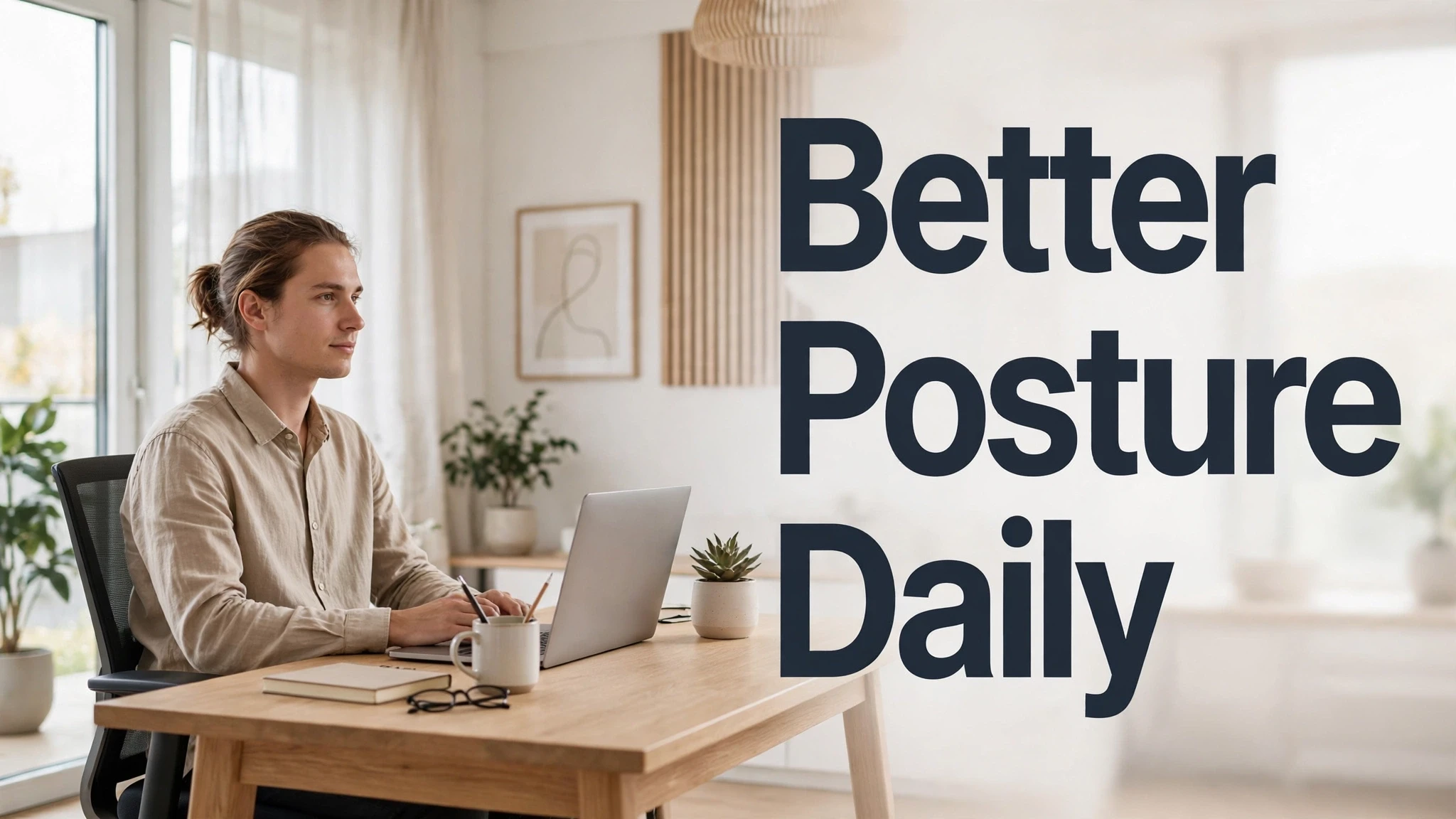
In sitting, good posture is similar but adapted to a chair: feet flat on the floor or on a footrest, knees roughly at hip level or slightly lower, hips back in the chair so the lower back is supported, and the head over the shoulders rather than jutting forward toward a screen. The lower back’s natural curve should be supported by the chair or by a small cushion, not forced into a deep arch. Arms should rest comfortably, with elbows roughly at right angles when typing, and the screen at eye level or slightly below, so the neck is not bent down for hours.
Walking posture builds on standing: head level, eyes forward, shoulders relaxed, arms swinging naturally, and steps of comfortable length, with weight rolling from heel to toe. Many people lean forward when walking quickly, especially while looking at a phone, which shifts the head forward and increases neck strain. A simple correction is to look ahead, not down, and to keep the phone at chest height when it must be used while walking, although walking while distracted also raises safety risks, so stopping to use a phone is often wiser.
It is important to note that no single posture is correct for hours on end. The body is designed to move, and even good posture becomes uncomfortable if held rigidly without change. The healthiest pattern is to vary position regularly: stand up, walk, stretch, shift weight, and change tasks, rather than seeking a perfect pose and freezing in it. Posture improvement is therefore about a range of good positions and frequent movement, not about one ideal shape held all day.
The Desk, the Phone, and Daily Sitting Habits
Most posture problems today come from sitting, especially at desks and with phones. A well-set-up desk makes good posture easier and poor posture harder. Start with chair height: feet should reach the floor, with thighs roughly parallel to the ground. If feet dangle, use a footrest. The chair should support the lower back; if it does not, a small rolled towel or lumbar cushion can help, placed in the curve of the lower back, not higher up. The desk height should allow elbows at about 90 degrees when typing, with wrists straight, not bent up or down.
Screen position is critical for neck posture. A laptop screen is usually too low, forcing the neck to bend down for hours, a pattern sometimes called tech neck. Raising the laptop on a stand and using a separate keyboard, or using an external monitor at eye level, can reduce this strain dramatically. The screen should be about an arm’s length away, with the top of the screen roughly at eye level, so you look slightly down, not sharply down or up. Lighting should avoid glare that causes you to lean forward to read, and text size should be large enough to read without hunching toward the screen.
Phone habits deserve separate attention, because phone use often involves the worst posture: head bent sharply down, shoulders rounded, for long periods. The weight of the head increases the load on neck muscles as it tilts forward, so even a small forward tilt, held for hours, can cause significant strain. Practical habits include holding the phone higher, at chest or eye level, taking breaks every 20 to 30 minutes, using voice input or a stand for long reading or video, and avoiding prolonged phone use in bed, where neck and back support are poor. These habits are simple, but they require conscious repetition until they become automatic.
Sitting breaks are as important as sitting posture. A useful rule is to stand, walk, or change position every 30 to 60 minutes, even for a minute or two. Standing desks can help, but standing all day brings its own problems, including leg fatigue and back strain, so alternating between sitting and standing is better than replacing one static position with another. Walking meetings, standing to take a phone call, and placing a printer or water bottle away from the desk are small environmental tricks that build movement into the day without requiring willpower alone.
Standing, Walking, and Carrying in Daily Life
Standing posture is often neglected because standing feels passive, but habits such as leaning on one hip, locking knees, or shifting weight to one leg can create uneven strain over time. A balanced stance involves feet roughly hip-width apart, weight evenly distributed, knees soft, pelvis level, and core gently engaged, not clenched. If you must stand for long periods, such as at work or in a queue, shifting weight periodically, taking small steps, and using a footrest to alternate one foot raised can reduce fatigue. Supportive footwear with a low heel and adequate cushioning also matters more than many people realise.
Walking is an opportunity to practise posture without extra time. Focus on a tall, relaxed upper body, with the head level and the gaze forward, rather than down at the ground or at a phone. Let arms swing naturally, keep steps comfortable, and avoid overstriding, which can jar the back and hips. Carrying a bag correctly is also part of walking posture: a backpack with two straps, worn close to the back and not overloaded, distributes weight better than a single-shoulder bag, which pulls the body sideways. If a single-strap bag must be used, switch shoulders regularly and keep the load light.
Lifting and bending are daily posture tests. The safest general pattern is to bend at hips and knees, keep the load close to the body, keep the back in a neutral position rather than rounded or twisted, and avoid twisting while lifting. For light objects, a hip hinge, bending at the hips with knees slightly bent, is often sufficient. For heavier objects, squatting with a straight back and using leg strength is safer. If an object is too heavy, awkward, or painful to lift, asking for help or using equipment is wiser than proving strength at the cost of injury. These habits protect the back far more than any single exercise.
Sleep posture also contributes to daily alignment. A mattress that is too soft or too old may allow the spine to sag, while a very firm mattress may create pressure points. Most people sleep best with a mattress that supports the spine’s natural curves and a pillow that keeps the head level with the spine, not propped high or flat. Side sleepers often benefit from a pillow between the knees to keep hips aligned, while back sleepers may benefit from a small pillow under the knees. Stomach sleeping tends to twist the neck and is generally less recommended for posture, although individual comfort and medical conditions matter, and changing sleep position should be gradual.
Simple Movements That Support Posture
Posture improves when the muscles that support alignment are strong and flexible enough to do their job without fatigue. The key muscle groups are the core, including deep abdominal and back muscles, the upper back muscles that hold shoulders in place, the hip muscles that stabilise the pelvis, and the chest and shoulder muscles that need flexibility to avoid rounding. You do not need a gym to support these groups; short, regular movements at home can help, provided they are done with good form and without pain.
Useful everyday movements include chin tucks, gently drawing the head back so ears align over shoulders, held for a few seconds and repeated several times, which counteracts forward head posture from screens. Shoulder blade squeezes, drawing shoulder blades gently together and down, held briefly, help activate upper back muscles without forceful pulling. Chest stretches, such as standing in a doorway with arms at shoulder height and leaning gently forward, open tight chest muscles that pull shoulders forward. Cat-cow movements on hands and knees, arching and rounding the back slowly, mobilise the spine and remind the body of its range.
Core and hip support can be built with simple exercises such as bridges, lying on the back with knees bent and lifting hips, planks held with a straight line from head to heels for short periods, and bird-dog movements, extending opposite arm and leg while keeping the trunk stable. These should be done with attention to breathing and neutral spine, not by holding the breath or forcing range. If any movement causes sharp pain, numbness, or worsening symptoms, stop and seek advice rather than pushing through. Posture exercises should feel like effort, not injury.
Stretching tight areas is equally important. Hip flexors tighten from prolonged sitting, pulling the pelvis forward and increasing lower back sway, so gentle hip flexor stretches, such as a kneeling lunge with a tall trunk, can help. Hamstrings, calves, and chest muscles also tighten with sitting and screen use, and regular gentle stretching, held for 20 to 30 seconds without bouncing, supports flexibility. The goal is balance: strength without flexibility creates stiffness, and flexibility without strength creates instability, so both are needed for sustainable posture.
Habits, Mindfulness, and When to Seek Help
Posture improvement is ultimately a habit project, not a one-week fix. Old habits formed over years will not change in days, and progress is often gradual and uneven, with good days and slouchy days. Helpful habit strategies include setting reminders to check posture, pairing posture checks with existing routines, such as every time you sit down or pick up your phone, and using environmental cues, such as a monitor at eye level or a chair that supports the back, so good posture requires less willpower. Self-compassion matters: noticing slouching and gently correcting it is more effective than criticising yourself for it.
Mindfulness of body signals also helps. Pain, stiffness, fatigue, and headaches can be signals that a position has been held too long or that a habit needs changing, and responding early, by moving, stretching, or changing tasks, prevents those signals from becoming persistent problems. Breathing is part of posture too: shallow, upper-chest breathing often accompanies hunched posture, while diaphragmatic breathing, with the belly expanding gently, supports a more open chest and relaxed shoulders. A few slow breaths with attention to posture can reset both body and mind during a busy day.
It is important to know when self-help is not enough. Persistent back or neck pain lasting more than a few weeks, pain that radiates into arms or legs, numbness, weakness, loss of bladder or bowel control, pain after trauma, or posture changes accompanied by fever or unexplained weight loss should be assessed promptly by a clinician. Structural conditions, such as scoliosis, kyphosis, or spinal injuries, require professional evaluation and cannot be corrected by posture tips alone. A physiotherapist can assess individual posture, movement, and muscle balance, and can design a programme tailored to your needs, which is more effective than generic exercises for persistent problems.
Ergonomic products, such as posture correctors, braces, and special chairs, should be viewed with caution. A brace that pulls shoulders back may feel supportive initially, but relying on it can weaken the muscles that should hold posture naturally, and it does not teach new habits. Such products may have a short-term role in specific situations, on professional advice, but they are not a substitute for movement, strength, and habit change. The best investment is usually in a good chair, a screen at eye level, supportive footwear, and time for regular movement, rather than in a device that promises to fix posture passively.
Posture at Home: Cooking, Cleaning, and Relaxing
Posture is not only a desk issue; it is shaped by home tasks that are repeated daily, often without thought. Cooking, for example, often involves standing hunched over a counter that is too low, or leaning over a stove, for extended periods, which strains the neck and lower back. Raising awareness of counter height, using a mat to reduce leg fatigue, and taking short breaks to stand tall can help, as can placing frequently used items at waist height rather than in low cupboards that require deep bending. Cleaning tasks, such as vacuuming, mopping, and making beds, often involve twisting, reaching, and lifting, and they should be done with the same principles as workplace lifting: bend at hips and knees, keep loads close, avoid twisting, and alternate sides where possible.
Relaxing posture also matters, because many people spend evenings slouched on a sofa with a phone or laptop, in a position that rounds the shoulders and bends the neck for hours. A sofa is designed for comfort, not for spinal support, and prolonged soft seating can encourage a slumped position that becomes habitual. Practical improvements include using a cushion for lower back support, sitting with feet on the floor rather than tucked under the body for long periods, taking breaks to stand and stretch during television programmes, and avoiding working on a laptop in bed, where support is poor and neck strain is high. Relaxation should be comfortable, but it does not need to be slumped; a supported, upright relaxed position can be just as restful and far less straining.
Children’s posture at home and school deserves attention as well, because habits formed young tend to persist. Heavy school bags, low desks, prolonged tablet use, and lack of physical activity can all contribute to poor posture in children, and early habits, such as carrying a backpack with two straps, taking screen breaks, and participating in varied physical activity, support healthy development. Parents and teachers can help by checking bag weight, desk and chair fit, and screen height, and by encouraging movement rather than by scolding slouching, which is less effective than changing the environment and building active habits. Posture education for children should be positive and practical, not shaming.
My Take:
My honest opinion is that posture advice has been harmed by the idea of a perfect, rigid position that everyone should hold all day. That idea makes people feel guilty for slouching, leads them to force their shoulders back until they ache, and then makes them give up when the forced position proves unsustainable. I think good posture is better understood as a comfortable, balanced, and variable alignment, with frequent movement, rather than as a pose to be held. That reframing alone would help many people, because it replaces perfectionism with practicality.
I also believe desk and phone setup matter more than willpower. Telling someone to sit up straight while their laptop screen is 30 centimetres too low and their chair offers no back support is asking them to fight their environment all day, which is exhausting and usually fails. Changing the environment, raising the screen, supporting the lower back, holding the phone higher, and building in movement breaks, makes good posture the easy option rather than the effortful one. I would always start with setup, not with scolding, because setup changes behaviour without requiring constant attention.
On exercises, my view is that simple, regular movements beat complex programmes that people abandon. A few chin tucks, shoulder squeezes, chest stretches, and bridges done daily are more valuable than an elaborate routine done once and forgotten. I think the key is to link movements to existing habits, such as doing a stretch while waiting for a kettle to boil, rather than treating posture as a separate workout that requires extra time and motivation. Small, attached habits survive busy days; large, separate habits often do not.
I am also cautious about posture products that promise quick fixes. A brace or a special chair may have a place, but it cannot replace muscle strength, flexibility, and awareness, and over-reliance can weaken the very muscles it is meant to help. I think consumers should be sceptical of any product that claims to fix posture without effort, and should prefer investments that support movement and good setup, with professional advice for persistent pain. The body learns posture by practising it, not by being held in place by a device.
Finally, I believe posture is worth improving not for appearance alone, but for comfort, breathing, energy, and the ability to work and move without unnecessary strain. People often notice that better posture reduces neck tension, headaches, and fatigue, and makes breathing feel easier, and those benefits are more motivating than looking taller in a photograph. I would encourage readers to judge progress by comfort and function over weeks, not by a single mirror check, because posture is a daily practice, not a single achievement, and a practice that feels good is one you will keep.
I also think posture should be discussed in the context of modern work, which has changed faster than our bodies or our furniture. Remote work, hot-desking, and mobile devices mean many people now work from sofas, kitchen tables, beds, and cafes, without the ergonomic setup that offices once provided. That flexibility is valuable, but it has created a posture crisis, because good setup is now a personal responsibility rather than an employer-provided standard. I think employers, especially for remote workers, should provide guidance, equipment allowances, and breaks, because posture-related pain affects productivity and wellbeing, and because the cost of a laptop stand and a supportive chair is far less than the cost of chronic pain and lost work.
Another angle is the relationship between posture and breathing, which is often overlooked. Hunched posture compresses the chest, restricts diaphragm movement, and encourages shallow, upper-chest breathing, which can increase feelings of anxiety and fatigue. Opening the chest, sitting tall, and breathing diaphragmatically can improve oxygen intake, calm the nervous system, and reduce tension, creating a positive feedback loop: better posture supports better breathing, and better breathing supports relaxed posture. I think breathing exercises should be paired with posture advice more often, because they address both the physical and the stress-related aspects of slouching.
I also want to reflect on ageing and posture. As people age, muscle strength, flexibility, bone density, and balance change, and posture may become more stooped, especially with conditions such as osteoporosis, which can cause vertebral fractures and increased curvature of the upper back. For older adults, posture improvement should focus on strength, balance, fall prevention, and bone health, with professional guidance, rather than on forcing an upright position that may be painful or unsafe. Gentle, regular movement, walking, and balance exercises are more valuable than rigid posture correction for older adults, and they support independence as well as alignment.
Finally, I believe posture improvement should be celebrated as a form of self-care, not as a vanity project. Standing tall, moving regularly, and working comfortably are not about looking good in photographs, although they can help with that; they are about feeling good in your body, breathing easily, working without unnecessary pain, and ageing with strength and mobility. I would encourage readers to approach posture with kindness toward themselves, noticing progress over weeks, appreciating small improvements, and seeking help when needed, rather than with criticism for every slouch. A body that is treated kindly is more likely to move well, and movement, more than any single pose, is what keeps posture healthy over a lifetime.
One last thought: posture improves not by chasing perfection, but by building a daily rhythm of good setup, regular movement, and gentle correction, repeated so often that it becomes automatic. Start with one change, such as raising your screen or taking a movement break every hour, and let that change settle before adding another. Over weeks, those small, sustainable habits add up to a body that stands, sits, and moves with less strain, and that gradual progress is far more rewarding than a single day of forced straightness.
That gradual, kind approach is the one most likely to last, because it works with your body and your daily life rather than against them.
Keep that lesson in mind whenever a new claim or trend appears: check the evidence, consider who benefits from the claim, and choose the option that is safe, sustainable, and suited to your own situation rather than the loudest option online.
Frequently Asked Questions
What is good posture, in simple terms?
Good posture is a relaxed, balanced alignment where ears sit over shoulders, shoulders over hips, and hips over ankles when standing, with the spine’s natural curves preserved and weight evenly distributed. It should feel sustainable, not forced or rigid.
How can I improve posture while working at a desk?
Set chair height so feet are flat, support the lower back, place the screen at eye level about an arm’s length away, keep elbows near 90 degrees, and stand or move every 30 to 60 minutes. Raising a laptop on a stand with a separate keyboard helps neck posture greatly.
Do posture corrector braces work?
They may offer short-term support, but they do not teach lasting habits and over-reliance can weaken supporting muscles. They are not a substitute for movement, strength, flexibility, and ergonomic setup, and should be used only on professional advice if needed.
How long does it take to improve posture?
Posture habits form over years, so improvement is usually gradual over weeks to months of consistent daily habits, movement, and setup changes. Progress is uneven, and judging by comfort and function over time is more useful than expecting a quick fix.
Can bad posture cause back pain?
Poor posture held for long periods can contribute to muscle strain, neck tension, and back discomfort, especially combined with inactivity, but back pain has many causes. Persistent, radiating, or severe pain should be assessed by a clinician rather than attributed to posture alone.
Is it bad to slouch sometimes?
Occasional slouching is normal, and no single position should be held rigidly for hours. The problem is prolonged, habitual slouching without movement or variation. Regular position changes, stretching, and returning to a balanced alignment matter more than never slouching.