How to Make a Budget Planner Spreadsheet
In this post
- Start With What Your Budget Must Do
- Set Up the Sheets and Columns
- Income, Fixed Costs and Variable Spending
- Formulas That Do the Work for You
- Savings, Sinking Funds and Debt in the Same Sheet
- A Monthly Routine That Keeps It Alive
- Tracking Cash, Cards and Shared Household Spending
- Templates, Apps and When to Switch Tools
- My Take:
Start With What Your Budget Must Do
A budget planner spreadsheet has one job: to show, clearly and honestly, where money comes from, where it goes, and what is left. It does not need to be beautiful to work, and it does not need dozens of categories. In fact, the most common reason a budget spreadsheet fails is over-complication. A beginner who creates fifty categories, complex formulas and daily tracking sheets will usually abandon it within two weeks. A simple sheet that is updated once a week will beat a perfect sheet that is never opened.
Before opening a spreadsheet app, decide three things. First, the period: a monthly budget suits most people, because pay, rent and bills are usually monthly, even if some income is weekly. Second, the currency and the level of detail: will you track every coffee, or group small spending into a single “food and drink” category? Grouping is usually better at first, because it reduces recording work while still showing the big picture. Third, the goal: is the budget for cutting spending, for saving toward a specific target, for paying off debt, or simply for understanding where money goes? The goal determines which numbers deserve attention.
A good starting structure has five sections: income, fixed essentials, variable essentials, discretionary spending, and savings. Fixed essentials are costs that rarely change, such as rent and insurance. Variable essentials change but cannot easily be avoided, such as groceries and transport. Discretionary spending is chosen spending, such as eating out and entertainment. Keeping these groups separate matters, because when money is tight, discretionary spending is the first place to adjust, while fixed costs require longer-term decisions such as renegotiating a contract or moving.
Set Up the Sheets and Columns
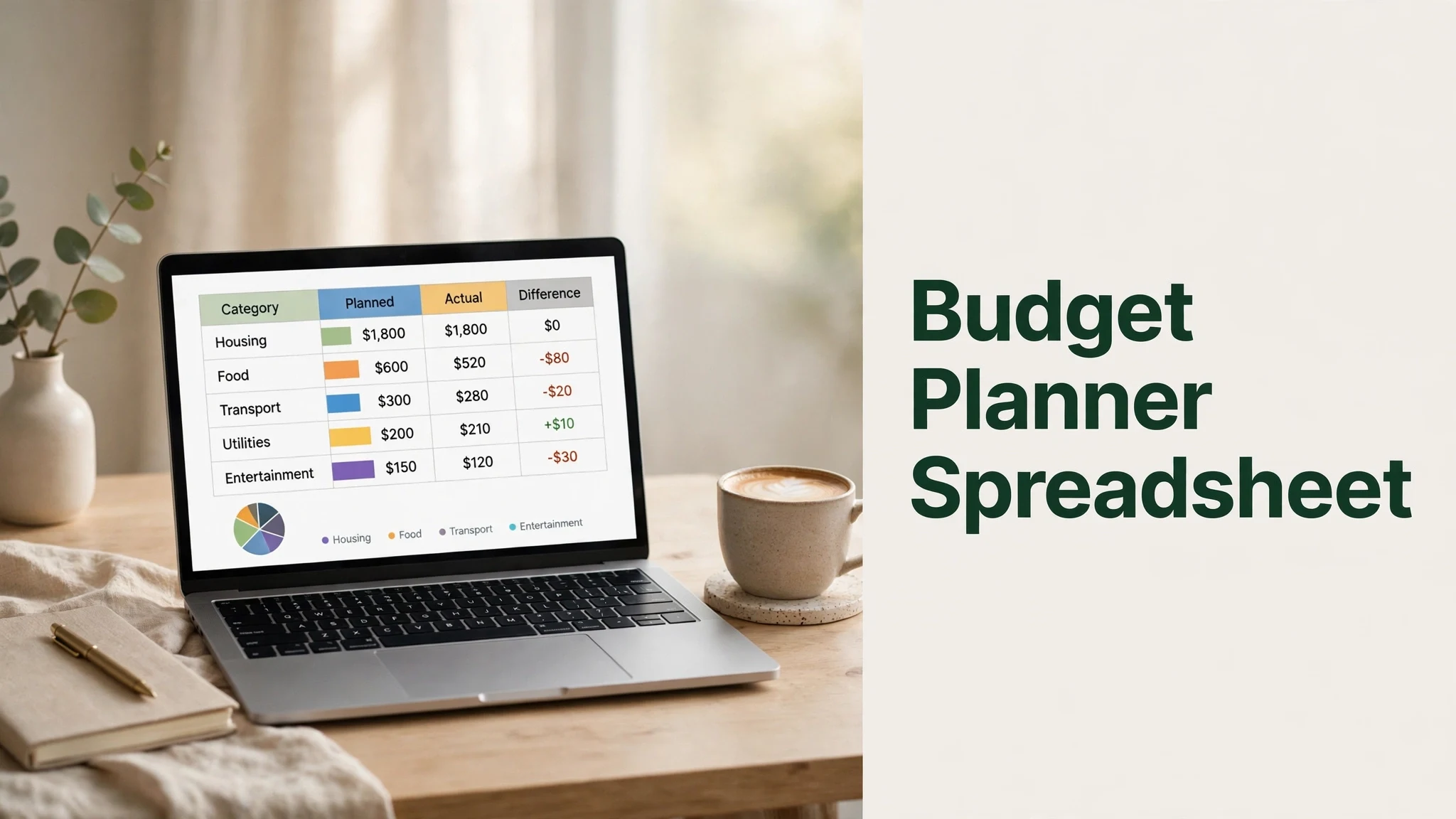
Most budget spreadsheets work well with three sheets: a monthly budget sheet, a transactions or spending log, and a yearly summary. The monthly sheet is the main view: it lists income and expense categories, a planned amount for each, an actual amount, and the difference between them. The transactions log is where individual spending is recorded, either manually or by importing from a bank statement where that feature is available. The yearly summary pulls monthly totals together, so progress over a year can be seen at a glance.
For the monthly sheet, use clear columns. A simple set is: Category, Planned, Actual, Difference, and Notes. The Difference column is a formula, not a typed number: for expenses, it is Planned minus Actual, so a positive number means under budget and a negative number means over budget. For income, the logic reverses, so it helps to keep income and expenses in separate sections with their own totals. Adding a Notes column is useful for explaining one-off items, such as a car repair or a gift, so a future review does not mistake a single unusual month for a new pattern.
Formatting should serve clarity, not decoration. Use bold for section totals, a consistent number format for money, and colour sparingly — for example, a soft red for over-budget items and a soft green for under-budget items, if the app supports conditional formatting. Freeze the header row so category names stay visible while scrolling, and keep the sheet printable on one or two pages if a paper copy is wanted. A sheet that is easy to read at a glance will be checked more often than a sheet that requires hunting for totals.
Income, Fixed Costs and Variable Spending
Income should be entered as take-home pay, not gross pay, because that is the money actually available to allocate. If income varies, for example for freelancers or shift workers, a conservative approach is to budget using a lower-than-average month, and to treat extra income in good months as a bonus for savings or debt rather than as regular spending money. Irregular income, such as bonuses or tax refunds, should be entered in the month received, with a note, rather than spread across the year, so the sheet stays honest about timing.
Fixed costs are the easiest section to complete, because they are predictable. List rent or mortgage, utilities where they are fixed, insurance, subscriptions, loan payments and any regular savings transfer. Review subscriptions carefully: many households pay for services they no longer use, and a budget sheet makes those costs visible in one place. Cancelling even two unused subscriptions can free money every month without reducing quality of life, which is why this review is often the quickest win in a new budget.
Variable spending needs more judgement. Groceries, transport, household goods and personal care vary, but they still have patterns. A beginner can estimate these from the last two or three months of bank statements, rounding to a realistic figure rather than an aspirational one. Setting a grocery budget far below actual spending will only produce repeated “failure” and discouragement. It is better to set a realistic planned amount, track actual spending for a month, and then adjust gradually. The spreadsheet is a learning tool first and a control tool second.
Formulas That Do the Work for You
A spreadsheet earns its value through formulas, but only a few are needed for a strong budget planner. The most important is SUM, which adds a column of income or expenses to give a section total. The overall balance is then total income minus total expenses, and that single number tells the household whether the month is in surplus or deficit. If the balance is negative, spending must be reduced, income increased, or savings paused — the sheet makes that choice explicit rather than leaving it vague.
The Difference formula, described earlier, shows performance per category. A second useful formula is percentage of income: dividing a category total by total income shows, for example, what share of pay goes to housing or food. Percentages help comparison across months even when income changes, and they reveal patterns that raw amounts can hide. A third useful tool is conditional formatting, which automatically highlights over-budget categories, so problems stand out without manual checking.
Charts add value when they are simple. A pie chart of spending by category shows at a glance where money goes, while a bar chart comparing planned and actual spending across months shows whether control is improving. Avoid charts for every category; one or two clear charts on the summary sheet are enough. The goal of formulas and charts is to reduce manual work and make decisions easier, not to impress with complexity. If a formula breaks, the sheet should still be understandable, so keep formulas visible and simple enough to fix.
Savings, Sinking Funds and Debt in the Same Sheet
Savings should be treated as a planned expense, not as whatever is left at the end of the month. That principle, often called paying yourself first, means entering a savings transfer in the budget before discretionary spending is allocated. Even a small regular amount builds a habit and a buffer, and the spreadsheet can track progress toward a target, such as an emergency fund or a holiday, by showing saved so far against the target. A separate savings tracker sheet, or a simple section on the monthly sheet, can show that progress without complicating the main budget.
Sinking funds are a useful next step. A sinking fund is money set aside monthly for a known future cost, such as car insurance, annual subscriptions, or holiday spending. Instead of a large bill arriving as a shock, the spreadsheet shows a small monthly allocation accumulating toward it. For example, if car insurance costs a certain amount per year, dividing it by twelve gives the monthly amount to set aside. When the bill arrives, the money is already available, and the monthly budget does not need to absorb a sudden spike. This is general information, not personal financial advice, but the concept is widely used in personal budgeting.
Debt can also be tracked in the same workbook, on a separate sheet. List each debt with its balance, interest rate, minimum payment and planned extra payment, and update the balance monthly. A simple chart of total debt over time can be motivating, as it shows progress even when individual payments feel small. The budget sheet and the debt sheet should agree on the monthly debt payment amount, so the household is not double-counting or missing a payment. Keeping debt visible, rather than hidden in a separate app, helps ensure it is part of monthly decisions.
A Monthly Routine That Keeps It Alive
A budget spreadsheet only works if it is maintained, and maintenance should be a short routine, not a daily burden. A practical routine has three moments. At the start of the month, copy the previous month’s sheet, update planned amounts for known changes, and enter expected income. During the month, record spending once or twice a week, in a single sitting, rather than after every purchase. At the end of the month, spend twenty minutes reviewing: compare planned and actual, note what caused large differences, adjust next month’s plan, and check savings progress.
The end-of-month review is the most valuable part, because it turns numbers into learning. If groceries were over budget for three months in a row, the planned amount may be unrealistic, or shopping habits may need attention — the sheet alone cannot decide, but it makes the question unavoidable. If discretionary spending was under budget, the surplus can be deliberately assigned to savings or debt, rather than drifting away unnoticed. Writing one short note each month about what was learned creates a record that is more useful than any single month’s figures.
Common mistakes can be avoided with simple rules. Do not budget to the last unit of currency; leave a small buffer for unexpected costs, so a minor surprise does not break the plan. Do not punish overspending by setting an impossibly tight budget next month; adjust gradually. Do not track every tiny purchase if that causes abandonment; grouping small items is acceptable. And do not keep the budget secret from a partner or household member who shares spending, because a budget that only one person follows will not reflect household reality. A shared, simple sheet that everyone understands will outperform a sophisticated sheet that only its creator uses.
Tracking Cash, Cards and Shared Household Spending
A budget spreadsheet must reflect how money actually moves, not only how it should move. Many households now pay mostly by card or phone, which makes tracking easier if statements are reviewed, but cash spending can disappear from records if it is not noted. A simple habit solves this: keep a small notes section in the phone, or a single envelope for receipts, and enter cash spending during the weekly update. It does not need to be perfect; even grouped cash entries — “cash food and transport this week” — keep the total honest without requiring every coin to be logged.
Shared household spending adds another layer. When two people share rent, groceries and bills, a spreadsheet that only one person updates will miss half the picture. Options include a shared cloud spreadsheet that both partners can edit, a weekly five-minute check-in to enter both people’s spending, or a simple rule that shared categories are entered by whoever paid, with a note. The method matters less than agreement: both contributors should understand the categories, the routine, and the goal. A budget that creates arguments about every small purchase will fail, while one that focuses on shared goals — saving for a holiday, reducing debt, building a buffer — is more likely to be sustained.
Irregular spending also needs a home in the spreadsheet. Birthdays, holidays, car servicing, medical costs and annual fees do not fit neatly into a monthly plan, but they are predictable in aggregate, even if their exact timing varies. A separate “irregular” section, or a sinking fund approach, prevents these costs from derailing a month. At the end of the year, reviewing irregular spending often reveals patterns — for example, that December consistently costs more, or that car costs cluster in one season — which can then be planned for in the following year’s budget. That annual learning is one of the most valuable outputs of a simple spreadsheet.
Templates, Apps and When to Switch Tools
Beginners often ask whether to use a ready-made template, build from scratch, or use an app instead. A template is a good starting point because it provides structure, formulas and formatting that a beginner might struggle to create. However, a template should be adapted: delete categories that do not apply, rename categories to match actual spending, and simplify formulas that are not understood. A template that is used unchanged, with irrelevant categories, will feel alien and is more likely to be abandoned than a simpler sheet built for the household’s real life.
Building from scratch, by contrast, teaches how the spreadsheet works, because the builder creates every formula and understands every total. That understanding makes fixing errors easier and customisation natural. A beginner who is comfortable with spreadsheets may prefer this route, starting with the five-section structure described earlier and adding features only when needed. The risk is spending weeks perfecting the sheet instead of using it; a useful rule is to build a working version in one evening, use it for a month, and only then improve it based on real experience.
Apps and spreadsheets can also complement each other. An app may import bank transactions automatically, while a spreadsheet provides a custom view, yearly summary, and goal tracking that the app lacks. Some households use an app for daily recording and a spreadsheet for monthly review, transferring totals once a month. Others start with a spreadsheet and later move to an app when life becomes more complex. There is no single correct tool; the correct tool is the one that is actually opened, understood and maintained. Switching tools is acceptable, provided past data are preserved and the new routine is simpler, not merely newer.
My Take:
My view is that a budget planner spreadsheet is less about numbers and more about attention. Most people do not overspend because they cannot add; they overspend because they never see the total until it is too late. A spreadsheet forces that total into view, once a week, in a calm moment, rather than at a checkout under pressure. That shift — from vague worry to a clear number — is the real benefit, and it does not require advanced formulas or a perfect template. A simple sheet, honestly updated, will teach a household more about its money in three months than years of good intentions.
I am also sceptical of templates that promise to fix finances in one download. A template is a starting point, not a solution, because every household’s income pattern, fixed costs and goals differ. The best spreadsheet is the one a household adapts to its own life: categories that match its actual spending, a routine it can sustain, and a savings section that reflects its real priorities. Copying someone else’s fifty categories will not create discipline; building a sheet that fits your life, and then actually opening it each week, will.
Another point I want to emphasise is kindness in budgeting. A budget that feels like punishment will be abandoned, and a month that goes over budget is not a moral failure. Life includes car repairs, gifts, illness and celebrations, and a good spreadsheet expects surprises by including a buffer and by treating one-off costs honestly. The goal is not to spend the least possible, but to spend deliberately on what matters and to save steadily for what is coming. A budget that allows for enjoyment, within a plan, is far more sustainable than one that forbids it.
Finally, I believe the monthly review is where a spreadsheet becomes a life skill. Looking back, noticing patterns, and adjusting next month’s plan without shame is a habit that extends beyond money: it is how people learn from experience rather than repeating it. A household that reviews its budget for twenty minutes a month will gradually make better decisions about work, housing, debt and saving, not because the spreadsheet told it what to do, but because it made the consequences of choices visible. That visibility, sustained over time, is the quiet power of a simple budget planner.
I would also warn against a common trap: confusing a budget with a diet for money. A diet that forbids everything enjoyable fails, and so does a budget that allows no eating out, no entertainment, and no small pleasures. A sustainable budget includes planned enjoyment, because a life with no discretionary spending is not a life most people can maintain, and a budget that is abandoned helps no one. Planning a modest amount for enjoyment, and spending it without guilt, is not a failure of discipline; it is discipline, applied wisely, because it keeps the overall plan alive.
Another point concerns comparison. It is tempting to compare a household budget with friends, influencers, or online examples, and to feel inadequate when spending differs. But households differ in income, rent, family size, health needs, location and obligations, so a budget that is right for one household may be impossible for another. The only meaningful comparison is with one’s own past months: is spending more deliberate, is saving steadier, is debt falling? Those internal comparisons measure progress without the distortion of other people’s circumstances, which are rarely fully visible.
Finally, I believe a budget spreadsheet is worth keeping even when finances improve. When income rises, it is easy to let spending rise invisibly, a pattern sometimes called lifestyle inflation, until the higher income feels just as tight as the old one. A spreadsheet makes that drift visible and allows a deliberate choice: how much of a pay rise goes to saving, how much to debt, and how much to improved quality of life. That deliberate allocation is the difference between earning more and feeling richer, and it is a skill that a simple spreadsheet teaches quietly, month after month, without lectures or guilt.
Another practical point is to keep the spreadsheet backed up and accessible. A budget stored only on one device, without a cloud copy or export, can be lost through device failure, and losing a year of financial records is frustrating and avoidable. Saving a monthly copy, exporting to a common format, or using a cloud spreadsheet with version history protects against loss. Security matters too: a spreadsheet containing income and account details should be protected with a strong account password and two-factor authentication, and should not be shared publicly or sent by unsecured email.
I also think beginners should celebrate small budget wins explicitly. Paying off a small debt, reaching a savings milestone, staying under budget in a difficult category for a month, or simply updating the sheet for twelve consecutive weeks are all achievements worth noting. Those wins build confidence and motivation, especially in early months when larger goals still feel distant. A budget that only highlights failures — over-budget categories in red, missed targets — will feel punitive, while one that also records progress will feel encouraging. Motivation, like money, compounds when it is noticed and reinforced.
A further lesson is to review the budget after major life changes, not only at year-end. A new job, a move, a new child, a change in working hours, or a health issue all change income and spending patterns, and a budget built for the old situation will quickly become inaccurate. Updating planned amounts promptly after such a change, rather than struggling with an outdated plan for months, keeps the spreadsheet useful. Life changes are precisely when a budget is most needed, because they bring uncertainty, and a clear, updated plan reduces that uncertainty.
Finally, I believe the best budget spreadsheet is one that becomes boring in a good way. After the initial learning phase, updating it should take minutes, reviewing it should feel routine, and surprises should become rarer because sinking funds and buffers absorb them. Boring, in this context, means stable: money is allocated deliberately, savings grow steadily, and debt, if any, falls predictably. That stability frees mental energy for work, family and enjoyment, which is the ultimate purpose of budgeting — not to obsess over money, but to worry about it less, because a simple, honest plan is quietly doing its job.
Frequently Asked Questions
How do I make a budget planner spreadsheet? Create a monthly sheet with income, fixed essentials, variable essentials, discretionary spending and savings, add Planned, Actual and Difference columns, and use SUM formulas for totals.
What columns should a budget spreadsheet have? Category, Planned, Actual, Difference and Notes cover most needs, with income and expenses in separate sections so totals and the overall balance are clear.
Should I track every purchase in my budget spreadsheet? Not necessarily; grouping small spending into categories is often enough, and a routine that is sustainable matters more than perfect detail that leads to abandonment.
What is a sinking fund in a budget spreadsheet? A sinking fund is money set aside monthly for a known future cost, such as annual insurance, so the cost does not arrive as a sudden shock to one month’s budget.
How often should I update my budget spreadsheet? Recording spending once or twice a week, plus a short review at the start and end of each month, is usually enough to keep a budget accurate without becoming a burden.
Is a spreadsheet better than a budgeting app? It depends on preference; a spreadsheet offers full control and customisation, while an app may automate imports, and many people use a spreadsheet because they can see and adjust every formula themselves.