How to Store Leftovers Safely: A Simple Guide
In this post
- Cool It Quickly: The Two-Hour Rule
- Fridge Storage: Containers, Labels, and Times
- Freezing Leftovers: A Second Life for Good Food
- Reheating: Hot All the Way Through
- Foods That Need Extra Care
- Reducing Waste Without Taking Risks
- The Weekly Leftover Routine That Saves Money
- Lunchboxes and Work Lunches From Last Night
- The History of Leftovers: How We Learned to Keep Food
- My Take:
Leftovers are one of the best ways to save money, reduce waste, and eat well with little effort. A meal cooked once can feed you twice, and a fridge full of leftovers is a sign of a well-run kitchen. But leftovers can also be a source of food poisoning if they are stored badly, cooled too slowly, or kept for too long. The good news is that safe storage is simple, and it follows a few clear rules that anyone can learn. Cool quickly, store properly, label clearly, and reheat thoroughly, and your leftovers will be safe and delicious.
This guide explains how to store leftovers safely, in plain language, without jargon. It covers cooling, refrigerating, freezing, and reheating, and it gives clear times for how long different foods last. It is based on food safety guidance from public health authorities, and it is practical for a normal home kitchen. Whether you are storing a Sunday roast, a pot of soup, or a takeaway, these rules will help you waste less and stay safe.
Cool It Quickly: The Two-Hour Rule
The most important rule of leftover safety is to cool food quickly. Bacteria grow fastest between 5 and 60 degrees Celsius, a range often called the danger zone, and food left in that range for too long becomes risky. The rule is simple: get cooked food into the fridge within two hours, and within one hour if the room is very hot. Do not leave a pot of soup, a roast, or a takeaway on the counter overnight, and do not wait for food to cool completely before refrigerating it. Modern fridges can handle warm food, and the risk of leaving it out is greater than the risk of putting it in warm.
To cool food faster, spread it in shallow containers, rather than leaving it in a deep pot, because a shallow layer cools more quickly. Stir soup or stew occasionally as it cools, and divide a large batch into smaller containers. You can also place a container in a bowl of cold water to speed cooling. Once the food is cool enough to handle, cover it and put it in the fridge. Do not put a very hot pot directly into the fridge if it will warm the food around it, but do not wait for it to reach room temperature either. A short cooling period, of thirty minutes to an hour, is usually enough, and it is far safer than leaving food out for hours.
Fridge Storage: Containers, Labels, and Times
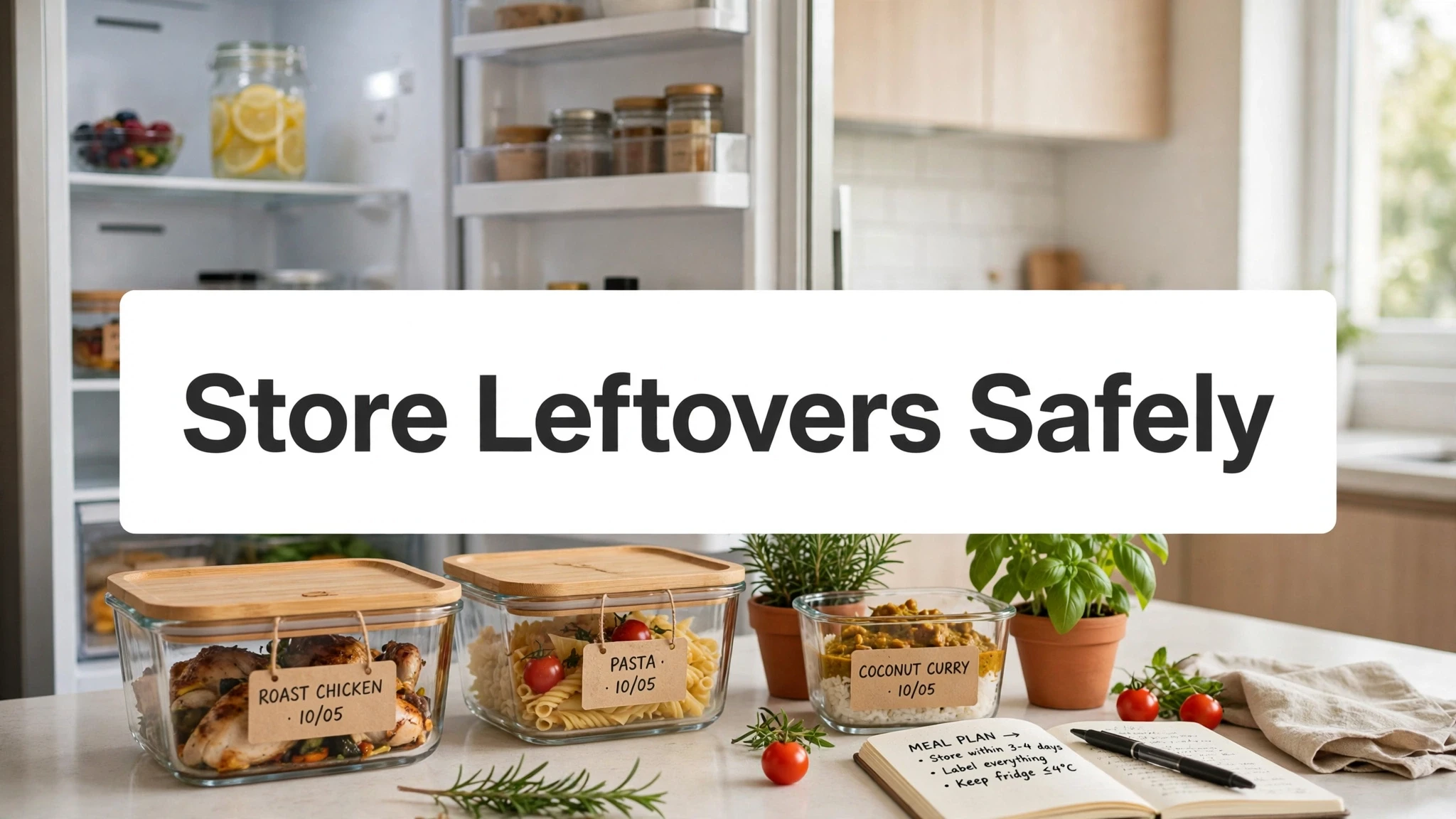
In the fridge, leftovers should be stored in clean, airtight containers, or in covered bowls, not in open plates or in the cooking pot. Airtight containers prevent contamination, keep food from drying out, and make it easy to see what you have. Label each container with the date it was cooked, using a piece of tape and a pen, because it is easy to forget when something was made, and a label removes the guesswork. Store leftovers on the upper shelves, away from raw meat, which should always be on the bottom shelf, so that it cannot drip onto cooked food.
How long leftovers last depends on the food. Most cooked meals, including meat, poultry, and vegetables, last three to four days in the fridge. Soups and stews last three to four days. Rice lasts one day in the fridge, and it should be cooled quickly and reheated thoroughly, because it can carry a bacterium that survives cooking. Fish lasts one to two days. If you are unsure, use the rule: when in doubt, throw it out. It is better to waste a small amount of food than to risk food poisoning. A tidy fridge, with labelled containers and a clear system, makes it easy to use leftovers before they spoil.
Freezing Leftovers: A Second Life for Good Food
Freezing is the best way to keep leftovers for longer, and it is safe for almost all cooked foods. Freeze leftovers within two days of cooking, in portions that suit your household, in freezer bags or containers, with the air pressed out. Label each portion with the contents and the date, because frozen food all looks the same after a month. Most cooked meals last two to three months in the freezer, though they remain safe for longer, and the quality declines with time. Soups, stews, and curries freeze particularly well, while fried foods and salads do not.
To defrost safely, move the food from the freezer to the fridge the night before, and let it thaw slowly. Do not defrost food on the counter, because the outside will reach the danger zone while the inside is still frozen. A microwave can defrost food quickly, but it should be cooked immediately afterwards. Once food has been defrosted, do not refreeze it, unless it has been cooked into a new dish. Freezing is a powerful tool for reducing waste, because it turns a meal you cannot finish into a meal for another day. A freezer full of labelled portions is a sign of a kitchen that wastes little and eats well.
Reheating: Hot All the Way Through
Reheating is where many people go wrong, because they heat food until it is warm, rather than until it is hot. Leftovers should be reheated until they are steaming hot all the way through, reaching at least 75 degrees Celsius, and they should be stirred during reheating, so that there are no cold spots. In a microwave, stir halfway through and let the food stand for a minute after heating, so that the heat evens out. On the hob, bring soups and stews to a rolling boil. In the oven, make sure the food is hot in the centre, not only on the surface.
Reheat leftovers only once. If you reheat a portion and do not finish it, throw the rest away, because repeated reheating gives bacteria more chances to grow. Rice deserves special care: cool it quickly, refrigerate it within an hour, eat it within a day, and reheat it until it is steaming hot. Never reheat rice more than once. If you follow these rules, reheated food is safe, and it can be just as delicious as the original meal. A good reheat is a skill, and it is worth learning, because it turns leftovers into a proper meal, not a sad compromise.
Foods That Need Extra Care
Some foods need extra care when stored as leftovers. Rice, as mentioned, can carry a bacterium called Bacillus cereus, which survives cooking and grows if rice is left at room temperature. Cool rice quickly, refrigerate it within an hour, and eat it within a day. Poultry and minced meat spoil faster than other meats, and they should be eaten within two days. Fish and seafood last one to two days, and they should be stored cold and eaten promptly. Dairy-based sauces, such as cream sauces, can separate when reheated, and they should be reheated gently, with stirring.
Takeaway food should be treated like home-cooked food: refrigerate it within two hours, eat it within two days, and reheat it thoroughly. Do not keep takeaway rice overnight unless you cooled it quickly, because it carries the same risk as home-cooked rice. If a food smells off, looks slimy, or has mould, throw it away, even if it is within its date. Your senses are a useful guide, but they are not perfect: some harmful bacteria do not change the smell or taste, which is why the time rules matter. When in doubt, throw it out, and do not take a risk with your health.
Reducing Waste Without Taking Risks
Safe storage and reducing waste go together, because the best way to waste less is to store food well and to use it in time. Plan your meals so that leftovers are used within three to four days, and build leftover meals into your week: a roast becomes sandwiches, a stew becomes a pie filling, and vegetables become a soup. Keep a list on the fridge of what needs to be used first, and check it before you shop, so that you do not buy food you already have. A clear fridge, with food visible and labelled, makes it easy to use what you have.
It also helps to cook the right amount. If you regularly throw away food, cook less, or freeze the extra portion immediately, before it becomes a leftover that sits in the fridge. Portioning food at the time of cooking, into containers for the freezer, is more effective than storing a large pot and hoping to use it. Reducing waste is not only about saving money. It is about respecting the food, the work that went into it, and the resources that produced it. Safe storage is the practical side of that respect, and it is a habit worth building.
The Weekly Leftover Routine That Saves Money
A weekly leftover routine is a simple system that saves money, reduces waste, and makes cooking easier, and it works by giving leftovers a place, and a time, in your week. Start by designating one day a week, perhaps Sunday, as the day you look in the fridge, and decide what needs to be used, what can be turned into a new meal, and what should be thrown away. Cook a large batch of something on that day, such as a stew, or a roast, and plan to use the leftovers, over the next two days, in different forms: roast chicken becomes sandwiches, then soup; a stew becomes a pie filling, or a pasta sauce. That planning turns leftovers from an afterthought into a part of your cooking.
It also helps to label everything, with the date, and the contents, so that you know what is there, and when it must be used. A small whiteboard, on the fridge, or a list on the door, can help you keep track, and it can remind you to use things, before they spoil. And at the end of the week, have a clear-out meal, where you use up whatever remains, in a stir-fry, or a soup, or a frittata. That meal is often the most creative, and the most satisfying, of the week, because it uses what you have, and it wastes nothing. A routine is not restrictive. It is freeing, because it saves you money, and it saves you from the guilt of throwing food away.
Lunchboxes and Work Lunches From Last Night
Last night’s dinner is the best lunch, if you plan for it, because it is already cooked, and it only needs to be packed, and reheated. The trick is to cook a little extra, at dinner, with lunch in mind, and to pack the lunchbox while you are cleaning up, so that it is ready, and you do not have to think about it in the morning. A portion of rice, and curry, or pasta, and sauce, or a stew, will reheat well, and it will taste better than a sandwich, or a bought lunch, and it will save you money, every day.
It helps to use containers that are microwave-safe, and leak-proof, and to pack the food in single portions, so that you only reheat what you will eat. A salad, or a cold grain, can be packed separately, and dressed at lunchtime, so that it stays fresh. And a piece of fruit, or a small snack, alongside the main dish, will make the lunch feel complete. The key is to make the lunchbox part of your evening routine, not a morning task, because mornings are rushed, and a lunch that is already packed is a lunch that will be taken. That small habit, of cooking extra, and packing it, will save you time, and money, and it will make your working day better.
The History of Leftovers: How We Learned to Keep Food
Leftovers are as old as cooking itself, because as soon as people began to cook more than they could eat in one meal, they needed a way to keep the rest. For most of human history, that meant eating the food quickly, or sharing it, because without refrigeration, food spoiled fast, especially in warm climates. People used salt, smoke, drying, and fermentation to preserve food, and those methods, which are still used today, were developed out of necessity. A salted ham, a smoked fish, or a jar of pickles is a leftover that has been transformed, and those transformations are the foundation of many cuisines. The history of leftovers is the history of preservation, and it is a history of ingenuity.
The invention of refrigeration changed everything. The first domestic refrigerators appeared in the early twentieth century, and they made it possible to keep food for days, rather than hours, and to store leftovers safely. That changed how people cooked, how they shopped, and how they ate, because they could cook in larger quantities, and eat the rest later. It also changed the economics of food, because less was wasted, and a family could buy in bulk, and save money. The refrigerator is one of the most important inventions in the history of food, and it is easy to forget how recent it is, and how much it changed daily life. Before it, leftovers were a risk. After it, they became a resource.
The freezer, which became common in the mid-twentieth century, changed things again, because it allowed food to be kept for months, not days, and it made it possible to cook in bulk, and to store meals for later. That led to the rise of batch cooking, of frozen meals, and of a new way of thinking about food, in which cooking was not only for today, but for the future. It also led to new concerns, about freezer burn, about thawing safely, and about how long food could be kept, and those concerns are still relevant today. The freezer is a powerful tool, but it requires knowledge, and care, to use well, and that knowledge is part of what this guide is about.
In recent years, there has been a renewed interest in leftovers, driven by concerns about waste, about cost, and about sustainability. Food waste is a major problem, and leftovers are part of the solution, because using them means less food is thrown away, less money is wasted, and less impact on the environment. Chefs, cookbooks, and campaigns now celebrate leftovers, and encourage people to be creative with them, to turn yesterday’s roast into today’s sandwich, or today’s soup, and to see leftovers not as a second-best meal, but as an opportunity. That shift in attitude is welcome, and it is a return to an older wisdom, in which nothing was wasted, and everything was used.
Finally, remember that the history of leftovers is a reminder that food safety is not a modern obsession, but a timeless concern, and that the rules we follow today are based on centuries of experience, and on modern science. The two-hour rule, the importance of cooling quickly, and the need to reheat thoroughly are all based on an understanding of how bacteria grow, and that understanding has saved lives. Respect those rules, learn from history, and use your leftovers well. They are not only safe, when handled correctly. They are a resource, a tradition, and a pleasure, and they connect you to a long history of cooks who learned, as you are learning, how to keep food, and how to waste nothing.
My Take:
The rule I live by is simple, and it has saved me from more than one bad decision: when in doubt, throw it out. I know it feels wasteful. I know the food looks fine, smells fine, and was expensive. But food poisoning is worse than waste, and the cost of a thrown-away container is nothing compared to a day of illness. I’ve kept food I shouldn’t have, and I’ve regretted it. I’ve thrown food away I probably could have eaten, and I’ve never regretted that. The asymmetry is the point. Waste is a small loss. Sickness is a large one. Trust the rule, not your optimism.
Here’s what I wish someone had told me years ago: the danger isn’t the fridge, it’s the counter. Food left out for hours is the real risk, and it’s the mistake most of us make without thinking. A pot of soup cooling on the stove overnight, a takeaway box left out until morning, a roast sitting on the side while everyone watches television. Those hours in the danger zone are when bacteria grow, and no amount of reheating afterwards fully fixes it. Get food into the fridge within two hours, even if it’s still warm. That single habit matters more than any other rule in this guide.
I’ll be honest about rice, because it’s the leftover people get wrong most often. Rice looks harmless, and it’s easy to assume it keeps like other foods. It doesn’t. The bacteria that affect rice survive cooking, and they grow quickly at room temperature. Cool rice fast, spread it on a tray, get it into the fridge within an hour, eat it within a day, and reheat it until it’s steaming. That sounds strict, and it is, but it’s the guidance from food safety authorities, and it’s worth following. Rice is the one leftover where being casual is genuinely risky.
What surprised me was how much money safe storage actually saves, once you do it properly. A freezer full of labelled portions, a fridge with dated containers, a habit of using leftovers within three days: these aren’t chores. They’re a system that turns one meal into two, and that cuts the weekly shop noticeably. The people who waste the least food aren’t the people who eat the most carefully. They’re the people who store food well, label it, and actually use it. Organisation saves more money than willpower.
So my advice is practical and short. Cool food quickly, label everything with the date, use the fridge within three to four days, freeze what you can’t use, and reheat until steaming. And when you’re unsure, throw it out. That’s the whole system, and it fits on a sticky note on the fridge. Follow it, and your leftovers will be safe, your waste will fall, and your kitchen will work better. That’s a good return for five small rules.
The freezer is the most underused tool in leftover safety, and it changes the whole calculation. A dish that must be eaten in three days in the fridge can last three months in the freezer, and that turns a surplus into a future meal instead of a race against the clock. The trick is to freeze in single portions, in flat bags or small containers, and to label each one with the name and the date, because a frozen box with no label is a mystery that nobody wants to solve. Cool the food first, freeze it the same day you cooked it, and thaw it in the fridge overnight, never on the counter, because thawing at room temperature lets the outside warm up while the middle is still frozen, and that is when bacteria grow.
Some foods freeze better than others, and it is worth knowing which. Soups, stews, curries, and cooked grains freeze beautifully, and they reheat well. Fried foods, creamy sauces, and salads do not, and they are better eaten fresh. Cooked rice should be cooled quickly and frozen the same day, and reheated until it is steaming hot all the way through. And when the fridge is full of small amounts that are not enough for a meal on their own, that is the time for a use-it-up dish: fried rice, a soup, or a frittata, which can take whatever you have and turn it into dinner. Those dishes are not second best. They are the cleverest cooking there is, because they waste nothing, they cost almost nothing, and they often taste better than the meal they came from.
The history is what I find most grounding, because it reminds us that leftovers are not a modern problem, but an ancient one, and that people have been solving it, ingeniously, for thousands of years. Salt, smoke, drying, fermentation, refrigeration, and freezing are all answers to the same question: how do we keep food, so that nothing is wasted? I think we should respect that history, and we should learn from it, because it teaches us that food is valuable, that waste is wrong, and that a little knowledge can save a great deal. The rules in this guide are not arbitrary. They are the result of centuries of learning, and of modern science, and they are worth following, not only for safety, but out of respect for the food, and for the people who grew it.
I also think we should be honest about waste, and about how much food is thrown away, in homes, in restaurants, and in shops, every day. That waste is a scandal, because it wastes money, it wastes resources, and it harms the environment, and it is unnecessary, because much of it could be avoided, by planning, by storing, and by using leftovers. I would urge anyone who cooks to take waste seriously, to plan meals, to store leftovers properly, and to use them creatively, because those small acts, multiplied across millions of homes, make a real difference. Waste is not inevitable. It is a choice, and it is a choice we can change, one meal at a time.
Another point I would make is about creativity, because leftovers are an opportunity, not a burden. A roast chicken can become a sandwich, a soup, or a curry. Cooked vegetables can become a frittata, or a pasta sauce. Rice can become fried rice, or a pudding. That creativity is part of the pleasure of cooking, and it is a skill worth developing. Do not see leftovers as a second-best meal. See them as an ingredient, and ask what they could become. That question will make you a better cook, and it will make your meals more interesting, and more varied, and it will save you money, and reduce waste, at the same time. That is a win, in every way.
And the final thing I would say is to respect the rules, because they are there for a reason, and they are simple. Cool quickly, store properly, label clearly, reheat thoroughly, and when in doubt, throw it out. Those rules are not difficult, and they will keep you safe, and they will allow you to enjoy your leftovers with confidence. Food safety is not about fear. It is about knowledge, and care, and it is a form of respect, for yourself, for your family, and for the food you eat. Learn the rules, follow them, and enjoy your leftovers, knowing that they are safe, delicious, and a part of a long, wise tradition. That is the best way to eat, and it is available to anyone.
Frequently Asked Questions
How long do leftovers last in the fridge?
Most cooked meals last three to four days in the fridge. Soups and stews last three to four days, fish lasts one to two days, and rice should be eaten within one day. Label containers with the date and throw out anything you are unsure about.
How quickly should I refrigerate leftovers?
Refrigerate cooked food within two hours, and within one hour if the room is very hot. Do not leave food on the counter overnight. Spread food in shallow containers to cool it faster, then cover and refrigerate.
Can you freeze leftovers?
Yes, most cooked foods freeze well for two to three months. Freeze within two days of cooking, in portions, in airtight bags or containers, labelled with the contents and date. Defrost in the fridge overnight, never on the counter.
How should I reheat leftovers safely?
Reheat until steaming hot all the way through, at least 75°C, stirring during reheating so there are no cold spots. Reheat only once, and throw away any reheated food you do not finish.
Is it safe to eat rice the next day?
Rice can be eaten the next day if it was cooled quickly, refrigerated within an hour, and reheated until steaming hot. Never reheat rice more than once, and throw it away if it was left at room temperature for hours.
How do I know if leftovers have gone bad?
If food smells off, looks slimy, or has mould, throw it away. However, some harmful bacteria do not change smell or taste, so follow the time rules too: when in doubt, throw it out.