How to Survive a Haunted House: A Fun Guide
In this post
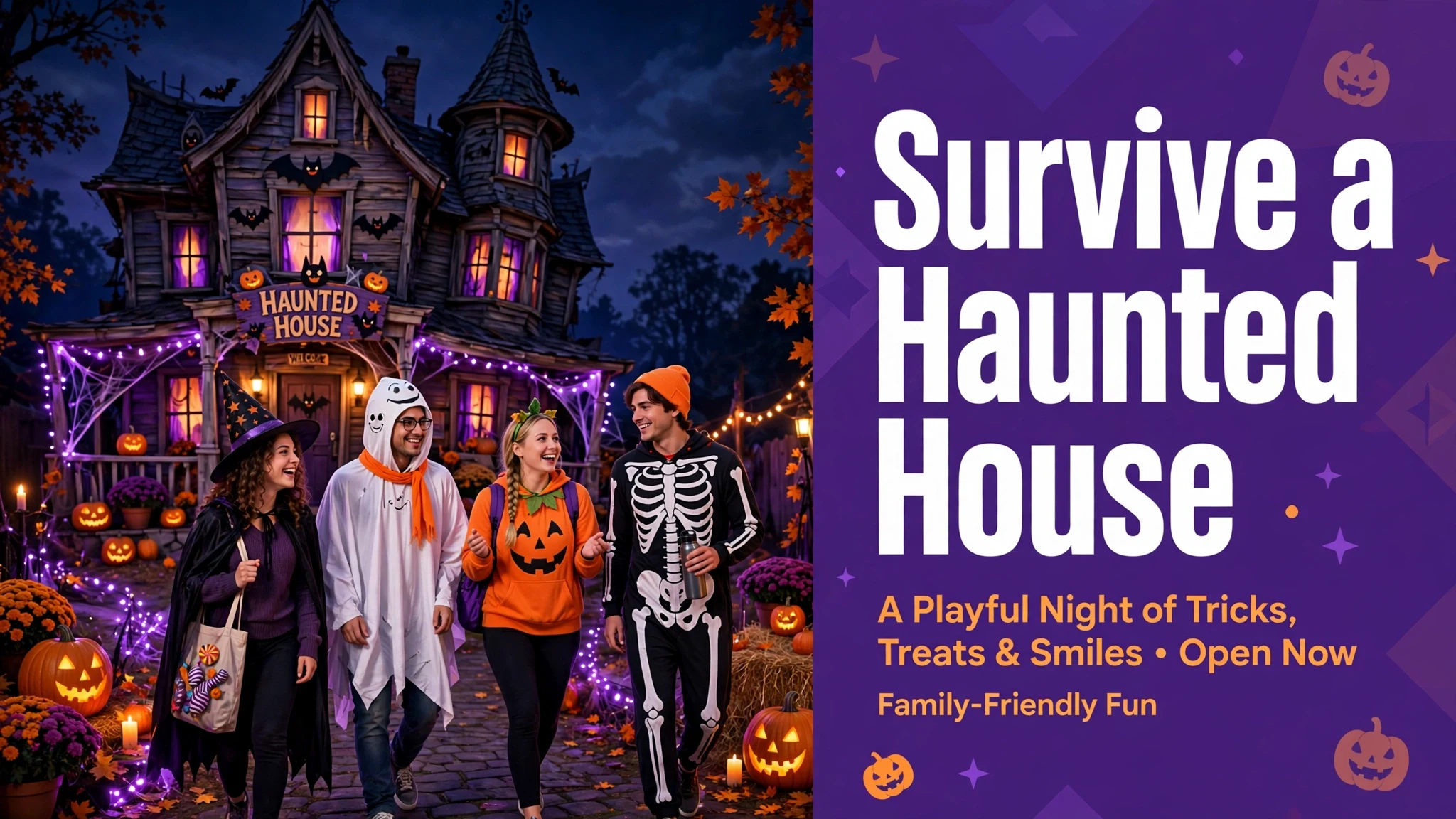
A haunted house is a strange kind of fun. You pay money to be frightened, you walk into a dark building on purpose, and you spend the next twenty minutes trying not to scream while actors in masks jump out at you. Then you come out laughing, your heart still racing, and you say you want to do it again. That is the whole point, and it is why haunted houses are one of the most popular Halloween attractions in the world.
Surviving a haunted house does not mean being brave in the way a hero in a film is brave. It means knowing what to expect, staying with your group, keeping your sense of humour, and not doing anything that will spoil the night for yourself or for anyone else. The actors are not real monsters, the building is not really cursed, and the exit is always marked, even when it feels as if you will never find it. This guide is a fun, practical handbook for first-timers and for nervous friends who have been dragged along by braver ones.
Think of a haunted house as a ride, not as a test. You do not need to prove anything, you do not need to touch anything, and you do not need to be the person who walks first. You only need to follow a few simple rules, to look after the people you came with, and to let yourself enjoy being scared in a safe place. If you can do that, you will survive — and you will probably have a better time than the person who pretends not to be scared at all.
Rule One: Go With People You Trust
The first rule of surviving a haunted house is the simplest: do not go alone. Go with friends, family, or a partner — people you trust, people who make you laugh, and people who will not leave you behind when an actor jumps out. A group is safer, funnier, and much less frightening than going solo, because fear shared is fear halved, and laughter shared is laughter doubled.
Choose your position in the group with care. The person at the front gets the first scare, and the person at the back gets the scare from behind. The middle is the safest place, and it is also the best place for a nervous first-timer. If you are the brave one, offer to go first; if you are the nervous one, say so honestly, and let your friends protect you. There is no shame in being in the middle. In fact, the middle is where the smartest survivors walk.
Agree on a plan before you enter. Decide that nobody will run, nobody will push, and nobody will leave the group. Decide on a safe word or a signal if someone needs to stop, and agree that you will all leave together if anyone is truly frightened. Most haunted houses have staff who can escort you out if you need to leave, and asking for help is not a failure; it is a sensible choice. A good group looks after its most nervous member, because the night is only fun if everyone enjoys it.
Dress for the Dark, Not for the Photo
What you wear to a haunted house matters more than you might think. You will be walking through dark corridors, up and down stairs, over uneven floors, and through rooms that may be smoky, strobe-lit, or filled with fog. Wear comfortable, closed shoes with a good grip, not high heels, not slippery soles, and not shoes you are afraid of ruining. You may step in fake blood, you may walk through water, and you will almost certainly be on your feet for a while.
Wear clothes you can move in, and avoid long, loose scarves, dangling jewellery, or anything that could catch on a prop or be grabbed by an actor. Tie your hair back if it is long, so that it does not fall over your face in the dark. Leave valuable items at home or in a secure bag, because you will not want to worry about your phone or your wallet while you are trying not to scream. If you need your phone, keep it in a zipped pocket, and do not use it as a torch inside the house, because the light will spoil the effect for everyone and may be against the rules.
Finally, think about the weather and the queue. Many haunted houses have long outdoor queues, and you may be waiting in the cold or the rain before you enter. Bring a jacket, and check whether the attraction has a cloakroom or a place to leave bags. Comfort before you enter means you will enjoy the scares more once you are inside.
Stay Calm When the Scare Comes
The scare is the whole point of a haunted house, and it is also the moment when most people forget every plan they made. An actor jumps out, a door slams, a light flashes, and your body reacts before your brain can think. Your heart beats faster, you gasp, and you may want to run. That reaction is normal, and it is exactly what the attraction is designed to produce.
The trick is to let the scare happen and then to recover quickly. Take a slow breath, remind yourself that you are in a safe attraction with staff nearby, and keep walking. Do not stop in the middle of a corridor, because the group behind you needs to keep moving, and the actors need space to reset for the next group. Do not run, because running in the dark is how people trip, fall, and get hurt. Walk steadily, stay with your group, and keep your hands by your sides.
If you feel panicky, focus on something real and boring: the floor beneath your feet, the hand of the friend next to you, or the exit sign glowing in the distance. Count your steps, or count your breaths, until the feeling passes. It will pass, usually within a few seconds, and the next room will give you something new to think about. If it does not pass, tell a staff member. Every haunted house has a way out, and using it is not a defeat.
The Actors Are People Doing a Job
It is easy to forget, in the dark, that the person in the mask is an actor who has rehearsed the scare, who has a break coming up, and who will go home at the end of the night like everyone else. The actors are not trying to hurt you; they are trying to entertain you, and they have rules about what they can and cannot do. In most haunted houses, actors are not allowed to touch you, and you are not allowed to touch them. That rule protects both sides, and it is important to respect it.
Do not hit, push, or grab an actor, even if you are frightened. It is not only rude; it can get you removed from the attraction, and it can injure someone who is doing their job. If an actor comes close, stand still, keep your hands down, and let them move on to the next person. They are trained to read the group and to give the biggest scare to the person who is enjoying it most, and they will usually leave alone the person who looks truly distressed.
A little kindness goes a long way. A smile, a laugh, or a “that was good” after a scare will make the actor’s night, and it will make your night better too, because you will have turned a frightening moment into a shared joke. The best haunted house visits are the ones where the visitors and the actors play together, each enjoying the game.
The Classic Mistakes to Avoid
Every haunted house has a list of classic mistakes, and most visitors make at least one of them on their first visit. The first mistake is splitting up. The group that splits up is the group that loses someone in the dark, and the person who is lost is the person who is most frightened. Stay together, even if it means walking more slowly.
The second mistake is using your phone as a torch or taking photographs with a flash. The darkness is part of the experience, and a bright light ruins it for everyone, including you, because it shows you the props, the wires, and the actors waiting in the corner. Many attractions ban photography inside for this reason, and breaking the rule can get you asked to leave.
The third mistake is trying to be the hero. The person who walks ahead alone, who touches the props, who opens the doors that are marked “do not enter”, or who tries to scare the actors back is not brave; they are a nuisance, and they are the person most likely to get hurt or to spoil the night for others. Follow the path, follow the instructions, and let the attraction do its work.
The fourth mistake is drinking too much before you enter. Alcohol may feel like it will make you braver, but it makes you slower, less aware, and more likely to trip or to react badly to a scare. A haunted house is best enjoyed with a clear head, so that you can remember the jokes afterwards.
After the Exit: The Best Part of the Night
The moment you step out of a haunted house, blinking in the light, is often the best part of the whole experience. Your heart is still racing, your friends are laughing, and everyone is talking at once about the scare they did not see coming. That shared retelling — “did you see the one in the kitchen?” — is where the memory is made, and it is why people return year after year.
Take a few minutes to sit down, to drink some water, and to let your heart rate settle before you drive home or walk to the next attraction. Talk about what scared you most, and what made you laugh, and listen to your friends’ versions of the same rooms. You will discover that everyone experienced the house differently, and that the person who looked calmest was often the most frightened inside.
If you enjoyed the visit, leave a kind review, thank the staff, and consider going back next year. Haunted houses change their themes, their rooms, and their scares, and a house you survived this year may be completely different next year. The best survivors are not the ones who were never scared; they are the ones who were scared, who laughed about it, and who came back for more.
What Happens Behind the Scenes
A haunted house does not appear by magic. Behind the dark corridors there is a team of people who build the sets, paint the walls, sew the costumes, apply the make-up, and rehearse the scares. Many haunted houses start preparing weeks before Halloween, and the actors rehearse their roles, learn where to hide, and practise how to time a scare so that it surprises the group without hurting anyone. The sets are built to be safe as well as scary, with marked exits, non-slip floors, and staff who watch the groups as they move through.
Knowing that can make the visit more enjoyable, not less. When you see a well-made set, or an actor whose make-up is convincing, you are seeing craft, and appreciating that craft is part of the fun. It also helps to remember, when you are frightened, that the person who just jumped out at you has probably done the same scare fifty times that night, and that they are as tired as you are excited. That shared effort — the actors working hard, the visitors playing along — is what makes a haunted house work, and it is worth respecting.
Haunted Houses for Children: Gentler Scares
Not every haunted house is designed for adults, and a house that is right for a teenager may be far too frightening for a young child. Many attractions now offer a family-friendly version during the daytime, with the lights a little brighter, the actors a little friendlier, and the scares replaced by jokes, games, and treats. These daytime visits are a good first step for a child who wants to try a haunted house without being overwhelmed, and they allow parents to judge whether their child is ready for the full evening experience. If your child is nervous, choose a daytime visit, stay close to them, and let them know that they can leave at any time. A child who enjoys a gentle haunted house is far more likely to want to return next year than a child who was frightened and did not enjoy it. For parents, the rule is simple: watch your child’s face, not the actors, and if the fun stops, leave together, with kindness, and without making the child feel that they have failed.
My Take:
My honest view is that a haunted house is one of the few places where being scared is actually good for you, because it is fear with a safety net. In real life, fear usually means danger, and we are right to avoid it. In a haunted house, fear means an actor, a prop, and a well-lit exit, and we can enjoy the rush without any real risk. I think that is a healthy thing, especially for teenagers and young adults who are learning how to handle strong feelings. A haunted house lets you practise being frightened, and then practise recovering, in a place where the worst thing that can happen is that you scream and your friends laugh at you. That is a useful lesson, and it is delivered in a way that a lecture never could.
I also believe that the social side of a haunted house matters more than the scares themselves. The best memories from these nights are rarely about the monster in the corner; they are about the friend who hid behind you, the partner who held your hand, or the group that laughed together on the way out. Fear brings people closer, because it makes us honest about how we feel, and it gives us a story to tell together afterwards. I have seen groups come out of a haunted house closer than they went in, not because the house was special, but because they survived it together. That is a small, human thing, and it is worth protecting.
Another point I care about is respect for the actors. It is easy to forget that the person in the mask is a worker who has spent hours in make-up, who has rehearsed the same scare dozens of times, and who is trying to give you a good night. Hitting an actor, or treating them as if they are not a person, is not brave; it is bullying, and it ruins the night for everyone. I would like to see haunted houses make the no-touching rule clearer, and I would like visitors to remember it even when they are frightened. A little respect makes the game better for both sides, and it means the actors will keep coming back to scare us next year.
On the subject of first-timers, my view is that we should be kinder to the nervous friend. Too often, the nervous person is teased, pushed to the front, or told not to be silly, and that turns a fun night into a miserable one. The brave thing is not to hide your fear; the brave thing is to say “I am scared, and I want to go in the middle, and I want to hold someone’s hand.” A group that respects that request is a group that understands what a haunted house is for. It is not a test of courage; it is a game, and games are only fun when everyone wants to play.
I also think there is a lesson here about how we handle fear in general. A haunted house teaches you that fear passes, that a racing heart slows down, and that the thing you were afraid of was not as bad as you imagined. That lesson applies outside the haunted house too: to a job interview, to a first date, to a difficult conversation. You walk in, you feel the fear, you keep walking, and you come out the other side. I am not saying a haunted house will cure anxiety, but I am saying that practising recovery in a safe place is a genuinely useful skill, and it is one that many people learn without ever realising they are learning it.
Finally, I believe that the best haunted house visits are the ones that end with laughter, not with a competition about who was least scared. The person who screamed the loudest is not the loser; they are the person who enjoyed the house most honestly. If you go to a haunted house, go to be scared, go to laugh, and go with people you like. Follow the rules, stay together, respect the actors, and let yourself enjoy the ride. You will survive, and you will have a story to tell, and that story will be better than any photograph you could have taken inside. For families with children, I would add one more piece of advice: choose the right house for the right age, start with a gentle daytime visit if you are unsure, and let your child set the pace. A child who is allowed to say “this is enough” and to leave with dignity will remember the visit fondly, while a child who is pushed too far will remember it with fear, and that is not what Halloween is for. The goal is a happy memory, not a test of courage, and a parent who protects that memory is doing the most important job of the night.
I also want to say something about the people who work behind the scenes, because they are the ones who make the night possible. The set builders, the make-up artists, the costume makers, and the actors all work long hours, often in hot costumes and in the dark, to give strangers a good time. A kind word at the exit, a thank you to the staff, or a positive review afterwards costs nothing, and it means a great deal to people who have spent weeks preparing. A haunted house is a team effort, and the visitors are part of that team, even if they do not realise it.
One more thought is about the difference between a haunted house and a real frightening experience. In a haunted house, you choose to be scared, you know there is an exit, and you know the monsters are actors. In real life, fear is not a choice, and there is no safe word. That difference is what makes a haunted house a healthy kind of fun: it lets you practise fear in a place where the fear is controlled, and where the ending is always the same — you walk out into the light, you laugh with your friends, and you go home safe. That is a good lesson to carry with you, and it is one of the reasons I think haunted houses will keep being popular for many Halloweens to come.
Frequently Asked Questions
Is a haunted house safe for first-timers?
Yes, if you follow the rules, stay with your group, and do not run. Haunted houses are staffed, have marked exits, and have actors who are trained not to touch you. Tell staff if you feel panicky and they will help you out.
What should I wear to a haunted house?
Wear comfortable closed shoes with good grip, clothes you can move in, and a jacket for the queue. Avoid high heels, loose scarves, and dangling jewellery, and keep your phone in a zipped pocket.
Can actors touch you in a haunted house?
In most haunted houses, actors are not allowed to touch visitors, and visitors are not allowed to touch actors. Check the rules of the attraction you visit, and respect the no-touching rule even if you are frightened.
How do I stop feeling panicky inside a haunted house?
Take slow breaths, focus on the floor or on a friend’s hand, and remind yourself that you are in a safe attraction with staff nearby. Keep walking with your group, and tell a staff member if you need to leave.
Is it okay to take photos inside a haunted house?
Many attractions ban photography and phone lights inside, because they spoil the darkness for everyone. Check the rules before you enter, and enjoy the experience without your phone.
What age is suitable for a haunted house?
It depends on the attraction, as some are designed for families and others are strictly for older teenagers and adults. Check the age guidance on the attraction’s website, and do not take a young child to a house designed for adults.