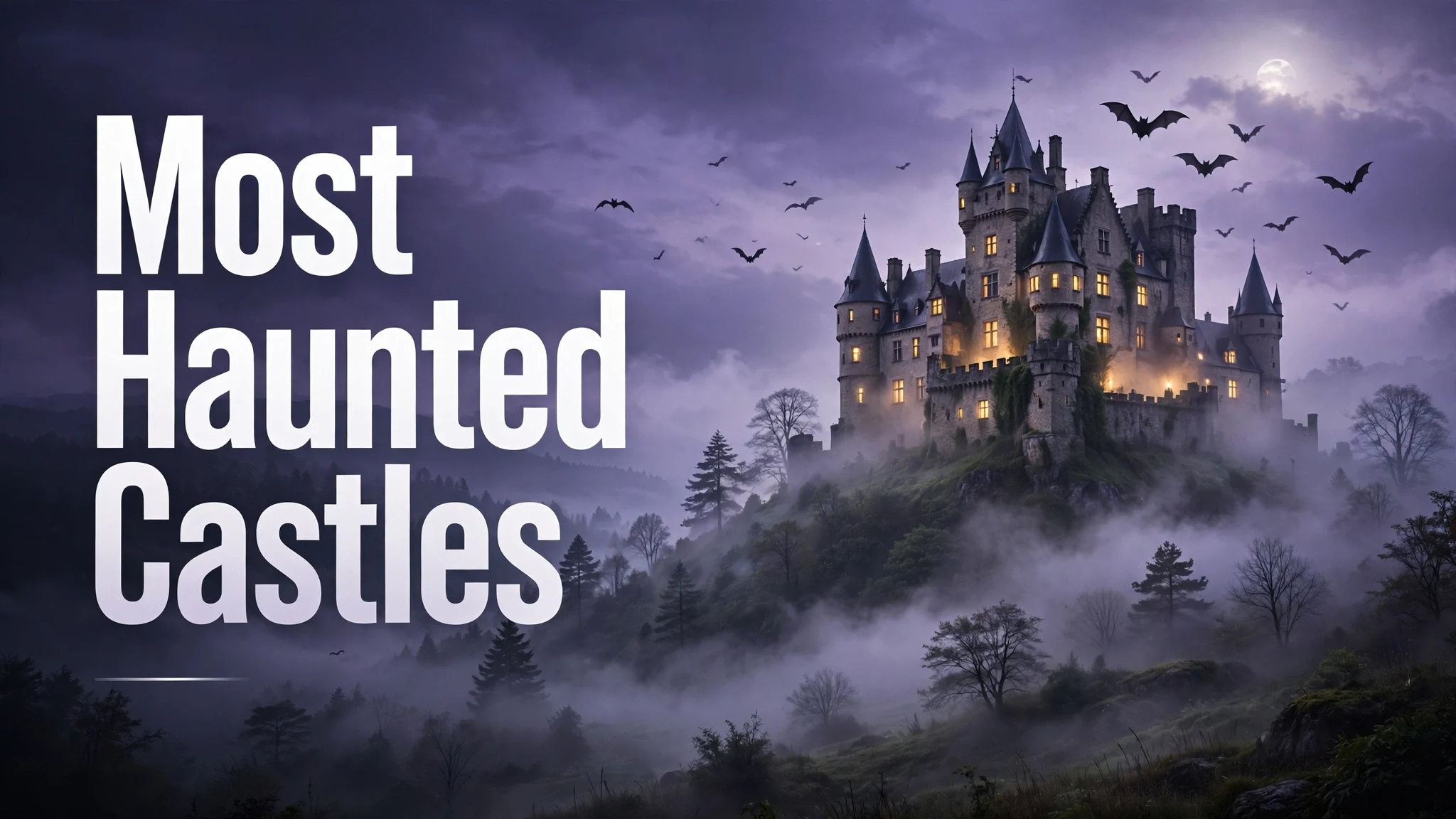
Most Haunted Castles in the World, Explained
In this post
- Edinburgh Castle, Scotland: The Piper and the Prisoners
- Bran Castle, Romania: Dracula’s Shadow
- Leap Castle, Ireland: The Elemental and the Bloody Chapel
- The Tower of London, England: Princes, Queens, and a Bear
- Chillingham Castle, England: The Blue Boy and the Torture Chamber
- Other Castles With Famous Ghosts
- Visiting a Haunted Castle: What to Expect
- How Ghost Stories Are Recorded and Checked
- My Take:
A castle is a perfect setting for a ghost story. It is old, it is made of stone, it has dark corridors, locked rooms, and a history of war, imprisonment, and sudden death. People lived and died inside those walls for hundreds of years, and the stories they left behind have been told and retold until they feel like part of the building itself. Whether you believe in ghosts or not, the world’s most haunted castles are worth visiting for their history alone — and the ghost stories make that history impossible to forget.
The castles in this guide are not chosen because they are the scariest, but because their stories are the best known, the most often reported, and the most closely tied to real events. Some of the ghosts are said to be former owners, soldiers, or prisoners. Others are nameless figures seen by visitors who had no idea the castle was supposed to be haunted. In each case, the story tells us something about the castle’s past, and about why people keep returning to hear it again.
It is important to be clear about what is known and what is legend. Many of these stories come from folklore, from tour guides, and from visitors’ reports, not from scientific evidence. No ghost has ever been proved in a laboratory, and many “hauntings” can be explained by cold draughts, old plumbing, creaking wood, and the power of suggestion. That does not make the stories worthless. It makes them a part of cultural history, and a way of remembering the people who lived — and sometimes died violently — in these places.
Edinburgh Castle, Scotland: The Piper and the Prisoners
Edinburgh Castle stands on a volcanic rock above Scotland’s capital, and it has been a fortress, a royal palace, a barracks, and a prison. Its history goes back more than a thousand years, and it has seen sieges, executions, and long periods of imprisonment. It is no surprise that it is often described as one of the most haunted places in Scotland.
The most famous ghost story is that of the Lone Piper. According to legend, a piper was sent into the tunnels beneath the castle to explore them, playing his pipes so that people above could follow his progress. The music grew fainter and fainter, and then stopped altogether. The piper was never seen again, and the tunnel was sealed. Visitors and staff have reported hearing the faint sound of pipes coming from beneath the castle, especially on quiet nights, though no piper is ever found.
Other reports include a headless drummer, said to have been seen before the castle was attacked, and the ghosts of prisoners held in the castle’s vaults during the wars with France and America. Prisoners of war were kept in dark, crowded cells, and many died of disease. Visitors to the vaults have reported cold spots, a feeling of being watched, and the sound of footsteps in empty corridors. The castle also holds the Honours of Scotland — the crown jewels — and the Stone of Destiny, both of which carry their own legends.
Whether these stories are true or not, they are part of why Edinburgh Castle draws millions of visitors. The castle’s own guides tell the stories with care, separating what is recorded in history from what is folklore, and the building itself — with its thick walls, its narrow stairs, and its views over the city — does the rest.
Bran Castle, Romania: Dracula’s Shadow
Bran Castle, in Transylvania, Romania, is known around the world as “Dracula’s Castle”, although its link to the historical Vlad the Impaler is debated by historians. The castle was built in the fourteenth century to guard a mountain pass, and it later became a royal residence. Its dramatic position on a rocky hill, its towers, and its narrow passages make it look exactly like a castle from a horror film, and that appearance has shaped its reputation.
The connection to Dracula comes from Bram Stoker’s novel, published in 1897, and from the popular belief that Vlad the Impaler, the inspiration for Count Dracula, once stayed at Bran. Historians note that Vlad may have passed through the area, but there is no firm evidence that he lived at the castle. That has not stopped the legend, and the castle now embraces its Dracula image, with exhibitions about the novel, the history of Transylvania, and the folklore of vampires.
Visitors report a feeling of unease in the castle’s darker rooms, and guides tell stories of strange sounds and cold draughts. Some of the castle’s history is genuinely dark: it was a border fortress, it saw fighting, and it was used as a hospital and a customs post. The “haunting” here is less about a single named ghost and more about an atmosphere — the sense that a building with such a history, in such a landscape, must hold secrets. For many visitors, that is enough, and the castle’s popularity shows that a good story, even one based on a novel, can become part of a place’s identity.
Leap Castle, Ireland: The Elemental and the Bloody Chapel
Leap Castle, in County Offaly, Ireland, is often described as one of the most haunted castles in the world, and its history gives that claim some weight. The castle was built in the thirteenth century, and it was the home of the O’Carroll family, who were known for their violence. According to tradition, one brother murdered another in the castle’s chapel, in front of the altar, and the chapel became known as the Bloody Chapel. The story has been told for centuries, and the chapel is still shown to visitors as a place of particular unease.
The castle’s most famous reported entity is called the Elemental: a small, hunched creature with a foul smell, said to have been seen by several people, including a family who lived in the castle in the early twentieth century. The description is unusual, and it has been repeated so often that it has become part of the castle’s identity. Other reports include the ghost of a woman in a red dress, the sound of footsteps on the stairs, and lights that appear in empty windows.
Leap Castle was ruined for many years, and it has been restored by its owners, who live there and who have spoken openly about their experiences. The castle is not open to the public in the same way as Edinburgh or Bran, and visits are usually by arrangement. That privacy has added to its reputation: a castle that is lived in, that has a violent past, and that is rarely visited, feels more haunted than a castle that welcomes thousands of tourists a day.
The Tower of London, England: Princes, Queens, and a Bear
The Tower of London is not a single castle but a fortress, a palace, a prison, and a place of execution, and its ghosts are among the most famous in England. The Tower has been the scene of some of the most dramatic events in English history, and the ghosts are said to include the people who died there.
The most famous are the Princes in the Tower: Edward V and his younger brother Richard, who were taken to the Tower in 1483 and never seen again. Their fate has never been proved, and their ghosts are said to have been seen in the Tower, wearing white and holding hands. Another famous ghost is Anne Boleyn, the second wife of Henry VIII, who was executed at the Tower in 1536. She is said to have been seen carrying her head under her arm, walking through the corridors where she was held.
Other reported figures include Lady Jane Grey, who was queen for nine days and was executed at the Tower, and the ghost of a bear, said to have been seen near the Martin Tower. The Tower’s Yeoman Warders, known as Beefeaters, tell these stories to visitors, and they do so with a mix of history and humour. The Tower is a working historic site, and its ghost stories are part of its guided tours, which draw millions of visitors each year.
Chillingham Castle, England: The Blue Boy and the Torture Chamber
Chillingham Castle, in Northumberland, England, is often called the most haunted castle in England, and it has a history that supports the claim. The castle was a fortress on the border between England and Scotland, and it saw centuries of fighting. It was also a place of imprisonment and torture, and its torture chamber, with its instruments, is still shown to visitors.
The castle’s most famous ghost is the Blue Boy, said to be the spirit of a young boy whose cries were heard in the Pink Room. According to the story, workmen renovating the room found the skeletons of a man and a boy hidden inside a wall, and after the remains were given a proper burial, the crying stopped. Visitors have also reported seeing a woman in white, a figure in the chapel, and the ghost of a former owner, Lady Mary Berkeley, who is said to walk the corridors looking for her husband.
Chillingham is now a lived-in castle that offers tours and overnight stays, and its owners have spoken about their own experiences. The castle’s atmosphere — its thick walls, its dark rooms, and its collection of armour and weapons — makes it easy to understand why people feel uneasy there, even before they hear the stories.
Other Castles With Famous Ghosts
Beyond the castles above, many others have well-known ghost stories. In Wales, the ghost of a lady in white is said to haunt Carew Castle. In Scotland, Glamis Castle is associated with the story of a hidden room and a figure known as the Grey Lady. In Germany, the castle of Frankenstein, which inspired Mary Shelley’s novel in part through its name, has its own legends. In the Czech Republic, Houska Castle is said to have been built over a pit that led to hell, and its chapel is said to be a place of strange phenomena.
In the United States, the Winchester Mystery House in California is not a castle, but it is often mentioned alongside haunted castles because of its maze of rooms and staircases, built by Sarah Winchester, who believed she was haunted by the spirits of people killed by Winchester rifles. In Japan, Himeji Castle, one of the most beautiful castles in the world, has stories of a ghost named Okiku, whose story is told in Japanese folklore.
Each of these stories reflects the history and culture of its place. A ghost story is rarely only about a ghost; it is about a war, a murder, a lost child, or a broken promise, and it survives because it gives a human shape to a history that might otherwise be forgotten.
Visiting a Haunted Castle: What to Expect
If you plan to visit a haunted castle, go for the history first and the ghost story second. Most of these castles are historic sites with museums, guided tours, and exhibitions, and the ghost stories are told as part of the tour. Book in advance, especially for popular castles such as Edinburgh and the Tower of London, and check whether photography is allowed in the areas where ghosts are said to appear.
Ghost tours and overnight stays are offered at some castles, including Chillingham and Leap, and they are popular with visitors who want a stronger experience. Be aware that these tours are entertainment as well as history, and that the stories are told to create an atmosphere. If you are sensitive to dark places, cold rooms, or sudden noises, a daytime tour may be a better choice than a midnight visit.
Finally, treat the castles and their staff with respect. These are real historic buildings, and in some cases they are people’s homes. The ghosts may be legends, but the history is real, and the people who died in these places deserve to be remembered with care, not only as characters in a scary story.
How Ghost Stories Are Recorded and Checked
Not every ghost story at a castle is told in the same way, and it helps to know how the stories are recorded. Some reports come from staff who work in the castle every day, and who notice a door that opens by itself, a cold spot that never warms up, or a sound that repeats at the same time each night. Those reports are often written down in a log, and they are taken seriously by the people who manage the building, because a repeated draught or a faulty door may need repair, even if it is not a ghost.
Other reports come from visitors, who may write in a guest book, tell a guide, or post a photograph online. Visitor reports are harder to check, because the visitor leaves, the light changes, and the moment cannot be repeated. A photograph that seems to show a figure may, on closer inspection, show a reflection, a statue, or another visitor. That does not mean the visitor was lying; it means that a castle is a difficult place to photograph, with stone walls, low light, and many reflective surfaces, and that the brain is quick to see a person where there is only a shadow.
A third source is the guidebook and the tour, where stories are passed down from one guide to the next. Over time, a story can grow: a single report of a cold draught becomes a story of a ghost that appears every night, and a legend about a hidden room becomes a fact in the next edition of the guide. Good guides are honest about this, and they will tell you which parts of a story are documented, which parts are folklore, and which parts are simply a good tale. That honesty is part of what makes a castle visit worthwhile, because it lets you enjoy the story without being misled about the history.
My Take:
My honest view is that haunted castles are fascinating not because they prove ghosts exist, but because they prove that stories can outlive stone. A castle is built to last for centuries, and the stories told inside it can last even longer, passed from guide to visitor, from parent to child, from one generation to the next. I find that more interesting than any single sighting, because it shows how human beings use stories to remember the past. A murder in a chapel, a child hidden in a wall, a piper who never returned — these are not only ghost stories; they are memories of real events, shaped by time into a form that people can retell. The castle gives the story a place to live, and the story gives the castle a reason to be visited.
I also think we should be honest about the difference between history and legend. The Tower of London really did hold prisoners, and people really were executed there, and that history is documented in records that can be checked. The ghost of Anne Boleyn carrying her head is a legend, and it should be told as a legend, not as a fact. When guides and books blur that line, they do a disservice to both history and to the people who are trying to learn from it. I would rather hear a guide say “this is the story people tell, and here is what we actually know” than hear them present a legend as if it were a police report. That honesty does not make the story less interesting; it makes it more trustworthy, and it allows the visitor to enjoy the tale without being misled.
Another point I care about is the way these castles are treated as tourist attractions. There is nothing wrong with a ghost tour, and there is nothing wrong with charging for entry, because historic buildings are expensive to maintain, and tourism helps to pay for repairs. But there is a line between sharing a story and exploiting a tragedy. A torture chamber should be shown with respect for the people who suffered there, not as a fun photo opportunity. A child’s grave, or a story about a murdered child, should be told with care, not with a joke. I think the best castles get this balance right: they tell the ghost story, but they also tell the human story, and they remind visitors that the people in the story were real.
On the subject of belief, my view is simple: I do not need to decide whether ghosts are real in order to enjoy a haunted castle. A cold draught in a stone corridor, a creaking floorboard, and a story told in a low voice are enough to create a feeling, and that feeling is real even if the ghost is not. The human brain is good at finding patterns, and it is especially good at finding them in dark, unfamiliar places. That does not mean every report is imagined, and it does not mean every report is true. It means we should listen to the stories with an open mind and a critical eye, and we should enjoy them without pretending that enjoyment is proof.
I also believe that haunted castles teach us something about how places remember. A modern building, made of glass and steel, rarely feels haunted, because it has no history to hold a story. A castle, with its thick walls and its centuries of use, feels as if it has absorbed the lives lived inside it. That feeling may be psychological, but it is powerful, and it is why people travel long distances to visit these places. In a world where so much is new and temporary, a castle offers a connection to the past that is physical and immediate. You can touch the same stone that a prisoner touched, walk the same stairs that a queen walked, and stand in the same room where a story began. That connection is worth preserving, whether or not a ghost is standing beside you.
Finally, I think the best way to visit a haunted castle is with curiosity and respect. Go to learn the history, listen to the stories, and ask questions about what is known and what is legend. Take photographs, but do not try to provoke a ghost, and do not treat the castle as a haunted house attraction. The people who lived and died in these places deserve to be remembered as people, not as props. If you leave a haunted castle with a better understanding of its history, and with a story to tell your friends, then the visit has done its job — ghost or no ghost.
I also want to add a word about the guides, because a good guide can make a castle visit unforgettable, and a bad one can ruin it. A good guide knows the difference between history and legend, tells the story with warmth, and answers questions honestly, even when the answer is “we do not know”. A bad guide presents every legend as fact, rushes through the rooms, and treats the visitors as an audience to be frightened rather than as people to be taught. When you visit a castle, listen for that difference, and remember that the guide who says “this is the story people tell” is giving you a gift: the chance to enjoy the tale and to learn the history at the same time.
One more thought is about children, because a haunted castle can be a wonderful visit for a child, or a frightening one, depending on how it is handled. A child who is told the history first, who is allowed to ask questions, and who is not forced to enter a dark room will usually enjoy the visit and remember it fondly. A child who is frightened by a sudden scare, or who is told a ghost story as if it were a warning, may remember the visit for the wrong reasons. Parents and guides should work together here, keeping the scares gentle, the stories clear, and the exits known, so that a castle visit becomes a family memory rather than a nightmare.
Frequently Asked Questions
Which castle is the most haunted in the world?
There is no official ranking, but Edinburgh Castle, Leap Castle, Chillingham Castle, and the Tower of London are among the most often named. Each has many reported sightings and a long, violent history.
Is Bran Castle really Dracula’s castle?
Bran Castle is known as Dracula’s Castle because of Bram Stoker’s novel and the legend of Vlad the Impaler, but historians say there is no firm evidence that Vlad lived there. The castle’s Dracula image is part of its tourist identity.
What is the ghost of the Blue Boy at Chillingham Castle?
The Blue Boy is said to be the spirit of a young boy whose cries were heard in the Pink Room. Workmen are said to have found the skeletons of a man and a boy inside a wall, and the crying was reported to stop after they were buried.
Can you stay overnight in a haunted castle?
Yes, some castles such as Chillingham offer overnight stays and ghost tours, usually by booking in advance. Others, such as Edinburgh Castle and the Tower of London, are daytime historic sites only.
Are ghost stories at castles based on real events?
Many are based on real events — wars, murders, and imprisonments — but the ghost itself is usually folklore or a visitor’s report, not scientific evidence. Guides often separate the documented history from the legend.
Why do castles feel haunted?
Castles are old, made of stone, dark, and full of history, which creates an atmosphere that makes people more likely to notice cold spots, sounds, and shadows. The feeling is real, even when the cause is natural.