Why Do We Believe in Ghosts? Explained Simply
In this post
- The Brain That Sees Faces in the Dark
- Grief, Love, and the Feeling That the Dead Are Near
- Culture, Religion, and the Stories We Grow Up With
- Fear of Death and the Hope of Life After Death
- The Science of Hauntings: Cold Spots, Sounds, and Suggestion
- Ghost Hunting, Television, and the Modern Ghost Story
- Ghosts in Literature, Film, and Everyday Language
- My Take:
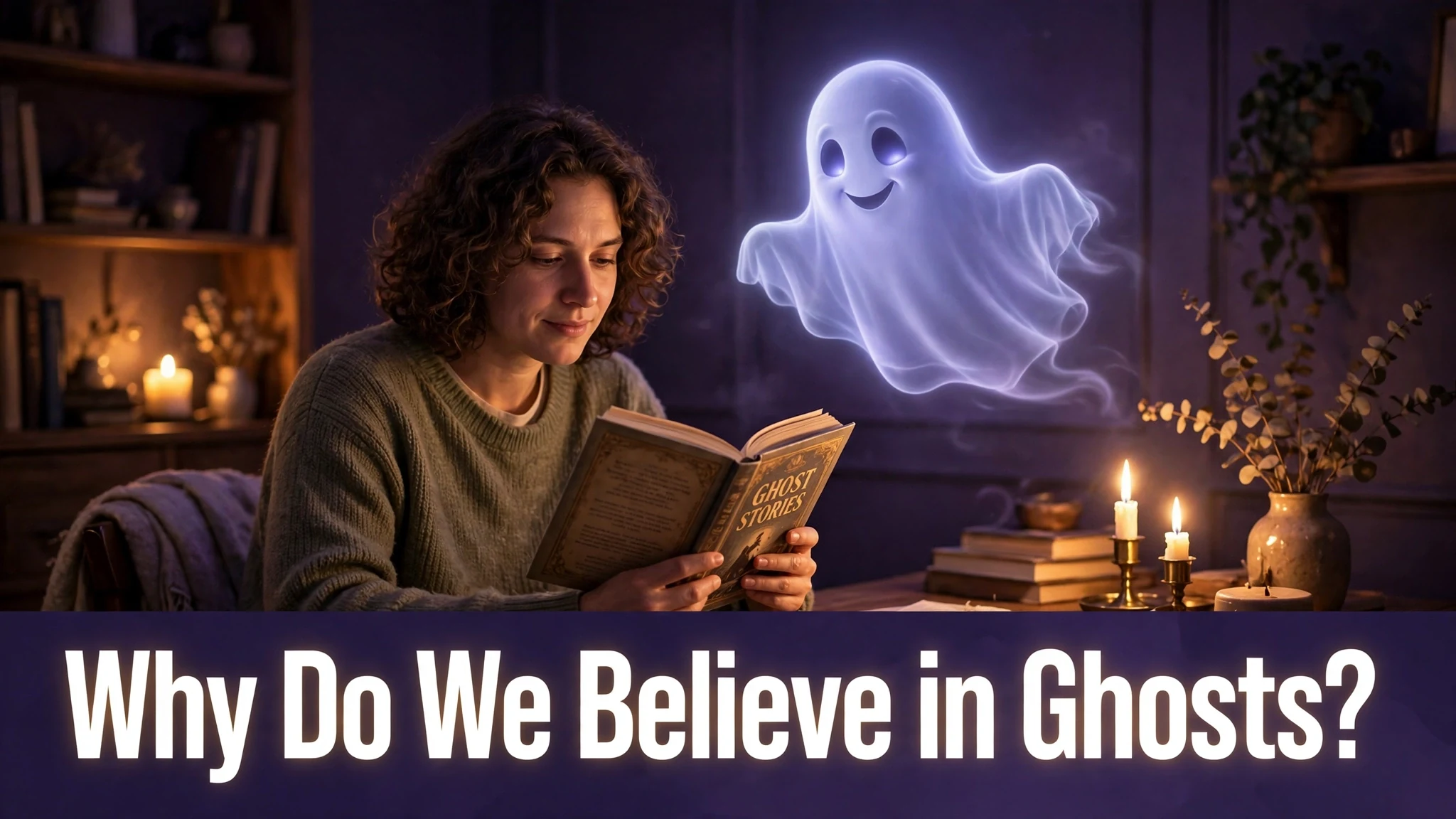
Almost every culture in the world has ghost stories. From the haunted castles of Scotland to the spirits of ancestors in Asia, from the Day of the Dead in Mexico to the ghost tales told around a campfire, the idea that the dead can return, or linger, is one of the oldest beliefs in human history. Surveys in many countries find that a large share of people — often around a third or more — say they believe in ghosts, and many more say they have had an experience they could not explain. The question is not only whether ghosts are real, but why the belief is so common, so persistent, and so powerful.
The answer is not a single cause. Belief in ghosts comes from many places at once: from the way our brains work, from grief and love, from culture and religion, from fear of death, and from stories we hear as children. Understanding those causes does not mean dismissing the belief, and it does not mean proving it. It means looking at a human idea with curiosity, and asking what it tells us about how people think, feel, and remember.
This guide explains the psychology, the science, the history, and the culture of ghost belief in simple words. It looks at why we see faces in the dark, why we hear footsteps in an empty house, why grief can make the dead feel present, and why ghost stories survive even in a world of science and smartphones. Whether you believe in ghosts or not, the reasons behind the belief are worth understanding.
The Brain That Sees Faces in the Dark
The human brain is built to find patterns, and it is especially good at finding faces and figures. This is useful in everyday life: it helps a parent recognise a child in a crowd, and it helps us read emotions from a glance. But the same skill can mislead us in the dark. When we see a shadow, a curtain, or a shape in a window, the brain may fill in the missing details and present us with a face, a figure, or a person who is not there. This is called pareidolia, and it is the reason people see faces in clouds, in tree bark, and in old photographs.
The brain is also built to detect agency — to assume that a sound or a movement was caused by someone, rather than by nothing. If a floorboard creaks in an empty house, it is safer, from an evolutionary point of view, to assume that someone is there than to assume that it was the wind. Our ancestors who assumed the worst were more likely to survive, and that instinct is still with us. In a dark, quiet house, a small noise can feel like a presence, because the brain is doing its job: it is warning us, even when there is nothing to warn us about.
Sleep also plays a role. In the state between waking and sleeping, known as sleep paralysis, a person may wake up unable to move, and may see or feel a figure in the room. This experience is frightening, and it has been reported in many cultures, often described as a demon, a ghost, or a shadow person sitting on the chest. Scientists now understand sleep paralysis as a normal, if distressing, part of sleep, but for the person experiencing it, it feels completely real, and it is easy to understand why it has been interpreted as a ghost for centuries.
Grief, Love, and the Feeling That the Dead Are Near
One of the most common reasons people believe in ghosts is grief. When someone we love dies, the loss does not end with the funeral. We continue to think about them, to dream about them, to expect to see them in their usual chair, or to hear their voice in the next room. For many people, this feeling is so strong that it can feel like a presence, and some report sensing the dead person, smelling their perfume, or hearing their footsteps.
Psychologists call this a “continuing bond”, and it is a normal part of grieving. It does not mean the person is mentally ill, and it does not mean they are seeing a ghost in a supernatural sense. It means that love does not stop when a person dies, and that the brain, which has spent years expecting that person to be there, takes time to adjust to their absence. In many cultures, this bond is recognised and honoured: people visit graves, talk to the dead, and keep photographs and objects that remind them of the person they lost.
In some cases, grief can lead to experiences that feel like a visitation: a vivid dream in which the dead person speaks, a feeling of warmth, or a sense that the person is watching over the family. These experiences are often comforting, and they can help a grieving person to feel less alone. Whether they are interpreted as a ghost, a dream, or a memory, they serve a human purpose: they keep the dead person present in the life of the living, at least for a while.
Culture, Religion, and the Stories We Grow Up With
Belief in ghosts is shaped by culture and religion from a very young age. In many traditions, the dead are believed to continue in some form: as ancestors who watch over the family, as spirits who need to be honoured, or as souls who have not yet moved on. In Hinduism, Buddhism, and many folk traditions, reincarnation and ancestral spirits are part of the worldview. In Christianity, the idea of a soul that survives death is central, even if ghosts themselves are not part of official teaching. In Islam, the concept of the soul and the afterlife is also central, though the interpretation of ghosts varies.
Children learn ghost stories from their families, from books, from films, and from friends. A child who grows up hearing that a particular house is haunted is more likely to feel frightened in that house, and more likely to interpret a strange sound as a ghost. That does not mean the child is foolish; it means that culture provides a framework for interpreting experience, and that framework is powerful.
Media also plays a large role. Ghost films, television shows, and books present ghosts in a consistent way: as pale figures, as cold spots, as voices in the dark. When a person has a strange experience, they may describe it using the language they have learned from media, because that is the language available to them. The story shapes the experience, and the experience, retold, shapes the story for the next person.
Fear of Death and the Hope of Life After Death
At the heart of ghost belief is a question that every human being asks: what happens when we die? The idea that death is the end is frightening, and the idea that some part of us continues is comforting. Ghosts offer a kind of evidence for that hope: if the dead can return, even briefly, then death is not the end, and the people we love are not truly gone.
This is not only a religious idea; it is a human one. Even people who do not follow a religion may find comfort in the thought that a loved one is still present in some way, or that they themselves will not simply vanish. Ghost stories give that hope a shape, a story, and a place — a house, a castle, a road — where the dead can be imagined as still present.
Fear also plays a role. The unknown is frightening, and a ghost story gives a name to that fear. A dark corridor is less frightening if the fear has a name, a story, and a reason, than if it is simply dark and empty. By telling ghost stories, people make the unknown manageable, and they create a shared way of talking about death, loss, and the things they cannot control.
The Science of Hauntings: Cold Spots, Sounds, and Suggestion
Scientists who study ghost experiences have found that many “hauntings” have natural explanations. A cold spot in a room can be caused by a draught, by a hidden vent, or by a stone wall that holds the cold. A strange sound can be caused by old pipes, by wood contracting at night, or by a building settling. A feeling of being watched can be caused by low-frequency sound, known as infrasound, which is below the range of human hearing but can cause feelings of unease, anxiety, and even the sense of a presence.
Suggestion is also powerful. If a person is told that a house is haunted before they enter it, they are more likely to notice strange sounds, to feel cold, and to interpret ordinary events as paranormal. This is not dishonesty; it is the brain doing what it does: looking for what it expects to find. In experiments, people who are told a room is haunted report more strange experiences than people who are told the same room is not haunted, even when the room is identical.
None of this proves that ghosts do not exist, and scientists are careful to say that absence of evidence is not evidence of absence. What it does show is that many ghost experiences can be explained without a ghost, and that the human brain, the environment, and the power of suggestion are enough to create a convincing haunting. For a believer, that may not be enough to change their mind, and for a sceptic, it may be enough to explain the story. Both positions are understandable, and both deserve respect.
Ghost Hunting, Television, and the Modern Ghost Story
In recent decades, ghost hunting has become a popular hobby and a television genre. Shows that investigate haunted houses with cameras, microphones, and thermal imaging have brought ghost stories to a new audience, and they have created a set of expectations about what a haunting should look like: a voice on a recorder, a figure on a thermal camera, a door that moves on its own. These shows are entertaining, but they are also edited for drama, and the evidence they present is rarely checked by independent scientists.
The internet has also changed ghost belief. A video of a strange shadow can be shared millions of times in a day, and a photograph of a “ghost” can be created with simple editing software. At the same time, the internet has made it easier to check a story, to find the original photograph, and to see whether the same “ghost” has appeared in many different places. The result is a world where ghost stories spread faster than ever, and where they are also debunked faster than ever.
For many people, ghost hunting is not about proof; it is about experience. Visiting a haunted castle, joining a ghost tour, or spending a night in a reputedly haunted house is a way of feeling close to history, to mystery, and to other people who share the interest. The social side of ghost belief — the shared story, the shared scare, the shared laugh afterwards — is as important as the question of whether ghosts are real.
Ghosts in Literature, Film, and Everyday Language
Ghosts are not only a belief; they are a part of our language and our stories. We speak of “ghosting” someone when we stop replying to their messages, of a “ghost town” when a place is empty, and of being “haunted” by a memory when we cannot forget it. In literature, ghosts appear in Shakespeare, in Charles Dickens’ “A Christmas Carol”, and in countless novels, plays, and poems. In film, ghost stories are one of the oldest genres, from early silent films to modern horror. These uses show that the idea of a ghost has become a way of talking about absence, about memory, and about the things that stay with us after they are gone, even when we do not believe in a literal spirit.
That literary use is worth remembering, because it shows that ghost belief is not only about the supernatural; it is about how human beings use stories to make sense of loss. A ghost in a novel can represent guilt, or grief, or a secret that has not been told, and the reader understands that without needing to believe in a real ghost. In the same way, a person who says they feel haunted by a loved one may be using the language of ghosts to describe a feeling that is real, even if the ghost is not. Understanding that language helps us to listen better, and to respect what a person is trying to say.
My Take:
My honest view is that belief in ghosts is not a sign of foolishness, and it is not a sign of wisdom either; it is a sign of being human. We are the only animals who know that we will die, and we are the only animals who tell stories about what happens afterwards. Ghosts are one of those stories, and they have survived for thousands of years because they speak to something real: love, loss, fear, and the hope that the people we care about are not truly gone. I think we should treat that belief with respect, even when we do not share it, because mocking a person’s grief, or their fear, does not make them more rational; it only makes them less likely to talk about what they experienced.
I also believe that science and ghost belief can coexist, even if they do not agree. Science can explain a cold spot, a creaking floorboard, and a sleep paralysis experience, and it should be allowed to do so, because those explanations are useful and they are true. At the same time, a person who has lost a mother, a husband, or a child, and who feels that person’s presence in a quiet moment, is not necessarily making a scientific claim; they are describing a feeling, and that feeling deserves to be heard. I would like to see more conversations where a scientist and a believer can listen to each other, rather than trying to win an argument, because both have something to offer: the scientist has a method for checking what can be checked, and the believer has an experience that reminds us why the question matters.
Another point I care about is the way ghost stories are used to teach children about death. A ghost story told well can help a child to talk about loss, to ask questions, and to feel less alone in their fear. A ghost story told badly — as a threat, or as a joke that mocks the dead — can do the opposite. I think families should tell ghost stories with care, making it clear what is a story and what is a belief, and allowing children to ask questions without being laughed at. The goal is not to make a child believe or disbelieve, but to give them a language for talking about a difficult subject.
On the subject of ghost hunting television, my view is mixed. I enjoy a good ghost story, and I understand why these shows are popular, but I also think they often present entertainment as evidence, and that is misleading. A voice on a recorder, a figure on a thermal camera, or a door that moves can all have ordinary explanations, and a show that does not explore those explanations is not investigating; it is performing. I would rather watch a programme that says “we do not know what caused this, and here are the possible explanations” than one that declares a haunting proved because a camera caught a shadow. Honesty is more interesting than a jump scare, and it is more respectful to the audience.
I also think we should pay attention to the cultural side of ghost belief, because it varies so much around the world. In some cultures, ghosts are ancestors to be honoured; in others, they are spirits to be feared; in others still, they are a normal part of daily life, mentioned in the same way as the weather. That variety is a reminder that there is no single “ghost belief”, and that the idea of a ghost means different things to different people. I find that variety fascinating, and I think it is a reason to learn about other cultures, rather than to assume that our own way of thinking about death is the only one.
Finally, I believe that the question “do ghosts exist?” is less important than the question “why do we need ghosts?” We need them because we love, because we grieve, because we fear death, and because we want to believe that the people we have lost are not entirely gone. That need is not a weakness; it is a part of being human, and it will be with us for as long as people love each other and lose each other. Whether ghosts are real or not, the belief in them tells us something true about ourselves, and that is why the stories will keep being told, in every culture, in every generation, for as long as people gather in the dark and ask what happens next.
I also want to add that ghost stories are a part of our shared language, and that language is useful even for people who do not believe. When we say we are haunted by a memory, or that a place feels like a ghost town, we are using the idea of a ghost to describe a real feeling: the feeling that something is present even though it is gone. That is a powerful way to talk about loss, and it is one that science alone cannot fully capture. I think we should value that language, and we should listen to it, because it tells us how people actually experience grief, fear, and love, not only how they explain it.
One more thought is about how to talk to a child who asks about ghosts. A child who asks is not asking for a lecture on science, and they are not asking to be told that their fear is silly. They are asking for reassurance, and for a way to understand a difficult idea. The best answer is an honest one: that many people believe in ghosts, that many people do not, that scientists have explanations for many strange experiences, and that it is okay to feel scared in the dark. That answer respects the child, it gives them information, and it leaves room for them to form their own view as they grow older. That is the kind of conversation that helps a child, and it is the kind of conversation that a good ghost story can start.
I also think we should notice how much money is made from ghosts, because the business of haunting is now a large one. Ghost tours sell tickets in almost every old city, hotels advertise their haunted rooms at a premium, and television shows turn an investigation into a franchise, all of it built on the hope that a visitor might see something strange. There is nothing wrong with enjoying a ghost story as entertainment, and a good tour can teach real history along the way, but a paying customer should know what they are buying. A creaking floorboard in a three-hundred-year-old house is not evidence of a spirit, and a tour guide who presents it as proof is selling a thrill, not a fact. Enjoy the tour, learn the history, and keep the difference between a good story and a proven haunting in mind when the lights go out.
Frequently Asked Questions
Do most people believe in ghosts?
Surveys in many countries find that around a third of people say they believe in ghosts, and many more say they have had an unexplained experience. Belief varies by age, culture, and religion, and it is common in almost every part of the world.
Why do we see ghosts in the dark?
The brain is built to find faces and figures, especially in low light, and to assume that a sound was caused by a person. In the dark, a shadow or a curtain can be misread as a figure, a process called pareidolia.
What is sleep paralysis?
Sleep paralysis is a state between waking and sleeping in which a person wakes up unable to move, and may see or feel a figure in the room. It is a normal part of sleep, though it is frightening, and it has been interpreted as a ghost or demon in many cultures.
Can grief make you feel a dead person’s presence?
Yes. Grief can make a person expect to see or hear a loved one who has died, and many grieving people report sensing their presence, dreaming about them, or smelling their perfume. Psychologists call this a continuing bond, and it is a normal part of grieving.
Is there scientific evidence for ghosts?
No scientific evidence has proved the existence of ghosts, and many reported hauntings have natural explanations, such as draughts, old plumbing, infrasound, and suggestion. Scientists say that absence of evidence is not proof that ghosts do not exist, but that the burden of proof rests on the claim.
Why do ghost stories survive in a scientific age?
Ghost stories survive because they speak to love, loss, fear of death, and hope for life after death. They are also part of culture, family, and entertainment, and they give people a shared language for talking about difficult subjects.