How to Travel Japan for the First Time 2027
In this post
Japan can feel both exciting and overwhelming for a first-time visitor. It is a country of bullet trains and quiet temples, neon cities and mountain villages, vending machines and centuries-old tea houses, all within a few hours of each other. The good news is that Japan is also one of the easiest countries in the world for first-time travellers, because transport is punctual, signs often include English, people are generally helpful, and daily life follows clear, polite routines that visitors can learn quickly. A first trip does not need to cover everything. It needs a clear route, a few practical skills, and enough free time to enjoy the places that surprise you.
The classic first trip usually follows the Golden Route: Tokyo, Kyoto, and perhaps Osaka, with day trips to nearby places such as Nara, Nikko, or Hiroshima. This route works because it combines modern cities, historic temples, food, gardens, and efficient rail travel, and it can be done in seven to fourteen days without rushing. Travellers with more time can add the Japanese Alps, Hokkaido, Kyushu, or rural regions, while travellers with less time can focus on Tokyo and Kyoto alone and still have a full, satisfying trip. The key is to choose a pace that leaves room for rest, because Japan rewards walking, and walking all day in a new city is tiring even for experienced travellers.
This guide covers the practical foundations of a first trip: when to go, how to plan an itinerary, how rail travel works, what to know about money, food, and etiquette, and how to handle common first-time worries such as language, luggage, and connectivity. Prices, rail pass rules, and entry requirements change, so always check official sources close to departure. With a little preparation, a first trip to Japan can feel smooth rather than stressful, and it often becomes the trip that travellers want to repeat, with new regions each time.
When to Go and How Long to Stay
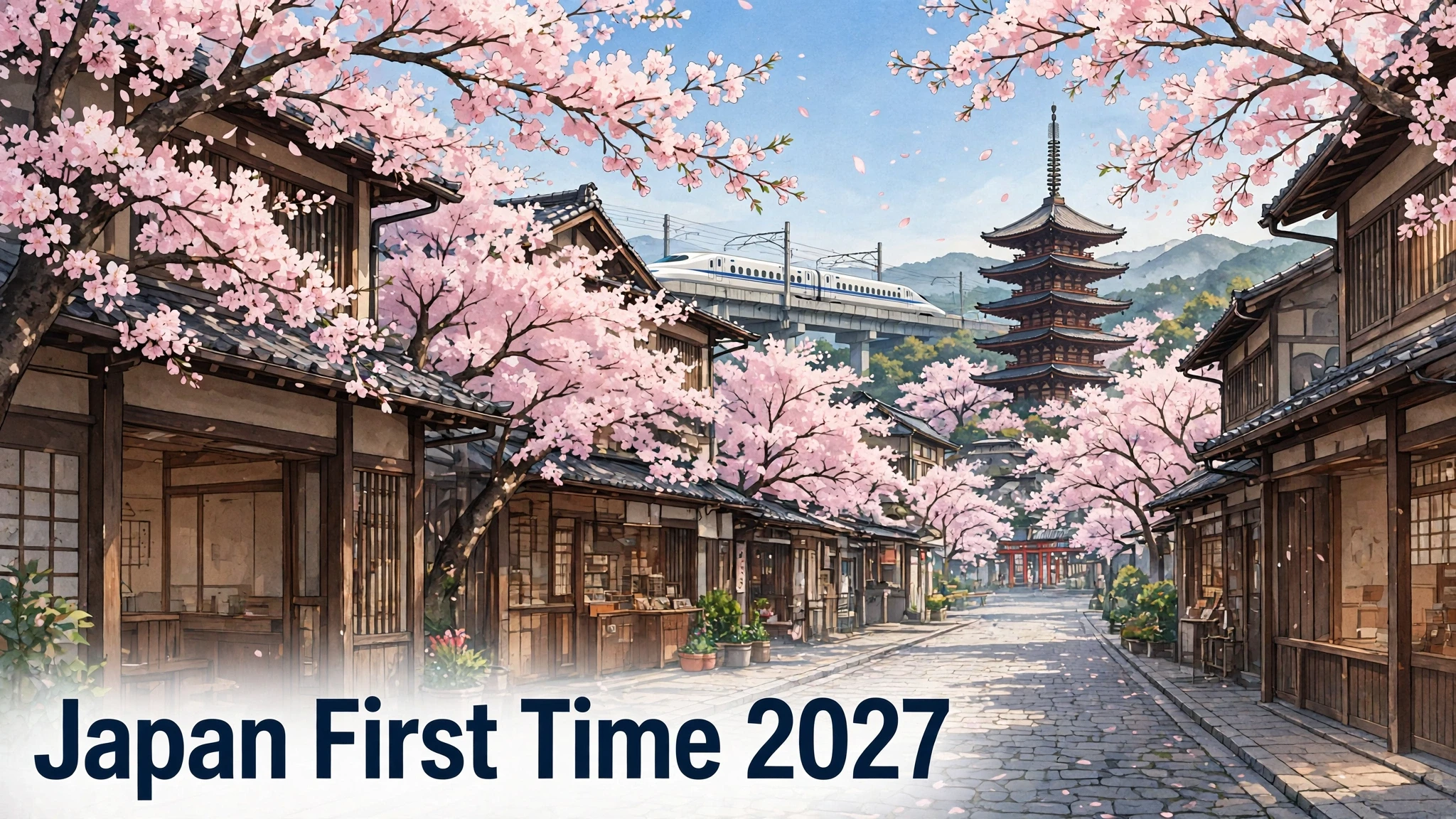
Japan has four distinct seasons, and each offers a different first-trip experience. Spring, especially cherry blossom season, is the most famous time to visit, with parks, temples, and riversides covered in pink blossom, although exact blossom timing varies by region and year, and popular spots become very crowded. Autumn is another excellent season, with colourful maple leaves, clear air, and comfortable walking weather, especially in Kyoto and Nikko. Summer is hot, humid, and busy, with festivals and fireworks, but also rain and typhoon risk in some regions. Winter offers snow in Hokkaido and the Japan Alps, illuminations in cities, and quieter temples, but some rural transport and attractions operate on reduced schedules.
For a first trip, seven to ten days is a practical minimum for Tokyo and Kyoto, while fourteen days allows a more relaxed pace with day trips and a third city such as Osaka or Hiroshima. Shorter trips of five days can still work if they focus on one city, such as Tokyo alone, rather than trying to cross the country. Travellers should also consider Japanese public holidays, especially Golden Week in late April and early May, Obon in mid-August, and New Year, when domestic travel peaks, trains fill, and accommodation prices rise. Avoiding these periods, where possible, makes a first trip calmer and often cheaper.
Seasonal planning also affects packing and daily comfort. Spring and autumn need layers and a light jacket, summer needs light clothes, sun protection, and frequent water, and winter needs warm layers, especially for northern regions. Comfortable walking shoes are essential in every season, because Japanese cities reward walking, and temple and shrine visits often involve steps and gravel paths. Choosing a season that fits your tolerance for heat, cold, and crowds is more important than choosing the season with the most famous photographs, because a comfortable traveller enjoys Japan far more than a traveller who is exhausted by weather or queues.
Planning a First Itinerary: Tokyo, Kyoto and Beyond
A simple first itinerary might spend three or four days in Tokyo, three or four days in Kyoto, and a day or two in Osaka or on day trips, with travel by bullet train between cities. Tokyo offers modern Japan at its most vivid: neighbourhoods such as Shibuya, Shinjuku, Asakusa, and Akihabara each have a different character, from historic temples and markets to shopping, nightlife, and pop culture. Kyoto offers historic Japan: temples, shrines, gardens, traditional streets, and a slower pace, although its most famous sites are busy and best visited early in the morning. Osaka, between them in spirit if not in geography, is known for food, street life, and a more relaxed, humorous atmosphere.
Day trips add depth without the stress of moving hotels every night. From Tokyo, Nikko offers shrines and nature, Kamakura offers temples and a coastal walk, and Hakone offers hot springs, lake views, and, on clear days, views of Mount Fuji. From Kyoto, Nara offers deer in a large park and a giant Buddha hall, Uji offers tea culture, and Himeji offers one of Japan’s most beautiful castles. From Osaka, Hiroshima and the island of Miyajima offer history, scenery, and a moving peace memorial, although travellers should allow a full day and approach the memorial with respect. Choosing one or two day trips, rather than one every day, keeps a first trip enjoyable rather than exhausting.
For travellers who want to go beyond the Golden Route, options include Kanazawa, with its gardens, samurai district, and seafood markets, Takayama, with its old town and mountain setting, and the Japanese Alps for walking and hot springs. Hokkaido offers wide landscapes, seafood, and winter snow, while Kyushu offers hot springs, volcanoes, and historic cities such as Nagasaki. These regions need more time and more transport planning, so they suit a second trip or a longer first trip. The best first itinerary is not the longest list of places. It is a route with enough time in each place to eat, walk, rest, and return to a favourite street a second time.
Rail Travel, Passes and Getting Around
Japan’s rail system is famous for punctuality, cleanliness, and coverage, and it is the backbone of most first trips. The Shinkansen, or bullet train, connects major cities quickly and comfortably, while local trains, subways, and buses cover cities and regions. For first-time visitors, the most important skill is reading station signs and platform information, which usually include English, and using a reliable map app with offline data. Stations can be large and busy, especially Tokyo, Shinjuku, and Osaka, so allowing extra time for transfers, following colour-coded signs, and asking station staff for help are all sensible habits.
Rail passes need careful comparison, because pass prices and coverage have changed in recent years, and a pass is not automatically good value for every trip. A national pass may save money for a long, multi-city journey with several bullet train rides, but it may cost more than individual tickets for a short Tokyo-Kyoto trip. Regional passes, such as those for Kansai or Hokuriku, can be better value for travellers staying in one region. Before buying any pass, calculate the cost of your planned journeys using official fare information, check which trains are included or excluded, and check whether seat reservations are needed or recommended. Always verify current pass rules on official railway sources before purchase, because rules and prices change.
Within cities, rechargeable IC cards, such as Suica or Icoca depending on region, make travel much easier. These cards can be tapped on trains, subways, and many buses, and can also be used in convenience stores and vending machines. They reduce the need to buy individual tickets and to handle cash at every station. For buses, especially in Kyoto, it helps to know whether to pay on boarding or on exiting, and to have small change or an IC card ready. Taxis are clean and reliable but can be expensive, especially for long distances, and ride-hailing availability varies by city. Walking remains the best way to enjoy neighbourhoods, and many Japanese cities are designed for pedestrians, with clear pavements, crossings, and signage.
Money, Connectivity and Luggage
Japan is increasingly card-friendly, especially in cities, hotels, and large shops, but cash is still important, particularly in rural areas, small restaurants, temples, markets, and for some transport. Carrying Japanese yen in cash, with a mix of notes and coins, avoids awkward moments at small businesses that do not accept cards. ATMs in convenience stores and post offices are usually reliable for international cards, while some bank ATMs may not accept foreign cards, so knowing where to find a compatible ATM before you need cash is useful. Tipping is generally not customary in Japan, and in many places it may be politely refused, so travellers should not feel obliged to tip for normal service.
Connectivity is essential for maps, translation, and transport, and most first-time visitors choose either a portable Wi-Fi device or a local SIM or eSIM, depending on their phone and needs. Free Wi-Fi is available in many hotels, stations, and cafés, but it is not reliable enough to depend on for navigation all day. A translation app with a camera function can help with menus, signs, and product labels, and downloading Japanese language data offline before departure is a wise step. It also helps to save hotel addresses in Japanese characters, because taxi drivers and local people may find a Japanese address easier to use than a Roman-letter version.
Luggage handling in Japan is remarkably convenient. Many hotels offer luggage forwarding services, which can send bags to your next hotel, freeing you to travel light on trains. Coin lockers and luggage storage at stations are widely available, although large lockers can fill up in busy stations. For bullet trains, large suitcases may need special handling or reservations depending on current rules, so checking luggage rules before travel is important. Packing light, using a bag that is easy to carry up station steps, and forwarding luggage between cities can transform a first trip from a struggle with suitcases into a comfortable journey.
Food, Etiquette and Daily Life
Japanese food is one of the greatest pleasures of a first trip, and it is also one of the easiest to enjoy, because quality is high at every price level. A first-time visitor can eat ramen in a small shop, sushi at a counter, curry in a casual restaurant, and a department-store food hall picnic, all in a few days, and each meal teaches something about Japanese cooking. Ordering is often straightforward: many restaurants have picture menus, ticket machines, or plastic food displays outside, and pointing politely, combined with a few basic phrases, usually works well. In smaller restaurants, it helps to know whether to order at a counter, wait to be seated, or buy a ticket first, and watching what local customers do is often the best guide.
Etiquette in Japan is based on consideration for others, and a few simple habits go a long way. Speak quietly on trains, avoid talking on the phone in train carriages, queue in an orderly way, and do not eat while walking in crowded areas where that is discouraged. At temples and shrines, follow signs about photography, washing hands at purification fountains, and bowing or clapping where customary, without worrying about perfect form. Removing shoes where required, such as in some traditional inns, temples, and homes, is important, so wearing shoes that are easy to remove is practical. Bathing in hot springs, or onsen, has its own etiquette, including washing before entering, and travellers should read onsen rules before visiting, especially regarding tattoos, which some facilities restrict.
Daily life details also matter. Convenience stores in Japan are excellent for breakfast, snacks, drinks, and basic supplies, and they are open long hours. Vending machines are everywhere and offer drinks, including hot drinks in winter. Queuing, recycling, and carrying rubbish until a bin is found are normal parts of Japanese public life, because street bins are less common than in many countries. These habits may feel unfamiliar at first, but they quickly become natural, and they are part of what makes Japan feel orderly and calm. A first-time visitor does not need to master every custom. Showing respect, observing others, and asking politely when unsure is enough, and Japanese people are generally patient with visitors who try.
Common First-Time Worries and How to Handle Them
Language is the most common worry for first-time visitors, but it is rarely a serious barrier in major tourist areas. Station signs, menus, and many attractions include English, and translation apps handle the rest. Learning a few phrases, such as greetings, thanks, and basic questions, makes interactions warmer and shows respect, even if pronunciation is imperfect. If communication fails, writing down a place name, showing a map, or using a translation app usually solves the problem. It also helps to carry your hotel’s name and address in Japanese, and to save key phrases offline, so you are not dependent on mobile data in a confusing moment.
Getting lost is another normal part of a first trip, especially in large stations and dense neighbourhoods. The best response is to stop, find a clear landmark, check an offline map, and ask staff in a station, shop, or hotel for help. Japanese station staff and police boxes, known as koban, are used to helping lost visitors, and asking for help is not a sign of failure. It is also wise to allow extra time for transfers, to photograph your hotel’s nearest station exit, and to note the name of your hotel in both English and Japanese. A lost hour in Japan often becomes a discovery, such as a quiet temple, a local market, or a neighbourhood café that was not in the plan.
Health and safety worries should be handled with preparation rather than anxiety. Japan is generally considered safe for travellers, but normal precautions still apply: keep valuables secure in crowds, follow local guidance during earthquakes or typhoons, and know the local emergency numbers. Travel insurance with medical cover is important, and travellers should carry regular medicines with prescriptions where required. For natural disasters, follow official alerts, hotel staff guidance, and local authority instructions, rather than social media rumours. With a charged phone, offline maps, insurance, and a calm plan for delays, most first-time worries become manageable, and the trip can focus on enjoyment rather than fear.
My Take:
My take on a first trip to Japan is that it should be slower than most itineraries suggest, because Japan rewards attention more than speed. It is tempting to list ten cities, twenty temples, and thirty restaurants, and to measure a trip by how much was covered. I think a better measure is how much was actually noticed: the sound of a temple bell, the taste of a bowl of noodles eaten at a counter, the quiet of a garden early in the morning, or the kindness of a station worker who walked you to the right platform. Those moments require time, and time requires saying no to some places. A first trip that leaves you wanting to return is more successful than a first trip that leaves you exhausted and determined never to travel that fast again.
I also believe that first-time visitors should not worry about doing Japan correctly. There is no single correct way to bow, order, or visit a temple, and Japanese people generally understand that visitors are learning. What matters is attitude: being quiet where quiet is expected, queuing patiently, removing shoes where required, and showing gratitude. Perfection is not expected, and anxiety about etiquette can spoil enjoyment if it becomes the main focus. Learn the basics, observe others, ask when unsure, and then relax. Japan is welcoming to visitors who try, and trying, even imperfectly, is far better than avoiding interaction out of fear of a mistake.
Another belief I hold is that food and neighbourhoods matter more than famous sights alone. A famous temple is worth visiting, but so is a morning market, a local bakery, a small park, and a residential street where daily life happens. I would rather spend an extra hour in one neighbourhood, eating, walking, and watching, than rush to another famous site for a photograph. Neighbourhoods are where Japan feels alive, and they are also where first-time visitors learn the most: how people shop, commute, eat, and rest. If your itinerary is only famous sights, you will see Japan. If it includes neighbourhoods, you will begin to understand it.
Finally, I think a first trip to Japan should end with a plan to return, not with a sense of completion. Japan is too large, too varied, and too interesting to finish in one trip, and that is good news, not bad news. A first trip can be the Golden Route, a second trip can be the Alps or Kyushu, a third can be Hokkaido or rural Shikoku, and each trip will feel different. Travel is not a checklist to complete. It is a relationship to build, and Japan is a country that rewards returning visitors with deeper knowledge, new regions, and familiar pleasures. Go slowly, eat well, walk a lot, and leave something for next time. That, in my view, is the best way to travel Japan for the first time.
Another aspect of Japan that first-time visitors often underestimate is the pleasure of small, everyday places: a neighbourhood bakery, a tiny park, a station bookshop, or a vending machine that sells hot coffee on a cold morning. These places do not appear in famous lists, but they are where Japanese daily life happens, and they are often the most relaxing parts of a trip. I think a first-time traveller should deliberately schedule unscheduled time: an hour to wander a residential street, a morning to sit in a park, or an evening to explore the shops near a hotel without a destination in mind. That time feels unproductive, but it is where understanding grows, because you see how people actually live, not only how famous sights are presented to visitors.
Shopping in Japan also deserves a calmer approach. Department stores, markets, and specialist shops offer extraordinary quality, from stationery and ceramics to food, clothing, and crafts, but the range can be overwhelming, and prices vary widely. I believe the best shopping strategy for a first trip is to buy fewer, better things: one well-made item that you will use at home, a food gift that can be shared, or a craft that reminds you of a specific place, rather than many souvenirs bought in a rush. Tax-free shopping rules, luggage limits, and customs rules at home should be checked before buying, and receipts should be kept. A thoughtful purchase, chosen slowly, often becomes a lasting memory, while a hurried purchase often becomes clutter.
Finally, I want to emphasise that a first trip to Japan does not need to be perfect to be wonderful, and that small mistakes are part of learning. You may board the wrong train, order the wrong dish, bow at the wrong moment, or miss a famous view because of rain. Those moments are not failures. They are the stories you will tell later, often with more affection than the perfect moments, because they show you adapting, laughing, and trying again. Japan is a forgiving country for visitors who try with respect, and its systems, from station staff to hotel workers, are designed to help people who are lost or confused. Go with curiosity, accept help, laugh at your own mistakes, and let the trip teach you. That attitude will serve you far better than a flawless itinerary, and it will make you want to return.
One more practical thought for first-time visitors is to learn how to use Japan’s convenience stores well, because they are far more than snack shops. A convenience store can provide a simple breakfast, a hot drink, a train ticket top-up, an ATM, a parcel service, and a clean toilet, often at any hour, and knowing how to use them calmly can solve many small travel problems. I think first-time travellers should visit a convenience store on their first day, explore its food, drinks, and services without rushing, and learn how to pay, how to heat food, and how to dispose of rubbish properly. That small, ordinary experience builds confidence for larger experiences, because it teaches you that Japanese daily life, while different in details, is designed to be convenient, clear, and helpful. Once you can handle a convenience store comfortably, a station, a restaurant, and a temple feel much less intimidating, and the whole trip becomes easier.
Frequently Asked Questions
How many days do I need for a first trip to Japan? Seven to ten days works well for Tokyo and Kyoto, while fourteen days allows a relaxed pace with day trips and a third city such as Osaka or Hiroshima.
Is Japan easy for first-time travellers who do not speak Japanese? Yes, major stations, signs and attractions often include English, and translation apps, offline maps and a few basic phrases handle most everyday situations.
Do I need a Japan Rail Pass for a first trip? Not automatically, because pass value depends on your route and number of long train journeys, so compare total individual ticket costs with current pass prices before buying.
Is Japan expensive for first-time visitors? Costs vary widely: transport and accommodation in major cities can be high, but food, convenience stores and many attractions offer good value, and careful planning keeps a trip affordable.
What is the best season for a first trip to Japan? Spring for cherry blossom and autumn for colourful leaves are popular, while summer is hot and busy and winter suits snow regions, so choose based on weather, crowds and interests.
Do I need cash in Japan? Yes, carry some yen cash for small restaurants, markets, temples and rural areas, even though cards are widely accepted in cities, hotels and large shops.