Is Amazon Forest Bigger Than Pakistan? Size Compared
In this post
- The short answer in plain numbers
- Why you will see three different Amazon sizes
- Nine countries, one forest, no single owner
- How long would it take to cross each one
- What the Amazon holds that Pakistan does not, and the reverse
- Why people ask this question in the first place
- Is the Amazon shrinking, and does that change the answer
- My Take: A Bar Chart Is A Good Start And A Bad Finish
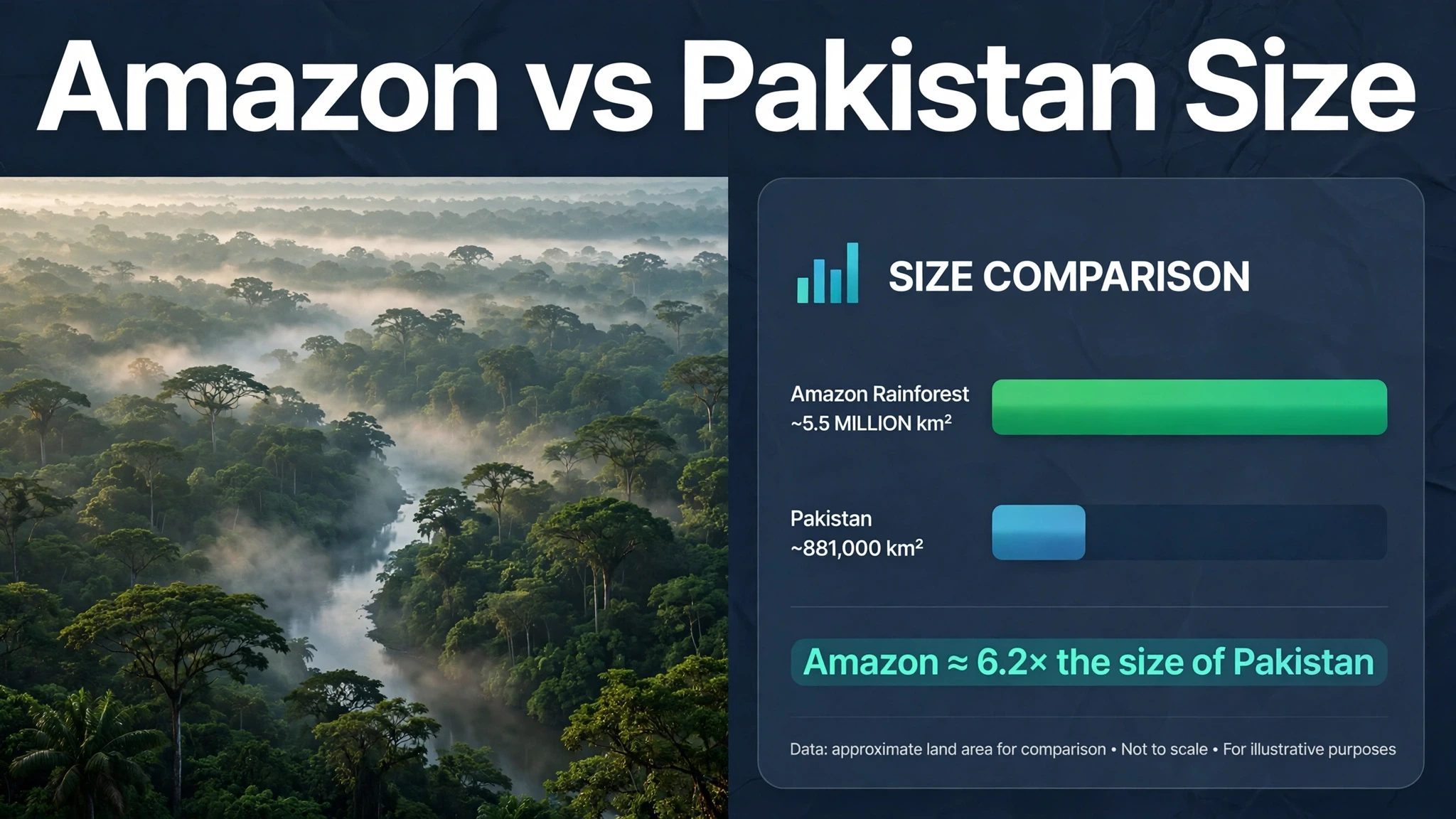
Yes. The Amazon rainforest is much bigger than Pakistan. It is not a close contest, and it is not a trick of the map. On the most widely used forest figure, the Amazon covers about 5,500,000 square kilometres, while Pakistan covers about 796,096 square kilometres. Divide the first number by the second and you get about 6.9. In plain words, you could fit almost seven Pakistans inside the Amazon rainforest and still have room left over. That single sentence answers the search, but it also hides a fair amount of confusion, because people use the word Amazon to mean three different things, and they compare a forest with a country as if the two were the same kind of place. They are not, and the difference matters for understanding why the Amazon feels so enormous, why it crosses so many borders, and why losing even a small-looking slice of it each year is still a very large loss in real land.
Pakistan is a country with cities, farms, deserts, mountains, rivers, and a long coastline. The Amazon is not a country at all. It is a living region spread across South America, shaped by one giant river system and by rain that falls in huge amounts year after year. When you place the two side by side, you are really comparing the total land of one nation with the tree-covered part of a whole continent-sized basin. That is why the result looks so dramatic. Pakistan is itself a large country, ranked among the larger countries in the world, yet the Amazon dwarfs it in the same way a whole region dwarfs a single nation inside a different region. The comparison works as a scale check. It fails if you treat it as a contest between equals.
The short answer in plain numbers
Start with the two headline figures and keep them separate from everything else. Pakistan’s total area, as listed by Britannica, is 796,096 square kilometres, or 307,374 square miles. Other common references give 796,095 square kilometres, a difference of one square kilometre that comes from rounding and from how disputed territory is counted. For a comparison on this scale, that one square kilometre changes nothing. The Amazon rainforest figure most often quoted in reference summaries is 5,500,000 square kilometres, or about 2,100,000 square miles. Put those together and the Amazon is roughly 6.9 times the size of Pakistan. If you round, call it seven times. If you want the leftover in numbers, the difference is about 4,703,904 square kilometres. That leftover alone is nearly six times the size of Pakistan.
It helps to see the same idea in smaller pieces. One Pakistan is 796,096 square kilometres. Two Pakistans would be about 1,592,192 square kilometres. Three would be about 2,388,288. Four would be about 3,184,384. Five would be about 3,980,480. Six would be about 4,776,576. Seven would be about 5,572,672, which is slightly above the 5,500,000 figure for the forest. So the forest holds six full Pakistans with ease, and a seventh Pakistan would almost fit, missing only a narrow strip. That is the cleanest way to picture it without a map: six whole countries of Pakistan’s size, plus most of a seventh, all covered in dense tropical forest, rivers, and flooded plains.
There is also a measurement detail worth knowing. Pakistan’s total area includes water as well as land, while the Amazon figure is a forest and ecosystem area, not a neat political total. So even the basic comparison mixes two slightly different kinds of measurement. It still gives the right broad answer, because the gap is so large that no reasonable adjustment closes it. The answer does not flip, wobble, or depend on a clever choice of numbers.
Why you will see three different Amazon sizes
If you search for the Amazon’s size, you will find at least three numbers, and this is where many readers get confused. The first is about 5,500,000 square kilometres, the forest area given in the summary for the Amazon rainforest. The second is about 6,000,000 square kilometres, the area covered by rainforest within the wider basin in some descriptions. The third is about 7,000,000 square kilometres, the size of the whole Amazon basin, which includes rivers, flooded areas, savanna edges, towns, farms, and cleared land as well as forest. All three can be correct at the same time, because they measure different things. The basin is the drainage area, the land whose rivers flow into the Amazon River. The forest is the tree-covered part inside that basin and around it. The smaller summary figure reflects one particular delineation of the forest ecoregions.
Use the basin figure and the comparison grows. Seven million square kilometres divided by 796,096 is about 8.8, so the basin is nearly nine times Pakistan. Use the six-million forest figure and the ratio is about 7.5. Use the 5,500,000 figure and it is about 6.9. None of these answers makes the Amazon smaller than Pakistan. They only change how many Pakistans you count: seven, seven and a half, or nearly nine. When a post gives only one number without saying whether it means forest, basin, or biome, it invites argument for no good reason. A careful reader should always ask which Amazon the writer means. For this post, the headline answer uses the 5,500,000 square kilometre forest figure, and the basin figure is shown separately so the range is honest.
The same caution applies to Pakistan’s figure. Some sources give 796,095 and some give 796,096 square kilometres, and some give a larger total when disputed areas are counted differently. That variation is tiny next to a gap of millions of square kilometres. It would matter if the two areas were close. They are not close. The Amazon wins the size comparison under every standard definition, and it wins by millions of square kilometres, not by a margin that rounding could erase.
Nine countries, one forest, no single owner
Another reason the comparison surprises people is that the Amazon is not owned by one country. It spans nine nations and territories in South America: Bolivia, Brazil, Colombia, Ecuador, French Guiana, Guyana, Peru, Suriname, and Venezuela. French Guiana is an overseas department of France, which is why counts sometimes say eight countries plus one territory, or nine nations in total. Brazil holds the largest share, about 58.4 percent of the basin in one detailed breakdown, with other summaries rounding that to about 60 percent. Peru holds about 12.8 percent, Bolivia about 7.7 percent, Colombia about 7.1 percent, Venezuela about 6.1 percent, Guyana about 3.1 percent, Suriname about 2.5 percent, French Guiana about 1.4 percent, and Ecuador about 1 percent. The exact shares move a little with the definition used, but the order does not change. Brazil alone holds more Amazon than the whole of Pakistan several times over, since 58 percent of 5,500,000 square kilometres is about 3,190,000 square kilometres, roughly four Pakistans on its own.
That spread matters because no single government can protect or damage the whole forest by itself. A policy in Brazil affects the largest part, but decisions in Peru, Colombia, Bolivia, and the other Amazon countries affect millions of square kilometres too. Rivers do not stop at borders, smoke does not stop at borders, and animals do not carry passports. A forest this large is really a shared system, and that is part of why international talks about it are so difficult. Pakistan, by contrast, is governed as one country, with one set of national laws, even though its provinces are large and varied. Comparing a nine-country ecosystem with a one-country total is useful for scale, but it should not be read as a comparison of governments, economies, or peoples.
The human side of that spread is just as large. More than 30 million people live in the Amazon region, from about 350 different ethnic groups, and the region includes thousands of formally acknowledged indigenous territories. Some communities live in cities such as Manaus, which has about 2.2 million people and is the largest city in the Amazon basin. Others live in small river settlements, and a small number of groups remain largely isolated from the outside world. Pakistan’s population is far larger than the Amazon region’s population, even though its land is far smaller, which is a useful reminder that land area and population have almost nothing to do with each other. A place can be enormous and thinly settled, or compact and crowded, and both facts can be true at once.
How long would it take to cross each one
Numbers on a page can feel abstract, so try a travel test. Pakistan stretches more than 1,800 kilometres from its southern coast toward the Khunjerab Pass on the border with China, and its north-to-south length is often described as more than 2,000 kilometres along the Indus. That is already a long journey by road. The Amazon, however, is wider in a different way. The Amazon River itself runs for thousands of kilometres across the continent, and the forest stretches across a whole northern belt of South America. Crossing the forest is not a single road trip. Much of it has no road at all. Travel means rivers, small planes, and long boat journeys, and large parts are reached only with great difficulty. The forest is not just large in area. It is large in the sense of being hard to cross, hard to patrol, and hard to know completely.
Think of area in terms of walking, farming, or flying over it. A square kilometre is a square one kilometre on each side, about 100 hectares, or about 247 acres. Pakistan has about 796,096 of those squares. The Amazon forest has about 5,500,000 of them. If you flew over Pakistan at a steady speed, you would cross it in hours. If you flew over the Amazon at the same speed, you would spend far longer over continuous green, and you would still not have seen the whole basin, because the basin is larger than the forest itself. Pilots, researchers, and satellite teams all face the same problem: the region is so large that even modern satellites must stitch together many passes to build one clear picture, and clouds often hide the ground below.
That scale also explains why deforestation figures that sound small are not small at all. A loss of one square kilometre is a real farm-sized piece of land. A loss of thousands of square kilometres in a year is a district-sized piece of land, repeated many times. When Brazil’s monitoring system reported 5,796 square kilometres of deforestation in the Legal Amazon for August 2024 to July 2025, that was described as the lowest rate in 11 years and a fall of about 11 percent from the previous period. It is still an area far larger than many cities, and it happened in a single year in one part of the Amazon. Size cuts both ways: the forest is big enough to absorb a lot of attention, and also big enough that damage can hide inside it for a long time before anyone notices from the ground.
What the Amazon holds that Pakistan does not, and the reverse
Size alone does not tell you what a place is like. The Amazon holds an extraordinary share of the world’s life. About one in ten known species in the world lives in the Amazon rainforest, and the region holds an estimated 390 billion individual trees in about 16,000 species. Tens of thousands of plant species, more than 2,000 birds and mammals, thousands of fish species, and millions of insect species have been recorded there, and many more remain undescribed. A single small patch of Ecuadorian rainforest, a quarter of a square kilometre, has been found to hold more than 1,100 tree species. That density of life is not something you can get from area alone. It comes from millions of years of warm, wet, stable conditions, plus rivers that create many different habitats side by side.
Pakistan holds a different kind of variety. About three-fifths of its land is rough mountainous terrain and plateaus, and the rest is largely level plain. It runs from the high Karakoram and Himalayan ranges in the north, through the Hindu Kush and western mountains and the Balochistan plateau, down to the Indus plain and the Arabian Sea coast in the south. It has deserts, fertile farmland, snow peaks including K2, and ancient sites such as Mohenjo-daro along the Indus. The Amazon has no equivalent of that mountain-to-desert range inside one country, because it is a lowland tropical system dominated by rain, rivers, and forest. The two places are not versions of each other at different sizes. They are different worlds that happen to be measurable in the same unit.
This is why a simple bar chart can mislead even when its numbers are right. A bar for the Amazon will tower over a bar for Pakistan, and that is accurate. But the bars hide the fact that one bar is mostly continuous forest and water, while the other bar contains cities, farms, deserts, mountains, and coastline. If someone only looks at the bars, they may imagine Pakistan as a small forest that lost a contest. It is not a forest at all. It is a country with only a small share of its land under forest. Pakistan’s own forest cover is only about 5 percent of its land area in commonly cited figures, which is a separate question from its total size. The Amazon is a forest region. Pakistan is a country that contains some forest. Keeping those two ideas apart prevents the most common misunderstanding in this whole comparison.
Why people ask this question in the first place
People usually ask whether the Amazon is bigger than Pakistan for one of three reasons. The first is simple curiosity: Pakistan feels large to anyone who lives there or studies it, so it is natural to test it against the most famous forest in the world. The second is a classroom or quiz habit: size comparisons are an easy way to make geography feel real, and Pakistan is a familiar reference point for millions of readers. The third is a map problem. On many common flat maps, areas near the equator look smaller than they really are, and areas far from the equator look larger. South America sits across the equator, and Pakistan sits further north, so a quick glance at a wall map can make the comparison look closer than it is. A careful area figure corrects the eye.
There is also a news reason. When deforestation is reported in square kilometres, readers need a reference they can feel. Saying that 5,796 square kilometres were lost in a year means little on its own. Saying that it is an area many times larger than a familiar city, or a small fraction of Pakistan, gives the number weight. In this case, 5,796 square kilometres is about 0.7 percent of Pakistan’s total area, and about 0.1 percent of the 5,500,000 square kilometre forest figure. Both statements are true, and they show different things. The first shows that a year’s loss in one part of the Amazon is still a substantial piece of land. The second shows that the forest is so large that even a large annual loss is a small share of the whole, which is why the damage accumulates over decades rather than destroying the forest in a single year.
Finally, people ask because the Amazon is often described in superlatives: largest tropical rainforest, largest river by discharge, most biodiverse tract of tropical rainforest. Superlatives invite a test. Pakistan is a good test because it is large enough that beating it means something, and familiar enough that the answer sticks. The Amazon passes that test easily, and it would also pass against many larger countries. It is larger than India by some forest measures, and it is larger than most countries on Earth taken one by one. Only a handful of the very largest countries, such as Russia, Canada, China, the United States, and Brazil itself, are larger than the Amazon forest figure. That puts the result in its proper place: the Amazon is not just bigger than Pakistan. It is bigger than almost every country.
Is the Amazon shrinking, and does that change the answer
The honest answer is that the Amazon forest area is not fixed. It changes every year as forest is cleared, regrows, burns, or is degraded by logging and fire. The 5,500,000 square kilometre figure is a reference size, not a live count that updates daily. Brazil’s PRODES system, run by the National Institute for Space Research, measures deforestation in the Legal Amazon each year from August to July. For August 2024 to July 2025, it reported 5,796 square kilometres, down about 11 percent from the previous period and the lowest rate in 11 years. That fall was widely reported just before the climate conference in Brazil, and it followed four consecutive years of decline in the official Amazon rate. Even so, the cumulative loss since systematic monitoring began is very large, built up over decades of clearing.
That cumulative figure deserves a pause. If about 830,000 square kilometres have been cleared in the Brazilian Amazon since monitoring began, that cleared area alone is slightly larger than the whole of Pakistan. It does not mean the forest has shrunk below Pakistan’s size. It means the original forest was even larger, and the remaining forest is still many times Pakistan’s size. It also means the comparison will stay true for a long time even if clearing continues at recent rates, because closing a gap of about 4,700,000 square kilometres at about 6,000 square kilometres a year would take centuries, and that simple division ignores regrowth, protection, and changes in policy. The danger is not that the Amazon will suddenly become smaller than Pakistan. The danger is that it will lose the connected, intact, old-growth character that makes it ecologically special, even while it remains enormous on a map.
Degradation is the quieter part of that story. Beyond outright clearing, selective logging, fire damage, and edge effects degrade additional forest without removing every tree. One widely cited assessment put outright loss at about 17 percent of the original forest cover, with another roughly 17 percent degraded. Those shares are estimates, and they depend on definitions, but they point to the same conclusion: a large forest can be damaged in ways that area alone does not show. A degraded forest still counts as forest on a simple area chart, but it may hold fewer species, store less carbon, and recover more slowly. So the size comparison answers the question asked, but it should not be used as proof that the forest is safe. Bigness is not safety.
My Take: A Bar Chart Is A Good Start And A Bad Finish
I think the Amazon-versus-Pakistan comparison is useful for exactly one minute, and misleading for every minute after that if you stop there. In that first minute, it does something no paragraph of adjectives can do. It turns an abstract giant into a shape a reader can hold in their head. Six Pakistans, plus most of a seventh, all forest. That image lands. It corrects the flat-map eye, it humbles anyone who thought Pakistan was close to the largest thing on Earth, and it gives a reader a ruler they already understand. I would keep that image in every geography lesson, every news report, and every classroom quiz, because without a ruler, numbers like 5,500,000 square kilometres are just noise. People do not feel millions. They feel countries they know, cities they have visited, and journeys they have made. Pakistan is a good ruler because it is large, real, and familiar to a huge audience, and the Amazon beats it so clearly that there is no argument left about the headline.
But I also think stopping at the bar chart is where most writing about the Amazon goes wrong, and I want to be blunt about why. A bar chart treats a forest as if it were a block of land waiting to be measured, and a country as if it were the same kind of block in a different colour. Neither is true. The Amazon is not a block. It is a wet, living network of rivers, flooded forests, dry-season islands, canopy layers, soil fungi, insects, birds, fish, and peoples who have shaped it for thousands of years. Pakistan is not a block either. It is mountains and deserts and plains and cities and farms, held together by a river and a history, not by a single landscape. When you reduce both to bars, you make the Amazon look like a prize and Pakistan look like a loser, and that framing helps nobody. Nobody needs to lose a size contest for the Amazon to matter. Its importance does not come from beating Pakistan. It comes from what it does: holding carbon, making rain, sheltering a tenth of known species, and sustaining peoples whose knowledge of it predates every modern map.
My judgement is that we should use size comparisons as doors, not as destinations. Open with the door, then walk through it into the harder questions. Who lives in the forest, and what do they want for it? Who profits when it is cleared, and who pays when the rain changes? What does a year’s loss of 5,796 square kilometres actually look like on the ground: a road, a farm, a fire, a town, a river choked with silt? What does degradation mean for a family that fishes the same creek their grandparents fished? Those questions do not fit in a bar, and that is precisely why they matter more than the bar. A reader who only learns that the Amazon is seven times Pakistan will remember a fact for a quiz. A reader who learns why that size makes protection a nine-country problem, why Brazil alone holds about four Pakistans of forest, and why a degraded forest still counts as green on a satellite image will remember a problem worth caring about.
I also have a strong view on how we talk about loss. Saying that deforestation fell to its lowest rate in 11 years is true, and it is good news, but it should never be reported as if the forest were recovering. Losing 5,796 square kilometres more slowly is still losing. It is like saying a leak slowed down while the tank is still draining. The honest headline is two-sided: enforcement and policy can bend the curve, and the curve is still pointing the wrong way over the long term. Decades of cumulative clearing, plus a similar share degraded, is not a footnote. It is the central fact of the modern Amazon, and it should sit next to every size comparison, not hidden in a later paragraph. If we celebrate a slower loss without naming the total already lost, we train readers to feel relieved by a smaller disaster, and that is a dangerous kind of comfort.
There is a related judgement I want to make about Pakistan’s place in this story. Pakistan is not a bystander in the climate story, and it should not be used only as a ruler. It is a country that faces floods, heat, water stress, and deforestation of its own, with only a small share of its land under forest. Using it as a measuring stick is fine, but using it only as a measuring stick wastes an opportunity. The better comparison is not which place is bigger. It is what each place teaches about living with a large, difficult landscape. Pakistan teaches about managing a long river from mountains to sea, about farming in dry and flooded years, and about protecting a small forest estate under great pressure. The Amazon teaches about managing a forest so large that no one government can see all of it, about indigenous stewardship, and about rainfall that crosses borders. Both lessons are needed, and neither replaces the other.
If I had to choose one sentence to leave with a reader, it would not be the seven-times sentence, even though that sentence is correct. It would be this: the Amazon is large enough that its fate cannot be decided by one country, one year, or one number, and small enough in ecological terms that every year’s clearing brings it closer to a different kind of forest, even if it remains huge on paper. That tension, huge yet fragile, is the real story. Size tells you where to look. It does not tell you what you will find when you get there, and it certainly does not tell you whether what you find will still be there for the next generation. A bar chart can start the conversation. Only the people, the rivers, and the long, slow work of protection can finish it, and that work deserves more than a single comparison, however striking it first appears.
Frequently Asked Questions
Is Amazon forest bigger than Pakistan?
Yes. The Amazon rainforest, at about 5,500,000 square kilometres, is about 6.9 times larger than Pakistan, at about 796,096 square kilometres. Using the wider Amazon basin figure of about 7,000,000 square kilometres, the ratio rises to about 8.8 times.
How many Pakistans can fit inside the Amazon rainforest?
About six full Pakistans fit inside the 5,500,000 square kilometre forest figure, plus most of a seventh. Seven full Pakistans would total about 5,572,672 square kilometres, slightly above that forest figure. Using the basin figure, nearly nine Pakistans would fit.
Why do different sources give different Amazon sizes?
Because they measure different things. The basin, about 7,000,000 square kilometres, is the whole drainage area. The forest inside it is smaller, with common figures of about 6,000,000 and 5,500,000 square kilometres depending on the delineation used. Always check whether a source means forest, basin, or biome.
Which countries does the Amazon rainforest span?
Bolivia, Brazil, Colombia, Ecuador, French Guiana, Guyana, Peru, Suriname, and Venezuela. Brazil holds the largest share, about 58.4 percent of the basin in one detailed breakdown, followed by Peru at about 12.8 percent.
Is Pakistan’s area 796,095 or 796,096 square kilometres?
Both figures appear in reputable references, differing by one square kilometre because of rounding and how disputed territory is counted. The difference does not change the comparison, because the Amazon is larger by about 4,700,000 square kilometres.
How much Amazon forest was lost in the most recent year reported?
Brazil’s PRODES system reported 5,796 square kilometres of deforestation in the Legal Amazon for August 2024 to July 2025, down about 11 percent from the previous period and the lowest rate in 11 years. That is still a large area, about 0.7 percent of Pakistan’s total area in a single year.
Is the Amazon bigger than India as well?
On the forest figures used here, yes in broad terms: the Amazon forest at 5,500,000 square kilometres is larger than India’s total area of about 3,287,263 square kilometres, though exact ratios depend on the Amazon definition chosen. The Amazon is larger than almost every single country except the very largest.
Sources
- Wikipedia — Amazon rainforest (fetched 2026-10-31)
- Britannica — Pakistan (fetched 2026-10-31)
- WWF Brazil — Deforestation falls by 11% in Amazon and Cerrado in a year (fetched 2026-10-31)