How Bees Make Their Honey
In this post
- Step One: Collecting Nectar, Flower By Flower
- Pollination: The Flower’s Side Of The Bargain
- Step Two: An Enzyme Begins The Change
- Many Trips To Fill One Cell
- Step Three: Regurgitation Into The Honeycomb
- Step Four: Fanning Wings To Dry The Nectar
- Why Drying Makes Storage Possible
- Step Five: Sealing The Cells With Wax
- The Flower Decides The Kind Of Honey
- Why Honey Matters, And Why Bees Are In Decline
- You may also like
Honey is the only food made by insects that humans eat, and it is also one of the strangest foods in the world: thick, golden, intensely sweet, and made by animals that cannot cook, cannot store food in a pantry, and cannot explain what they are doing. Yet a colony of bees, working together, turns the thin, sugary water of flowers into a thick, concentrated food that can feed them through the months when no flowers bloom, and that humans have prized for thousands of years. How do bees make honey? The answer involves a special pouch, an enzyme, a great deal of fanning, and a wax seal, and it begins, flower by flower, with nectar.
Most bee species do not make honey, but those that do, as you might guess, are specifically called honey bees. There are thousands of species of bees in the world, and only a small number of them produce honey in quantities worth collecting. The rest live different lives: solitary bees, bumblebees, and others that feed themselves and their young without storing large reserves. When this post says “bees,” it means honey bees, the social bees that live in colonies and make honey as a group, because honey-making is a group project, and no single bee could do it alone.
Step One: Collecting Nectar, Flower By Flower
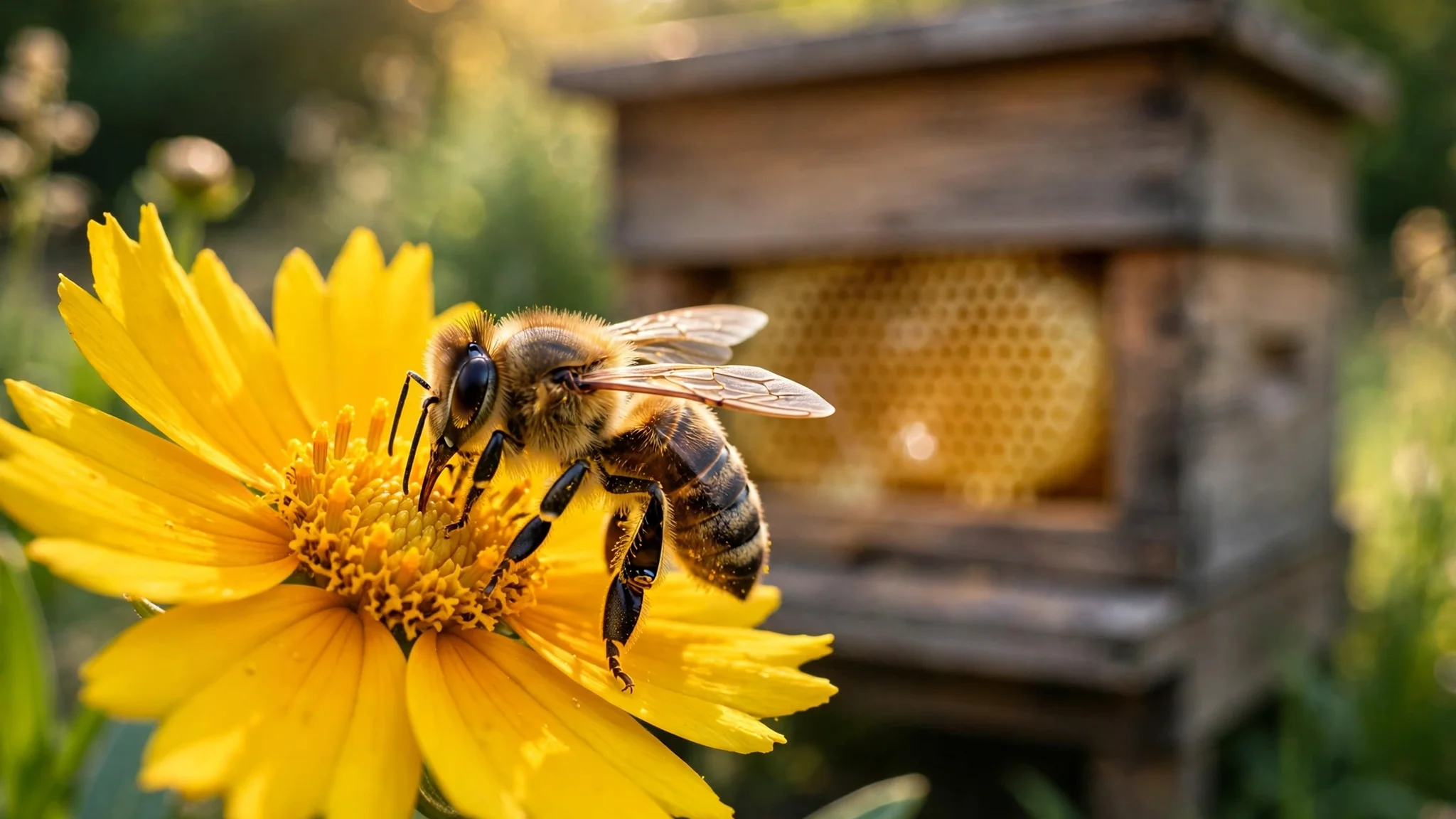
Honey begins as nectar, a sugary water that flowers produce. Plants produce nectar to attract pollinators like bees, and this nectar is the main food source for bees. A forager bee, a worker bee assigned to collecting, flies out from the hive, goes into the centre of flowers, and collects nectar, storing it in a special pouch called a honey pouch. When the pouch is full, it tells the bee that it is time to go back to the hive.
A single forager may visit many flowers on a single trip, and a colony may make thousands of trips a day, in good weather, when flowers are abundant. The scale is hard to grasp: each trip contributes a tiny amount of nectar, and the colony’s honey is the sum of a very large number of tiny contributions, gathered over weeks and months, by many bees working in parallel. No single trip makes honey. The colony’s store is built trip by trip, flower by flower, until cells begin to fill.
Pollination: The Flower’s Side Of The Bargain
While collecting nectar, the bee also serves the flower. Plants produce nectar to attract pollinators, and as bees move from bloom to bloom, they carry pollen with them, helping flowers to produce seeds. Most of the vegetables, fruits, and oil or hay producing crops like canola and alfalfa require insects like bees for seed production. Honey-making and pollination are two sides of the same bargain: the flower offers nectar, the bee offers transport, and both benefit, along with every plant and animal that depends on the flowers’ seeds.
Step Two: An Enzyme Begins The Change
The transformation from nectar to honey begins before the bee even returns to the hive, and it continues in the bee’s mouth. When the nectar is in a bee’s mouth, it is mixed with an enzyme called invertase that helps break down part of the sugar. An enzyme is a substance that speeds up a chemical change without being used up itself, and invertase begins breaking down the sugars in nectar into simpler forms, which are easier to store and use as food.
This chemical change is the first of two transformations that turn nectar into honey. Nectar is a sugary water: thin, dilute, and mostly water. Honey is thick, concentrated, and far richer in sugar. The enzyme starts that change inside the bee, during the flight home, and the change continues after the nectar is delivered to the hive. The bee is not only a carrier. She is also a processor, and the honey pouch and mouth are where the first processing happens, quietly, on every trip, before the nectar ever reaches a cell.
Many Trips To Fill One Cell
It can take a bee many nectar-gathering trips to fill up a single cell. The work is slow, repetitive, and shared: one bee’s trips alone would never fill a comb, but the trips of thousands of bees, over a season, fill cell after cell, until the hive holds a store large enough to matter. Patience is built into the process. Honey is not made in a day. It is made in a season.
Step Three: Regurgitation Into The Honeycomb
When the forager returns to the hive, she regurgitates, or spits back out, the nectar into cells, honeycombs in the hive made especially for honey production. Regurgitation sounds unpleasant, and to human ears it is, but in bee terms it is normal and necessary: the honey pouch is a dedicated storage pouch, and the nectar stored there is carried home as raw material, not eaten as food for the bee herself. Spitting it back out is how the raw material is delivered to the place where it will be finished.
The honeycomb itself is a marvel of construction. It is made of beeswax, produced by the bees themselves, and built into rows of hexagonal cells, each one a small storage pot, open at the top, ready to be filled. The comb hangs in sheets inside the hive, and different areas serve different purposes: some cells hold honey, some hold the colony’s young, and some hold the pollen that feeds them. The honey cells are the pantry, and the forager’s regurgitated nectar is the first delivery to it, thin and watery, not yet honey, waiting for the next step.
It is worth pausing on how strange this is, from a human point of view. We store food in jars, tins, and refrigerators, made by other people, in factories. Bees store food in a structure they build themselves, from a substance their own bodies produce, filled with a liquid they gather flower by flower, and they do it without plans, instructions, or overseers. Each bee follows simple rules, and the result, a full honeycomb, is more than any single bee intended or understood. That is the nature of a colony: simple actions, repeated by many, producing something none of them could produce alone.
Step Four: Fanning Wings To Dry The Nectar
Even after enzyme processing, the nectar is still far too watery to be honey. The water must be removed, and the bees remove it by fanning. Once a cell is full, a group of bees will fan it to help evaporate out the water and make the mixture more concentrated. The bees stand over the open cells and beat their wings vigorously, creating air currents that carry moisture away, while the hive’s ventilation brings drier air in. The work continues until the mixture is concentrated enough to be honey.
Honey is about 75 percent thicker than nectar, so lots of water needs to be removed. That single figure tells the story of the fanning stage: the change from nectar to honey is mostly a change in concentration, achieved by evaporation, powered by wings. Fanning is hard work, and it is done by many bees at once, for hours, with the sound of the hive rising to a constant hum. The bees regulate the hive’s temperature and airflow as they work, keeping conditions right for drying, just as a human factory controls its drying rooms.
Why Drying Makes Storage Possible
The drying matters because concentrated honey keeps far better than watery nectar. A thin, sugary liquid ferments easily, turning sour and useless. A thick, concentrated liquid resists that change, and can be stored for months, through winter, until it is needed. The bees’ fanning is therefore not a finishing touch. It is the step that makes storage possible, and storage is the whole purpose of honey: food for the future, made in summer, kept for winter, when no flowers bloom and no foraging is possible.
Step Five: Sealing The Cells With Wax
When the bees are happy with it and it is concentrated enough, they will cap the cell in which the honey is produced. The wax cap seals the cell, protecting the honey inside from moisture in the air, which would dilute it, and from dust, pests, and other contaminants. The sealed cell is the colony’s pantry: a store of food, preserved and protected, ready to be opened when it is needed.
The cap is made of beeswax, the same material as the comb itself, produced by the bees and moulded into place. Opening a sealed cell is a deliberate act: a bee must chew or break the cap to reach the honey, and once opened, the honey is used, not resealed. The colony opens cells as it needs them, through winter, drawing down its stores gradually, and the beekeeper who harvests honey must leave enough sealed cells for the bees, because taking too much is taking the colony’s winter supply, and a colony robbed of its stores may starve before spring. Responsible beekeeping is a negotiation between human appetite and bee survival, and the bees, who made the honey, must come first.
A full hive may contain many kilograms of sealed honey, enough to feed the colony through a long winter. That store is the reward for a season of work by thousands of bees, and it is also the colony’s insurance: without it, the colony cannot survive the months when flowers are gone. The wax caps, row upon row, are the visible sign that the season’s work is done, and that the colony is prepared for what comes next.
The Flower Decides The Kind Of Honey
The type of flower visited impacts the kind of honey produced. Scientists are finding that in one foraging trip a bee will mostly stay with the same flower, visiting bloom after bloom of the same kind, rather than mixing flowers at random. That faithfulness means the nectar a bee brings home on a single trip is largely from one flower type, and the honey made from it carries that flower’s character: its colour, its flavour, its aroma. A colony foraging in a landscape of many flowers produces a blended honey, reflecting every flower its foragers visited, while a colony foraging where one flower dominates produces a honey that reflects that flower above all others.
Commercial producers of honey will often make sure the bees visit certain plants in order to get a certain type of honey. Beekeepers move hives to follow flowering crops, placing colonies beside fields and orchards in bloom, so that the bees gather nectar mainly from one source, and the honey can be named for it. The bee does not choose the kind of honey. The flower does, and the bee is its faithful recorder, carrying the flower’s nectar home, trip after trip, until the comb holds a record of the landscape the colony foraged in.
This is why honey is, in a real sense, a record of a place and a season. A jar of honey contains the flowers of a particular landscape, at a particular time, processed by a particular colony, and no two jars, from different places or different years, are exactly alike. The flavour in the jar is the flavour of the flowers, concentrated, dried, and sealed, and tasting it is tasting the summer the bees worked through, months after the flowers themselves have gone.
Why Honey Matters, And Why Bees Are In Decline
Honey matters to bees as stored food, to humans as food, and to the wider world as a by-product of the pollination on which much of agriculture depends. Currently honey bees are in decline due to colony collapse disorder and factors like climate change, and scientists are working to understand all the causes. Losing bees affects not only honey production but agriculture and food production, because most of the vegetables, fruits, and oil or hay producing crops like canola and alfalfa require insects like bees for seed production. Without pollinators, many crops would struggle to produce seeds, and the food system would narrow.
The decline is not fully understood, and scientists are working to understand all the causes, which is itself a reason for caution: a problem with many causes needs many solutions, and no single fix will restore bee numbers on its own. What is clear is the scale of what is at stake. Bees are not only honey-makers. They are pollinators, and pollination is the invisible service on which a large share of human food depends. Honey is the visible product. Pollination is the more important of the two, and it is the reason bee decline matters far beyond the honey jar.
What helps bees helps honey, and it helps the crops and wildflowers that depend on them. Planting diverse flowers, leaving wild areas unmown, and supporting beekeepers who leave enough honey for their colonies are practical steps, available to anyone with a garden, a balcony, or a shopping choice. The bees that make honey do not ask for much: flowers, water, shelter, and a landscape in which they can thrive. In return, they offer pollination, honey, and a lesson in cooperation that humans, with all our technology, have never quite matched: thousands of individuals, each following simple rules, producing together something none of them could produce alone.
You may also like
Frequently Asked Questions
How do bees make honey? Honey bees collect nectar, a sugary water that flowers produce to attract pollinators, and store it in a special pouch called a honey pouch. When they return to the hive, they regurgitate the nectar into honeycomb cells, where it is mixed with an enzyme called invertase that helps break down part of the sugar. A group of bees then fans the filled cells to evaporate out the water and make the mixture more concentrated, and when the bees are happy with it, they cap the cell with wax. Honey is about 75 percent thicker than nectar, so lots of water needs to be removed before it is sealed.
Do all bees make honey? No, most bee species do not make honey, but those that do are specifically called honey bees. There are thousands of species of bees, and only a small number produce honey in quantities worth collecting, while solitary bees, bumblebees, and many others feed themselves and their young without storing large reserves. Honey-making is a group project of social honey-bee colonies, in which foragers collect nectar and other bees process, dry, and seal it into honeycomb cells.
Why is honey thicker than nectar? Because a group of bees fans the filled honeycomb cells to help evaporate out the water and make the mixture more concentrated, and honey ends up about 75 percent thicker than nectar. Nectar is a sugary water, thin and dilute, while honey is the same material with lots of the water removed, mixed with the enzyme invertase, and sealed under a wax cap. The drying stage is what makes storage possible: concentrated honey keeps far better than watery nectar, and can feed the colony through the months when no flowers bloom.
Does the flower change the honey? Yes, the type of flower visited impacts the kind of honey produced. Scientists are finding that in one foraging trip a bee will mostly stay with the same flower, so the nectar brought home on a single trip is largely from one flower type, and the honey made from it carries that flower’s character. Commercial producers of honey will often make sure the bees visit certain plants in order to get a certain type of honey, and a colony foraging in a mixed landscape produces a blended honey reflecting every flower visited.
Why are honey bees in decline? Currently honey bees are in decline due to colony collapse disorder and factors like climate change, and scientists are working to understand all the causes. Losing bees affects not only honey production but agriculture and food production, because most vegetables, fruits, and oil or hay producing crops like canola and alfalfa require insects like bees for seed production. The decline has many causes still being studied, which is why protecting flowers, wild areas, and beekeepers’ colonies matters for food production as well as for honey.
Sources
- Morgridge Institute for Research, “How do bees make honey?”: https://morgridge.org/blue-sky/how-do-bees-make-honey/