Jimmy Page: The Life Story Behind the Led Zeppelin Guitarist
In this post
Jimmy Page is one of the greatest guitarists in rock history, and he is also one of its great builders. He did not only play the guitar. He built a band, he built a sound, and he built a career that changed music for ever. His guitar playing is famous for its power, its variety, and its sense of drama. He could play a soft folk tune, a loud blues riff, and a wild rock solo, all in the same song, and he made each part sound natural.
He was born in London, grew up in the suburbs, and learned the guitar as a boy. He became a session musician as a teenager, playing on records by other people, and he learned how a studio works. He joined the Yardbirds, he formed Led Zeppelin, and he became the leader of the biggest rock band in the world. His work with Led Zeppelin, from the first album to the last, is still studied by guitarists today.
This is the story of a quiet, serious man who let his guitar do the talking, who wrote some of the most famous riffs ever played, who faced the loss of his band, and who kept making music long after Led Zeppelin ended. It is a story of talent, hard work, and a love of music that never faded.
A Boy With a Guitar in Heston
James Patrick Page was born on 9 January 1944 in Heston, a suburb of London. His father worked as a personnel manager in an industrial firm, and his mother worked as a doctor’s secretary. The family later moved to Epsom in Surrey, where Page grew up. The house was comfortable, and his childhood was quiet. He was a shy boy, good at drawing, and interested in music from an early age.
He first heard the guitar on the radio, and he was drawn to the sound of rock and roll. He listened to Elvis Presley, to skiffle, and to American blues. He got his first guitar when he was a teenager, and he practised for hours every day. He was not a showy player. He was a careful one, learning chords, learning scales, and listening closely to records. He wanted to understand how music worked, not only how to play it fast.
At school he was a good student, but music took more and more of his time. He played in a school band called the Crusaders, and he played at local dances and parties. He learned how to perform in front of a crowd, how to keep time, and how to work with other musicians. He was still a teenager, but he was already thinking like a professional.
He left school and began to work as a session musician, playing guitar on records for other artists. Session work was hard. He had to arrive on time, learn a song quickly, and play it well in a few takes. He played on many records in the 1960s, and he learned about studios, producers, and the music business. That training would later help him when he produced Led Zeppelin’s records himself.
He also played in a band called Neil Christian and the Crusaders, and he toured with them. The touring life was tough, with long drives and small pay, but it taught him about life on the road. He was learning all the time, and he was building a reputation as a reliable, talented guitarist.
By the mid-1960s he was one of the most in-demand session players in London. He had played on pop records, on film music, and on songs by famous singers. He had money, he had work, and he had a future in the studio. Yet he wanted more. He wanted to be in a band of his own, to write his own songs, and to play his own music. That wish would soon lead him to the Yardbirds.
Session Star and the Yardbirds
In the mid-1960s Page was asked to join the Yardbirds, a band that had already had hits with Eric Clapton and Jeff Beck. At first he said no, because he was earning good money as a session player and he did not want to give that up. Later, when the band needed a bass player, he agreed to join, and soon he moved to guitar. He played alongside Jeff Beck for a short time, and the two guitarists made a powerful sound together.
The Yardbirds were a popular band, with hits such as For Your Love and Heart Full of Soul. They toured in Britain and America, and they were known for their loud, exciting live shows. Page learned a lot from being in the band. He learned how to play on a big stage, how to deal with a crowd, and how to work with a group that was always changing. He also began to think about the kind of band he would like to lead himself.
By 1968 the Yardbirds were falling apart. The members were tired, they argued, and they wanted different things. Page was the last member left, and he had the rights to the band’s name and to its future bookings. He decided to form a new band, which he first called the New Yardbirds. He needed a singer, a bass player, and a drummer, and he began to look for musicians who shared his ideas.
He found Robert Plant, a young singer from the Black Country with a wild, high voice. He found John Paul Jones, a talented bass player and arranger he knew from session work. And Plant suggested John Bonham, a powerful drummer from the Band of Joy. The four men rehearsed together, and they knew at once that they had something special. The sound was heavy, loud, and full of blues, and Page’s guitar was at the centre of it.
The new band changed its name to Led Zeppelin, after a joke about the band going down like a lead balloon. The name was strange, but it fitted the music. They recorded their first album in a few weeks, and they released it in early 1969. The album was a success, and it marked the start of one of the greatest careers in rock.
Led Zeppelin Takes Off
Led Zeppelin’s first album, released in 1969, included Good Times Bad Times, Dazed and Confused, and Communication Breakdown. Page produced the record himself, and he used the studio in a creative way. He placed microphones far from the drums to get a big sound, he layered guitars, and he let the band play live in the studio. The result was a record that sounded huge, and it made other bands take notice.
The band toured America constantly, playing in small clubs and then in larger halls. Their live shows were long and loud, and Page was the centre of attention. He played his guitar with a violin bow on Dazed and Confused, creating a strange, wailing sound that audiences had never heard before. He also played long solos, and he moved around the stage with energy. He was not a singer, but he was a showman in his own way.
Their second album, Led Zeppelin II, released later in 1969, was even bigger. It included Whole Lotta Love, a song built around a simple, powerful riff by Page. The riff is one of the most famous in rock, and it is still played by guitarists all over the world. The album reached number one in Britain and America, and it made Led Zeppelin one of the biggest bands in the world. Page was now a star, and he was only twenty-five years old.
In the early 1970s the band released Led Zeppelin III, which mixed hard rock with folk music, and Led Zeppelin IV, which included Stairway to Heaven. Page wrote the music for Stairway, a song that starts with a gentle guitar pattern and builds into a loud, emotional solo. The solo is one of the most famous guitar solos ever recorded, and it is still studied by players today. Page played it with feeling, not with speed for its own sake, and that is why it lasts.
The band’s success was huge, but it was also hard work. They toured for months at a time, they recorded in different studios, and they lived under constant pressure. Page was the leader, and he made many of the decisions about the music, the tours, and the records. He took that role seriously, and he worked hard to keep the band’s sound fresh.
The Peak Years and the Double-Neck Guitar
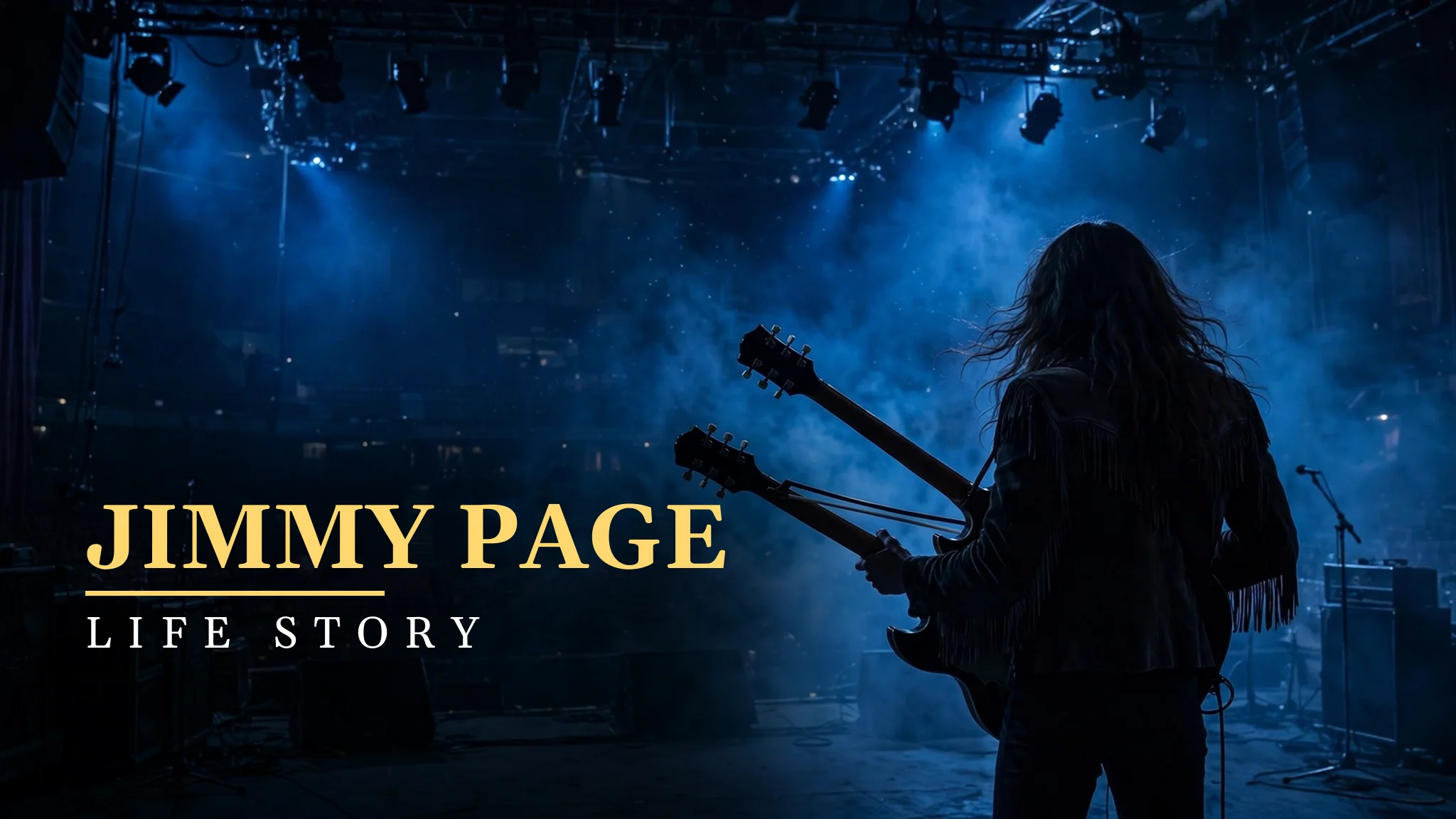
In the mid-1970s Led Zeppelin were at their peak. They released Houses of the Holy in 1973, Physical Graffiti in 1975, and Presence in 1976, and each album sold millions of copies. They played to huge crowds in stadiums, they travelled in private planes, and they were the biggest rock band in the world. Page’s guitar playing was at its best, and he was known for his use of a double-neck guitar, an instrument with two necks, one for six strings and one for twelve strings.
The double-neck guitar became his symbol. He used it on Stairway to Heaven, switching between the necks during the song, and audiences loved the sight of it. The guitar was heavy and hard to play, but Page made it look easy. He also used a Gibson Les Paul, a guitar that became closely linked with his sound. His riffs, his solos, and his use of the studio made him a hero to a generation of guitarists.
His playing was not only about power. He also played acoustic guitar, and he wrote beautiful folk songs such as The Rain Song and Bron-Y-Aur Stomp. He was interested in Celtic music, in Eastern music, and in the sounds of other cultures. He brought those ideas into Led Zeppelin’s music, and he made the band’s sound richer. He was a curious musician, always listening, always learning.
The band’s live shows in this period were legendary. They played for three hours or more, with long solos, drum solos, and songs that changed every night. Page was the musical leader on stage, and he guided the band through the long sets. He also began to use special effects, including a laser show and a dry ice machine, to make the concerts more dramatic. The shows were a mix of music and theatre, and they set a standard for rock concerts.
Yet the peak years also brought problems. The band were often away from home, they were tired, and they faced personal tragedies. Page himself struggled with drug use, and it affected his health and his playing. He has spoken about this period with honesty, and he has said that he wishes he had taken better care of himself. The band’s story in the late 1970s was one of great music and great strain, side by side.
Tragedy and the End of Zeppelin
In 1977 Robert Plant’s son Karac died, and the band cancelled their American tour. The loss affected everyone in the band, and it made them think about their lives. Page, who was close to Plant, supported his friend, and the band took time off. They returned in 1979 with the album In Through the Out Door, which showed a band that was still talented but also tired.
In September 1980 John Bonham died after a night of heavy drinking. He was thirty-two, and he was the band’s drummer and a close friend of Page. The band decided at once that they could not go on without him. Led Zeppelin ended, and Page lost not only his band but also a friend and a musical partner. He was thirty-six years old, and he had to decide what to do next.
He took time away from music. He worked on film soundtracks, including the music for Death Wish II, and he played with other musicians in small projects. He did not rush to form a new band. He needed time to grieve, to rest, and to think about his future. He had been in Led Zeppelin for twelve years, and it had been his whole life. Starting again was not easy.
He also faced the problem of his own health. Years of touring, of late nights, and of drug use had taken a toll. He began to look after himself better, and he slowly returned to playing. He formed a band called the Firm with the singer Paul Rodgers in the 1980s, and they made two albums. The Firm was a solid rock band, but it was not Led Zeppelin, and Page knew it. He was learning to be a musician again, without the huge fame of his old band.
In 1988 he released his first solo album, Outrider, which showed his guitar playing in a new setting. The album was well received, and it proved that he could still write and play great music. He toured with his own band, and he played to smaller crowds than he had with Zeppelin. He seemed happier, and more relaxed, than he had been in the late 1970s.
Later Work, Reunions, and Honours
In the 1990s Page worked again with Robert Plant, on the album No Quarter and on a tour that mixed Led Zeppelin songs with new arrangements. The project was a success, and it showed that the two men could still make great music together. They used Egyptian and Moroccan musicians on some songs, and they created a new sound that was both old and new. Page’s guitar playing was strong, and his arrangements were clever.
In 2007 Led Zeppelin reunited for a one-off concert at the O2 Arena in London, in memory of Ahmet Ertegun. Jason Bonham, the son of John Bonham, played drums. The show was a huge success, and fans hoped for a full tour. Page was willing, but Plant was not, and the reunion remained a single night. Page accepted the decision, and he moved on to other work. He has said that the night was a fitting tribute, and that he is proud of it.
Page has received many honours for his work. He was inducted into the Rock and Roll Hall of Fame twice, once with the Yardbirds and once with Led Zeppelin. He was made an Officer of the Order of the British Empire in 2005 for his charity work, especially for his work with children in Brazil. He has also been praised for his work in preserving Led Zeppelin’s music, through remastered albums and a book about his life in music.
He has also worked as a producer, as a writer, and as a collector of guitars and of art. He is known for his interest in the occult, in history, and in the work of the artist Aleister Crowley, an interest that has often been misunderstood. He has said that his interest is in ideas and in art, not in the dark stories that the press has sometimes told about him. He is a private man, and he does not often talk about his personal life.
In recent years he has continued to work on Led Zeppelin’s legacy, releasing remastered albums and a live album from the O2 concert. He still plays guitar, he still listens to music, and he still inspires new guitarists. His influence can be heard in rock, in metal, and in many other kinds of music. He is, by common agreement, one of the greatest guitarists who ever lived.
Page as Producer and Guitar Collector
Jimmy Page was not only a guitarist. He was also a producer, and his work in the studio is as important as his playing on stage. He produced every Led Zeppelin album himself, and he made them sound huge, warm, and clear. He used new techniques, such as placing microphones far from the drums, layering guitars, and using natural echo from stairwells and halls. Those techniques gave Led Zeppelin a sound that other bands tried to copy, but few could match. He thought of the studio as an instrument, and he played it as carefully as he played his guitar.
He also collected guitars, and his collection is famous among musicians. He owns many Gibson Les Pauls, Fender Stratocasters, and other rare instruments, and he has written a book about them, with photographs and stories. He cares for his guitars, he plays them, and he knows their history. He is not a collector who locks instruments away. He is a player who uses them, and who understands that a guitar is meant to be played, not only to be looked at. That attitude is part of why his playing is so good: he knows his instruments intimately.
His work as a producer continued after Led Zeppelin, on his solo album Outrider, on film soundtracks, and on remastered versions of Led Zeppelin’s albums. He spent years remastering the band’s records, listening to the original tapes, and making sure the new versions sounded as good as possible. That work was slow and careful, and it showed his commitment to the band’s legacy. He wanted new listeners to hear Led Zeppelin as it was meant to be heard, with all its power and clarity.
He also worked with other musicians as a producer and as a guest guitarist, playing on records by artists such as Roy Harper, the Rolling Stones, and others. Those collaborations showed his generosity as a musician: he was willing to help other artists, to play on their records, and to share his talent. He did not need to be the star in every project. He was happy to be a supporting player, if the music was good.
Page Today and His Guitar Legacy
Today, Jimmy Page is in his eighties, and he is still a revered figure in rock music. He is honoured at awards, he is interviewed about his work, and he is studied by young guitarists who want to learn his riffs and solos. His influence can be heard in rock, in metal, in blues, and in many other kinds of music. Bands such as Guns N’ Roses, Metallica, and the White Stripes have all named him as an influence, and their guitarists have learned from his playing.
He continues to work on Led Zeppelin’s legacy, releasing live albums, books, and remastered records. He has also been involved in charity work, especially for children in Brazil, through the ABC Trust, which he founded to help street children. He has used his fame and his money to help children who have no home, no school, and no safety, and that work is a central part of his later life. He is a man who cares about children, and who has worked for them for many years.
His guitar playing is still studied in music schools, and his riffs are still taught to beginners. Whole Lotta Love, Heartbreaker, and Black Dog are among the first riffs many young guitarists learn, and they are still exciting to play, even after fifty years. That is a remarkable legacy, because it means that Page’s music is not only listened to, but also played, by new generations. He is a teacher, even if he never set out to be one, because his guitar teaches anyone who listens to it.
New listeners continue to discover Led Zeppelin through streaming, through films, and through older friends and family. A teenager today can hear Stairway to Heaven for the first time, and feel the same wonder that a listener felt in 1971. That is the power of a great guitar: it travels through time, and it speaks to people who were not there when it was first played. Page’s guitar is still here, still clear, and still moving people, and it will keep moving them for many years to come.
My Take:
I think Jimmy Page is a guitarist who makes me want to listen more carefully, because his playing is never simple. When I hear a Led Zeppelin song, I hear layers: a riff, a second guitar, a soft acoustic part, and then a solo that seems to come from nowhere. That layering is Page’s gift. He does not just play one guitar. He builds a sound, piece by piece, until it feels huge. I admire that patience, because it is easy to play loud and fast. It is much harder to build a song that lasts.
I love the riff for Whole Lotta Love, because it is so simple and so powerful. It is only a few notes, but it is enough to make a whole stadium move. That is the mark of a great riff writer. He does not need a hundred notes. He needs the right notes, played at the right time, with the right sound. I think many guitarists forget that. They try to impress with speed, and they lose the feeling. Page never loses the feeling. He plays for the song, not for himself.
I also admire his work as a producer. He produced Led Zeppelin’s records himself, and he made them sound big, warm, and clear. He placed microphones in new ways, he used the studio as an instrument, and he let the band play live. That is a rare skill. Many guitarists are great players but poor producers. Page was both, and that is why Led Zeppelin’s albums still sound good today, more than fifty years after they were made.
His use of the double-neck guitar is a good example of his showmanship. It is a strange, heavy instrument, and it looks amazing on stage. When he switches necks during Stairway to Heaven, the audience knows they are watching something special. I like that he was willing to use a difficult instrument to make a song better. He did not choose the easy way. He chose the way that served the music, even if it was harder to play.
I think about his session years, and I respect them a lot. He was a teenager playing on other people’s records, learning how to be on time, how to play well in a few takes, and how to work with producers. That training made him a better musician, and it made him a better leader. He knew how a studio worked, he knew how to talk to engineers, and he knew how to get the sound he wanted. That knowledge is part of why Led Zeppelin’s records are so good.
The end of Led Zeppelin makes me sad, because it was so sudden. John Bonham died, and the band ended at once. Page lost a friend and a band in the same week, and he had to start again in his thirties. I respect the way he handled it. He did not try to replace Bonham. He took time off, he worked on other projects, and he slowly found his way back to music. That is a hard thing to do when you have been in the biggest band in the world.
I also think his later work with Robert Plant, on No Quarter, is underrated. The two men took old Led Zeppelin songs and gave them new life, with new instruments and new arrangements. It showed that Page was still curious, still willing to try new things, and still able to work with Plant. I wish they had made more music together, but I understand why Plant wanted to move on. Page accepted that, and he kept working on his own.
His interest in the occult is often talked about, and I want to be honest about it. I do not share that interest, and I do not think it explains his music. I think his music comes from blues, folk, and rock, not from magic. But I respect that he has his own beliefs, and that he does not try to force them on others. He is a private man, and he has the right to be interested in what he likes. The press has sometimes made his interest sound darker than it is, and I think that is unfair.
For a young guitarist, I think the lesson of Jimmy Page is to learn everything, not only how to play fast. Learn how to record, learn how to write a riff, learn how to play acoustic guitar, and learn how to listen to other kinds of music. Page did all of those things, and that is why his playing is so rich. He did not only learn rock. He learned folk, blues, and Eastern music, and he brought those sounds into his work. That curiosity is what makes a great musician.
I also think his charity work matters, especially his work with children in Brazil. He has used his fame and his money to help children who have no home, no school, and no safety. That is a kind and practical use of fame, and it shows a side of Page that many people do not see. He is not only a rock star. He is a man who cares about children, and who has worked for them for many years.
In the end, I listen to Jimmy Page because his guitar makes me feel something I cannot put into words. It makes me feel the power of a riff, the beauty of a soft acoustic line, and the thrill of a solo that builds and builds. He is a guitarist who can do it all, and he does it with a sense of drama that few others can match. I am glad he is still here, still working on his music, and still inspiring new players.
I keep thinking about Stairway to Heaven, and about how a song that starts so quietly can end so loudly. That is Page’s music in miniature: a soft beginning, a careful build, and a powerful ending. It is a lesson in how to make music that lasts, and it is a lesson I will remember every time I hear his guitar.
One more thought stays with me. Page was the leader of Led Zeppelin, but he was also a team player. He let Plant sing, he let Jones arrange, and he let Bonham drum. He did not try to do everything himself. He built a band, and he trusted his bandmates. That trust is why Led Zeppelin worked. A great leader does not need to be the loudest person in the room. He needs to bring out the best in others, and Page did that for twelve years.
I hope young musicians listen to Page and learn that a guitar is not only an instrument for showing off. It is an instrument for telling a story, for building a sound, and for making people feel. Page told stories with his guitar, and those stories are still being heard today.
I also think about his work as a producer, and about how important it is. Many guitarists are great players, but they do not understand the studio. Page understood it, because he had been a session musician, and he had learned how a record is made. He produced Led Zeppelin’s albums himself, and he made them sound huge, warm, and clear. That is a rare skill, and it is why those albums still sound good today. I admire that, because it shows a musician who learned everything, not only how to play, but also how to record, how to arrange, and how to lead a band in the studio.
I think about his guitar collection, and about how he cares for his instruments. He owns many famous guitars, but he does not lock them away. He plays them, he writes about them, and he shares them with fans through books and exhibitions. That generosity is part of who he is. He believes that a guitar is meant to be played, and that its story should be shared. I find that moving, because it shows a man who loves his instruments, not as objects, but as tools for making music.
When I listen to Heartbreaker, I hear a riff that is simple, powerful, and unforgettable, and I think about how hard it is to write a riff like that. It is only a few notes, but it is enough to make a whole song work. Page wrote many such riffs, and each one is different. That is a gift, and it is one that comes from years of listening, practising, and thinking about music. I think young guitarists should study his riffs, not only to copy them, but to learn how a good riff is built: with simplicity, with power, and with feeling.
I also think about his charity work in Brazil, and about how it shows a different side of him. He founded the ABC Trust to help street children, and he has worked for it for many years. He did not just give money. He visited, he talked to children, and he used his fame to draw attention to their plight. That is a serious and kind use of fame, and it is one that many rock stars do not bother with. Page bothers, and he has helped many children because of it. I respect that deeply.
For a young guitarist, I think the lesson is to learn everything, not only how to play fast. Learn how to record, learn how to write a riff, learn how to play acoustic guitar, and learn how to listen to other kinds of music. Page did all of those things, and that is why his playing is so rich. He did not only learn rock. He learned folk, blues, and Eastern music, and he brought those sounds into his work. That curiosity is what makes a great musician, and it is what keeps music fresh.
I keep returning to the O2 reunion in 2007, and to how Page played that night. He was sixty-three, he had not played with Led Zeppelin for twenty-seven years, and he played as if he had never stopped. His guitar was clear, his riffs were powerful, and his solos were full of feeling. That night showed that his talent had not faded, and that his love of music was still strong. I am glad that night happened, because it gave fans a final chance to see Led Zeppelin play together, and it gave Page a fitting tribute to his band.
One more thought stays with me. Page was the leader of Led Zeppelin, but he was also a team player. He let Plant sing, he let Jones arrange, and he let Bonham drum. He did not try to do everything himself. He built a band, and he trusted his bandmates. That trust is why Led Zeppelin worked. A great leader does not need to be the loudest person in the room. He needs to bring out the best in others, and Page did that for twelve years, with patience and with skill.
I hope young musicians listen to Page and learn that a guitar is not only an instrument for showing off. It is an instrument for telling a story, for building a sound, and for making people feel. Page told stories with his guitar, and those stories are still being heard today, by new listeners, in new countries, who are learning his riffs for the first time.
I also think about his love of old instruments, and about how he cares for them as if they were living things. He knows the history of each guitar, he plays them, and he shares their stories with fans through books and exhibitions. That care is part of his musicianship: he does not treat a guitar as a tool to be thrown away. He treats it as a partner, with a history and a voice of its own. I find that moving, because it shows a man who respects the objects that make his music possible, and who understands that a good instrument deserves care.
I keep thinking about his quiet manner off stage, and about how different it is from his powerful playing on stage. He is a private, thoughtful man, who does not seek attention, and who prefers to let his guitar speak. That quietness is a strength, because it means he listens, he thinks, and he does not waste words. When he does speak, in interviews or in his books, people listen, because they know he has thought carefully about what he is saying. That is a kind of leadership that does not need to shout.
Frequently Asked Questions
Where was Jimmy Page born and when?
He was born on 9 January 1944 in Heston, London, and he grew up in Epsom, Surrey. He learned guitar as a teenager and became a session musician before joining the Yardbirds and forming Led Zeppelin.
How did Jimmy Page become famous as a session guitarist?
He played guitar on many records in London in the 1960s, learning studio work and playing for other artists. That training made him a skilled player and producer, and it helped him when he later produced Led Zeppelin’s albums himself.
What is Jimmy Page’s most famous guitar solo?
The solo in Stairway to Heaven is his most famous, and it is often listed among the greatest guitar solos ever recorded. He also wrote the famous riffs for Whole Lotta Love, Heartbreaker, and Black Dog.
Why did Jimmy Page use a double-neck guitar?
He used a double-neck guitar, with six and twelve strings, to play Stairway to Heaven live, switching between necks during the song. The instrument became his symbol, and audiences loved the sight of it on stage.
What happened to Led Zeppelin after John Bonham died?
The band ended at once in 1980 after Bonham’s death, because the members decided they could not continue without him. Page later worked on film music, formed the Firm, made a solo album, and worked again with Robert Plant.
Is Jimmy Page still active in music?
Yes, he has worked on remastered Led Zeppelin albums, released a live album from the 2007 O2 reunion, and continues to be honoured as one of the greatest guitarists in rock history.


