The Yardbirds: The Life Story Behind the Blues Rock Band
In this post
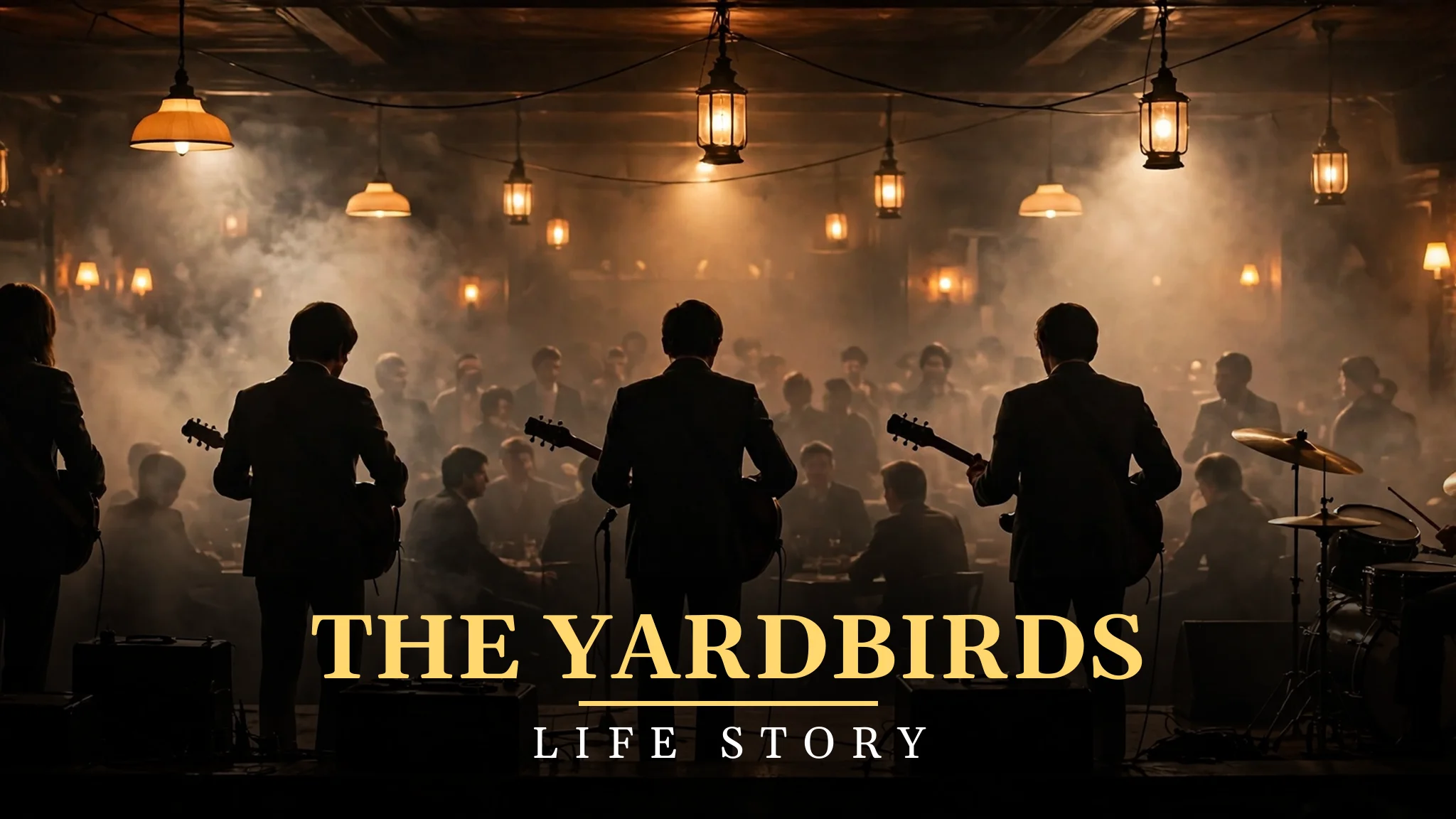
The Yardbirds are one of the most important bands in rock history, not only for the music they made but for the musicians who passed through them. Three of the greatest guitar players of all time played in this one band: Eric Clapton, Jeff Beck, and Jimmy Page. No other band can make that claim. Clapton played with them first, then Beck, then Page, and each of them brought a different sound and a different style. The band began as a blues group in London, and it ended as the seed from which Led Zeppelin grew.
Their songs are still known today. For Your Love was a hit in 1965, with a harpsichord sound that was unusual for a rock band. Heart Full of Soul and Shapes of Things showed a band that was pushing the blues into new places, using feedback, Eastern sounds, and loud guitars. Over Under Sideways Down was a fast, exciting song that showed how tight the band could be. These were not simple pop songs. They were experiments, and they were made by young musicians who wanted to see how far the blues could go.
The Yardbirds lasted only five years in their first form, from 1963 to 1968, and they changed members many times. Their singer, Keith Relf, had a gentle voice and a harmonica style that gave the band its blues heart. Jim McCarty played drums with energy and precision. Chris Dreja played rhythm guitar and later bass. Paul Samwell-Smith played bass in the early years. Together they made music that was respected by other musicians, even when it did not always sell in huge numbers. This is the story of a band that was a school for guitar legends, and a band that helped to invent the sound of modern rock.
A Blues Band in London
The Yardbirds formed in London in 1963, at a time when young British musicians were falling in love with American blues. Records by Muddy Waters, Howlin’ Wolf, and other blues artists were hard to find in Britain, but they were treasured by the young people who found them. The Yardbirds were part of that world. They played in clubs, they learned blues songs by ear, and they tried to play them with the same feeling as the American originals.
The early members were Keith Relf on vocals and harmonica, Jim McCarty on drums, Chris Dreja on rhythm guitar, Paul Samwell-Smith on bass, and Top Topham on lead guitar. Topham left soon after, and he was replaced by a young guitarist named Eric Clapton, who was already known in London blues circles for his skill. Clapton was a serious blues player, and he believed that the blues should be played with respect and with feeling. He did not want the band to become a pop group. He wanted them to stay true to the blues.
The band played at the Crawdaddy Club in Richmond, a venue that had also hosted the Rolling Stones, and they built a following among blues fans. They recorded their first album, Five Live Yardbirds, in 1964, which captured their live sound in a club setting. The album showed a band that could play loud, fast blues with energy and with skill. It was not a polished studio record. It was a record of a band playing live, with the crowd in the room, and that rawness was part of its appeal.
London in 1963 and 1964 was full of bands, and the Yardbirds had to work hard to stand out. They did it by playing well, by respecting the blues, and by developing a stage act that included long guitar solos and a driving rhythm. They were not the most famous band in London, but they were one of the most respected among musicians. Other guitar players came to watch them, and they learned from what they heard. The band was becoming a place where great guitar playing was expected, and that reputation would only grow.
Eric Clapton Leaves and For Your Love Arrives
In 1965 The Yardbirds were offered a song called For Your Love, written by the songwriter Graham Gouldman. The song had a pop melody, a harpsichord part, and a sound that was very different from the blues the band had been playing. Eric Clapton did not like it. He felt that the band was moving away from the blues and towards pop music, and he did not want to be part of that change. He left the band, and he joined John Mayall’s Bluesbreakers, where he could play the blues in a more serious way.
For Your Love became a hit without Clapton. It reached number three in Britain and number six in America, and it gave The Yardbirds their first major success. The song showed that the band could make a pop hit, and it brought them a new audience. But it also showed that the band was changing. They were no longer only a blues band. They were a band that could try new sounds, new instruments, and new ideas, and that willingness to experiment would define the next part of their career.
Clapton was replaced by Jeff Beck, a guitarist with a wild, inventive style. Beck did not play the blues in the same way as Clapton. He played with feedback, with distortion, and with sounds that no one had heard before. He used the guitar as an instrument for noise and for colour, as well as for melody, and he pushed the band into new territory. With Beck, The Yardbirds became one of the most exciting bands in Britain, and their records began to sound like the future of rock music.
The band released Heart Full of Soul in 1965, a song with a sitar-like guitar sound that was influenced by Indian music, and Shapes of Things in 1966, a song about war, greed, and the need for change. Shapes of Things was a serious song, with a strong message and a powerful guitar part, and it showed that The Yardbirds were not afraid to write about important subjects. They were not just a pop band. They were a band with ideas, and they were using their music to express them.
Jeff Beck, Experimentation, and the Rave-Up
With Jeff Beck in the band, The Yardbirds developed a style that became known as the rave-up, a section in the middle of a song where the tempo doubled and the band played faster and louder until the music reached a peak. It was an exciting live trick, and it made their concerts feel wild and unpredictable. The band also began to use feedback, distortion, and other guitar effects in a way that few other bands were doing. They were inventing the sound of psychedelic rock and hard rock, even before those terms were widely used.
In 1966 they released the album Yardbirds, which is often called Roger the Engineer because of the drawing on its cover. The album was recorded with Beck and with Jimmy Page, who had joined the band as a bass player before moving to lead guitar. The album included songs like Over Under Sideways Down, which was a fast, driving song with a strong beat, and Happenings Ten Years Time Ago, which featured both Beck and Page on guitar. The album showed a band that was confident, creative, and willing to try new things.
The same year, Beck left the band after a tour of America, following arguments and tiredness. He went on to have a successful solo career, forming the Jeff Beck Group and becoming one of the most respected guitarists in rock. His time with The Yardbirds had been short, but it had been important. He had shown that the guitar could be used in new ways, and he had helped the band to make some of its best records.
Jimmy Page was now the lead guitarist, and the band continued with him. Page was a skilled session musician who had played on many records before joining The Yardbirds, and he brought a professional, disciplined approach to the band. He also brought new ideas, and he began to shape the band’s sound in his own way. The Yardbirds were changing again, and they were moving towards a heavier, louder sound that would soon become the sound of Led Zeppelin.
Jimmy Page Takes Over and the End Begins
With Jimmy Page as the lead guitarist, The Yardbirds released the single Little Games in 1967 and the album Little Games the same year. The record had a heavier sound, with strong guitars and a more direct rock style. It did not sell as well as the band had hoped, and the music industry was changing. The band were no longer at the centre of pop music, and they were struggling to find a new audience. They toured, they recorded, and they worked hard, but the excitement of the early years was fading.
Keith Relf, the singer, was also struggling. He had health problems, including asthma, and the life of touring was hard for him. He was a gentle person, and the rough life of a rock band did not suit him as well as it suited others. He continued to sing and to play harmonica, but he was tired, and the band was tired too. The other members were also thinking about their futures, and about what they would do when the band ended.
In 1968 The Yardbirds split up. The final line-up played its last concerts, and the band came to an end. It had lasted five years, it had changed members many times, and it had made a small number of albums and singles. But its influence was far greater than its sales. The band had been a home for three of the greatest guitarists in rock, and it had helped to invent the sound of modern rock guitar. That was a legacy that few bands could match.
Keith Relf died in 1976, at the age of thirty-three, after an accident at home involving an electric guitar. His death was a sad loss, and it reminded fans of how young the band had been when they made their music. Jim McCarty and Chris Dreja later reformed The Yardbirds with new musicians, and they continued to tour and to record, keeping the name alive for new audiences. The original band was gone, but its music and its story lived on.
From the New Yardbirds to Led Zeppelin
The most famous part of the Yardbirds story came after the band ended. Jimmy Page had the rights to the band’s name for a time, and he formed a new group called the New Yardbirds to fulfil the band’s remaining tour dates. That group included Robert Plant on vocals, John Paul Jones on bass and keyboards, and John Bonham on drums. The four musicians worked so well together that they decided to form a new band of their own, and they called it Led Zeppelin.
Led Zeppelin became one of the biggest rock bands in history, selling hundreds of millions of records and filling stadiums around the world. Their music was built on the blues, on loud guitars, and on the lessons that Jimmy Page had learned in The Yardbirds. Songs like Whole Lotta Love, Stairway to Heaven, and Immigrant Song owed something to the Yardbirds’ experiments with feedback, with Eastern sounds, and with the rave-up. The Yardbirds had been a small band. Led Zeppelin was a giant band. But the giant had grown from the small band’s seed.
The Yardbirds were inducted into the Rock and Roll Hall of Fame in 1992, honouring the band and its members, including Clapton, Beck, and Page. The induction recognised that the band had been more than a footnote in rock history. It had been a central part of the story, a place where the sound of modern rock was invented, and a band that had given the world three guitar legends. The honour was well deserved, and it came at a time when the band’s music was being rediscovered by a new generation.
Today The Yardbirds are remembered as a band for musicians, a band that other musicians admire and study. Their records are still played, their guitar parts are still learned by young players, and their story is still told as an example of how a band can change music even in a short life. They were not the biggest band of the 1960s, but they were one of the most important, and their influence is still felt in rock music today.
What the Yardbirds Mean for Guitar Music
The legacy of The Yardbirds is clearest in the guitar. Eric Clapton, Jeff Beck, and Jimmy Page all became legends, and they all learned something in The Yardbirds. Clapton learned how to lead a band and how to play the blues with feeling. Beck learned how to experiment with sound and how to make the guitar speak in new ways. Page learned how to arrange, how to produce, and how to build a band around a guitar sound. Each of them took those lessons into their later careers, and each of them changed music in his own way.
The band also showed that a group could be a school, a place where musicians learn from each other and grow. The Yardbirds were not a fixed band with a fixed sound. They were a changing band, with new members bringing new ideas, and that change was a strength. It kept the music fresh, and it kept the band moving forward, even when the changes were painful. That is a lesson for any band. Change is not always a failure. Sometimes it is the way forward.
Their songs also last. For Your Love is still a charming, unusual pop song. Heart Full of Soul still sounds fresh, with its Eastern guitar and its sad melody. Shapes of Things still sounds serious and relevant, with its message about war and greed. Over Under Sideways Down still sounds fast and exciting. These are songs that were made in the 1960s, but they do not sound old. They sound like music that was ahead of its time, and that is why they are still played.
The Guitar Sound, the Harmonica, and the Band’s Lasting Lesson
The Yardbirds’ guitar sound was the most important thing about them, and it changed three times, with three different guitarists, each of whom brought something new. Eric Clapton played the blues with feeling and with respect, and his playing was clean, melodic, and honest. Jeff Beck played with wildness and with invention, using feedback and distortion to make sounds that no one had heard before. Jimmy Page played with power and with discipline, arranging the music and building a heavier sound that would become Led Zeppelin. Each of them learned something in The Yardbirds, and each of them took that learning into their later careers. That is why the band is remembered as a school for guitarists, a place where great players were made.
Keith Relf’s harmonica and voice were also central to the band’s sound, and they deserve more attention than they usually get. Relf played harmonica with a blues feeling, and he sang with a gentle, melodic voice that gave the band a softness to balance the loud guitars. He was not a loud singer, but he was a sincere one, and his voice suited the blues songs that the band played. His health problems, including asthma, made touring hard for him, but he kept singing, and he kept playing, because he loved the music. His death in 1976, at thirty-three, was a sad loss, and it reminded fans of how young the band had been.
Jim McCarty’s drumming was another key part of their sound, because he played with energy and with precision, and he gave the band a beat that was both fast and steady. He was a drummer who could play blues, rock, and psychedelic music, and he adapted to each guitarist’s style. Chris Dreja’s rhythm guitar and later bass playing also held the band together, providing a solid foundation for the lead guitar to shine. Together, McCarty and Dreja were the rhythm section that made the band work, even when the lead guitarist changed.
The band’s experiments with Eastern music, with feedback, and with the rave-up also deserve mention, because they showed a willingness to try new things that was unusual for the time. Heart Full of Soul used a sitar-like guitar sound, Shapes of Things used a powerful guitar riff to talk about war and greed, and the rave-up sections in their live shows made the music faster and louder until it reached a peak. These experiments were not just tricks. They were attempts to see how far rock music could go, and they helped to invent the sound of psychedelic rock and hard rock.
The Yardbirds’ influence on later bands is enormous, and it is felt in the work of Led Zeppelin, in the work of many guitarists who learned their parts, and in the sound of modern rock itself. Their records are still studied by young guitar players, who learn For Your Love, Heart Full of Soul, and Shapes of Things as part of their education. That is a special kind of legacy, one that is about teaching as much as about performing. The Yardbirds taught the world how to play rock guitar, and the world is still learning from them.
In the end, the band’s guitar sound, their harmonica, and their willingness to experiment are all part of the same story, a story about a small London band that changed music in five short years. Their songs are still played, their guitar parts are still learned, and their story is still told, because they were a band that mattered, even though they lasted only a short time.
The Yardbirds also recorded some of their best work in a very short time, and that speed is part of their legend. In just a few years, from 1963 to 1968, they made a handful of albums and singles that changed rock music, and they did it while changing guitarists three times. That is a remarkable achievement, and it shows how much talent was in the band. They did not need decades to make their mark. They needed only five years, three guitarists, and a willingness to experiment. That is a lesson for any band. What matters is not how long you last, but what you make while you are together.
Their later reformation, with Jim McCarty and Chris Dreja leading a new line-up, also deserves mention, because it kept the band’s name alive for new audiences. The reformed Yardbirds toured and recorded, playing the old songs alongside new material, and they showed that the music still had power, even without Clapton, Beck, or Page. That persistence is admirable, and it shows that the band’s songs are strong enough to live on, even when the original members are gone. The Yardbirds are still remembered today, not only for their guitarists, but for their songs, and that is a fitting legacy.
My Take:
When I think about The Yardbirds, I think about a band that was really a school. Most bands are a group of people who stay together and make music. The Yardbirds were a group of people who came and went, and each person who passed through left something behind and took something away. Eric Clapton, Jeff Beck, and Jimmy Page all played in this one band, and that fact alone makes it one of the most remarkable bands in history. I cannot think of another band that can say the same thing. It is like a small school that produced three of the greatest teachers in the world.
I admire Eric Clapton for leaving when he did. He believed in the blues, and he did not want to play pop music. That is a hard choice to make when a band is about to have a hit. For Your Love became a success, and Clapton was not part of it. He chose his principles over fame, and he went to play the blues with John Mayall. I respect that kind of honesty. It is easy to stay in a band because it is successful. It is much harder to leave because you believe in something else. Clapton did that, and his later career proved that he was right to follow his own path.
Jeff Beck is the member who fascinates me most, because his playing was so wild and so inventive. He did not play the guitar like other people. He used feedback, he used distortion, and he made sounds that no one had heard before. When I listen to Shapes of Things, I hear a guitar that sounds like it is crying and shouting at the same time. That is not easy to do, and it takes a special kind of imagination. Beck was not always easy to work with, and his time in the band was short, but his impact was huge. He showed that the guitar could be more than a rhythm instrument or a solo instrument. It could be a voice.
Jimmy Page is the member who took the lessons of The Yardbirds and built something enormous from them. He learned how to arrange, how to produce, and how to lead a band, and then he formed Led Zeppelin. Led Zeppelin became one of the biggest bands in the world, and their music still fills stadiums today. I think about how much of that success began in The Yardbirds, in the small clubs and the recording studios where Page learned his craft. It is a reminder that big things often start small, and that a short time in a small band can change a life.
I also think about Keith Relf, because he is often forgotten in the story of The Yardbirds. People talk about the guitar players, and they forget the singer. But Relf was the heart of the band. He sang the songs, he played the harmonica, and he gave the band its blues feeling. He was a gentle person, and he had health problems that made touring hard for him. He died young, at thirty-three, and his death was a sad loss. I think he deserves more credit than he usually gets, because without him there would have been no Yardbirds at all. The guitar players needed a singer, and Relf was that singer.
For Your Love is a song that I like because it is strange. It has a harpsichord, a pop melody, and a sound that does not fit neatly into any category. It was a hit, but it was not a typical hit. It showed that The Yardbirds were willing to try new things, even if those things were risky. That willingness to experiment is what made them important. They did not just play the blues. They tried to see what else the blues could become, and they found new sounds in the process.
Shapes of Things is a song that moves me because it is serious. It is about war, about greed, and about the need for change, and it was written in 1966, at a time when many pop songs were about love and dancing. The Yardbirds were not afraid to write about important subjects, and they did it with a powerful guitar part and a strong vocal. That courage is worth remembering. Pop music can be about more than fun, and The Yardbirds proved that.
I also think about the rave-up, that part of a Yardbirds song where the music gets faster and louder until it reaches a peak. It was a simple idea, but it was exciting, and it made their concerts feel wild. It was also a sign of what rock music was becoming. Rock was no longer just about songs. It was about energy, about volume, and about the feeling of being in a room with a band that is playing as hard as it can. The Yardbirds helped to invent that feeling, and later bands took it further.
One thing that stays with me is how short the band’s life was. Five years is not a long time, and yet in those five years they changed music. They had three great guitarists, they made a handful of great records, and they gave birth to Led Zeppelin. That is a lot to achieve in five years, and it shows that a band does not need to last for decades to matter. What matters is the quality of the work, and the influence it has on others. The Yardbirds had both.
If I have a criticism, it is that the band never quite found a stable line-up, and that instability cost them. They changed guitarists, they changed bass players, and they never had time to settle into a sound for long. That was both a strength and a weakness. It kept the music fresh, but it also meant that the band was always starting again. I wonder what they might have achieved if Clapton, Beck, and Page had all stayed longer, or if the band had found a way to keep its members together. But history does not work that way, and the band we have is the band that existed, with all its changes and all its brilliance.
In the end, I will remember The Yardbirds as a band that taught the world how to play rock guitar. They were a school, a laboratory, and a launching pad, all at once. Their songs still sound fresh, their guitar parts are still studied, and their story is still told. Eric Clapton, Jeff Beck, and Jimmy Page all passed through this one small London band, and each of them became a legend. That is a legacy that no other band can claim, and it is one that deserves to be celebrated.
I also think about Jim McCarty, the drummer, because he was the member who stayed with the band through all its changes, and who later helped to reform it. He played drums with energy and with precision, and he gave the band a beat that was both fast and steady. He was not a famous name like Clapton or Page, but he was a key member, and his playing held the band together. I respect him for his loyalty, and for the way he kept the Yardbirds’ name alive after the original band ended.
Chris Dreja is another member who deserves credit, because he played rhythm guitar and later bass, and he provided a solid foundation for the lead guitar to shine. He was a reliable musician, and his work was essential to the band’s sound, even though it was not as flashy as the lead guitar. I think about how many bands rely on a rhythm player who does the quiet work, and how rarely that work is recognised. Dreja did that work well, and he deserves to be remembered for it.
Paul Samwell-Smith, the original bass player, is also worth remembering, because he played on the band’s early records and he helped to produce their later work. He left in 1966, but his contribution to the band’s early sound was important. He was a skilled musician, and his bass playing gave the band a steady rhythm in its formative years. I admire him for his work, and for the way he moved into production after leaving the band, showing that musicians can have more than one career in music.
I think about the album Roger the Engineer, because it is a record that shows the band at its most creative, with both Beck and Page playing guitar. The album includes Over Under Sideways Down, a fast, driving song, and Happenings Ten Years Time Ago, a song that features both guitarists. It is a record that was ahead of its time, and it is still loved by fans and by musicians today. I think about how much talent was in that band at that moment, with two of the greatest guitarists in history playing together, and I feel grateful that they made a record together.
The song Heart Full of Soul is another favourite of mine, because it uses a sitar-like guitar sound that was influenced by Indian music, and it shows the band’s willingness to try new sounds. It was released in 1965, at a time when few British bands were experimenting with Eastern music, and it was a bold choice. The song is sad, it is beautiful, and it is unlike anything else on the radio at the time. I admire the band for taking that risk, and for showing that rock music could be open to influences from around the world.
I also think about the Crawdaddy Club in Richmond, where the band played in its early years, because that club was a home for British blues, and it was where the Rolling Stones had also played. The Yardbirds played there, they learned their craft there, and they built a following there. It was a small club, but it was an important place, and it shows how much of British rock was made in small venues, by young musicians who were learning as they went. That is a humbling thought, and it is one that I keep coming back to.
In the end, I come back to the idea of a school, because that is what The Yardbirds were. They were a school for guitarists, a school for musicians, and a school for anyone who wanted to learn how rock music could be made. Eric Clapton, Jeff Beck, and Jimmy Page all passed through that school, and each of them became a legend. That is a legacy that no other band can claim, and it is one that deserves to be celebrated. The Yardbirds may have lasted only five years, but their lessons have lasted for sixty.
I also think about the band’s first album, Five Live Yardbirds, because it captured their live sound in a club, with the crowd in the room, and it showed a band that could play loud, fast blues with energy. That album is a reminder of how much of British rock was made in small clubs, by young musicians who were learning as they went. It is a raw record, and it is an honest one, and it deserves to be listened to by anyone who wants to understand where rock music came from. The Yardbirds were not a polished studio band. They were a live band, and that live energy is what made them special.
The song Over Under Sideways Down is another favourite of mine, because it is fast, it is exciting, and it shows how tight the band could be. The song has a driving beat, a strong guitar part, and a vocal that is full of energy. When I hear it, I think about the excitement of being young, of playing loud music, and of feeling like the world is yours. That is a feeling that The Yardbirds captured well, and it is why their songs are still played today by young guitarists who want to learn how to play rock.
In the end, I think about how much The Yardbirds gave to music in such a short time, and how grateful I am that they existed. They were a school, a laboratory, and a launching pad, all at once, and their lessons are still being learned today. Eric Clapton, Jeff Beck, and Jimmy Page all passed through this one small London band, and each of them became a legend. That is a story that will never be repeated, and it is one that deserves to be told again and again.
Frequently Asked Questions
Which three famous guitarists played in The Yardbirds?
Eric Clapton, Jeff Beck, and Jimmy Page all played lead guitar for The Yardbirds at different times. Clapton played first, Beck replaced him in 1965, and Page joined later and became the lead guitarist before the band split in 1968.
Why did Eric Clapton leave The Yardbirds?
Eric Clapton left in 1965 because he did not want the band to move from blues towards pop music, as shown by the song For Your Love. He joined John Mayall’s Bluesbreakers to play the blues in a more serious way, and he later became one of the most famous guitarists in the world.
What is For Your Love and why was it unusual?
For Your Love was a 1965 hit written by Graham Gouldman, featuring a harpsichord and a pop melody that was very different from the band’s blues sound. It reached the top ten in Britain and America, and it marked the band’s move towards more experimental pop and rock.
How did The Yardbirds lead to Led Zeppelin?
After The Yardbirds split in 1968, Jimmy Page formed a new group called the New Yardbirds to fulfil tour dates, with Robert Plant, John Paul Jones, and John Bonham. That group soon became Led Zeppelin, one of the biggest rock bands in history.
What was the Yardbirds’ rave-up style?
The rave-up was a section in a Yardbirds song where the tempo doubled and the band played faster and louder until the music reached a peak. It became a signature of their live shows and helped to shape the louder, more energetic sound of later rock music.
When were The Yardbirds inducted into the Rock and Roll Hall of Fame?
The Yardbirds were inducted into the Rock and Roll Hall of Fame in 1992, honouring the band and its members including Clapton, Beck, and Page. Their influence on rock guitar and on modern rock music was formally recognised.


