Lake That Turns Animals Stone
In this post
- A Shallow Red Lake In A Wild Corner Of Tanzania
- Soda Water Stronger Than Soap
- The Volcano That Keeps Feeding The Lake
- So Does It Really Turn Animals To Stone?
- The Photographer Who Posed The Dead
- Why The Water Turns The Colour Of Blood
- The Flamingos That Call This Deadly Lake Home
- Other Tough Lives At The Water’s Edge
- Sources
In 2013, a set of photographs travelled around the whole world and made millions of people shiver. A bat hanging from a branch, dry and grey, as if carved out of rock. A flamingo standing on still water, looking alive — but not alive at all. People shared the pictures with one frightening claim: somewhere in Africa, there is a lake that turns any animal that touches it into stone, like the monster Medusa of Greek myth.
The lake is real. The stone animals are real. But the famous claim is not quite true — and the true story is stranger, sadder, and more beautiful than the myth. This is Lake Natron’s story, explained honestly, step by step.
A Shallow Red Lake In A Wild Corner Of Tanzania
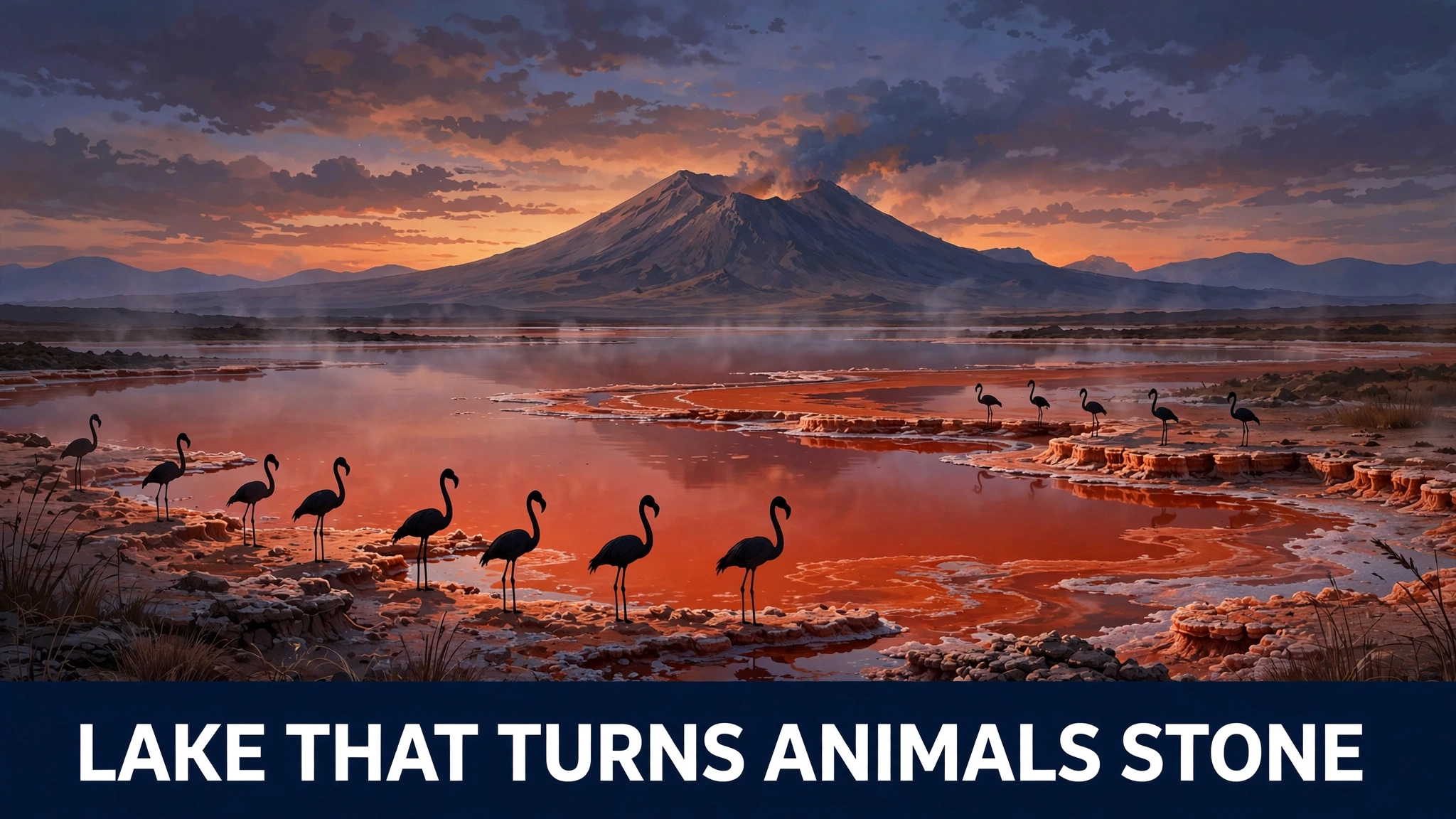
Lake Natron lies in the far north of Tanzania, close to the border with Kenya, in the hot, dry floor of the East African Rift Valley. It is wide but not deep — in most places the water is less than three metres deep, more like a giant flooded plain than a true lake.
It also has no way out. Rivers and springs flow in, but no river flows out. Under the fierce sun, water can only leave by evaporating — and everything dissolved in it stays behind, growing stronger. Month after month, the lake has collected salt and soda this way, until its water became some of the most extreme on Earth.
From the air, the lake often glows deep red and orange, like a sheet of rusty metal. On its southern horizon stands a volcano, Ol Doinyo Lengai, and that volcano is the secret behind almost everything unusual about this lake.
Soda Water Stronger Than Soap
To understand Lake Natron, you need one small idea: the pH scale. It measures whether water is acidic, like lemon juice, or alkaline, like soap and washing soda. Pure water sits in the middle, at 7. Lemon juice is near 2. Soap is around 9 or 10.
Lake Natron’s water usually measures about 9 to 10.5 on this scale — roughly like milk of magnesia — and in its hottest, driest corners it has been measured even higher, close to strong household cleaners. Water like this is caustic: it stings and can burn the skin and eyes of animals that are not built for it. The shallow water can also become astonishingly hot, climbing towards 60 degrees Celsius in the hottest spots — hot enough that no sensible creature goes for a swim.
The reason for this harsh chemistry has a name you already know from your kitchen: soda. The lake is loaded with sodium carbonate, the same family of chemical as washing soda, mixed with other salts. This mix is called natron — and it is where the lake gets its name.
The Volcano That Keeps Feeding The Lake
Where does all this soda come from? From the volcano next door.
Ol Doinyo Lengai is a very unusual volcano. According to NASA’s Earth Observatory, it produces molten material rich in sodium carbonate and calcium carbonate salts — a rare kind of lava found almost nowhere else on Earth. Ash and debris from its eruptions wash down towards the lake, and the salty mixture also moves through cracks in the ground and bubbles up in more than twenty hot springs that empty into the lake.
So the lake is not a one-time accident. The volcano keeps topping it up, the sun keeps boiling the water away, and the soda keeps growing stronger. It is a slow, endless recipe — and it explains both the lake’s dangers and its most famous mystery.
So Does It Really Turn Animals To Stone?
Now for the honest answer, because this is the part the viral posts usually get wrong.
No — Lake Natron does not turn a living animal into stone the moment it touches the water. There is no magic instant freeze, and the grey creatures in the famous photographs are not actually made of stone at all. If you look closely at them, you can still see feathers and flesh.
What really happens is slower and quieter. Birds and bats sometimes die at this lake — nobody knows the exact cause in every case, though the lake’s mirror-flat surface may confuse flying birds and cause them to crash into it, and the burning, soda-heavy water is a terrible place to end up struggling. Once a body lies in the shallows or along the shore, the preserving work begins.
Natron is a powerful drying mineral. It pulls moisture and fat out of a dead body — so powerfully that the ancient Egyptians used this same kind of salt to preserve their dead as mummies. At the same time, soda and salt from the water build up on the body and crust over it. The result is a dried, hardened creature that keeps its shape — wings, feathers, beak and all — like a statue of itself: what scientists would call a mummy, or a calcified body. It looks like stone, but it is really an animal that has been dried and coated, not turned into rock.
It cannot happen in a second, and it cannot happen to a living animal that simply dips a toe in the water.
The Photographer Who Posed The Dead
The photographs that started the legend were taken by Nick Brandt and published in his 2013 book, Across the Ravaged Land. Brandt has explained openly what he did. Travelling along the lake, he unexpectedly found the bodies of all kinds of birds and bats washed up along the shoreline, already dried and preserved by the soda and salt.
Then came the artistic step that most sharers of the photos never mention: he picked the creatures up and placed them in lifelike positions — a bat on a branch, a bird standing tall — and photographed them that way, bringing them back to “life”, as he put it, in death. Brandt also warned that the water is so caustic that even the tiniest cut on your skin makes it very painful, and that nobody would ever swim in it.
So the photos are real photographs of real animals, honestly explained by the man who took them. The myth grew later, when the internet repeated the pictures with a scarier story than the truth.
Why The Water Turns The Colour Of Blood
The lake’s second famous mystery is its colour. In the dry season, wide areas of Lake Natron turn deep red, pink and orange. No one is pouring dye into it. The colour is alive.
The soda water is a perfect home for tiny salt-loving microorganisms — including haloarchaea and cyanobacteria — that carry red and orange pigments inside them. When the lake shrinks in the dry season and the water grows saltier, these tiny creatures multiply enormously, and their colours show through the shallow water. The redder the lake looks, the saltier and stronger it has become.
These same microbes are also the start of the lake’s food chain — which leads to the biggest surprise of all.
The Flamingos That Call This Deadly Lake Home
You might expect a lake like this to be empty and silent. Instead, at the right time of year, Lake Natron holds one of the greatest bird gatherings on the planet: around two and a half million lesser flamingos, one of the largest flamingo gatherings in East Africa. The shores of this lake are the lesser flamingo’s only regular breeding ground in the whole of East Africa.
How do they survive water that burns other animals? They are built for it. Flamingos have tough skin and scales on their legs that protect them from the caustic water, and special glands in their heads that remove extra salt, draining it out through their nostrils. They feed on the lake’s spirulina algae — part of the same tiny life that colours the water.
Better still, the lake protects their babies. When the water level drops, little islands of salt and mud appear in the lake, and the flamingos build their nests on them. A hungry predator that wants a flamingo egg must first wade through burning soda shallows to reach the island — and almost none of them try. The deadliest water in the region has become its safest nursery. Life found a way to use the danger itself as a wall.
Other Tough Lives At The Water’s Edge
Flamingos are not the only ones holding on here. A few kinds of alkaline tilapia — hardy fish found almost nowhere else — live in the lake too, especially around the edges where hot-spring inlets bring in water that is a little less salty. Algae, bacteria and tiny water creatures manage in conditions that would destroy most life within minutes.
Most wild animals, though, give the open lake a wide berth. They drink from the fresher streams and springs nearby and treat the red water with the respect it deserves. The lake is not a trap that grabs everything near it — it is a place with strict rules, and the creatures beside it have learned them over thousands of years.
So the next time you see those grey, ghostly photographs, you will know the full story. There is no Medusa lake, and no animal is turned to stone in a flash. There is a volcano quietly feeding a soda lake under a burning sun — and dead birds, dried and dusted with the same mineral the Egyptians used for their mummies, keeping their shapes on the shore, while on the red water itself, millions of pink flamingos raise their chicks in the one place their enemies cannot follow. The truth needed no magic added. It was already wonderful enough.
Frequently Asked Questions
Does Lake Natron really turn animals into stone instantly? No. That is the myth. A living animal that touches the water is in danger from the burning, alkaline water, but nothing turns to stone in a flash. What people call “stone animals” are dead birds and bats whose bodies were dried out and coated in soda and salt over time — closer to natural mummies than to statues of rock.
Why is Lake Natron’s water so alkaline? Because of the volcano Ol Doinyo Lengai nearby. Its rare lava and ash are rich in sodium carbonate, which washes into the lake and rises through hot springs. The lake has no outlet, so the sun’s evaporation keeps concentrating the soda and salts, pushing the pH to about 9 to 10.5, and sometimes higher.
Why is the lake red? Tiny salt-loving microorganisms, such as haloarchaea and cyanobacteria, grow in huge numbers in the salty water, especially in the dry season. Their red and orange pigments colour the shallow lake.
How can flamingos live in such dangerous water? Lesser flamingos are specially adapted: tough, scaly skin on their legs resists the caustic water, and glands in their heads remove extra salt. They eat the lake’s algae, and they nest on salty islands in the lake where predators cannot reach them. Lake Natron is their only regular breeding ground in East Africa.
Can a person swim in Lake Natron? No. The water can burn skin and eyes, and in the shallow areas it can also be extremely hot. A brief accidental dip would not turn anyone to stone, but it could cause serious burns. It is a lake for looking at, from a safe distance.
Sources
- Discover Wildlife (BBC Wildlife Magazine), “Deadly African lake appears to turn animals to stone — but the truth is even stranger”: https://www.discoverwildlife.com/animal-facts/lake-turns-animals-to-stone
- IFLScience, “Lake Natron Doesn’t Turn Animals Into Stone, It Calcifies Them Into Mummies”: https://www.iflscience.com/is-there-a-lake-in-africa-that-turns-animals-to-stone-the-truth-is-even-more-grim-83358
- Ultimate Kilimanjaro, “Lake Natron — the Deadly Lake That Turns Animals into Stone”: https://www.ultimatekilimanjaro.com/lake-natron-the-deadly-lake-that-turns-animals-into-stone/
- The picture on this page is an original illustration made for Talha M Blog.