Why Sky Blue Sunset Orange
In this post
Here is a question a child can ask in five seconds — and most adults cannot answer in five minutes. Why is the sky blue?
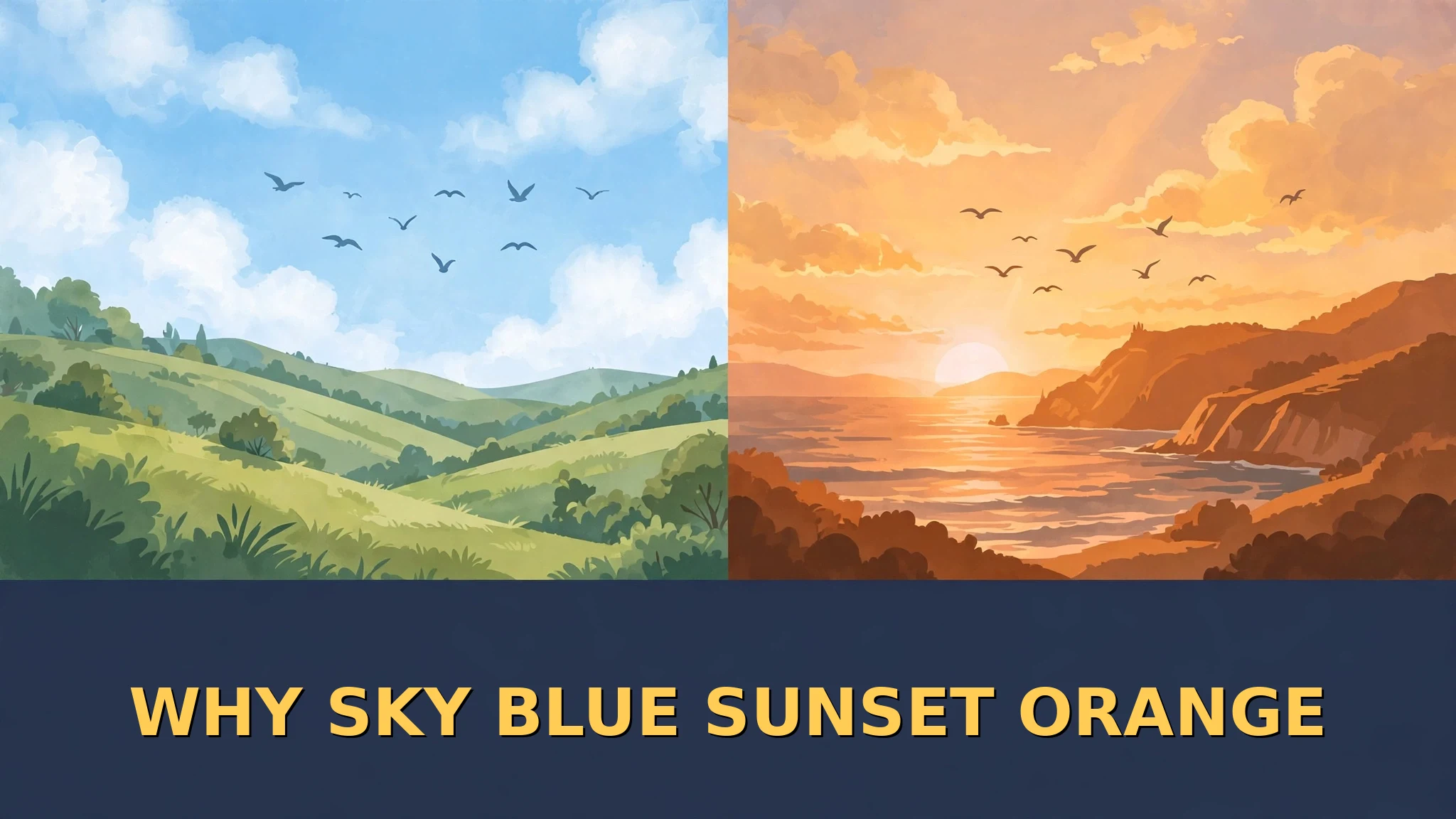
And here is its twin brother: if the sky is blue at lunch time, why does the very same sky turn orange, pink and red in the evening, as if somebody quietly changed the painting? The Sun did not change. The air did not change. So what changed?
The answer is a small, beautiful piece of physics happening above your head right now. Once you understand it, you will never look at a sunset the same way again.
Sunlight Looks White but Hides Every Colour
Sunlight shines on your hand and looks plain white. But that whiteness is a disguise. NASA explains that the light from the Sun looks white, but it is really made up of all the colours of the rainbow. A piece of glass called a prism can prove it: when white sunlight passes through a prism, it comes out split into its separate colours — red, orange, yellow, green, blue and violet.
Those colours are light travelling in waves, and the waves are different sizes. This is the key to the whole mystery, so let us go slowly. Imagine the sea. Some waves are short and choppy, bumping up and down quickly. Others are long and lazy, rolling in slowly. Light behaves in a similar way: blue light travels in short, small waves, while red light travels in long waves. The National Weather Service puts it in the same order — red light has the longest wavelength, and blue and violet light have much shorter wavelengths.
So sunlight arriving at Earth is a mixed crowd: long red waves, medium green and yellow waves, and short blue waves, all travelling together. The next question is what the air does to this crowd.
What Is Rayleigh Scattering in Simple Words?
The air around Earth — our atmosphere — is full of tiny gas molecules, mainly nitrogen and oxygen. These molecules are far smaller than the waves of light travelling through them.
When sunlight enters the atmosphere, it collides with these molecules, and the light gets scattered — thrown off in different directions, like a ball bouncing away after hitting a post. Scientists call this kind of scattering Rayleigh scattering, after Lord Rayleigh, the scientist who explained it. NASA’s Space Place describes it plainly: sunlight reaches Earth’s atmosphere and is scattered in all directions by all the gases and particles in the air.
But the scattering does not treat all colours equally. The National Weather Service explains that because air molecules are much smaller than the wavelength of visible light, they scatter the shorter wavelengths much more than the longer ones. In everyday language: blue light, with its short, choppy waves, gets bounced around easily and strongly, while red light, with its long, lazy waves, mostly sails straight through.
Picture two balls thrown at a field of small posts. A tiny, light ball bounces off in a new direction again and again; a big, heavy ball rolls on almost straight. Blue light is the tiny bouncy ball. Red light is the big heavy one.
Why the Sky Is Blue in the Daytime
Now put the pieces together. At midday the Sun is high, and its light pours down through the air above you. The blue part of that light gets scattered in every direction by the air molecules — up, down, left, right, everywhere. Wherever you look in the sky, some of that scattered blue light is arriving at your eyes.
That is the whole secret. The sky is not blue because it is painted blue, and not because it reflects the sea. It looks blue because the air itself is busy throwing blue light into your eyes from every direction. NASA’s short answer is the same: blue light is scattered more than the other colours because it travels as shorter, smaller waves, and that is why we see a blue sky most of the time.
The reds and yellows are up there too. They simply travel straighter, arrive with the direct sunlight, and do not spread themselves across the whole sky the way blue does.
Why the Sky Is Not Violet
A clever question hides here. Violet light has even shorter waves than blue. If short waves scatter the most, why is the sky not violet?
NASA answers neatly: even though violet light is scattered even more than blue, our eyes are more sensitive to blue, and there is less violet in sunlight to begin with. So the mixture reaching our eyes is read by our brains as blue. The sky’s colour is, in a sense, a team decision between physics and the human eye.
Why Sunsets Turn Orange and Red
Now let the day end. The Sun sinks low, close to the horizon — and everything changes, not because the light changed, but because its road got longer.
When the Sun is overhead, its light takes a short path through the atmosphere. At sunset, that light must travel through a much thicker layer of air to reach you. NASA describes it exactly so: as the Sun gets lower in the sky, its light passes through more of the atmosphere to reach you.
Over that long journey, the bouncy blue light gets scattered again and again — so much of it is thrown away in other directions that very little blue remains in the light travelling straight towards you. The National Weather Service agrees: the shorter-wavelength blue light is scattered further as sunlight passes over a greater distance, and we are left seeing the longer wavelengths — the reds and oranges — that create those beautiful sunset and sunrise colours.
So an orange sunset is not the Sun changing colour. It is the blue being taken out of the light, step by step, along a very long road through the air. What survives the journey — red, orange and yellow — is what reaches your eyes and sets the evening sky on fire.
Dust can make the show even stronger. NASA notes that when the whole western sky seems to glow red, small particles of dust, pollution or other aerosols in the air also scatter blue light, leaving more purely red and yellow light to pass through. That is why some evenings burn a deep, dramatic red while others fade in soft gold.
Why Clouds Turn Pink and Red at Sunset
One more piece of the evening magic: the clouds. In the daytime, clouds look white because they receive the full mixture of sunlight and reflect all of it back to us.
At sunset, the mixture arriving is no longer full. The blue has been scattered away on the long road, so the light now falling on the clouds is rich in red, orange and pink. The clouds simply show us the colour of the light shining on them — the same reason a white shirt looks orange under an orange lamp.
High clouds catch this coloured light even after the Sun has dropped below the horizon for people on the ground. That is why the sky’s last glow often lives in the clouds: soft pink first, then deeper red, then grey as the light finally leaves.
Why the Sky Looks Pale Near the Horizon
You may have noticed that even at midday, the sky is a rich blue high above you but pale, almost white, near the horizon. That is the same story from another angle.
Light from the horizon has travelled through much more air than light from overhead. Along that longer path, blue light is scattered and re-scattered many times, and Earth’s surface reflects and scatters light too. All this extra scattering mixes the colours back together, NASA explains, so near the horizon we see more white and less blue.
Look up, and you see the scattering at its purest. Look sideways, and you see it diluted.
One Sky, One Simple Trick of Light
So the next time a child asks why the sky is blue, you have a real answer that takes one breath. Sunlight is many colours travelling together. The air throws the short blue waves in every direction, so the whole sky glows blue. And at sunset, the light travels such a long road through the air that the blue gets scattered away before it arrives, leaving the long red and orange waves to finish the journey alone.
Blue sky and red sunset are not two different tricks; they are one trick seen at two different hours. The National Weather Service makes the same point in its own guide: one scattering process, working all day long, gives us both the blue of noon and the fire of evening. One Sun, one sky, one beautiful piece of physics — performed fresh for you every morning and evening, free of charge.
Frequently Asked Questions
Is the sky blue because it reflects the ocean? No. The colour comes from the air itself: air molecules scatter blue sunlight in all directions, so blue light reaches your eyes wherever you look. The sky would be blue even far from any sea.
What is Rayleigh scattering, in one line? It is the scattering of sunlight by tiny air molecules, in which short blue waves are scattered much more strongly than long red waves. It is named after the scientist Lord Rayleigh.
Why do some sunsets look redder than others? Dust and other small particles in the air scatter even more blue light away, leaving purer red and yellow light. Evenings with more dust in the air often produce deeper red skies.
Why is the sky near the horizon almost white at midday? Light from that direction crosses much more air, and the blue light is scattered and re-scattered so many times that the colours mix back together towards white.
Is the sky blue on other planets? Not necessarily — it depends on what is in the atmosphere. NASA points out that Mars has a very thin, dusty atmosphere, so its daytime sky looks orange or reddish, while at sunset the sky around the Sun there takes on a blue-grey tone — almost the opposite of Earth.
Sources
- NASA Space Place — Why Is the Sky Blue?: https://spaceplace.nasa.gov/blue-sky/en
- National Weather Service (NOAA) — Why Is the Sky Blue?: https://www.weather.gov/fgz/SkyBlue
- The picture on this page is an original illustration made for Talha M Blog.