The Amazon Jungle: Inside the Last Wild Corner of Earth
A journey into the Amazon rainforest — the giant river with no bridges, pink dolphins, tribes that have never met the outside world, flying rivers in the sky, and the desert dust that feeds it all. The full story in simple English.
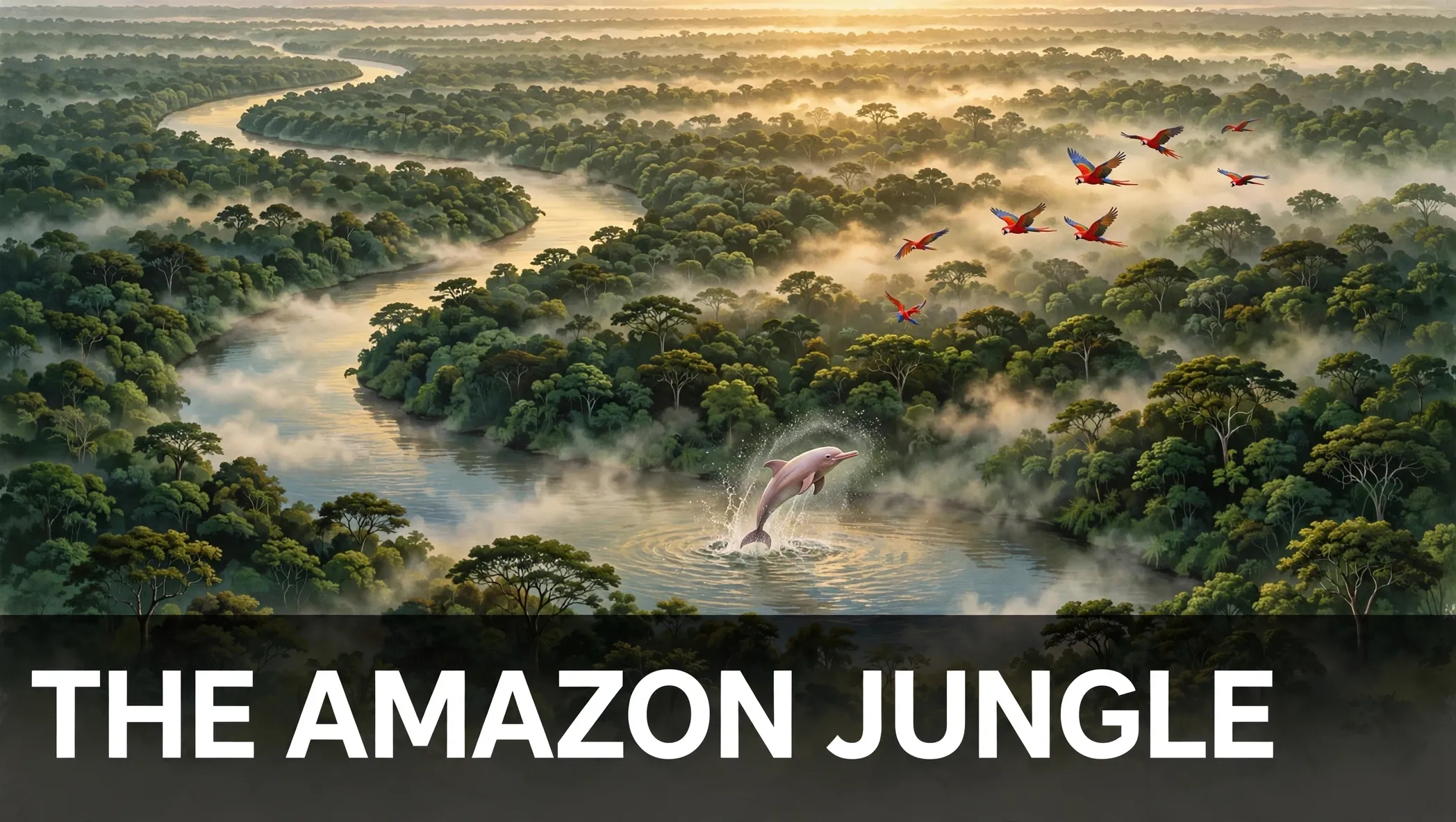
Stand in the middle of the Amazon rainforest at noon, and you will not see the sun. The trees above you are so tall and so tightly woven together that the light dies before it reaches the ground — less than two percent of it ever touches the forest floor. It rains almost every day, yet much of that rain never lands on you either; it is caught by leaves sixty metres above your head. Around you is the sound of ten thousand living things you cannot see. Under your feet, one teaspoon of soil can hold more life than there are people in a small town.
This is the largest rainforest on Earth — a green ocean bigger than most continents, home to one in every ten species alive today, crossed by a river so wide that in places you cannot see the other side, and so wild that not a single bridge crosses it. There are tribes inside it who have never spoken to the outside world. There are rivers in its sky. And strangest of all, scientists say this mighty forest survives partly because of dust blown across an ocean from a desert on the other side of the planet.
Welcome to the Amazon — the last truly wild corner of the Earth. This is its full story.
Quick facts first
- Size: about 6.7 million square kilometres of rainforest — roughly twice the size of India, covering about 40 percent of South America
- Countries: 9 — Brazil (about 60 percent), Peru (about 13 percent), Colombia (about 10 percent), plus Bolivia, Ecuador, Venezuela, Guyana, Suriname and French Guiana
- Trees: an estimated 390 billion trees of about 16,000 species
- Species: home to about 10 percent of all known species on Earth — including some 2.5 million insect species, 40,000 plant species, 1,300 bird species and more than 3,000 freshwater fish species
- The river: about 6,400 kilometres long by the most accepted measure, and the largest river on Earth by the volume of water it carries
- People: about 47 million people live in the Amazon region, including more than 2 million Indigenous people from hundreds of different groups
A forest the size of a continent
Numbers like “6.7 million square kilometres” are hard for the mind to hold, so try it this way instead. If the Amazon rainforest were a country, it would be the seventh largest country on Earth. You could fit the whole of Pakistan inside it more than eight times over. You could fit the United Kingdom inside it more than twenty-five times. And almost all of it is one unbroken, breathing carpet of green.
The forest is so old that dinosaurs walked under its ancestors’ trees — its roots go back tens of millions of years. It sits on the equator, where the sun is strong and the rain is heavy all year round, with about three metres of rainfall a year in many areas. This endless water and warmth is exactly why life exploded here into a variety found nowhere else.
The river that behaves like a sea
Every great forest has a heart, and the Amazon’s heart is its river.
The Amazon River begins as melting snow and small streams high in the Andes mountains of Peru. From there it flows east for roughly 6,400 kilometres — some scientists, measuring differently, argue it may stretch past 7,000 kilometres and even beat the Nile as the longest river on Earth. That argument has run for years and is still not fully settled. What nobody disputes is the volume: the Amazon pours out around 209,000 cubic metres of water every single second on average — more water than the next seven largest rivers on the planet combined. About one fifth of all the river water that flows into the world’s oceans comes out of this one river’s mouth.
The river has around 1,100 tributaries — rivers feeding into it — and two of the ten biggest rivers on Earth by water volume are actually Amazon tributaries. In the rainy season, parts of the main river swell to tens of kilometres wide. Old sailors called it “the River Sea”, and standing on its bank, watching brown water run to a horizon with no far shore, you understand why.
And here is the fact that surprises everyone: there is not one single bridge across the Amazon River’s main channel — not one, in its entire length. It is not only the width. For most of its journey the river passes through deep forest where there are few roads and even fewer cities, and the people who live along it travel the way they always have: by boat. The river is not an obstacle to cross. The river is the road.
Near the city of Manaus, two great rivers meet in one of nature’s strangest sights, called the Meeting of Waters. The Rio Negro runs dark, almost black, from swampy forest lands. The Solimões runs pale and sandy. Where they join, the two waters flow side by side for about six kilometres without mixing — a dark river and a light river sharing one bed, divided by a line you can see from a boat, because they differ in temperature, speed and density. Only after kilometres of travelling together do they finally blend into one.
Four worlds stacked on top of each other
The Amazon is not one forest. It is four worlds stacked in layers, each with its own citizens.
High above everything stand the emergents — giant trees like the kapok that punch through the roof of the forest to heights of sixty metres or more, standing in full sun and wind, watched over by harpy eagles, among the most powerful birds of prey alive.
Below them is the canopy, the true roof of the jungle — a continuous green ceiling of leaves where most of the forest’s life actually lives: monkeys, sloths, toucans, macaws in screaming colours, and more insects than science has names for. Most of these animals are born, eat, sleep and die without ever touching the ground.
Under that roof lies the understory — a dim, humid world of young trees, giant leaves stretched wide to catch the little light that falls, and jaguars moving like shadows.
And at the bottom is the forest floor, where less than two percent of the sunlight arrives, where fungi and armies of ants recycle every fallen leaf and dead tree back into life. Almost nothing is wasted in the Amazon. Death is dismantled within days and fed back into the green.
The creatures: a cast no imagination could invent
If a film-maker invented the Amazon’s animals, audiences would laugh at the exaggeration.
There is the jaguar, the third-largest big cat on Earth and the king of this forest — a cat that, unusually, loves water, swims powerfully, and kills with a bite through the skull. There is the pink river dolphin, the boto, largest of the world’s river dolphins, born grey and turning pinker with age, bending its neck in ways sea dolphins cannot, hunting fish among the flooded trees. There is the green anaconda, the heaviest snake on Earth, which can grow beyond five metres and squeeze the life out of caimans and capybaras in the black water.
There is the arapaima, a fish like a living dinosaur, armoured in huge scales, which can reach around three metres and must rise to the surface to breathe air. There are piranhas, famous far beyond the truth — they are mostly shy scavengers, and attacks on humans are rare — and there are poison dart frogs, tiny jewels of gold, blue and red, whose skin carries poison that Indigenous hunters once used on their blowpipe darts. There are sloths so slow that algae grows in their fur, turning them green and invisible. There are harpy eagles with talons the size of a grizzly bear’s claws. There are leaves that walk (insects in disguise), birds that stink (the hoatzin, which digests leaves like a cow), and giant water lilies — Victoria amazonica — whose floating leaves can stretch about three metres across and are ribbed strongly enough, it is often said, to hold the weight of a small child.
And this is only what we know. Scientists estimate that the great majority of the Amazon’s species — especially insects and fungi — have never been described by science at all. New species are still being found every year: new frogs, new fish, new monkeys. The forest is a library most of whose books nobody has opened.
The people of the forest
The Amazon is not empty, and it never was.
About 47 million people live in the region. Most live in cities that outsiders forget exist — places like Manaus, a city of over two million people sitting deep in the Brazilian forest, and Iquitos in Peru, often called the largest city in the world that no road reaches: you can only arrive by plane or by boat.
Beyond the cities live more than 2 million Indigenous people, belonging to roughly 385 different groups, speaking hundreds of languages. Their knowledge of the forest is unmatched — which plants heal, which poison, which fruits feed, which seasons turn. A large share of the ingredients in modern medicines traces back to rainforest plants — scientists often estimate about a quarter of modern medicine’s ingredients have rainforest origins — and much of that knowledge began with Indigenous healers.
And then there are the most mysterious people on Earth: the groups in voluntary isolation — often estimated at more than one hundred in the Amazon, the majority of all such groups in the world. They are the descendants of people who met the outside world generations ago and chose, after violence and disease, to refuse it forever. They live as their ancestors did, hunting with bows, moving through forests they know leaf by leaf. Brazil and Peru protect their lands by law, and the rule is simple and strict: they are not to be contacted. They know we exist. They have made their answer clear. In a world where every square metre is mapped by satellite, these are the last people living completely outside it — inside the last wild corner.
How the Amazon got its name — and the golden city that never was
The forest’s name comes from a battle. In 1541–42, the Spanish explorer Francisco de Orellana became the first European to travel the river’s whole length, on an expedition that had set out hunting El Dorado, the legendary city of gold. Along the way, his men fought a fierce battle against local warriors — among whom, Orellana reported, women fought alongside the men. It reminded him of the Amazons, the women warriors of Greek myth. The river took their name. Then the forest did.
El Dorado was never found, because it never existed. But the greed it woke never died. Wave after wave of outsiders came for the Amazon’s riches — and one of those waves built something so unlikely that it sounds like fiction.
The opera house in the jungle
In the late 1800s, the world suddenly needed rubber — for bicycle tyres, then car tyres — and rubber trees grow wild in the Amazon. For a few wild decades, the jungle produced almost all the world’s rubber, and money flooded into Manaus, the port city in the forest’s heart. Rubber barons grew so rich that, the story goes, they sent their laundry to Europe to be washed.
And in 1896, in a city reachable only by river, surrounded by a thousand kilometres of jungle in every direction, they opened the Amazon Theatre — a grand opera house built with marble, glass and steel shipped across the Atlantic and up the river. Italian opera companies travelled for weeks to perform in the middle of the rainforest for rubber millionaires.
The boom died as suddenly as it came. Rubber seeds were taken out of Brazil and planted in vast plantations in Asia, where trees grew in neat rows, free of the diseases that plagued them at home. Prices collapsed. Manaus faded. The opera house fell silent for decades — though today it sings again, hosting an annual opera festival in the jungle, perhaps the most improbable concert hall on Earth.
America tried its own Amazon dream a generation later. In 1928, car maker Henry Ford built an entire American town in the Brazilian forest — Fordlândia — with neat houses, a hospital, a golf course and strict rules, all to grow rubber for his tyres. The forest defeated him: the planted trees were ravaged by the leaf disease that wild, scattered trees naturally escape, local workers rebelled against the rules, and the project was abandoned. Fordlândia’s ruins still stand in the jungle — a ghost town built by the richest man of his age, beaten by trees.
The rivers in the sky — and the desert that feeds the forest
Here is where the Amazon’s story becomes almost unbelievable, because the forest does not end at its own edges. It reaches across a continent — and across an ocean.
A single giant Amazon tree can release more than a thousand litres of water into the air in a day, drawn up from the soil and breathed out through its leaves. Multiply that by 390 billion trees, and the forest pours an ocean of vapour into the sky — so much that scientists call these air-currents “flying rivers”. These invisible rivers carry moisture from the Amazon across South America, watering farmland and filling reservoirs thousands of kilometres away. Cut down too much forest, scientists warn, and the flying rivers weaken — and rain fails in places that never knew their water came from trees.
And the forest itself is fed from the sky in return. Every year, winds carry enormous quantities of dust from the Sahara Desert — from a dried lake bed in Chad especially rich in phosphorus — across the entire Atlantic Ocean, and rain washes it down onto the Amazon. NASA scientists have calculated that roughly 22,000 tonnes of phosphorus arrive this way each year, replacing almost exactly the amount the forest loses, washed away by its own rains and rivers. The greatest desert on Earth is fertilising the greatest forest on Earth. The two most extreme landscapes on the planet are holding each other up.
The truth about “the lungs of the Earth”
You have probably heard the Amazon called “the lungs of the Earth”, producing 20 percent of the world’s oxygen. Scientists will tell you this is a half-truth, and the real truth is more interesting.
The forest’s photosynthesis does produce a large amount of oxygen — but the forest also breathes: its trees, animals, fungi and microbes consume almost all of that oxygen back as things grow, rot and decay. The net gift of oxygen to the world is close to zero. The Amazon is not really Earth’s lungs.
It is something more like Earth’s air conditioner and water pump. Its trees hold an almost unimaginable store of carbon — scientists estimate 150 to 200 billion tonnes of it locked in wood and soil, carbon that would flood the sky and heat the planet if the forest burned or died. Its flying rivers shape the rains of a continent. Its dark green surface cools the land beneath it. The forest does not keep the world breathing. It keeps the world stable.
Which is why what is happening to it matters to people who will never see it.
The danger: a forest can die of thirst
In the last fifty years, about 17 percent of the Amazon forest has been destroyed — cut or burned, mostly for cattle pasture, farms, roads, mines and timber. Each year’s fires are visible from space. And scientists who study the forest, among them some of Brazil’s most respected researchers, warn of a tipping point: if total loss reaches roughly 20 to 25 percent, the forest may no longer be able to make its own rain. The flying rivers would falter, the east and south of the forest would dry into savanna — grassland — and a dying forest would release its stored carbon instead of holding it. A savanna cannot shelter jaguars, pink dolphins and a tenth of the world’s species. The library would burn with most of its books unread.
Against this stands an army of the hopeful: Indigenous peoples, whose protected lands consistently lose far less forest than surrounding areas; park rangers and scientists; governments that, in stronger years, have slowed deforestation sharply; and millions of ordinary people worldwide who buy, vote and donate with the forest in mind. The Amazon’s fate is not sealed. Forests that took sixty million years to grow can be lost in a human lifetime — or defended for all the lifetimes after ours. That choice is being made right now, tree by tree.
Why a reader thousands of miles away should care
Perhaps you are reading this in a busy city, in Multan or Manchester or Minneapolis, and the Amazon feels like another planet. But its air-currents touch the weather of a hemisphere. Its carbon store guards the climate of every farm on Earth, including the ones that grow your food. Its plants hold medicines not yet discovered for diseases not yet cured. And its sheer existence — the knowledge that somewhere on this crowded planet there is still a forest where the river has no bridges, where dolphins are pink, where whole peoples live free of our world by their own choice — is worth something all by itself.
The explorers who named it went looking for a city of gold. They never found it. They were standing in something far richer the whole time: a green treasure no vault could hold, that pays its wealth out to the entire Earth — in rain, in cool air, in medicine, in wonder — every single day.
The Amazon is still there. The last wild corner is still wild. The question of our century is simply whether it stays that way.
Frequently Asked Questions
Where is the Amazon rainforest? In northern South America, spread across nine countries: Brazil (about 60 percent), Peru, Colombia, Bolivia, Ecuador, Venezuela, Guyana, Suriname and French Guiana. It covers about 6.7 million square kilometres — around 40 percent of the continent.
How long is the Amazon River, and is it the longest river in the world? Its most accepted length is about 6,400 kilometres, usually ranked second behind the Nile — though some studies argue it is longer. By water volume there is no contest: it is the largest river on Earth, carrying more water than the next seven largest rivers combined, and there is not a single bridge across its main channel.
Does the Amazon really produce 20 percent of the world’s oxygen? Not in the way most people mean. The forest produces a great deal of oxygen but uses almost all of it itself as plants and animals live, rot and decay. Its true global gifts are storing 150–200 billion tonnes of carbon, cooling the land, and driving rainfall through its “flying rivers”.
What animals live in the Amazon? Jaguars, pink river dolphins, green anacondas, sloths, harpy eagles, poison dart frogs, piranhas, giant arapaima fish, giant water lilies you could almost stand on — and an estimated tenth of all known species on Earth, most of its insects still unnamed by science.
Do uncontacted tribes really live there? Yes. More than one hundred groups are estimated to live in voluntary isolation in the Amazon — the largest number anywhere in the world. They are protected by law in countries like Brazil and Peru, and contacting them is forbidden: they have made their choice to live apart.
Why is the Amazon in danger? About 17 percent has already been cut or burned, mainly for cattle, farms, mining and roads. Scientists warn that at around 20–25 percent loss, the forest may fail to make its own rain and begin turning into dry savanna, releasing its vast stored carbon — which is why protecting it matters to the whole planet.
Sources: Encyclopaedia and scientific references on the Amazon basin, NASA research on Saharan dust fertilisation, and WWF and research-institute figures on Amazon biodiversity and deforestation, summarised October 2026.