Thomas Vinterberg: The Life Story Behind the Another Round Director
In this post
Thomas Vinterberg is a director who likes to put real people in real rooms and let the truth come out. His films are about families, about friends, about men who drink too much, about teachers, about children, and about the small moments that change a life. He made his name with The Celebration, a film about a family dinner that turns into a nightmare, and he went on to make The Hunt, about a man falsely accused, and Another Round, about four teachers who decide to drink every day, which won him an Academy Award. His films are not loud or showy. They are honest, and they are human.
He was born in Copenhagen, Denmark, and he grew up in a home where film and theatre mattered. He studied at the Danish National Film School, and he became one of the youngest directors to graduate from it. He was part of Dogme 95, a movement that said films should be made simply, without tricks, and with real light and real sound. That idea shaped his whole career, and it is why his films feel so close and so real, as if you are sitting in the room with the characters.
What makes his story worth telling is the mix of success and sorrow in it. He won an Oscar, he was praised around the world, and he also lost his daughter Ida in a car accident in 2019, a loss that changed his life and his work. This is the story of a Danish director who became one of the most respected filmmakers in Europe, by telling stories about real people, in a real way, and by keeping going through the hardest time of his life.
A Childhood in Copenhagen
Thomas Vinterberg was born on 19 May 1969 in Copenhagen, Denmark. He grew up in the Danish capital, a city known for its bicycles, its harbour, and its long tradition of film and theatre. His family lived a life where culture was part of everyday life, where films were watched, books were read, and ideas were discussed. Thomas was a curious child, and he loved stories. He liked to watch films, he liked to make up stories of his own, and he liked to think about how people behaved when no one was watching.
As a boy, he was interested in the world around him, and he was especially interested in people. He watched the way adults talked to each other, the way they hid their feelings, and the way they pretended to be happy when they were not. That interest in people stayed with him, and it later became the heart of his films. His films are not about superheroes or about fantasy. They are about ordinary people, in ordinary rooms, trying to live their lives, and that is why they feel so real.
When he was a teenager, he began to think more seriously about film. He made short films, he watched the work of other directors, and he dreamed of going to film school. He was not yet sure he could make a living from it, but he knew that film was where he felt most alive. He applied to the Danish National Film School in Copenhagen, one of the most respected film schools in Europe, and he was accepted. He studied there, and he graduated in 1993, at the age of twenty-four, as the youngest director to graduate from the school at that time.
His time at film school was important, because it was where he met other young filmmakers, including Lars von Trier, who would become a close friend and a collaborator. They talked about film, about what was wrong with it, and about how it could be made better. Those conversations led to Dogme 95, a movement that would change Danish cinema, and that would change Thomas’s life. He was young, he was ambitious, and he was ready to make films that were different from anything that had come before.
Film School, Dogme 95 and a New Kind of Cinema
Thomas studied at the Danish National Film School, and he graduated in 1993 with a short film called Last Round, which won awards and brought him to the attention of the Danish film world. He was a young director with a clear voice, and he was not afraid to take risks. He made films about young people, about love, about friendship, and about the search for meaning, and he did it in a style that was direct and honest.
In 1995, Thomas and Lars von Trier, along with other Danish directors, created Dogme 95, a set of rules for making films. The rules said that films should be shot on location, with a handheld camera, with natural light, with no special effects, with no music that was not part of the scene, and with no tricks. The idea was to strip film back to its basics, to focus on the story and the acting, and to get rid of the gloss and the glamour that had come to dominate cinema. It was a bold idea, and it was controversial, but it also inspired filmmakers around the world.
Thomas’s first feature film under the Dogme rules was The Celebration, known in Danish as Festen, released in 1998. It was the first Dogme film, and it became a huge success. The film was about a family gathering at a country hotel, where a son reveals that his father abused him and his twin sister as children. It was a shocking film, and it was also a powerful one, about family, about secrets, and about the pain of telling the truth. It won the Jury Prize at the Cannes Film Festival, and it brought Danish cinema to the attention of the world.
The Celebration made Thomas famous, and it made him one of the most talked-about young directors in Europe. He was twenty-nine years old, and he had made a film that changed Danish cinema. But fame also brought pressure, and his next films did not have the same success. He made It’s All About Love in 2003, a science fiction film, and Dear Wendy in 2005, a film about young people and guns, and neither film was as successful as The Celebration. He was learning that success does not last forever, and that a director has to keep working, keep learning, and keep finding new stories to tell.
The Celebration and the Price of Truth
The Celebration is a film that is hard to watch, and hard to forget. It takes place over one weekend, at a hotel in the Danish countryside, where a wealthy family has gathered to celebrate the sixtieth birthday of the father, Helge. His son Christian stands up to make a speech, and instead of praising his father, he tells the guests that his father abused him and his twin sister, Linda, when they were children. The room goes silent, the family tries to pretend it did not happen, and Christian has to say it again, and again, until the truth cannot be ignored.
Thomas directed the film with a handheld camera, with natural light, and with no music, following the Dogme rules. The result was a film that felt like real life, as if the audience was sitting in the room with the family, watching a terrible secret come out. The actors, including Ulrich Thomsen as Christian and Henning Moritzen as Helge, gave powerful performances, and the film was praised by critics around the world. It won the Jury Prize at Cannes, and it was nominated for many other awards.
The film was also a turning point for Danish cinema. It showed that a small country could make a film that was as powerful as anything in the world, and it inspired other filmmakers to try the Dogme rules. Thomas became a symbol of a new Danish cinema, a cinema that was honest, brave, and unafraid to talk about difficult subjects. He was proud of that, but he also knew that it was a lot to live up to. His next films would be judged against The Celebration, and that was a hard standard to meet.
In the years that followed, Thomas continued to make films, but he also learned that a director’s life is not always easy. He made films in Denmark and in other countries, he worked with different actors, and he kept searching for stories that mattered to him. He did not want to repeat The Celebration. He wanted to make new films, about new people, in new ways. That search took him many years, and it led him to some of his best work, including The Hunt and Another Round.
The Hunt and a Man Falsely Accused
In 2012, Thomas directed The Hunt, known in Danish as Jagten, a film about a kindergarten teacher named Lucas, played by Mads Mikkelsen, who is falsely accused of abusing a child. The film follows Lucas as his life falls apart, as his friends turn against him, as his community rejects him, and as he tries to prove his innocence in a world that has already decided he is guilty. It was a powerful film, about the danger of rumours, about the power of a lie, and about how quickly a community can turn on one of its own.
The Hunt was a huge success. It was shown at the Cannes Film Festival, where Mads Mikkelsen won the award for Best Actor, and it was nominated for an Academy Award for Best Foreign Language Film. Critics praised Thomas for his direction, for his ability to tell a difficult story with honesty and with restraint, and for his work with Mads Mikkelsen, who gave one of the best performances of his career. The film brought Thomas back to the top of Danish cinema, fourteen years after The Celebration, and it showed that he was still one of the best directors in Europe.
The film also showed how much Thomas had grown as a director. He was no longer the young man who had made The Celebration. He was a mature filmmaker, a father, and a man who understood the pain of being falsely accused, of being judged by people who do not know the truth. He directed the film with care, with patience, and with a deep understanding of human nature. He did not shout. He let the story speak for itself, and that was why it was so powerful.
After The Hunt, Thomas directed Far from the Madding Crowd in 2015, an English-language adaptation of the novel by Thomas Hardy, about a woman named Bathsheba Everdene, played by Carey Mulligan, who inherits a farm and has to choose between three men who love her. The film was a success, and it showed that Thomas could work in English, with British actors, and in a different kind of story. He was becoming an international director, and he was respected in many countries.
Another Round, an Oscar and a Loss
In 2020, Thomas directed Another Round, known in Danish as Druk, a film about four high school teachers in Denmark who decide to test a theory that humans are born with too little alcohol in their blood, and that they should drink a small amount every day to feel better. The film follows the teachers, played by Mads Mikkelsen and others, as they drink, as they feel happier at first, and as their lives slowly fall apart. It was a funny film, and a sad film, and a film about friendship, about middle age, and about the search for joy in a life that has become routine.
Another Round was a huge success. It won the Academy Award for Best International Feature Film in 2021, and it won the BAFTA for Best Film Not in the English Language. Mads Mikkelsen won awards for his performance, and Thomas won praise for his direction. The film was shown around the world, and it became one of the most talked-about films of the year. It was a triumph for Thomas, and for Danish cinema.
But the film was also marked by a terrible loss. Thomas’s daughter Ida, who was nineteen years old, died in a car accident in 2019, while the film was being made. Ida had been due to appear in the film, and her death changed everything. Thomas has spoken about the loss with great honesty, saying that it was the hardest thing he has ever faced, and that it changed the film, and changed him. He dedicated the film to Ida, and he has said that making the film helped him to keep going, to find a reason to get up in the morning, and to honour his daughter’s memory.
The loss of Ida is a part of Thomas’s story that must be told with respect. He does not talk about it lightly, and he does not use it to sell his films. He talks about it when he feels it is right, and he talks about it with love for his daughter. His story is not just about success. It is also about grief, about loss, and about the way a person can keep working, keep living, and keep loving, even after the worst thing has happened. That is a brave story, and it is one that many people admire.
A Director Who Keeps Going
Thomas Vinterberg continues to work as a director, in Denmark and in other countries. He has directed films in Danish and in English, he has worked with some of the best actors in the world, and he has won some of the most important awards in film. He is now in his fifties, and he is still learning, still growing, and still searching for stories that matter to him. His films are about real people, in real rooms, trying to live their lives, and that is why they feel so true.
He has also worked as a writer, and he has taught at film schools, sharing his knowledge with young filmmakers. He is a mentor to many young directors, and he is respected for his willingness to help others. He believes that film is a collaborative art, and that a director should listen to the actors, to the crew, and to the story itself. That belief is at the heart of his work, and it is why his films feel so human.
His influence on Danish cinema is large. He was part of Dogme 95, which changed Danish film, he made The Celebration, which brought Danish cinema to the world, and he made Another Round, which won an Oscar. He has shown that a Danish director can make films that are seen around the world, and that are loved by audiences in many countries. He is proud of Denmark, and he often talks about it, about its culture, and about the way it shaped him.
As he moves into his late fifties, Thomas is still a working director, still choosing projects, still learning. His story is not finished, and his fans wait with hope for whatever he does next. He is a director, a father, and a man who has faced the hardest loss a parent can face and kept going, and his story is one of the most inspiring in European film. He shows that a good film can come from a real place, and that a real life, with all its joy and its pain, is the best material for a story.
Far From the Madding Crowd and Working in English
After The Hunt, Thomas Vinterberg directed Far from the Madding Crowd in 2015, an English-language film based on the novel by Thomas Hardy, about Bathsheba Everdene, a young woman in Victorian England who inherits a farm and must choose between three men who love her: a shepherd, a soldier, and a wealthy farmer. The film starred Carey Mulligan as Bathsheba, and it was shot in the English countryside, with beautiful landscapes, with period costumes, and with a story about love, pride, and independence. It was a very different film from The Celebration or The Hunt, and it showed that Thomas could work in English, with British actors, in a period drama, and make it feel fresh and alive.
The film was a success, and it was praised for its beauty, for Carey Mulligan’s performance, and for Thomas’s direction. He brought the same honesty to a Victorian story that he had brought to modern Danish stories, and he showed that a good story is a good story, no matter when or where it is set. He did not try to make the film feel old or distant. He made it feel close, human, and real, as if the characters were people you could meet today. That is a gift, and it is one that few directors have.
He also directed other English-language projects, and he worked with actors from many countries, learning how to communicate across languages and cultures. He was becoming an international director, not just a Danish one, and he was respected in Britain and in America for his talent and his vision. But he never left Denmark behind. He continued to make films in Danish, he continued to work with Danish actors, and he continued to tell stories about Denmark. That balance, between Denmark and the world, is a big part of his career, and it is why his films feel both Danish and universal at the same time.
His work in English also taught him a great deal about himself as a director. He learned to listen more, to be patient, and to trust his actors, even when they spoke a language that was not his own. He learned that directing is not about giving orders. It is about creating a space where actors can be their best, where they feel safe, and where they can tell the truth. That belief is at the heart of his work, and it is why actors love working with him, in Danish and in English, in Denmark and abroad.
He has also become known for the way he works with children on set, for the patience he shows them, and for the care he takes to make them feel safe. In The Hunt, he worked with a young girl who played a key role, and he has talked about how important it was to protect her, to explain the story to her, and to make sure she understood that it was only a film. That care for young actors is a sign of a director who understands his responsibility, not just to the film, but to the people in it. Thomas takes that responsibility seriously, and it is one of the reasons actors trust him, and one of the reasons his films feel so honest.
My Take:
When I think about Thomas Vinterberg, the first thing I feel is respect for his honesty. His films do not hide from hard truths. The Celebration is about abuse in a family. The Hunt is about a false accusation. Another Round is about drinking, about middle age, about men who feel lost. These are not easy subjects, and many directors would avoid them. Thomas does not avoid them. He looks at them directly, and he tells the story with care and with compassion. That takes courage, and it is the kind of courage I admire most, because it is quiet, and it is honest, and it does not seek attention for itself.
I admire The Celebration most of all, because it is a film that changed the way I think about family. It shows a family that looks perfect on the outside, with a big house, a birthday party, and smiling guests, but that is broken on the inside, with a secret that has been hidden for years. When Christian stands up and tells the truth, the room goes silent, and I feel that silence in my chest. I have been in rooms where the truth was hard to say, and I know how much courage it takes to say it. Thomas directed that scene with such power that I felt I was in the room, and I will never forget it. That is what great directing does. It puts you in the room, and it makes you feel what the characters feel.
What moves me about The Hunt is the way it shows how quickly people can turn on each other. Lucas is a kind man, a good teacher, and a friend to everyone in his town. Then one lie, one rumour, spreads, and suddenly he is an outcast. His friends will not talk to him, his dog is killed, and he is beaten up in a shop. It is a painful film to watch, because it shows how fragile trust is, and how easily a community can destroy a person. I think about that film when I hear rumours about people, and I ask myself, do I know this is true, or am I just repeating what I heard? Thomas’s film teaches me to be careful, to listen, and to not judge too quickly. That is a valuable lesson, and I am grateful for it.
I also think about Another Round, and how it captures the feeling of being middle-aged and lost. The four teachers in the film are not young. They have jobs, they have families, and they feel that their lives have become routine. They drink to feel alive again, and at first it works. They laugh, they dance, they feel young. Then it stops working, and their lives fall apart. Mads Mikkelsen’s dance at the end of the film is one of the most joyful and sad moments I have ever seen in a film. It is a man who has lost so much, dancing anyway, because dancing is all he has left. Thomas directed that scene with such beauty that I cried. I think many people who are middle-aged will understand that feeling, of wanting to feel alive again, and of not knowing how to do it.
The loss of his daughter Ida is the part of his story that moves me most, and that I find hardest to write about. I do not want to use her death to make a point, because she was a real person, a young woman with a life ahead of her, and her death was a tragedy for her family. But I do want to say that I admire Thomas for keeping going after it, for finishing Another Round, and for dedicating it to her. That takes a strength that I cannot fully understand, because I have not lost a child. I can only imagine the pain, and I can only respect the way he has carried it, with honesty and with love. He did not hide from it. He talked about it, he made a film about life and joy, and he honoured his daughter by living, by working, and by loving. That is brave, and it is beautiful.
I also think about Dogme 95, and how bold it was for a group of young directors to say, we will make films without tricks, without special effects, without music, with only real light and real sound. That was a radical idea, and it changed cinema. It said that a film does not need a big budget to be good. It needs a good story, good actors, and honesty. Thomas believed that, and he made The Celebration under those rules, and it became a classic. That is a lesson for anyone who wants to make art. You do not need a lot of money. You need a true story, and the courage to tell it simply. I think that is a hopeful message, and I want to remember it.
If I have a sadness in his story, it is that his films after The Celebration did not always get the attention they deserved. He made good films, but the world did not always notice them, and he had to wait fourteen years for The Hunt to bring him back to the top. That is a long time to wait, and it must have been hard. But he kept working, he kept learning, and he kept believing in his stories. That patience is a lesson for all of us. Sometimes you have to work for a long time before the world sees you again, and that is all right, as long as you keep working and keep believing.
For a young reader, I think the lesson from Thomas is simple: tell the truth, even when it is hard. His films tell the truth about families, about communities, about men who drink, about people who lie, and about people who try to do the right thing. That truth is not always comfortable, but it is always important. If you want to make films, or write, or tell stories, tell the truth as you see it, and do it with care and with compassion. That is what Thomas does, and it is why his films last.
In the end, I think Thomas Vinterberg is a reminder that a film can be a kind of truth-telling. It can take a family dinner and turn it into a story about abuse. It can take a teacher and turn him into a story about rumours. It can take four friends and turn them into a story about joy and loss. That is a powerful thing, and it is why I admire him. I am grateful for his films, and I hope he keeps making them for many years to come. The world needs more directors like him, directors who are honest, brave, and true.
I also think about the way he works with actors, and how much they love him for it. Mads Mikkelsen has worked with Thomas in The Hunt, in Another Round, and in other films, and he has praised Thomas for his kindness, for his patience, and for his ability to create a safe space on set. That is a rare quality in a director, and it is one that matters a great deal. When actors feel safe, they take risks, they try new things, and they give better performances. Thomas creates that safety, not by being soft, but by being honest, by listening, and by trusting his actors. That trust is at the heart of his work, and it is why his films feel so real. The actors are not performing for the camera. They are living in the scene, and Thomas lets them do it.
There is another side to him that I want to mention, and that is his humour. His films are often sad, but they are also funny, in a dry and Danish way. Another Round is funny, even as it is sad, because the four teachers are funny men, trying to be young again, and their attempts are both hilarious and heartbreaking. The Celebration is funny too, in a dark way, because the family tries to pretend nothing is wrong, and their pretending is absurd. Thomas understands that life is both funny and sad at the same time, and he puts both into his films. That is a mature view of life, and it is one that I appreciate. He does not make films that are only sad, or only funny. He makes films that are both, just as life is both.
I also think about his work with Thomas Hardy, and how it shows his love of literature. Far from the Madding Crowd is based on a novel, and Thomas directed it with a respect for the book and a love of the story. He did not try to change it into something else. He tried to bring it to life, to make Bathsheba feel like a real woman, and to make the English countryside feel like a real place. That respect for a story, for a book, for a writer, is a sign of a director who loves stories, not just films. He is a storyteller first, and a filmmaker second, and that is the right order.
I think about the young directors who look at Thomas and see a role model. They see a man who made a film at twenty-nine that changed Danish cinema, who waited fourteen years for his next big success, who lost his daughter, and who kept going, and who won an Oscar at fifty-one. That story tells them that a career is long, that success does not come all at once, and that loss does not have to end a life. It tells them to keep working, to keep believing, and to keep telling stories that matter. I hope those young directors remember that, and I hope they keep going when they face hard times. Thomas did, and his story proves that it is possible.
I also want to say something about his friendship with Lars von Trier, because it is a big part of his story. They created Dogme 95 together, they argued, they challenged each other, and they pushed each other to be better. That friendship, with all its ups and downs, shaped Danish cinema, and it shaped both men. It shows that art is not made alone. It is made with friends, with collaborators, with people who challenge you and who believe in you. Thomas had that, and he used it well. I think about my own friends, and about the people who challenge me, and I feel grateful. Thomas’s story reminds me that we do not achieve things alone.
I also think about the way he treats the people who work for him, the crew, the actors, and the young filmmakers who look up to him. People who have worked with Thomas say that he is kind, that he listens, and that he creates a warm atmosphere on set, where everyone feels they are part of the film. That is a rare quality in a director, and it is one that matters a great deal, because a film is made by many people, not just by the director, and a director who respects his crew gets better work from them. Thomas respects his crew, and his films show it, in the care, in the detail, and in the warmth that comes through in every scene.
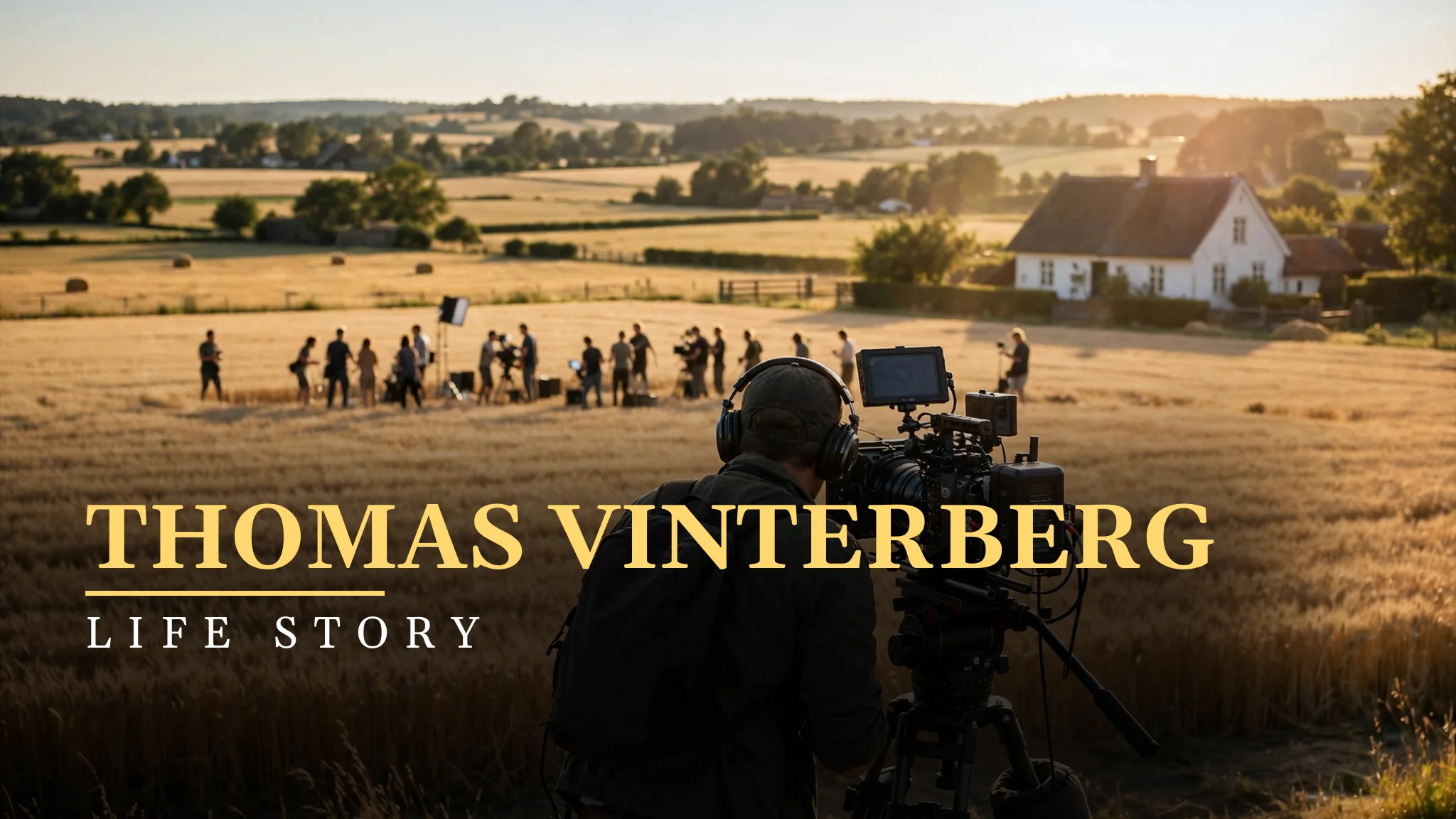
One more thought stays with me. I think about the wheat field in the image, with its golden light and its white farmhouse, and how it fits Thomas. His films are like that field: simple, golden, full of life, and rooted in the Danish countryside. They are not flashy, they are not loud, but they are beautiful, and they feed the people who watch them. I hope he keeps filming in those fields, keeps telling his stories, and keeps showing the world what Danish cinema can do. He is a director, but he is also a storyteller, and that is the best kind of director.
Frequently Asked Questions
Where was Thomas Vinterberg born and how old is he?
Thomas Vinterberg was born on 19 May 1969 in Copenhagen, Denmark, which makes him 57 years old in 2026. He grew up in Copenhagen, studied at the Danish National Film School, and graduated in 1993.
What is Thomas Vinterberg most famous for?
He is most famous for directing The Celebration in 1998, The Hunt in 2012, and Another Round in 2020. The Celebration won the Jury Prize at Cannes, The Hunt was nominated for an Oscar, and Another Round won the Academy Award for Best International Feature Film.
What is Dogme 95?
Dogme 95 was a set of rules created in 1995 by Thomas Vinterberg, Lars von Trier, and other Danish directors, saying films should be shot on location with a handheld camera, natural light, and no special effects or added music. The Celebration was the first Dogme film.
What is Another Round about?
Another Round, known in Danish as Druk, is about four high school teachers who decide to drink a small amount of alcohol every day to test a theory that it will make them feel better. The film, starring Mads Mikkelsen, is funny and sad, and it won the Oscar for Best International Feature Film in 2021.
What is The Hunt about?
The Hunt, known in Danish as Jagten, is about Lucas, a kindergarten teacher played by Mads Mikkelsen, who is falsely accused of abusing a child. The film follows his life falling apart as his community turns against him, and it was nominated for an Academy Award.
Did Thomas Vinterberg lose a daughter?
Yes, his daughter Ida died in a car accident in 2019, while Another Round was being made. She was nineteen years old and had been due to appear in the film. Thomas dedicated Another Round to her, and he has spoken about the loss with honesty and love.
What was Thomas Vinterberg’s first film?
His first feature film was The Celebration in 1998, though he graduated from film school in 1993 with a short film called Last Round. The Celebration was the first Dogme 95 film and it won the Jury Prize at the Cannes Film Festival.


