Man Sold Eiffel Tower Twice
In this post
- A Young Trickster Learns His Trade
- A Newspaper Story Gives Him A Wild Idea
- The Secret Meeting At The Hotel De Crillon
- Andre Poisson: The Perfect Victim
- Gone Within The Hour
- He Came Back And Tried It Again
- America: Bigger Games And A Gangster Fooled
- The Escape, Alcatraz, And The Quiet End
- The Tricks Scammers Still Use Today
- Sources
The Eiffel Tower cannot be bought. It belongs to the city of Paris, it is guarded by law, by history and by common sense, and no official on Earth has the power to sell it to a scrap dealer. Yet in 1925, one man sold it anyway. Then, when nobody stopped him, he came back and sold it a second time.
His name was Victor Lustig, and a Secret Service agent who finally caught him is reported to have called him the smoothest con man that ever lived. This is his most famous trick, told step by step — and at the end, we will look at the same tricks he used, because scammers are still using them on ordinary people today.
A Young Trickster Learns His Trade
Victor Lustig was born in 1890 in Austria-Hungary. He grew up clever, polished and fluent in several languages, and as a young man he found his hunting ground on the great ocean liners that carried rich travellers between Europe and America.
On those ships he perfected an early favourite trick: the money box. He would show a wealthy new friend a handsome wooden machine and demonstrate, in private, how it could copy a hundred-dollar bill. The friend watched one real bill go in and two come out — because Lustig had quietly loaded the machine beforehand. Eager buyers paid him around ten thousand dollars, sometimes two or three times that, for a worthless box. By the time they discovered the trick, the smooth gentleman had left the ship.
A Newspaper Story Gives Him A Wild Idea
The Eiffel Tower had been built in 1889 for the Paris Exposition, the great world’s fair. It was only ever meant to stand for a limited time, and by the 1920s it was already well past its expected lifespan. It was rusting. Paint, repairs and upkeep cost the city a fortune, and many Parisians openly said the ugly iron giant should simply be pulled down.
Lustig read a newspaper story about the tower’s expensive maintenance problems, and in his mind a door opened. If the whole city was already grumbling that the tower cost too much and might have to come down — why not be the man who quietly arranged its sale?
He researched the biggest scrap-metal dealers in Paris. Then he sent them letters on forged official stationery. The letters claimed he was a Deputy Director of the Ministry of Posts and Telegraphs, a senior government official, and they invited each dealer to a meeting about a matter of great importance. One condition was stressed above all: absolute secrecy.
The Secret Meeting At The Hotel De Crillon
The meetings took place at the Hotel de Crillon, one of the grandest hotels in Paris — exactly the kind of address that makes a government story feel real. There, in hushed and serious tones, Lustig delivered his news. The decision had been made, he said. The tower’s upkeep had become too costly, and the government would take it down. The right to demolish it, and to keep its roughly 7,000 tons of metal, would go to the dealer who offered the best bid.
But, he warned, the public must not hear a word of it yet. Parisians would be furious if they learned their beloved landmark was being sold behind closed doors. Everything had to stay secret until the deal was done.
Notice what the secrecy really did. It was not there to protect the government — there was no government plan at all. It protected Lustig. A dealer who believes he is inside a secret cannot phone a ministry, cannot ask a friend in the business, cannot check anything. He can only listen to the charming official in front of him.
Lustig then rented limousines and personally took the dealers on tours of the tower, letting them study the ironwork like buyers examining a house. He was not really selling them a tower. He was watching them, the way a fisherman watches the water, to learn which man would bite hardest.
Andre Poisson: The Perfect Victim
His chosen man was Andre Poisson. Poisson was fairly new to Paris and hungry to be counted among the city’s important businessmen. Winning the Eiffel Tower contract would not just make him rich — it would make him somebody. That hunger is exactly what Lustig fed on.
Poisson asked many questions, and during one private conversation, Lustig quietly changed the subject. A government official’s salary, he sighed, was sadly small for a man handling decisions of this size. He let the meaning hang in the air.
Poisson understood at once — and here is the terrible cleverness of the trap. Instead of becoming suspicious, Poisson became more convinced. In his mind, a real bureaucrat was exactly the kind of man who would ask for a bribe; a fake one would not dare. The corruption felt like proof. So Poisson paid. As Smithsonian Magazine reports the figures, he handed over about $20,000 in cash, with a further $50,000 tied to making sure his bid would be the winning one — some $70,000 in total, a fortune at the time.
In return he received papers that looked official and were completely worthless.
Gone Within The Hour
Lustig did not linger. With the money secured, he was on his way to Austria within about an hour, while Poisson was still dreaming of iron.
Then Lustig waited. He watched the newspapers for the scandal, the police hunt, the published description of the smooth foreigner who had sold the Eiffel Tower. Nothing came. No story. No arrest. Silence.
Poisson had discovered the truth by then, of course. He had paid a fortune for a tower that was never for sale, in a meeting that never officially happened, to an official who did not exist. But to report it, he would have to stand up in front of all Paris and admit it. The embarrassment would destroy the very reputation he had been so eager to build. So Andre Poisson said nothing, and swallowed his loss in private.
Lustig understood men like Poisson perfectly. Shame, he knew, is the con man’s best bodyguard.
He Came Back And Tried It Again
For most criminals, one miracle would be enough. But the silence from Paris told Lustig something irresistible: the trick was safe, the door was still open, and the tower — in a manner of speaking — was still for sale.
So he returned to Paris and ran the whole performance a second time: the letters, the secrecy, the hotel, the bids. But this time, one of the dealers smelled something wrong and went to the police. Word reached Lustig just in time, and he escaped across the Atlantic to the United States before the net could close.
He had now sold the Eiffel Tower twice — once for money, and once for the legend. The second sale failed, yet it is the second attempt that made him immortal: only Victor Lustig had the nerve to sell the same impossible thing again.
America: Bigger Games And A Gangster Fooled
In America, Lustig went back to the money box and a shelf full of false names. In one famous episode, he persuaded the gangster Al Capone to hand him $50,000 to finance a scheme, promising to double it within two months. Lustig simply locked the money away, returned after two months, and sadly reported that the plan had failed — but here was every cent back. Capone, astonished by such honesty, rewarded him with $5,000. It was the easiest money Lustig ever made: he had never intended to invest a penny. He had only been buying a dangerous man’s trust, and selling it back to him.
Then, around 1930, he moved into truly dangerous territory: counterfeiting. Working with a chemist partner, his operation pushed out more than $100,000 a month in fake bills, so well made that they passed through banks across the country. The Secret Service, watching phony money flood in, began calling the bills “Lustig money” and hunting the man behind them.
The end began with a phone call. Lustig’s girlfriend, in a fit of jealousy over another woman, anonymously told the police where he was staying in New York. In May 1935, agents arrested him as he walked along Broadway. In his wallet they found a key. The key opened a locker in the Times Square subway station, and inside the locker sat $51,000 in counterfeit bills together with the printing plates that made them.
The Escape, Alcatraz, And The Quiet End
Even then, Lustig was not finished performing. Held in a federal detention building in New York that was supposed to be escape-proof, he vanished on the day before his trial. He had knotted bedsheets into a rope, climbed out of a window, and — as startled crowds watched without understanding — calmly pretended to be a window washer, wiping the glass as he lowered himself down the face of the building in broad daylight.
He was caught again about a month later in Pittsburgh. This time there was no performance left. He pleaded guilty and was sentenced to 20 years in the federal prison on Alcatraz Island, in San Francisco Bay — the most feared prison in America.
There, the smoothest con man that ever lived finally ran out of audiences. Victor Lustig died at Alcatraz in 1947. So quietly did he pass that the newspapers only reported his death two years later.
The Tricks Scammers Still Use Today
Lustig’s Paris is a hundred years behind us, but his toolkit sits in a million pockets right now. Read his method again, and you will recognise the modern scam messages that arrive on our phones every week:
- Fake authority. Forged ministry letters then; fake officials, fake bank staff and fake delivery companies now. A uniform, a logo or a confident voice is not proof of anything.
- Secrecy. “Tell no one.” It is the oldest line in the book, and it exists for one reason: a person who cannot check cannot discover the lie. Any deal that collapses the moment you ask a question was never a deal.
- The inside favour. The bribe made Poisson feel clever and chosen. Today’s version is the “special offer just for you”, the secret investment, the prize you must claim quietly. Flattery is a hook.
- Greed in a hurry. Big profit, short deadline, no time to think. Lustig’s victims were rushed by their own ambition; modern victims are rushed by countdowns and “last chance” warnings.
- Shame as a shield. Poisson’s silence protected Lustig for years. Scammers still count on embarrassed victims staying quiet — which is why reporting a scam, however painful, protects the next person in line.
The Eiffel Tower still stands over Paris, unsold and unsellable. The real monument of this story is a warning: whenever a stranger offers you a secret fortune, remember Andre Poisson, standing in a grand hotel, feeling clever — at the exact moment he was being robbed.
Frequently Asked Questions
Did Victor Lustig really sell the Eiffel Tower twice? He completed the trick once, taking a large sum from scrap dealer Andre Poisson in 1925. He then returned to Paris and ran the identical scheme a second time, which is why history remembers him as the man who sold the tower twice — the second attempt failed when a dealer went to the police, and Lustig fled to the United States.
How much money did he take from Andre Poisson? As Smithsonian Magazine reports the story, Poisson paid about $20,000 in cash plus a further $50,000 connected to securing the winning bid — roughly $70,000 in total, a very large sum in 1925. Some retellings give the figures in francs, but all agree the amount was a fortune.
Why did Poisson never report the crime? Embarrassment. Reporting it meant publicly admitting he had tried to buy the Eiffel Tower — and had paid a bribe to do it. He chose silence to protect his reputation, and that silence is exactly what allowed Lustig to try the same trick again.
How was Lustig finally caught? Years later, in 1935, United States Secret Service agents arrested him in New York over his huge counterfeiting operation, after his girlfriend tipped off the police. A key in his wallet led them to a subway locker holding $51,000 in fake bills and the printing plates.
What happened to Lustig in the end? He escaped once, brilliantly, from a New York detention building the day before his trial, but was recaptured in Pittsburgh. He pleaded guilty, received a 20-year sentence, and died in Alcatraz prison in 1947.
Sources
- Smithsonian Magazine, “The Smoothest Con Man That Ever Lived”: https://www.smithsonianmag.com/history/the-smoothest-con-man-that-ever-lived-29861908/
- The Eiffel Tower (official site), “Who sold the Eiffel Tower?”: https://www.toureiffel.paris/en/news/history-and-culture/who-sold-eiffel-tower
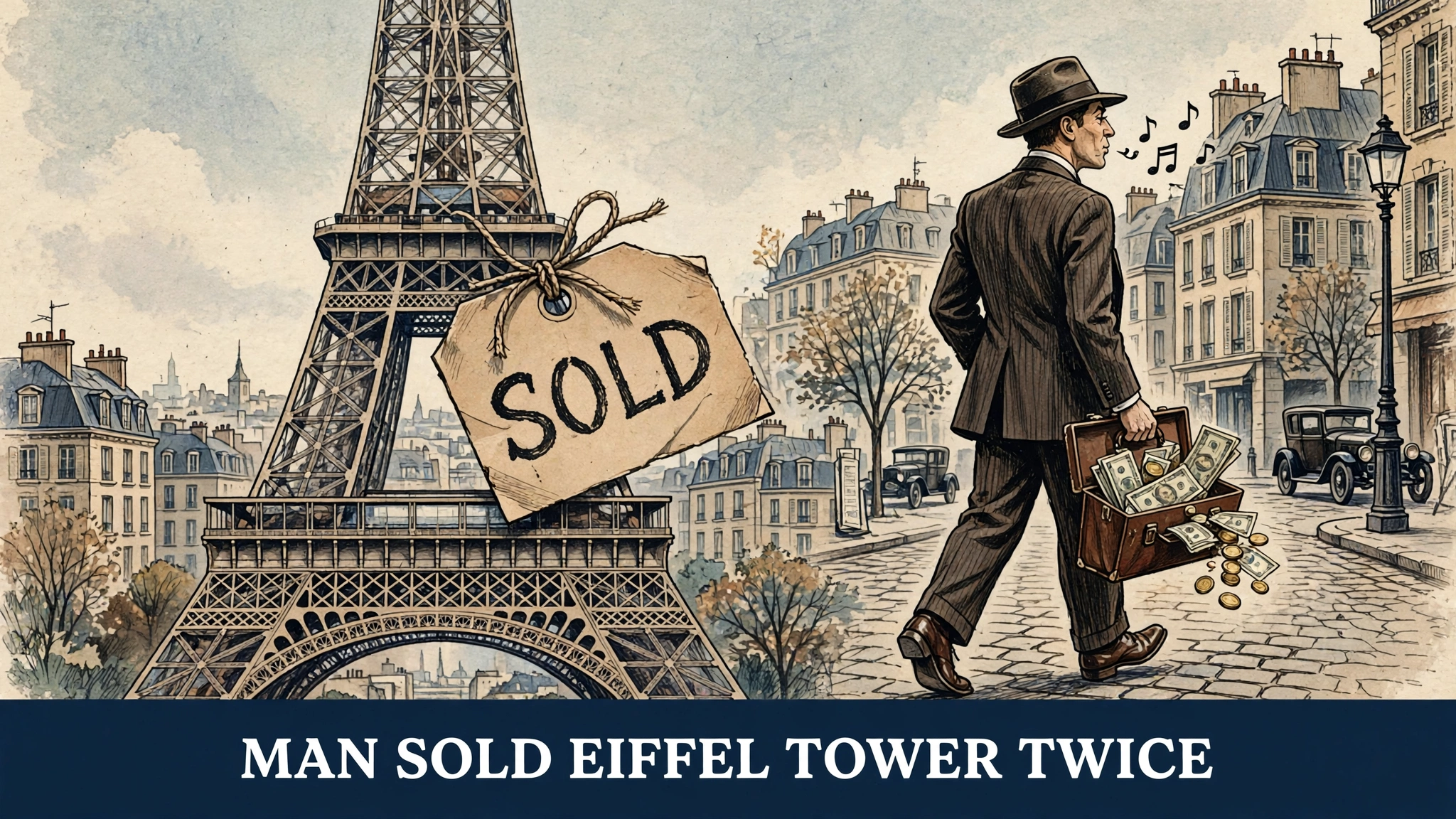
- The picture on this page is an original illustration made for Talha M Blog.