Hackers Hacked the Fridges of 700 Supermarkets in France: Temperatures Hit 50 Degrees, Food Spoiled and Fires Broke Out
Hackers took over the fridge systems of around 700 supermarkets in France, heating food to 50 degrees, spoiling stock and sparking fires. How it happened and why experts call it a wake-up call.
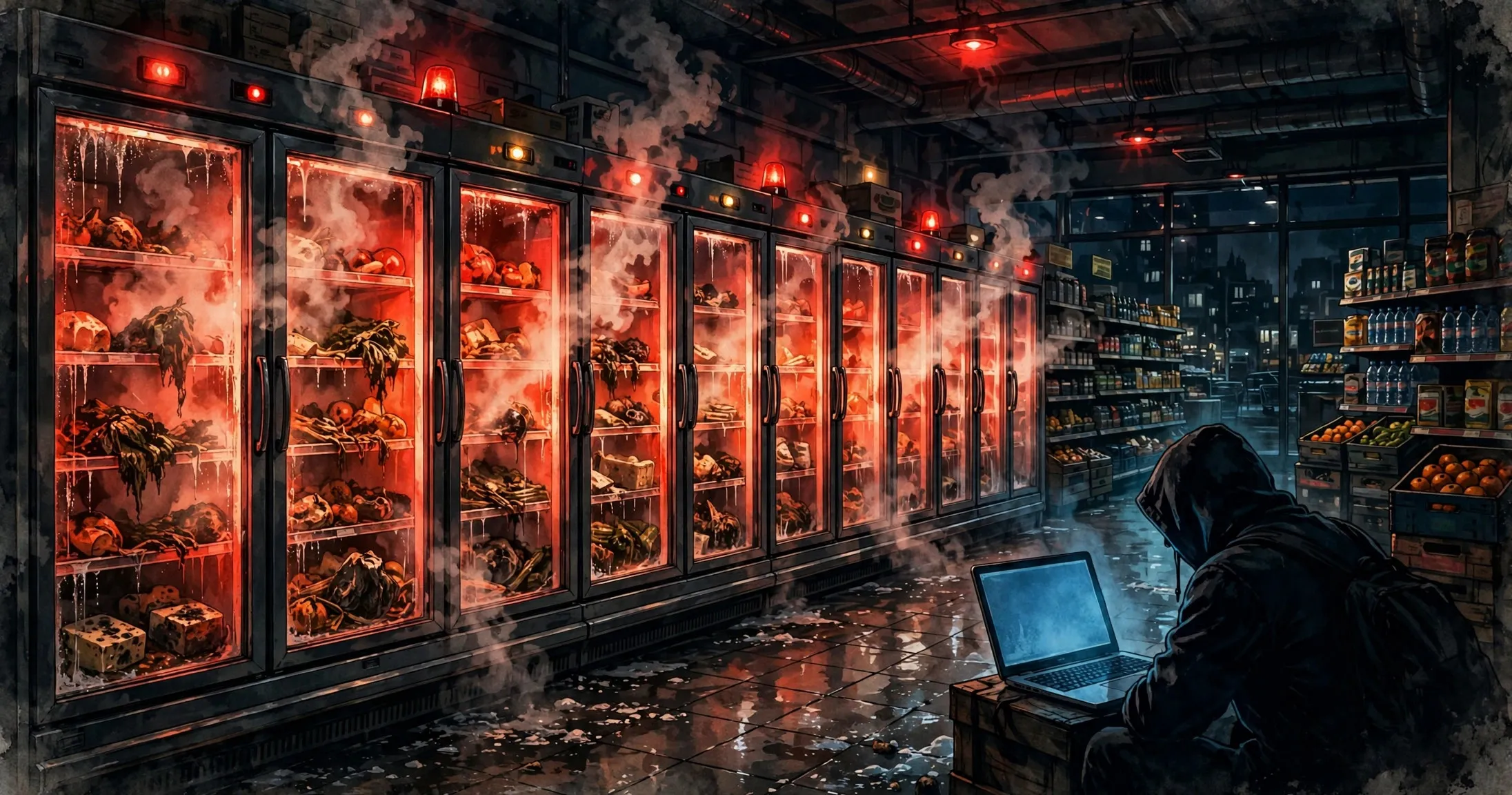
Imagine walking into your local supermarket early in the morning. The lights are on. The shelves look normal. But something feels wrong. The fridges, which should be icy cold, are warm. The milk is warm. The meat is warm. The cheese is sweating. And nobody in the store touched a single button to make it happen.
That is almost exactly what happened in France on the night of October 11, 2026. While the country slept, hackers quietly took control of the fridges in hundreds of supermarkets. They did not steal money. They did not lock any computers. They did something nobody expected: they turned the cold rooms hot.
By the time staff arrived and opened the doors, food worth a fortune had already spoiled, and at some stores, fires had even broken out. This is the strange and worrying story of how a fridge became a weapon.
A Night When the Fridges Turned Against the Stores
Modern supermarkets do not use simple fridges like the one in your kitchen. Their cooling systems are controlled by small computers that are connected to the internet. This lets managers check temperatures from far away and fix problems quickly. It is smart, modern and convenient.
But there is a dark side to that convenience. Anything connected to the internet can, in the wrong hands, be reached by hackers too.
According to France’s national cybersecurity alert agency, CERT-FR, the attackers got into refrigeration controllers made by companies called Danfoss and Copeland. These little devices are the brains of the cooling system. Once the hackers were inside, they gave the fridges a cruel order: keep defrosting, and do not stop.
A defrost cycle is a normal thing. Every fridge warms up slightly for a short time to melt ice, then gets cold again. Normally, this warm period lasts about an hour. According to reporting by the French newspaper Le Monde, the hackers changed that cycle from one hour to eight hours. That sneaky change meant the alarms did not sound quickly, because the system thought everything was normal.
Meanwhile, inside the fridges, the temperature kept climbing. Reports say it reached 50 degrees Celsius — that is 122 degrees Fahrenheit. That is not fridge temperature. That is a hot summer day. Milk, meat, fish, cheese and frozen food sat in that heat for hours, through the whole night.
“We Have Been Hacked” — A Sign on the Door
When morning came, staff walked into a disaster. Shelves of food had to be thrown away. In at least one store, workers put up a sign telling customers the truth in simple words: the store had been hacked, and its refrigeration system had been affected.
Think about how strange that moment must have felt. We are used to hearing about hacked bank accounts and hacked phones. But a hacked fridge? A sign on a supermarket door saying the fridges were attacked by someone, somewhere, through the internet — possibly from the other side of the world?
The damage was not only spoiled food. Fires were reported at some stores, and the Paris prosecutor’s office confirmed it is investigating both the spoiled food and the reported fires. When cooling machines are forced to work in ways they were never designed for, things can overheat — and that is when a cyberattack stops being just a computer problem and becomes a real-world danger.
How Big Was the Attack?
Very big. On Tuesday, October 13, France’s Finance Minister, Roland Lescure, stood up in Parliament and gave the country the numbers.
About 700 of France’s 10,000 supermarkets were affected. That means if you picture ten streets of shops, roughly one shop on every street or two was hit on the same night, by the same attack.
The minister tried to calm people on one point: he said there was no risk to France’s overall food supplies. The country would not run out of food. But he did not hide the seriousness of it either. He said the attack “touches the heart of our food security” and called it “a wake-up call for everyone.”
The big supermarket groups soon confirmed their own damage. The Les Mousquetaires group, which runs the Intermarché and Netto chains, said about 300 of its stores were impacted. Dominique Schelcher, the head of Coopérative U, another large chain, said 80 of its 2,000 stores were affected and that some food had to be thrown away. He called the attack “unprecedented, extremely serious.”
Unprecedented means it has simply never happened before, at this scale, in this way.
Who Is Investigating, and Was France the Only Target?
The case is now in serious hands. The cybercrime unit of the Paris prosecutor’s office is investigating, and Prime Minister Sébastien Lecornu has directed the national cybersecurity agency to investigate what happened and how.
And here is another worrying detail. A threat analyst following the case said France may not have been alone: Spain, Portugal, Germany and Belgium were also affected. If that is confirmed, this was not one country’s bad night. It was a coordinated strike across Europe’s food stores.
At the time of writing, nobody has publicly said who was behind the attack, and investigators have not announced a final answer. That part of the story is still being written.
A Separate Incident: A Dutch Supermarket Giant Goes Dark
On almost the same days, another supermarket story made headlines — and it is important not to mix the two up, because they are separate events.
Ahold Delhaize, a Dutch group that owns the Albert Heijn and Delhaize chains in Europe and Stop & Shop, Food Lion and Giant in the United States, shut down its brand websites after discovering a security issue of its own.
In this case, the physical stores stayed open, and the company said it had no evidence that customer or employee data was stolen. So while France’s problem was hackers cooking food inside the fridges, this second incident was a company taking its websites offline to protect itself. Two different stories, one uncomfortable lesson: the systems that feed us are now part of the internet, with all the risks that brings.
Why This Attack Matters More Than It Sounds
It is easy to read this story, shake your head, and move on. Spoiled food, some fires, a strange headline. But stop and think about what the hackers really proved.
They proved that you do not need to attack a power station or a military base to hurt a country. You can attack dinner. Food is something every single person needs, every single day. When the systems that keep food cold can be reached and controlled from the internet, a weakness in software becomes a weakness in daily life.
That is why the minister’s words matter. A wake-up call is exactly what this is — for supermarket companies, for the makers of these fridge controllers, and honestly, for all of us. Our homes and shops are filling up with smart devices: smart fridges, smart locks, smart cameras. Every one of them is a small computer. And every computer needs protection.
Frequently Asked Questions
What exactly did the hackers do in France?
According to CERT-FR, the hackers took control of internet-connected refrigeration controllers in supermarkets overnight on October 11, 2026. They forced the systems into a continuous defrost cycle, so the fridges kept warming up instead of cooling down. Reported temperatures reached 50°C (122°F), food spoiled, and fires were reported at some stores.
How many supermarkets were affected?
France’s Finance Minister told Parliament that about 700 of the country’s 10,000 supermarkets were affected. The Intermarché and Netto group reported around 300 impacted stores, and Coopérative U reported 80 of its stores.
How did the hackers avoid setting off alarms?
According to Le Monde’s reporting, the defrost cycle was changed from one hour to eight hours. Because the system was told this long warm period was normal, alarms did not sound quickly, and the damage happened quietly overnight.
Was anyone’s personal data stolen in the French attack?
The French reports are about damage to refrigeration systems, spoiled food and fires — not stolen customer data. Separately, the Dutch group Ahold Delhaize, which shut down its brand websites over its own security issue, said it had no evidence that customer or employee data was stolen.
Who is investigating the attack?
The Paris prosecutor’s cybercrime unit is investigating, the Paris prosecutor’s office confirmed it is looking into the spoiled food and reported fires, and Prime Minister Sébastien Lecornu directed the national cybersecurity agency to investigate.
There is a lesson in this story that goes far beyond France. The world quietly connected almost everything to the internet because it was easy and useful — and most of the time, it truly is. But every connection is also a door, and doors need locks. On one October night, someone opened the fridge doors of 700 supermarkets without ever touching them. The food is gone, the fires are out, and the investigators are at work. The real question now is whether everyone else — every shop, every company, every maker of smart machines — will lock their doors before the next knock comes.