Man Who Survived Lightning Seven Times
In this post
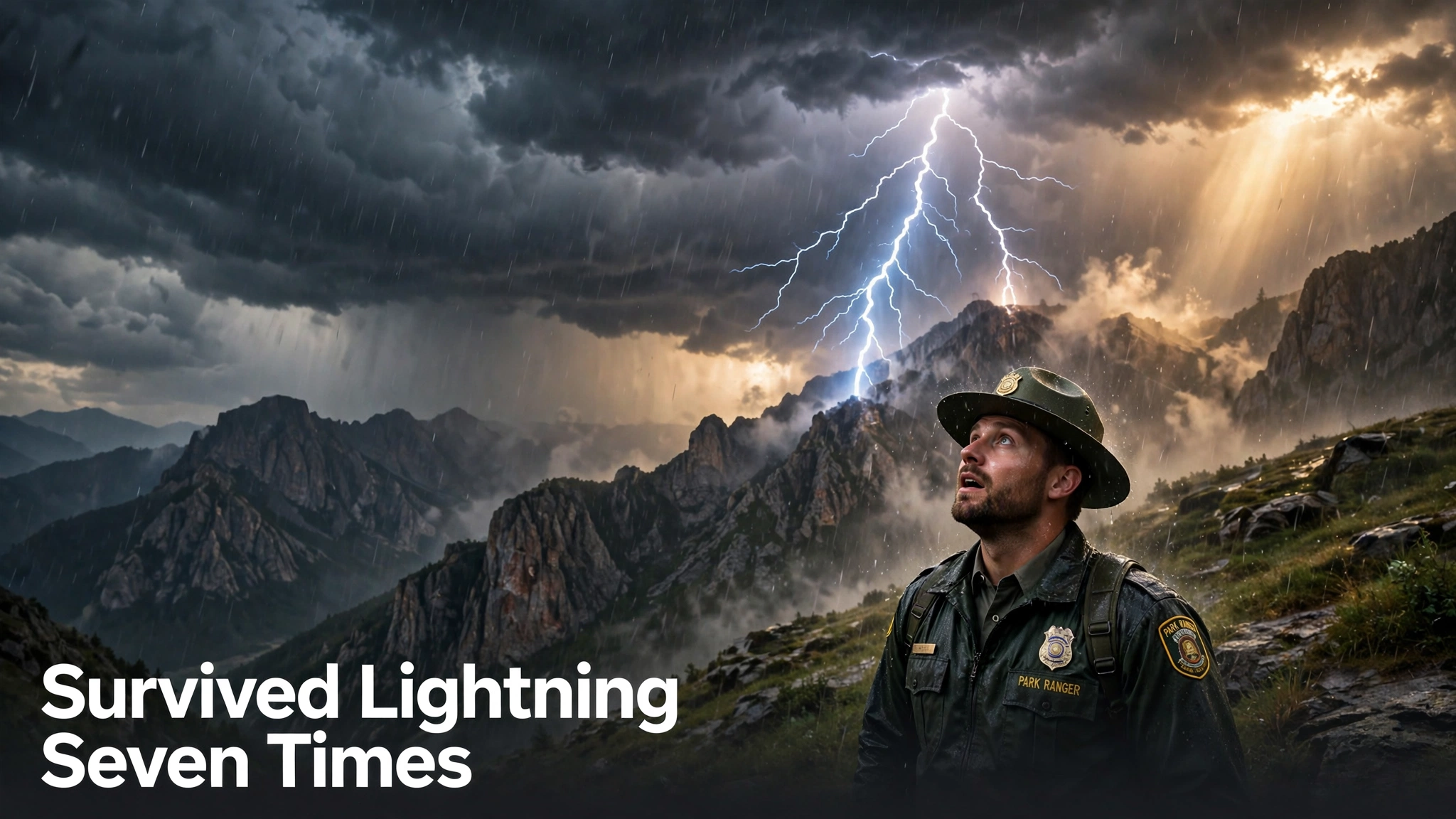
Some records sound too strange to be true. Roy Sullivan, a park ranger in Shenandoah National Park in Virginia, United States, is reported to have been struck by lightning seven times between 1942 and 1977, and to have survived every strike. He is recognised by Guinness World Records as the person struck by lightning the most times, a record that has made him famous, and also a figure of folklore, with stories growing taller with each retelling. His story raises obvious questions: is it true, how did he survive, what injuries did he suffer, and why him? The answers involve a mix of verified records, a job that kept him outdoors in storms, the physics of lightning, and the remarkable, if imperfect, resilience of the human body.
Sullivan was born in 1912 and worked as a ranger in Shenandoah National Park, a job that required patrolling mountains, forests, and lookouts, often alone, in all weather. That exposure matters: most people struck by lightning are outdoors, and rangers, farmers, fishermen, golfers, and hikers are overrepresented among victims. Sullivan’s seven strikes, if all are accepted, occurred over 35 years, which is about one strike every five years on average, still extraordinary, but less like a curse and more like a statistical outlier combined with high exposure. He died in 1983, reportedly by suicide, not by lightning, a sad ending that is often omitted from the sensational retellings and deserves respectful mention, not jokes about his luck running out.
The Seven Strikes: What Is Reported
Accounts of Sullivan’s strikes, compiled from his own reports, park records, and later interviews, list the following episodes, though details vary slightly between sources and some details cannot be independently verified decades later. The first reported strike was in 1942, when Sullivan was working in a fire lookout tower. Lightning struck the tower, and he is said to have suffered a leg injury and lost a toenail. The second, in 1969, occurred while he was driving in a mountain area; lightning is reported to have struck nearby trees, entered through an open window, knocked him unconscious, and burned his eyebrows and hair. The third, in 1970, struck him in his front yard, reportedly burning his left shoulder. The fourth, in 1972, at a ranger station, is said to have set his hair on fire, after which he reportedly began carrying water with him while on duty.
The fifth, in 1973, is reported to have struck him while he was on patrol, again setting his hair alight, and he is said to have driven to a nearby area to douse himself. The sixth, in 1974, at a campground, reportedly injured his ankle. The seventh, in 1977, while he was fishing, is said to have burned his chest and stomach. These summaries are based on secondary accounts that draw on Sullivan’s own telling and on park lore. The core fact, seven strikes, is widely reported and recognised by Guinness World Records, but readers should understand that the precise details of each early strike, exact injuries, and circumstances, rely on recollection and contemporary reporting, not on modern medical records for every event. That caveat does not make the story false; it makes it a historical record with the usual limits of historical records, and it is why responsible retellings distinguish the recognised record from embellished anecdotes, such as claims that Sullivan was followed by a personal storm cloud.
Sullivan’s own reaction to his fame is also part of the story. He reportedly disliked being struck, feared storms, and became reluctant to go outdoors when thunder was heard, a response that is understandable and consistent with trauma after repeated injuries. He is also reported to have said that people avoided him, fearing they would be struck by association, though lightning does not target people that way. That social isolation, whether exaggerated or not, illustrates how extraordinary events can stigmatise a person, even when the science says there is no contagion. Sullivan was not a lightning magnet in a supernatural sense; he was a man whose job, location, and era placed him repeatedly in harm’s way, and whose survival, while remarkable, follows known patterns of lightning injury.
How Lightning Strikes a Person: Five Mechanisms
Lightning does not strike in only one way. The US National Weather Service and medical literature describe five main mechanisms. A direct strike, when lightning hits a person directly, is the most dangerous and least common, accounting for a small proportion of cases. A side flash occurs when lightning strikes a taller object, such as a tree, and jumps sideways to a nearby person. Ground current, the most common cause of lightning deaths and injuries, occurs when lightning strikes the ground or an object nearby and current spreads through the ground, entering one foot and exiting the other, or passing through the body. An upward streamer, a discharge that rises from a person toward a descending lightning leader, can cause injury even without a full strike. Finally, conduction occurs when lightning strikes an object a person is touching, such as a wire, fence, or plumbing, and current travels to the person.
Most lightning victims are not hit directly. They are injured by ground current or side flash while sheltering under a tree, standing near a tall object, or standing in an open area. That is why safety advice emphasises not sheltering under a tree, not because trees attract lightning to you personally, but because they are tall, they are struck often, and side flash and ground current can injure people nearby. Sullivan’s strikes, involving towers, trees, vehicles, and open areas, fit these mechanisms: a lookout tower is a tall, exposed structure; a car with an open window offers a path for current; a campground and a fishing spot place a person near water and open ground. His story, in other words, is consistent with known lightning physics, not an exception to it.
Lightning itself is extraordinarily powerful: a typical strike carries tens of thousands of amperes, heats air to temperatures hotter than the Sun’s surface, and lasts only a fraction of a second. That brevity is one reason people survive: the current passes quickly, and much of it may travel over the skin, a phenomenon called flashover, rather than through internal organs, especially if skin and clothing are wet. Wet skin, paradoxically, can help, because current travels over the wet surface rather than penetrating deeply, though it still causes burns and other injuries. The brevity and flashover explain why lightning survival, while not common for direct strikes, is far from impossible, and why many survivors suffer burns, hearing damage, and neurological effects rather than immediate cardiac arrest.
Injuries and Long-Term Effects of Lightning Strikes
Lightning injuries are diverse and often underestimated. Immediate effects can include cardiac arrest, respiratory arrest, burns, ruptured eardrums, eye damage, and fractures from being thrown by the shock wave or from falls. The heart may stop, then restart on its own, while breathing may not restart, which is why immediate CPR, focused on breathing support, can save a lightning victim. A crucial safety fact follows: lightning victims do not carry a charge and are safe to touch. The myth that they remain electrified delays rescue and costs lives. If you encounter a lightning victim, call emergency services, check breathing and pulse, and begin CPR if needed, without fear of being shocked.
Long-term effects can be more disabling than the initial burns. Survivors commonly report memory problems, difficulty concentrating, depression, anxiety, sleep problems, chronic pain, hearing loss, tinnitus, and sensitivity to storms, a form of post-traumatic stress. Nerve damage, cataracts, and musculoskeletal problems are also reported. Sullivan is reported to have suffered burns, hair loss, and injuries to his leg, shoulder, and ankle, and to have developed a fear of storms, which fits this pattern. His repeated strikes would have compounded these effects, though detailed medical follow-up for each strike is not publicly available in full. The lesson is that surviving lightning is not the same as recovering fully. Many survivors live with invisible injuries that affect work, relationships, and mental health, and they deserve support, not only amazement.
The odds of being struck are often quoted as about 1 in 1.2 million in a given year in the United States, with lifetime odds around 1 in 15,000, though these figures vary by location, occupation, and behaviour, and should be treated as population averages, not personal predictions. The odds of being struck seven times are astronomically small if strikes were random and independent, which is why Sullivan’s case is a record. But odds change with exposure: a ranger who spends decades outdoors in a mountain park, in an era before modern lightning safety protocols and forecasts were as widely followed, faces far higher odds than an office worker. Sullivan’s record is therefore best understood as an extreme outlier produced by high exposure over a long career, plus chance, not as evidence that lightning seeks out certain people.
Why Sullivan? Exposure, Geography, and Chance
Shenandoah National Park, in the Blue Ridge Mountains, has frequent thunderstorms, especially in summer, and its ridges, lookouts, and open areas increase exposure. A ranger patrolling those areas, often alone and far from shelter, cannot always reach a safe building within minutes of hearing thunder. In Sullivan’s era, lightning safety education was less widespread, and the rule “when thunder roars, go indoors,” now promoted by weather services, was not as firmly established. Modern rangers have radios, forecasts, and protocols to seek shelter, which reduce risk, though they cannot eliminate it. Sullivan’s career spanned a period when outdoor work and storm exposure overlapped more than they do today, which helps explain, without fully explaining, his record.
Geography also matters in a subtler way. Lightning does not strike the same place repeatedly because it “remembers,” but tall, isolated, conductive objects, towers, trees, ridges, are struck repeatedly because they are tall and exposed. A person who repeatedly works near such objects will be near repeated strikes. Sullivan’s first strike involved a lookout tower, a classic tall target. Later strikes involved trees and open areas. None of this implies a personal attraction. It implies a job that repeatedly placed him near tall targets during storms. If another ranger had held the same posts for the same years, that ranger might have been struck multiple times as well, though seven remains extraordinary and suggests a large element of chance on top of exposure.
Chance itself deserves respect. In a population of millions, over decades, extreme outliers will occur by chance alone. Someone will be struck multiple times, just as someone will win a lottery twice, not because they are special in a supernatural sense, but because large numbers produce rare combinations. Sullivan’s case is the lightning equivalent of that statistical truth. Recognising chance does not diminish his story; it makes it more honest. He was not cursed, blessed, or magnetised. He was a man in a risky job, in a stormy place, over a long career, who experienced an extremely rare sequence, survived it, and lived with its consequences.
Lightning Safety: What Sullivan’s Story Should Teach
The most useful part of Sullivan’s story is not the record, but the safety lesson it reinforces. Lightning kills and injures people every year, and most of those deaths are preventable by simple actions. The core rule is: when thunder roars, go indoors, and stay indoors for 30 minutes after the last thunder. A substantial building with wiring and plumbing, or a hard-topped metal vehicle with windows closed, offers protection, because current travels through the metal shell to the ground, not through occupants. A tent, a picnic shelter, a tree, or an open vehicle does not offer protection. If you are caught outdoors with no shelter, crouch low, minimise contact with the ground, stay away from water, tall objects, and metal fences, and do not lie flat, which increases ground current exposure. These actions reduce risk; they do not make you safe, and they are a last resort, not a substitute for shelter.
Water is especially dangerous. Fishing, swimming, boating, and beach activities during thunderstorms account for many lightning deaths, because water conducts current and people in water are exposed. Sullivan’s final reported strike while fishing illustrates that risk directly. If you hear thunder while fishing or swimming, leave the water immediately and seek a substantial building or vehicle. Do not wait to finish a cast or a swim. Similarly, golfers, hikers, and campers should check forecasts, watch for building cumulonimbus clouds, and have a shelter plan before starting. Lightning can strike up to 16 kilometres from the parent storm, in so-called “bolts from the blue,” so a clear sky overhead does not guarantee safety if a storm is nearby.
After a strike, help is critical. Call emergency services, check if the victim is breathing and has a pulse, and begin CPR if needed. Treat burns with cool water, cover with a clean dressing, and do not apply ointments or ice directly to severe burns. Seek medical evaluation even if the victim feels well, because internal injuries, heart rhythm problems, and neurological effects may not be immediately obvious. Long-term follow-up, including hearing, vision, cognitive, and mental health assessment, is important for survivors. Sullivan’s story, with its repeated injuries and reported fear of storms, shows why that follow-up matters, and why lightning safety is not only about the moment of the strike, but about the years afterwards.
Lightning Myths That Put People at Risk
Several lightning myths persist and directly endanger people. The first is that rubber tyres or rubber shoes protect you in a car or outdoors. In a car, protection comes from the metal shell conducting current around occupants to the ground, not from tyres, which are not sufficient insulation against lightning voltage. Rubber shoes offer no meaningful protection against a strike. The second myth is that lightning never strikes the same place twice. Tall structures are struck repeatedly, which is why lightning rods are installed on them: they provide a controlled path to ground. The third myth is that if it is not raining, you are safe. Lightning can strike kilometres from a storm, and the first strike of a storm can occur before rain arrives. The fourth myth is that a lightning victim remains charged and dangerous to touch. Victims are safe to touch, and immediate CPR saves lives. Correcting these myths is not trivia; each one, believed, can delay shelter or delay rescue, and delay, with lightning, can be fatal.
Another myth is that metal objects attract lightning to a person. Metal does not attract lightning from the sky in the way popular imagination suggests, but metal objects that are tall, or that conduct current from a strike, can increase injury risk if you are touching them during a storm. The distinction matters: you do not need to remove jewellery or avoid all metal, but you should avoid holding a metal golf club, fishing rod, or umbrella in an open area during a thunderstorm, because you become taller and you are holding a conductor that can carry current. Similarly, avoid wired phones, plumbing, and electrical appliances during a storm indoors, because lightning can travel through wiring and pipes. Cordless phones and mobile devices, not connected to a wire, do not carry that same risk, though you should still be indoors. Clear, specific advice, not vague fear of metal, saves lives.
My Take:
My view is that Roy Sullivan’s story should be told with respect, not as a joke about bad luck. It is easy to laugh at a man struck seven times, to imagine a cartoon cloud following him, or to call him the unluckiest man alive. That laughter hides the reality: burns, injuries, fear, and a career spent outdoors in storms, in an era with less safety guidance than we have now. Sullivan survived, but survival is not a punchline. It is a medical and psychological achievement, and it came with costs that are often invisible in a record book entry. If we tell his story only as a curiosity, we miss the human being, and we miss the safety lesson that could save someone else. A record is interesting; a person is more important than a record.
I also think Sullivan’s story teaches us about how we think about risk. We tend to treat rare events as if they happen to other people, or as if they happen for a reason, a curse, a magnet, a fate. In reality, risk is a product of exposure, geography, behaviour, and chance, and it can be reduced, though not eliminated, by simple actions. A ranger in a mountain park faces more lightning risk than an office worker, just as a fisherman on a lake faces more risk than someone indoors. That is not fate; it is arithmetic. Understanding that arithmetic empowers us: check the forecast, seek shelter when thunder roars, leave the water, do not shelter under a tree. Those actions do not guarantee safety, but they shift the odds dramatically in your favour, and shifting odds is the best we can do against a force as powerful and fast as lightning.
There is a third lesson about records and fame. Sullivan became famous for something he did not seek and did not enjoy. Fame based on suffering can be isolating, especially when people avoid you out of superstition or treat you as a curiosity. I think we should be careful about how we celebrate such records. Guinness World Records recognises the fact, which is valuable for history, but our retelling should not turn a person into a freak show. The respectful way to tell Sullivan’s story is to state the record, explain the science, acknowledge the injuries and the fear, and end with safety advice that honours his experience by preventing similar injuries in others. That is a better tribute than a joke about lightning following him.
Finally, I am struck by the fact that Sullivan’s story ends not with lightning, but with a human tragedy, his death by suicide in 1983, reportedly linked to personal difficulties. That ending is often omitted, perhaps because it complicates a fun story, but omitting it does a disservice. It reminds us that survivors of trauma, including repeated physical trauma, may struggle with mental health, and that those struggles deserve support and compassion, not silence. If Sullivan’s story prompts even one person to take lightning safety seriously, to seek shelter promptly, or to check on a survivor’s mental health as well as their burns, then telling it well has value beyond curiosity. The man who survived lightning seven times deserves to be remembered as a ranger, a survivor, and a human being, not only as a number in a record book.
I want to add a practical note for anyone who works outdoors today, because Sullivan’s era is not entirely past. Rangers, farmers, construction workers, lifeguards, and athletes still face lightning risk, and modern forecasts and phones help, but only if people act on them. A forecast is not a shelter, and a phone app is not a building. The decision to stop work, leave a field, or abandon a game when thunder is heard must be made quickly, even when it is inconvenient, even when the sky looks clear overhead, even when others want to continue. That decision is often unpopular in the moment and lifesaving in retrospect. Sullivan, who reportedly carried water and feared storms after his injuries, learned that lesson through pain. We can learn it from his story, without paying his price, if we take the simple rule seriously: when thunder roars, go indoors, and stay there until the storm has truly passed.
One more point deserves emphasis, because it concerns children and schools. Children are often taught to fear lightning, but not taught what to do, which leaves them frozen or running to a tree when a storm arrives during play, sport, or a school trip. The rule must be taught as an action, not only as a fear: hear thunder, go to a building or hard-topped car, stay for thirty minutes after the last thunder. Coaches, teachers, and camp leaders should have that rule written into their plans, with a designated shelter identified before activities begin, not improvised when clouds gather. Sullivan’s story, told to children, should end not with amazement at seven strikes, but with that action rule, repeated until it is automatic. A record can inspire curiosity; a rule, practised, can save a life, and for a story about lightning, that is the only ending that truly honours the man who lived it.
A final thought is about how we remember Sullivan himself, beyond the number seven. He was a ranger who loved, or at least served, a national park, who worked outdoors for decades, who suffered repeated injuries and kept going, and who, by all accounts, came to fear the storms that had hurt him. That fear was not cowardice; it was a rational response to experience, and it deserves the same respect we give to any worker who continues after injury. If his story is told in schools, parks, and safety courses, it should be told with that humanity intact: a man, a job, a place, a record, injuries, fear, and a death that had nothing to do with lightning. Numbers make a record memorable, but humanity makes it meaningful, and Sullivan’s humanity, not only his seven strikes, is why his story is still worth telling more than forty years after his last strike.
One more safety point is worth repeating because it is the most common mistake: people wait too long to seek shelter, hoping the storm will pass or that one more cast, one more hole, or one more photograph will be safe. Lightning does not give a warning strike. The first strike in your area can be the one that injures you, and by the time you hear close thunder, you are already at risk. The decision must be made at the first thunder, not at the first close flash. Make that decision a habit, teach it to children and teams, and do not let social pressure, a game, a catch, or a photograph override it. Sullivan survived seven strikes; most people will not survive one direct strike, and no photograph, fish, or game is worth testing that difference.
Frequently Asked Questions
Who was struck by lightning seven times? Roy Sullivan, a park ranger in Shenandoah National Park, Virginia, is recognised by Guinness World Records as the person struck by lightning seven times, between 1942 and 1977, surviving each time.
How did Roy Sullivan survive seven lightning strikes? Lightning is brief, and much current can travel over wet skin rather than through organs. Sullivan’s strikes involved varied mechanisms, including side flash and ground current, and he received treatment, though he suffered burns and other injuries.
What injuries do lightning survivors suffer? Burns, hearing loss, eye damage, cardiac and breathing problems, fractures, memory and concentration problems, chronic pain, anxiety, and post-traumatic stress are all reported among survivors.
Are lightning victims safe to touch? Yes, lightning victims do not carry an electrical charge after the strike. Call emergency services, check breathing and pulse, and begin CPR if needed without fear of being shocked.
What should I do if caught outdoors in a thunderstorm? Seek a substantial building or hard-topped vehicle immediately. Avoid trees, water, tall objects, and metal fences. If no shelter is available, crouch low, minimise ground contact, and do not lie flat.
What are the odds of being struck by lightning? Population averages in the United States are often quoted as about 1 in 1.2 million in a given year, but odds vary greatly with location, occupation, and behaviour. Being struck seven times is an extreme outlier.