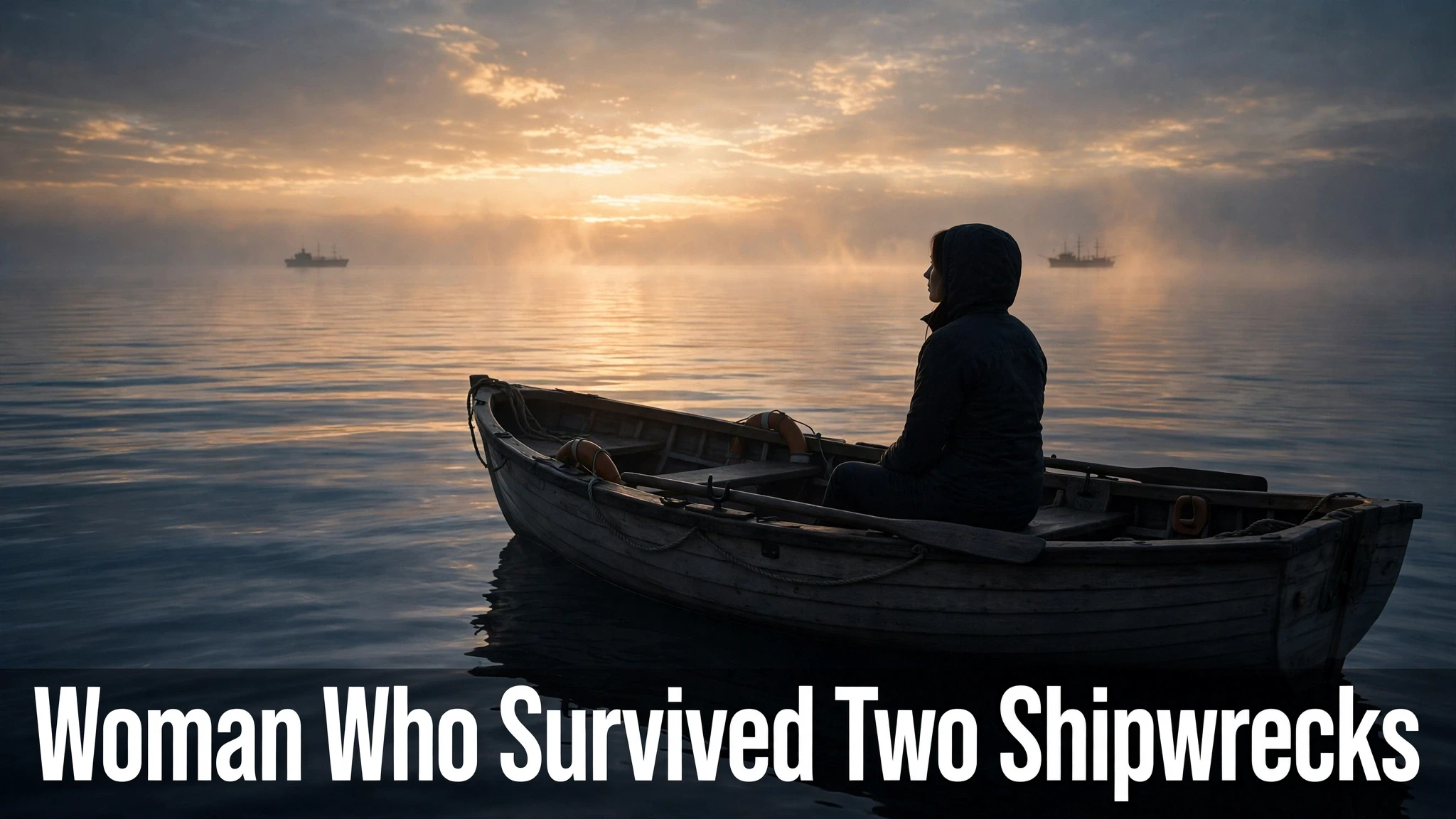
Woman Who Survived Two Shipwrecks
In this post
The woman who survived two shipwrecks — in fact, three major incidents on three sister ships — was Violet Constance Jessop, an Argentine-born Irish ocean liner stewardess and, later, a wartime nurse. She was aboard RMS Olympic when it collided with HMS Hawke in 1911, aboard RMS Titanic when it sank in 1912, and aboard HMHS Britannic when it sank in 1916. She was called “Miss Unsinkable” and “Queen of sinking ships,” nicknames she did not choose and, by her own memoir, did not enjoy as jokes. Her story is not a luck tale. It is a working woman’s story: a stewardess who kept returning to sea because sea work paid her family’s bills, and who, each time a ship failed, did the job she had been trained to do — calm passengers, show them the way to boats, and then get into a boat herself.
Born in Argentina, Raised for Work at Sea
Violet Jessop was born on 2 October 1887 near Bahía Blanca, in the Pampas of Argentina, the eldest daughter of Irish immigrants Katherine Kelly and William Jessop, a sheep farmer. She was the eldest of six children. As a child she became seriously ill with what is presumed to have been tuberculosis, and doctors reportedly predicted she would not survive. She did. That early illness is often quoted as the start of her “unsinkable” story, but its practical effect was different: a child who survives a predicted fatal illness in a farming family learns early that medical predictions are not destinies, and that recovery requires patience, not panic.
When her father died, the family moved to England, and her mother became a stewardess at sea to support the children. After about five years at sea, Katherine fell ill, and Violet, then 21, became the family’s sole supporter. She followed her mother into stewardess work, first, by the accounts summarised in her memoir and later profiles, after hesitation about cold North Atlantic crossings, and after a period working for Royal Mail Line. Stewardess work in 1910 was not glamorous. It meant long hours, low pay by modern standards, strict discipline, and responsibility for passengers’ cabins, meals, and, in an emergency, their evacuation. A stewardess was not a passenger with a better cabin. She was crew, and crew were expected to stay at their posts while passengers left.
That job explains why Jessop was on all three sister ships. White Star Line’s Olympic-class liners — Olympic, Titanic, and Britannic, built in Belfast from 1908 to 1914 — were the largest, most prestigious ships of their day, and crew transferred between them as schedules required. Jessop did not seek disasters. She sought steady work on the best ships, and the best ships, by chance and by design, included the two that sank and one that collided. The coincidence is extraordinary, but the mechanism is ordinary: a loyal employee, transferred within a fleet, happened to be on each ship at the wrong time.
Olympic and Hawke: A Collision, Not a Sinking
In 1911, Jessop signed on with RMS Olympic, the first of the trio and the largest ship of its day. On 20 September 1911 — some accounts give the departure date as 20 October in error, but the collision date widely recorded is 20 September — Olympic collided with the British cruiser HMS Hawke in the Solent, off Southampton. Hawke’s ram bow tore a major rip below Olympic’s waterline, flooding two compartments and twisting a propeller shaft. Olympic limped back to Southampton and then to Belfast for repairs. No one died, and Olympic did not sink.
That distinction matters for counting her shipwrecks. Strictly, Jessop survived two sinkings — Titanic and Britannic — and one serious collision — Olympic. Popular retellings often call it three shipwrecks, which overstates Olympic. The accurate version is more impressive in a different way: she was aboard three sister ships, each of which suffered a major incident within five years, and she survived all three. She also, by some accounts, was initially reluctant to transfer to Titanic, but a friend persuaded her it would be a wonderful experience. That persuasion, if true, shows how little anyone, crew included, expected Titanic to sink. No stewardess joins a ship expecting to need a lifeboat.
Olympic itself went on to a long career, serving until 1935, including as a troopship in the First World War, when it rammed and sank a German U-boat. It was the only Olympic-class ship not to sink. That fact sharpens Jessop’s story: she was not aboard a cursed fleet where every ship sank. She was aboard a fleet where one ship survived a long, hard career, one sank on its first voyage, and one sank as a hospital ship in war. Luck, in that fleet, was unevenly distributed, and Jessop’s share was to be on the two that sank and survive both.
Titanic: Lifeboat 16 and a Baby in Her Arms
Jessop transferred to Titanic and boarded for its maiden voyage on 10 April 1912, aged 24. On the night of 14 April, at 11:40 p.m., she had just finished prayers and was in her berth when she heard what she described in her memoir as a low, rending, crunching, ripping sound. Titanic had struck an iceberg. As a stewardess, she was ordered on deck to serve as an example to passengers, especially non-English-speaking passengers, showing them how to wear lifejackets and where to go. That order is a detail that reveals crew discipline: in an emergency, crew did not run first. They demonstrated calm, so passengers would follow.
She was later ordered into Lifeboat 16, in part to show women passengers that boarding a lifeboat was safe. As the boat was being lowered, an officer handed her a baby to look after. She held that baby through the night, in cold, in darkness, watching Titanic disappear, until rescue by RMS Carpathia after about eight hours in the boat. The baby’s mother, by Jessop’s later account, took the child from her arms on Carpathia the next morning, without, in some retellings, a word of thanks or even a recognition — a detail Jessop recalled with hurt, and which later became part of her legend.
Years later, according to a story Jessop herself told, a woman telephoned her on a stormy night and said she was that baby, thanking her for saving her life. Jessop reportedly did not ask for proof and accepted the call as closure. Historians treat that later call as unverified: no name, no record, and no independent confirmation has been published. It should be reported as Jessop’s own account, not as a proven reunion. The verified core — Lifeboat 16, eight hours, Carpathia rescue, more than 1,500 dead — needs no embellishment, and adding an unverified reunion weakens, rather than strengthens, a story that is already extraordinary.
After Titanic, Jessop did what many survivors did not: she went back to sea as soon as she could. Author and Britannic expert Simon Mills, quoted by National Geographic, notes she later wrote she needed to get back to work before she lost her nerve. That sentence is the most human line in her story. It is not bravado. It is a working woman’s calculation: if she waited, fear would grow; if she returned, routine would replace fear. She returned, and the sea gave her a third incident.
Britannic: A Hospital Ship Sunk in 55 Minutes
During the First World War, Jessop served as a nurse with the British Red Cross, in the Voluntary Aid Detachment, aboard HMHS Britannic, the third Olympic-class liner, converted to a hospital ship. On the morning of 21 November 1916, Britannic was in the Aegean Sea, en route to Gallipoli, when a muffled explosion shook the vessel. It had struck a German naval mine, by the widely accepted account, though some contemporary speculation mentioned a torpedo. Britannic sank in about 55 to 57 minutes, far faster than Titanic’s roughly two hours and forty minutes, because, among other factors, portholes and watertight doors were open for hospital ventilation and the ship was steaming toward shallow water in an attempt to beach.
Jessop had just come from morning Mass and was sitting down to breakfast when the explosion occurred. Ordered to the lifeboats, she raced back to her cabin for a few valuables, including her prayer book and, following a friend’s advice after Titanic — “never undertake another disaster without first making sure of your toothbrush” — her toothbrush. That toothbrush detail, quoted from her memoir, is often laughed at, but it is a practical lesson in disaster psychology: after one sinking, a survivor learns what small, ordinary things she will miss in a lifeboat and in a rescue ship, and she prepares for them. It is not vanity. It is experience.
In the water, Jessop’s lifeboat was drawn toward Britannic’s still-turning propellers, which were churning as the ship tried to reach shallow water. She leapt from the boat into the sea and was sucked under the ship’s keel, which struck her head. She escaped, swam clear, and was rescued, but years later, when she consulted a doctor about persistent headaches, he discovered she had sustained a fracture of the skull in that impact. Of 1,066 people aboard Britannic, 30 died, most killed by lifeboats drawn into propellers, not by drowning in the sinking itself. Jessop survived a mechanism — a propeller strike — that killed others in the same incident, by jumping at the right moment and by luck in the water.
After Britannic: 34 More Years at Sea
Jessop did not retire after Britannic. She returned to White Star Line in 1920, later transferred to Red Star Line, and then to Royal Mail Line, working until her retirement in 1950, 32 to 34 years after Britannic depending on how service is counted. She married John J. Lewis, a merchant seaman, in later life, and died of congestive heart failure on 5 May 1971, aged 83, in Suffolk, England. She published her memoir, Titanic Survivor, edited by John Maxton-Graham, in 1997, after her death, from manuscripts she had written earlier.
That long career after two sinkings is the part of her story most often ignored, because it is not dramatic. It is, however, the most revealing: a woman who survived Titanic and Britannic did not become a professional survivor, giving lectures about luck. She became, again, a stewardess, serving passengers, making beds, serving meals, and doing the same emergency drills she had already needed twice. Her colleagues, by some accounts, teased her about her history, and passengers, when they learned it, were sometimes uneasy to sail with her, as if survival were contagious in reverse. She endured that teasing, as she endured much else, with faith — she was a devout Catholic who prayed frequently — and with a dry humour about toothbrushes and prayer books.
Her story also includes a parallel survivor who is often forgotten: Arthur Priest, a stoker, who also survived Titanic and Britannic, was aboard Olympic during the Hawke collision, and survived other shipwrecks as well. Priest’s existence does not diminish Jessop’s story. It shows that survival in that fleet was not a single miracle assigned to one woman. It was a pattern of crew who, by training, position near lifeboats, and experience, had a better chance than passengers below decks, and who, by returning to sea, accumulated more chances to be in the wrong place at the wrong time — and to survive it.
Stewardess Work in 1912: What Her Job Actually Required
Understanding Jessop’s job in 1912 explains why she survived when many passengers did not. A stewardess was responsible for a set of cabins, for passengers’ daily needs, and, in an emergency, for directing those passengers to muster stations and lifeboats, in an order set by officers. She knew the ship’s layout, the location of lifejackets, the stairways that would jam, and the deck where boats were launched, because she walked those routes daily. A first-class passenger, by contrast, might have visited the boat deck only for a stroll, and a third-class passenger might never have seen it before the alarm. Knowledge of layout, gained through work, is a survival advantage that has nothing to do with luck, and it is why crew survival rates in Titanic and Britannic were higher than those of passengers in the lowest classes, even though crew were ordered to stay longer.
Her job also required a specific kind of emotional labour that is rarely counted as skill: calming frightened strangers while frightened yourself, speaking clearly in a language some passengers did not understand, and demonstrating a procedure — putting on a lifejacket, stepping into a boat — so others would copy it. Jessop was ordered on deck on Titanic precisely to be an example, and that order worked because passengers copy calm, competent behaviour in a crisis more readily than they follow shouted instructions. That is a lesson for modern emergency training: the most effective safety role is often not the person with the loudest voice, but the person who visibly does the safe thing first, calmly, and repeatedly, until others follow.
My Take:
Violet Jessop’s story is usually told as luck, and luck is the wrong word, because it hides the work. She survived Titanic not because she was lucky, but because she was crew, because she was ordered on deck early, because she was ordered into a boat to demonstrate safety, and because she obeyed those orders instead of panicking or hiding. She survived Britannic not because she was lucky, but because she jumped from a lifeboat that was being drawn into propellers, a decision that required recognising danger in seconds and acting on it. Luck played a part — a propeller that struck her head but did not kill her, a lifeboat that held, a Carpathia that arrived — but luck favoured a trained, obedient, calm worker, not a passive passenger. That distinction matters for anyone who reads survival stories for lessons: training and position matter more than fate.
I think her return to sea is the bravest part, and the part modern retellings get wrong by making it sound easy. She wrote that she needed to get back before she lost her nerve. That is not a slogan. It is a description of how fear works: after trauma, avoidance feels safe, but avoidance grows fear, while a controlled return, with routine, colleagues, and a job to do, shrinks it. She did not return because she loved danger. She returned because she needed wages, because sea work was what she knew, and because waiting would have made the next voyage harder, not easier. That is a practical, working-class kind of courage, very different from the cinematic courage of running into a fire. It is the courage of going back to the same corridor, the same drill, the same sea, after the sea has already tried to kill you twice.
The toothbrush story is, for me, the most honest detail in her memoir. After Titanic, she was teased for complaining that she had no toothbrush in the rescue ship. After Britannic, she made sure she had one. That is not a joke about vanity. It is a lesson in what survivors actually miss: not grand things, but small, ordinary, dignifying things — a toothbrush, a prayer book, a change of clothes, a name to be called by. Disaster planning today, from emergency kits to go-bags, is built on exactly that insight: prepare the small things you will need in the first 24 hours, because the large things — a house, a ship, a job — cannot be carried in a lifeboat. Jessop learned that in 1912, and she applied it in 1916, without a training course or a government leaflet. Experience was her training.
I also think we should be careful with the baby story. The verified part — a baby handed to her in Lifeboat 16, held through the night, returned to its mother on Carpathia — is already powerful. The later telephone call, decades later, from a woman claiming to be that baby, is unverified and should stay unverified in any honest retelling. Adding it as fact does not make Jessop more heroic. It makes the story less trustworthy, because a reader who discovers one embellishment will doubt the rest. Jessop’s real story does not need a perfect reunion. It needs the imperfect, human detail that the mother, in shock and exhaustion, may not have thanked her properly on Carpathia. That imperfection is believable, and therefore more moving than a perfect phone call.
Her faith deserves mention without sentimentality. She prayed before Titanic struck, she went to Mass before Britannic struck, and she carried a prayer book to a lifeboat. For a modern reader, that may seem like superstition, but for Jessop it was routine, discipline, and community: a set of words she knew by heart, in a language and rhythm that calmed her when instructions were shouted and water was rising. Faith, in her case, functioned like a drill: something practised in calm that could be recalled in panic. Whether a reader shares her faith or not, that function — a practised calm routine — is transferable. It could be a prayer, a breathing exercise, a checklist, or a song. The point is to have something to do with your hands and mind when fear tells you to freeze.
Finally, Jessop’s long, ordinary career after Britannic is a rebuke to the idea that a dramatic life must end dramatically. She worked until 1950, married, lived in Suffolk, and died at 83 of heart failure, not at sea. That ordinary ending is the real victory: she did not let two sinkings define her as a victim, a celebrity, or a warning. She let them define her as a worker who had survived, learned, and carried on. In a culture that rewards trauma as identity, that choice — to work, to marry, to live quietly after extraordinary events — is radical. It says survival is not the end of a story. It is the middle, and what you do after survival, for 34 more years, is the story.
There is also a point about money that should not be lost in the drama. Jessop returned to sea after Titanic not only for courage, but for wages, because she was her family’s supporter after her mother fell ill. A survival story that ignores wages makes return look like a free choice, when it was also an economic necessity. That necessity, paradoxically, may have saved her from a different harm: staying ashore, unemployed, and afraid, with no income and no routine, could have harmed her health and her family more than returning to a job she knew. Economic pressure is often treated as the opposite of bravery, but here it supplied the structure that bravery needed — a reason to board, a timetable to follow, and colleagues to work with — and that structure, in turn, made bravery sustainable over 34 more years, not just one night.
Finally, Jessop’s story should change how we remember Titanic’s crew. Films focus on passengers, on romance, on wealthy men and their choices, and crew appear as background figures in uniform. Jessop, and stoker Arthur Priest, show crew as the people who made evacuation possible at all: they knew the ship, they stayed at posts, they demonstrated lifejackets, they launched boats, and they, too, needed boats. Remembering crew by name — Violet Jessop, Arthur Priest, and the many who died at their posts — restores a fairer picture of 1912 and 1916: disasters are not only about who had a ticket, but about who had a job to do while others left, and who did that job even when the ship they served was the second one to sink beneath them.
Frequently Asked Questions
Who was the woman who survived two shipwrecks, Titanic and Britannic? Violet Constance Jessop, an Argentine-born Irish stewardess and wartime nurse, survived RMS Titanic in 1912 and HMHS Britannic in 1916, and was also aboard RMS Olympic when it collided with HMS Hawke in 1911. She was known as “Miss Unsinkable.”
What did Violet Jessop do on Titanic in lifeboat 16? As a stewardess, Jessop was ordered on deck to show passengers how to wear lifejackets, then ordered into Lifeboat 16 to demonstrate boarding was safe. An officer handed her a baby, which she held through about eight hours until rescue by RMS Carpathia.
How did Violet Jessop survive Britannic sinking in 1916? On 21 November 1916, Britannic struck a German mine in the Aegean and sank in about 55 minutes. Jessop’s lifeboat was drawn toward turning propellers, so she jumped into the sea, was struck under the keel, sustained a skull fracture discovered years later, and was rescued. Thirty of 1,066 aboard died.
Was Violet Jessop aboard Olympic when it hit HMS Hawke? Yes, in 1911 she was on RMS Olympic when it collided with HMS Hawke on 20 September 1911, tearing a hole below the waterline. Olympic did not sink, limped to port, and later served until 1935, so this was a collision, not a third sinking.
Did Violet Jessop really get a phone call from the Titanic baby years later? Jessop herself told a story of a woman telephoning years later claiming to be the baby from Lifeboat 16. That reunion is unverified, with no published name or record, and should be treated as Jessop’s own account, not as proven fact. The Lifeboat 16 rescue itself is well documented.
Why did Violet Jessop keep working at sea after Titanic and Britannic? She later wrote she needed to return before she lost her nerve, and sea work was her livelihood and her family’s support. She returned to White Star in 1920, later worked for Red Star and Royal Mail, and retired in 1950, about 34 years after Britannic.
When was Violet Jessop born and when did she die? Violet Constance Jessop was born on 2 October 1887 near Bahía Blanca, Argentina, to Irish immigrants, and died on 5 May 1971, aged 83, of congestive heart failure in Suffolk, England. Her memoir Titanic Survivor was published posthumously in 1997.