Titanic Unsolved Mysteries Still Open
In this post
- Why Only 20 Lifeboats for About 2,223 People?
- The Locked Binoculars and David Blair
- The Californian: Close Enough to Help, or a Different Ship?
- Why Did Titanic Break in Two, and How Exactly?
- The Coal Fire: Did Fire Weaken the Hull Before the Iceberg?
- Captain Smith’s Final Moments and the Wealthy Passengers
- My Take:
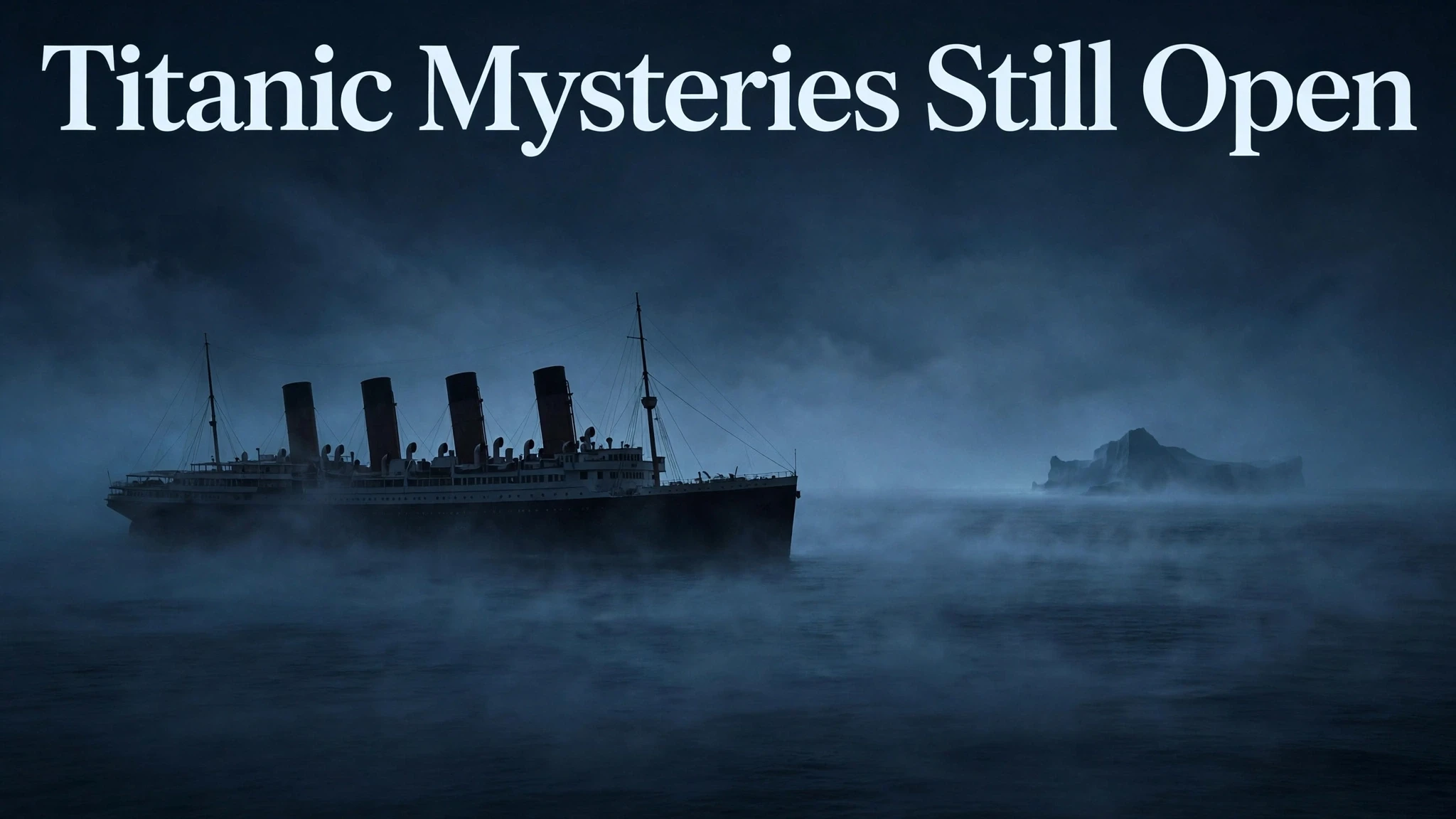
Titanic sank on 15 April 1912, four days into its maiden voyage from Southampton, after striking an iceberg on the night of 14 April, with about 1,500 of about 2,223 people aboard lost. The wreck was found in 1985, split in two on the seabed. That discovery answered one question — it did break apart before sinking — and opened others that remain open because key witnesses died, key records are incomplete, and the wreck itself is decaying. The mysteries below are not all equal: some are genuine gaps in evidence, some are debates between historians and engineers, and some are theories with little support. Keeping those levels separate is the only honest way to read them.
Why Only 20 Lifeboats for About 2,223 People?
Titanic carried 20 lifeboats with capacity for about 1,178 to 1,200 people, just over half the people aboard. That number met the law at the time, which based lifeboat requirements on ship tonnage, not on passenger numbers, and which had not kept pace with ships as large as Titanic. Legally compliant and morally indefensible are not the same, and Titanic is the case that proved it. After the disaster, lifeboat law changed to require boats for everyone aboard, a reform bought with 1,500 lives.
The open part is not the law, but the decision inside Harland & Wolff, the Belfast builder. Alexander Carlisle, the shipyard’s general manager, reportedly submitted plans for 64 lifeboats, later reduced to 32, and in 1910 a decision reduced the number further to 20. Carlisle left the company in 1910, reportedly after a breakdown, and historians still debate whether his departure was linked to the lifeboat dispute, to health, or to other business reasons. No single memo has settled it. What is clear is the design trade-off that was made: fewer boats meant a clearer, more elegant promenade deck, less clutter for first-class passengers, and lower cost and weight. Aesthetics and comfort were, in effect, weighed against a disaster that builders believed would not happen, because they believed Titanic’s watertight compartments would keep it afloat long enough for rescue.
That belief is the second open question inside the lifeboat mystery: did builders and crew genuinely believe Titanic was unsinkable, or is that a later simplification? No one in 1912 used the word unsinkable as a technical guarantee in the way popular history suggests. The ship was described as “practically unsinkable” in trade press, meaning its compartments made sinking unlikely, not impossible. The practical effect, however, was similar: lifeboats were treated as ferries to a rescue ship, not as survival craft for everyone, and many boats were launched half-empty because passengers did not believe the ship would sink and crew did not force them aboard. The mystery is therefore not only “why 20 boats?” but “why, with even 20 boats, did so many leave half-full?”
The Locked Binoculars and David Blair
Lookouts in Titanic’s crow’s nest had no binoculars on the night of the sinking. Binoculars were, according to the BBC account summarised in later coverage, locked in a locker whose key was taken off the ship by Second Officer David Blair, who was reassigned at the last minute before sailing and forgot to hand the key over. That story is widely repeated, and the key itself later became a famous artefact, but several details remain open.
First, would binoculars have helped? Lookouts are trained to spot with the naked eye first, because binoculars narrow the field of view and can delay spotting a low object like an iceberg in darkness. Some historians argue binoculars would have made little difference, or even hurt, on a moonless night with calm sea and no waves breaking against ice. Others argue they might have given a few extra seconds, and a few seconds at 22 knots is a long distance. No experiment can replay that night exactly, so the question remains a debate between seamanship practice and hindsight.
Second, why was there no safety check that caught the missing key? A ship about to sail on a maiden voyage, with a last-minute officer change, should have had a handover checklist for navigation equipment. Whether that check was skipped, informal, or simply not recorded is unclear. Blair’s reassignment itself is also unexplained in full: why was an experienced officer removed so late, and why was the replacement, Charles Lightoller, not given a complete equipment handover? Those administrative gaps, small on their own, combined with speed, darkness, and ice warnings to produce a disaster. The binoculars mystery is therefore a systems mystery, not a single-key mystery.
The Californian: Close Enough to Help, or a Different Ship?
The SS Californian, under Captain Stanley Lord, was stopped in ice about 19.5 miles from Titanic by Lord’s own account, according to the inquiry record. Its crew saw rockets, but did not interpret them as distress signals and did not wake the wireless operator, who had gone to bed after being told by Titanic’s operator to shut up earlier that evening. By the time Californian arrived, Carpathia had already rescued survivors. The British inquiry blamed Lord for failing to respond. That verdict has been debated ever since, and the wreck discovery added a twist.
Some later researchers argued that the wreck’s position exonerated Lord, because Titanic’s actual sinking position was further from Californian than the inquiry assumed, making rescue in time less certain. Others point to witness accounts of a third vessel, closer to Titanic, that seemed to watch and then sail away. The Norwegian sealing ship Samson has been suggested as that vessel, with a crew that, by some accounts, feared revealing illegal sealing activity and therefore stayed silent. That theory is unproven, and Samson’s logs do not confirm it, but it cannot be fully ruled out because no complete, independent log from a third ship has been produced.
The open question is therefore twofold: how far was Californian, in nautical miles and in time to reach Titanic through ice at night, and was there another ship closer still? Distance matters because it decides moral blame: a captain 19 miles away through ice, without wireless, faces a different decision from a captain 5 miles away in clear water. Time matters because even if Californian had steamed at once, it might have arrived after Titanic sank, but in time to rescue people in the water and in half-empty lifeboats. That second possibility — rescue after sinking, not prevention of sinking — is often lost in the blame debate, and it keeps the Californian mystery open: Lord may have failed, but the exact lives that failure cost cannot be counted from the evidence we have.
Why Did Titanic Break in Two, and How Exactly?
Survivors disagreed: some said Titanic sank intact, others said it broke apart. The wreck proved the second group right in broad terms, but the exact mechanics remain debated. The ship was about 882 feet long. A study reported in Scientific American found failure began in the ship’s bottom structure when it was at an angle of about 17 degrees, then spread across the breadth and upward, forming two separate pieces of the double bottom. Other researchers emphasise rivet quality: metallurgical analysis found Titanic’s rivets contained a high concentration of slag, a smelting residue that can make metal brittle and split under stress, especially in cold water.
The debate is not whether it broke, but where the first failure occurred and what sequence followed. Did the stern rise, hang, and snap under its own weight as the bow flooded and pulled down? Did the keel fail first, or did side plating fail and then the keel? Computer simulations produce different scenarios depending on assumptions about flooding rates, steel properties at near-freezing temperatures, and the exact angle at breakup. The wreck’s two main sections, about 600 metres apart on the seabed, with a debris field between them, confirm a violent breakup, but the seabed impact and 100 years of decay have distorted the evidence. No simulation can be checked against a complete, undistorted wreck, because the wreck itself is the distorted result.
That uncertainty has a practical consequence: modern ship design uses Titanic’s breakup as a case study, but designers must design for a range of failure modes, not a single proven sequence. The mystery, in other words, is not a failure of research. It is a limit of evidence: a ship that broke in darkness, sank 3,800 metres, and was not seen again for 73 years cannot yield the same certainty as a laboratory test.
The Coal Fire: Did Fire Weaken the Hull Before the Iceberg?
A coal bunker fire had been burning in Titanic’s coal store before sailing, and some researchers, notably in a documentary using photographs from the Harland & Wolff archive, argue the fire had burned for about three weeks and weakened the hull plating where the iceberg later struck. The fire would have heated steel, potentially making it more brittle or warped, and the crew’s efforts to control it — moving coal, shovelling it into furnaces — may have been one reason the ship maintained high speed: to burn coal quickly and empty the burning bunker, as engineer Robert Essenhigh argued in a 2004 Geological Society of America paper.
Other historians accept the fire existed but dispute its importance. Coal fires were common on steamships of the era, crews knew how to manage them, and there is no direct proof the fire reached the exact plates struck by the iceberg with enough heat to change their strength materially. The photographs showing a dark mark on the hull are suggestive, not conclusive, because they could show coal dust, shadow, or fire damage, and the mark’s location relative to the iceberg damage is debated.
The fire theory also intersects with the speed mystery. Titanic was steaming at close to maximum speed, about 22 knots, despite multiple iceberg warnings. Was Captain Edward Smith pressured by White Star Line to make a fast crossing, was he following normal practice of maintaining speed in clear weather until ice was sighted, or was he trying to burn off burning coal? No order to speed has been found, and Smith, a seasoned captain, would not normally risk a ship for a record on a maiden voyage. The fire explanation gives speed a technical motive that does not require pressure or recklessness, but it remains a hypothesis, not a proven cause, because the fire’s exact extent and the ship’s exact speed orders were lost with the ship.
Captain Smith’s Final Moments and the Wealthy Passengers
Captain Smith went down with Titanic, but how he died is unknown. Some accounts place him on the bridge until water overwhelmed it. Others claim he rescued a child, or swam to a lifeboat and was turned away, or shot himself — a claim with no reliable witness and often repeated without evidence. His last confirmed sighting was minutes before the sinking, on or near the bridge. Beyond that, accounts conflict because witnesses were in lifeboats, in darkness, in shock, and at different positions. The mystery persists because the most important witness, Smith himself, did not survive, and because later films and books filled the gap with dramatic scenes that readers now mistake for record.
Similar gaps surround wealthy passengers such as John Jacob Astor IV and Benjamin Guggenheim. Why did some refuse lifeboats, send wives aboard and stay, or change their minds? Astor helped his pregnant wife into a lifeboat and was reportedly told he could not board; Guggenheim reportedly changed into evening dress and said he was prepared to go down like a gentleman. Those stories come from survivor testimony, but testimony about a man’s motives in his final minutes is inherently uncertain. A man who refuses a boat may be acting from chivalry, from disbelief that the ship will sink, from a wish not to separate from a companion, or from confusion in darkness and noise. Historians can record what he did; they cannot prove why, and the attempt to prove why often says more about the storyteller’s values than about the passenger’s.
The same caution applies to the wireless room. Surviving operator Harold Bride reported chaos, including a coal trimmer trying to steal operator Jack Phillips’s lifejacket. That account is vivid, but it comes from one survivor in a traumatic night, and it cannot be cross-checked against Phillips, who died. The wireless messages themselves — distress calls, ice warnings, and the Californian exchange — are better documented, but the human moments around them remain single-source and therefore open.
One further open detail deserves a place before any judgement: the exact iceberg damage itself. Titanic did not suffer a single clean gash, as early reports suggested. Modern analysis of the wreck and of survivor testimony points to a series of smaller openings, buckled plates, and popped rivets along about 90 metres of the starboard bow, flooding five or six compartments — more than the four the design could survive with. The precise pattern of those openings cannot be inspected directly, because the bow section is buried in seabed mud and distorted by impact. That uncertainty matters, because it decides whether a slower speed, a different turn, or stronger rivets would have saved the ship, or merely delayed sinking by minutes. Without a clear damage map, every “what if” about that night remains an estimate, not a verdict.
My Take:
Titanic’s mysteries stay open for a reason that is not romantic: evidence was lost in the same night as the ship. That is a simple, unglamorous truth, and it should make readers suspicious of any book or film that claims to have solved everything. A historian who says “we do not know why Carlisle left” is more trustworthy than one who invents a memo. A metallurgist who says “simulations differ” is more useful than one who picks a single rivet as the villain. The wreck gave us a seabed, not a confession, and the inquiries gave us testimony, not a complete record. Accepting those limits is not giving up. It is the start of honest history.
I think the lifeboat decision is the mystery that should anger readers most, because it was not a mystery at the time. It was a choice, made in daylight, in an office, with plans on a table. Carlisle reportedly wanted 64 boats, then 32, then 20. Someone, somewhere, decided that a clear deck mattered more than boats for everyone, and that decision was legal. That is why Titanic changed law after the fact: law had allowed a deadly trade-off to look responsible. The lesson for today is to ask, whenever a safety rule is based on size, tonnage, or an old standard rather than on people aboard, who benefits from the gap, and who would pay if the gap is tested. Titanic’s answer was first-class passengers with a clear promenade, and third-class passengers and crew with no boat.
The Californian debate, in my view, is often argued backwards. People ask “was Lord guilty?” as if guilt were a single verdict. The better question is “what could have been done, in what time, through ice, at night, without wireless?” If Californian had steamed at once, it might not have saved Titanic, but it might have saved people in the water, and that possibility alone makes Lord’s inaction serious, even if the exact number of lives cannot be proved. Conversely, if a third ship was closer and sailed away, then focusing only on Lord lets that ship, and the system that allowed ships to ignore rockets, off the hook. The mystery is not only about one captain. It is about a maritime culture where rockets could be misread, wireless operators could sleep, and no one was required to investigate a signal that might be distress. That culture changed after Titanic, and that change is the real verdict.
The coal fire theory interests me because it shows how a new piece of evidence — old photographs, re-examined — can reopen a settled story without overturning it. Fire does not replace the iceberg. It may have made the iceberg’s damage worse, or it may have been a manageable fire that historians have overstated. Either way, it reminds us that Titanic did not sail as a perfect ship on a perfect night. It sailed with a fire in a bunker, with a last-minute officer change, with a locked binocular locker, with ice warnings that were not all passed to the bridge in time, and at high speed. Disasters rarely have one cause. They have a chain, and Titanic’s chain had many links, each small enough to be dismissed on its own. That chain model is more useful than any single-cause theory, including the popular ones about a cursed mummy, a switched sister ship, or a torpedo, none of which has credible evidence.
The switched-ship theory — that the sunken ship was actually Olympic, disguised for insurance after an earlier accident — deserves a plain verdict: it has been examined, and it fails on hull numbers, on the scale of fraud it would require, and on the fact that Olympic continued to sail for years after Titanic sank. Its persistence tells us more about distrust of large companies than about Titanic. People want a villain with a plan, not a system with flaws. But Titanic’s real villains were not conspirators. They were ordinary decisions: speed in clear weather, boats as ferries, a key forgotten, a wireless operator asleep, rockets misread. Ordinary decisions are harder to dramatise, but they are easier to fix, and fixing them has saved lives on every ship since.
Finally, Captain Smith’s unknown end should be left unknown. Films that show him dying heroically, or tragically, or by his own hand, are filling a gap with a story that comforts the audience. The honest version is colder: a 62-year-old captain, on his last voyage before retirement by some accounts, faced a disaster he could not reverse, gave orders that saved some and could not save others, and died with his ship. We do not know his last words, his last thoughts, or his exact position when water took him. Leaving that gap open respects him more than inventing a speech for him. It also respects readers, who deserve to know the difference between what happened and what we wish had happened.
There is a further lesson in how Titanic changed safety culture that goes beyond lifeboats. Before 1912, wireless was a commercial service for passengers, not a safety system that had to be staffed around the clock. After Titanic, the Radio Act of 1912 in the United States and the later international SOLAS convention required ships to maintain a continuous wireless watch, to carry enough lifeboats for all aboard, and to conduct lifeboat drills. Those rules did not come from a single mystery being solved. They came from a system being recognised as broken: a wireless operator asleep, rockets misread, boats half-empty, and a captain without a complete ice picture. When a disaster has many small causes, the fix must also be many small rules, each closing one gap, rather than one grand invention.
The wreck itself is now a second, ongoing mystery, because it is decaying. Bacteria that eat iron, deep currents, and the collapse of decks mean the wreck will, over time, lose the very evidence historians still need to settle the breakup sequence, the coal fire mark, and the hull damage. Expeditions since 1985 have photographed, mapped, and, controversially, recovered artefacts, and each visit both adds knowledge and disturbs the site. That trade-off — study versus preservation — has no perfect answer, and it means future historians may know less, not more, about some Titanic questions, unless the existing photographic and sonar record is preserved and shared. The open mysteries, in that sense, may stay open not because we failed to ask, but because the evidence itself is dissolving on the seabed.
Frequently Asked Questions
Why did Titanic carry only 20 lifeboats for about 2,223 people? Titanic’s 20 boats held about 1,200 people and met tonnage-based law at the time, which did not require boats for everyone. Builder Alexander Carlisle reportedly proposed 64, then 32, before the number was cut to 20 in 1910, for reasons still debated, including deck appearance, cost, and belief boats were ferries to a rescue ship.
What is the Titanic locked binoculars mystery with David Blair? Lookouts had no binoculars because, by the BBC account, they were locked away and Second Officer David Blair, reassigned at the last minute, took the key off the ship. Whether binoculars would have helped on a moonless night, and why no handover check caught the key, remain debated.
Did the SS Californian ignore Titanic’s distress rockets? Californian, under Captain Stanley Lord, was stopped in ice and its crew saw rockets but did not treat them as distress or wake its wireless operator. The British inquiry blamed Lord, but later debate concerns exact distance, time through ice, a possible third ship such as Samson, and how many lives a faster response could have saved after sinking.
Why did Titanic break in half before sinking? The wreck confirms a breakup, with a study reported in Scientific American finding failure began in the bottom structure at about 17 degrees. Rivet slag, cold steel, flooding, and stern weight are all debated contributors, and simulations differ on the exact sequence because the wreck is distorted by impact and decay.
Did a coal fire weaken Titanic’s hull before the iceberg? A coal bunker fire burned before sailing, and some researchers argue it weakened hull plates and may explain high speed to burn coal, as in Essenhigh’s 2004 paper. Others accept the fire but dispute its effect on the struck plates, so it remains a hypothesis, not a proven cause.
How did Captain Edward Smith die on Titanic? Captain Smith went down with the ship, but his exact death is unknown. Accounts place him on the bridge, rescuing a child, or swimming, with no reliable confirmation beyond a last sighting minutes before sinking. Claims he shot himself have no reliable witness support.
Was the sunken ship actually Titanic’s sister ship Olympic? No credible evidence supports the switched-ship insurance theory. Hull numbers, Olympic’s continued service after 1912, and the scale of fraud required argue against it. It remains a popular conspiracy theory, not a historian’s conclusion.