What Happens During a Solar Eclipse
In this post
- The basic geometry: Sun, Moon, and shadow
- The phases: from first contact to totality
- Total, partial, annular, and hybrid eclipses
- Why total eclipses are rare where you live
- What the sky and Earth do during totality
- What scientists learn from eclipses
- Eclipses in history, myth, and culture
- How to watch safely and what to plan
- My Take:
For a few minutes, day turns into an eerie twilight, the temperature drops, birds fall silent, and a black disc hangs in the sky surrounded by a pearly crown of light. A total solar eclipse is one of the most dramatic sights in nature, and it has frightened, fascinated, and inspired people for thousands of years. Yet the cause is beautifully simple: the Moon passes directly between Earth and the Sun, casting its shadow on our planet, and for a brief moment, observers standing in that shadow see the Sun blocked out.
This guide explains what happens during a solar eclipse, minute by minute, why total eclipses are rare in any one place, what the different types of eclipse look like, and how to watch one safely. It also looks at what scientists learn from eclipses, and why ancient peoples, who could not explain them, often treated them as omens.
The basic geometry: Sun, Moon, and shadow
A solar eclipse can only happen at new moon, when the Moon lies between Earth and the Sun. That alignment alone is not enough, because the Moon’s orbit is tilted by about five degrees relative to Earth’s orbit around the Sun. Most months, the new moon passes slightly above or below the Sun as seen from Earth, and no eclipse occurs. Only when a new moon happens near one of the two points where the orbits cross, called nodes, does the Moon’s shadow fall on Earth and an eclipse take place.
The Moon’s shadow has two parts. The umbra is the central, darkest part, where the Sun is completely blocked. The penumbra is the larger, lighter outer part, where the Sun is only partly blocked. Observers inside the umbra experience a total eclipse, while those in the penumbra see a partial eclipse. The umbra is surprisingly narrow, usually less than about 270 kilometres wide, and it races across Earth’s surface at speeds that can exceed 1,500 kilometres per hour, depending on geometry. That is why totality is both brief and local: the shadow sweeps a long, narrow path, but any single place inside it experiences darkness for only a few minutes at most.
There is also a remarkable coincidence that makes total eclipses possible. The Sun is about 400 times wider than the Moon, but it is also about 400 times farther away, so the two appear almost exactly the same size in our sky, each about half a degree across. If the Moon were much smaller or farther away, it could never fully cover the Sun, and we would never see a total eclipse. If it were larger or closer, it would hide the Sun’s outer atmosphere as well. As it is, the match is close enough that the Moon just covers the Sun’s bright disc and reveals the faint corona around it, a sight no other known planet offers in quite the same way.
The phases: from first contact to totality
A solar eclipse unfolds in stages, each with its own name and appearance. First contact is the moment the Moon’s edge first touches the Sun’s edge, and a small notch appears in the Sun’s disc. Over the next hour or so, the Moon slowly covers more of the Sun, and daylight dims gradually, though most people barely notice the change until coverage passes about 70 or 80 percent. Shadows become sharper, colours look slightly strange, and the temperature may begin to fall.
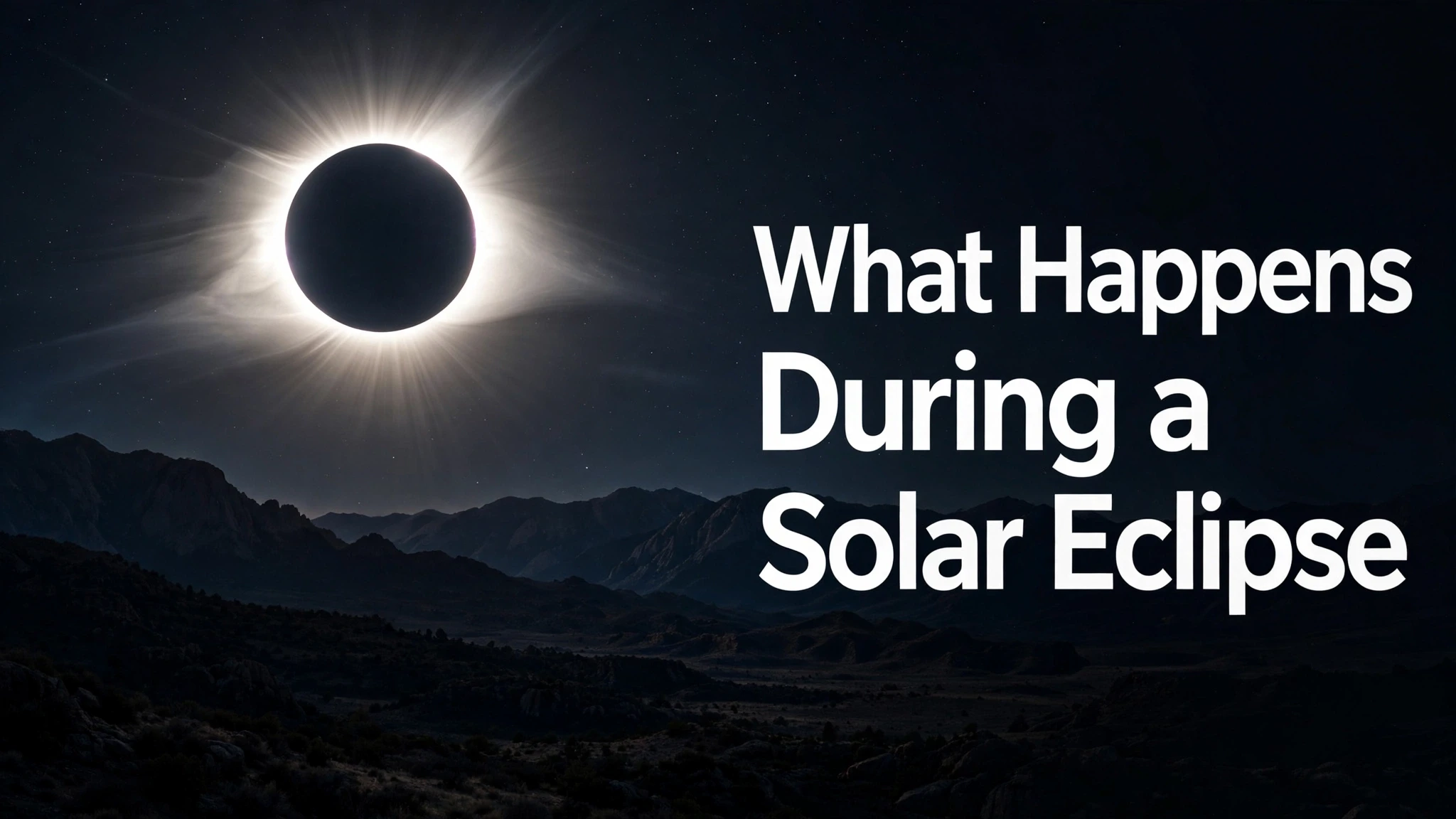
As totality approaches, the light changes rapidly. The last sliver of Sun breaks into a string of bright beads, called Baily’s beads, as sunlight shines through valleys on the Moon’s edge, and then a single brilliant point remains, the diamond ring effect, where the corona appears as a ring around a dazzling spot. Then, in a moment that eclipse watchers describe as unforgettable, the diamond vanishes and totality begins. The sky darkens to a deep twilight blue, stars and planets may become visible, and the Sun’s corona, its outer atmosphere, glows around the black disc of the Moon. Animals may behave as if night has fallen: birds go to roost, crickets begin to chirp, and farm animals head for shelter.
Totality lasts from a few seconds to a maximum of about seven and a half minutes, depending on the eclipse geometry, though most last two to four minutes. Then the sequence reverses: the diamond ring reappears on the opposite side, Baily’s beads flash again, and the Moon gradually uncovers the Sun over the next hour until fourth contact, when the Moon leaves the Sun’s disc entirely and the eclipse is over. For observers outside the path of totality, the whole event is a partial eclipse, with no totality and no visible corona, and the Sun must never be viewed without proper eye protection at any stage.
Total, partial, annular, and hybrid eclipses
Not every solar eclipse is total. The Moon’s orbit around Earth is elliptical, so its distance from Earth varies. When the Moon is near its farthest point, it appears slightly smaller in the sky and cannot fully cover the Sun, even when perfectly aligned. The result is an annular eclipse, named from the Latin word for ring, in which a bright ring of sunlight, the annulus, remains visible around the dark Moon. An annular eclipse is striking, but it is not the same as totality: the sky does not darken fully, the corona is not visible, and eye protection is required throughout.
A partial eclipse happens when the Moon covers only part of the Sun, either because the observer is outside the path of totality or because the alignment is not central. Partial eclipses are far more common than total ones, and a partial eclipse of some degree is visible from a wide area around the totality path. A hybrid eclipse is rarer still: it begins as annular in some places and becomes total in others, because Earth’s curved surface changes the apparent size of the Moon along the path. Hybrid eclipses are uncommon and usually brief in their total phase.
The distinction matters for safety and for science. Only during the brief minutes of totality, when the Sun’s bright disc is completely covered, is it safe to look directly at the eclipse without special filters, and even then only for that total phase. During partial and annular phases, and during the partial phases before and after totality, the Sun’s remaining light is still intense enough to damage the eyes, and proper eclipse glasses or other approved filters are essential. More detail on safe viewing is given below, because eye safety is the single most important practical point of this guide.
Why total eclipses are rare where you live
Solar eclipses themselves are not rare: there are between two and five solar eclipses somewhere on Earth each year, counting partial eclipses. Total eclipses happen roughly every 18 months somewhere in the world. The rarity is local. Because the path of totality is narrow, any given place on Earth experiences a total eclipse only about once every 360 to 400 years on average, although the exact interval varies with geography and chance, and some places have had two total eclipses within a few years while others wait far longer.
That rarity explains why eclipse chasing has become a hobby, even a passion, for many people. Enthusiasts travel across continents to stand in the path of totality for a few minutes, sometimes in remote deserts, on ships at sea, or in mountain villages. The experience is often described as life-changing, not because of any mystical effect, but because of the sheer strangeness of midday darkness, the visible corona, and the sudden drop in temperature, all happening on a timescale of minutes. For many watchers, one total eclipse creates a desire to see another, and eclipse maps become travel plans years in advance.
Eclipse seasons also follow a pattern. Because the Moon’s nodes shift slowly, eclipses tend to occur in seasons about six months apart, and a particular pattern of eclipses, called a Saros cycle, repeats roughly every 18 years and 11 days, with similar eclipses occurring but shifted in location. Ancient astronomers, notably the Babylonians, recognised the Saros cycle and could predict eclipses with surprising accuracy, even without understanding the full geometry. Modern predictions are far more precise, giving the path of totality to within a kilometre or so, and allowing observers to plan exactly where to stand.
What the sky and Earth do during totality
Totality affects more than the Sun. As the Moon’s shadow races across the landscape, the temperature can drop by several degrees within minutes, sometimes by as much as 10 degrees or more in clear, dry conditions. Wind patterns may shift as the air cools, and a shadow band effect can appear: faint, rippling lines of light and dark moving across light-coloured ground just before and after totality, caused by turbulence in Earth’s atmosphere distorting the thin crescent of sunlight.
The sky itself changes colour. Instead of the familiar blue of day or the black of night, the sky during totality takes on a deep, dusky blue-grey, darkest near the Sun and lighter toward the horizon, where sunlight from outside the shadow still illuminates the atmosphere. Bright stars and planets, such as Venus and Jupiter if they happen to be near the Sun in the sky, can appear, and the horizon may glow with a sunset-like band all around, because the observer is standing in a small island of darkness surrounded by daylight in all directions.
Animals respond in varied and sometimes confusing ways. Daytime birds may fall silent or return to roosts, nocturnal insects may begin their evening chorus, and domestic animals may show restlessness or seek shelter. These behaviours are not evidence of any mysterious force; they are responses to the sudden change in light and temperature, the same cues animals use to judge dawn and dusk. Researchers have used eclipses as natural experiments, studying how quickly ecosystems respond to an abrupt, predictable change in light, and how different species recover afterwards.
What scientists learn from eclipses
For scientists, a total eclipse is a rare opportunity to study the Sun’s corona, the outer atmosphere that is normally hidden by the Sun’s overwhelming brightness. The corona is a million degrees or more, far hotter than the Sun’s visible surface, and understanding why it is so hot remains one of the big questions in solar physics. During totality, instruments can observe the corona’s structure, its streamers and loops, and the solar wind that flows outward from it and affects space weather around Earth.
Historically, eclipses have led to major discoveries. The element helium was first identified in the Sun’s spectrum during an eclipse in 1868, before it was found on Earth. In 1919, observations during a total eclipse provided one of the first tests of Einstein’s general theory of relativity, by showing that starlight passing near the Sun was bent by gravity, as the theory predicted. Modern space telescopes can now create artificial eclipses with coronagraphs, blocking the Sun’s disc to study the corona at any time, but ground-based eclipse observations still offer high resolution and a chance to test instruments and train new researchers.
Eclipses also help refine our knowledge of the Moon’s motion and Earth’s rotation. Precise timings of contacts, recorded over centuries, reveal that Earth’s rotation is gradually slowing, partly due to tidal friction with the Moon, and that the Moon is slowly receding from Earth. Ancient eclipse records, from China, Babylon, and Greece, are therefore valuable data, not just historical curiosities: they allow modern astronomers to calculate how the length of the day has changed over thousands of years, and to predict future eclipses with ever greater accuracy.
Eclipses in history, myth, and culture
Before the geometry of eclipses was understood, a sudden darkening of the Sun was terrifying, and cultures around the world explained it in their own ways. Many traditions described a monster, dragon, or demon devouring the Sun, and people made noise, banged drums, or fired weapons to scare the creature away. In Chinese tradition, a celestial dragon was said to eat the Sun, and the word for eclipse in Chinese retains a sense of eating. In Norse mythology, wolves chasing the Sun and Moon were said to catch them at the end of the world. In some Indian traditions, the demon Rahu was said to swallow the Sun, only for it to re-emerge from his severed neck.
Not all responses were fearful. Some cultures treated eclipses as moments of ritual, reflection, or renewal, and skilled astronomers in Babylon, China, Greece, and later the Islamic world learned to predict them, turning terror into knowledge. The ability to predict an eclipse became a mark of learning and, sometimes, of political power, because a ruler who could warn of a darkened Sun appeared to command the heavens. Columbus is said to have used his knowledge of an upcoming lunar eclipse to impress Indigenous people in Jamaica, although that story concerns a lunar, not a solar, eclipse, and its details are debated.
In modern culture, eclipses still inspire art, music, and literature, and they remain communal events, with millions of people gathering to watch together, sharing glasses and telescopes. That communal aspect is worth noting: unlike many astronomical events that require a telescope and a dark sky, a total eclipse is visible to the naked eye, in daylight, and its drama is obvious to anyone standing in its path. It is one of the few scientific spectacles that needs no explanation to be felt, even if understanding its cause makes it more, not less, impressive.
How to watch safely and what to plan
Eye safety is the most important practical part of watching a solar eclipse. Looking directly at the Sun, even during a partial eclipse, can cause serious and permanent eye damage, because the Sun’s ultraviolet and visible light can burn the retina without pain. Ordinary sunglasses, smoked glass, and photographic film are not safe. The safe options are eclipse glasses that meet the ISO 12312-2 international safety standard, used according to their instructions and discarded if scratched or damaged, or indirect viewing methods such as a pinhole projector, which casts an image of the Sun onto a surface without looking at it directly.
During totality only, and only if you are inside the path of totality, it is safe to remove eclipse glasses and look directly at the corona, because the Sun’s bright disc is fully covered. As soon as the diamond ring reappears, glasses must go back on immediately. Observers watching a partial or annular eclipse must keep glasses on for the entire event, with no safe moment to look directly. Children should be supervised closely, and eclipse glasses should be checked for damage before use. If in doubt, use indirect viewing, which is completely safe and still shows the changing shape of the Sun clearly.
Planning also matters. Check the official path of totality from a reliable source, such as a national space agency or observatory, arrive early, and have a backup location in case of cloud, because a single cloud at the moment of totality can hide the corona entirely. Bring water, sun protection, and warm layers, because temperatures drop during totality, and remember that traffic after a major eclipse can be heavy, as thousands of visitors leave at once. A little preparation turns a few minutes of darkness into a memory that lasts a lifetime, and it keeps your eyes safe to enjoy the next one.
My Take:
My first judgement is that a total solar eclipse is the best possible argument for learning basic astronomy, because it makes an abstract idea suddenly visible. The idea that the Moon is 400 times smaller than the Sun but also 400 times closer sounds like a textbook coincidence until you stand in the Moon’s shadow and watch the Sun’s disc disappear, leaving only the corona. At that moment, geometry stops being a diagram and becomes an experience. I think science education should use that power more deliberately: a person who has seen totality rarely forgets why eclipses happen, while a person who has only read about them may forget within a week.
My second judgement concerns safety messaging, which I think is often either too alarming or too casual. Some warnings make it sound as if glancing at any eclipse will instantly blind you, which can lead people to ignore the advice altogether when they realise a brief accidental glance did not harm them. Other messages are so relaxed that people use sunglasses or smoked glass, which are genuinely dangerous. The honest message is specific: the danger comes from the Sun’s bright disc, not from the corona during totality, and approved filters or indirect viewing remove that danger completely. Clear, specific advice is more protective than fear, because people follow advice they understand.
I also think eclipse chasing deserves respect rather than dismissal as an expensive hobby. Critics sometimes ask why anyone would travel thousands of kilometres for three minutes of darkness. The answer is that those three minutes are unlike anything else in ordinary life: midday twilight, a visible stellar corona, a temperature drop, and animals behaving as if night has fallen, all at once. People travel for concerts, matches, and festivals that last longer but move them less. An eclipse is a natural event of a different order, and the fact that it cannot be replayed, postponed, or bought makes the effort worthwhile for those who value it.
A further point is about the history of eclipse science, which I find humbling. Ancient astronomers predicted eclipses using cycles, without telescopes, without a correct model of the solar system, and without understanding what the corona was. Modern astronomers predict them to the kilometre and second, and still use eclipses to study questions, such as coronal heating, that remain unsolved. That combination, ancient skill and modern mystery, is a reminder that science progresses by refining questions, not by answering everything at once. The corona’s million-degree temperature is still not fully explained, and that unsolved problem should excite, not embarrass, us.
I would also argue that eclipses are a useful test of how we handle shared, predictable events. A total eclipse is known years in advance, its path is published, and its timing is exact, yet traffic jams, sold-out accommodation, and cloud disappointment still catch people by surprise. The same pattern appears with other predictable events, from floods to heatwaves: we know they are coming, but we plan as if they were surprises. An eclipse is a low-stakes rehearsal for that planning failure, and learning to arrive early, choose a backup site, and leave time to get home is a small lesson with wider applications.
My practical takeaway is simple: if you ever have the chance to see a total eclipse, take it, but prepare properly. Buy approved glasses well in advance, check the path from a reliable source, and practise using indirect viewing as a backup. During totality, put the camera down for at least a minute and simply look, because photographs rarely capture what the eye sees, and the memory of the corona, the dark sky, and the horizon glow is worth more than a blurry image. And if you can only see a partial eclipse, enjoy it safely with glasses or a pinhole projector; it is still a striking demonstration that the Moon, Earth, and Sun are moving in a precise, predictable dance, and that for a short time, we get to watch that dance cast a shadow on our own world.
There is also a community point worth making. Eclipse watching is one of the few scientific events that is genuinely better shared. A lone observer sees the same corona, but a crowd gasps together at first darkness, shares glasses with strangers, and points out planets and shadow bands to each other. That shared gasp matters, because it turns a private observation into a public memory, and public memories are what keep science funding, planetariums, and school astronomy alive. I think organisers should lean into that: public viewing events, school projects, and accessible explanations in local languages do more for astronomy than any number of expert lectures delivered to empty rooms.
I would add a caution about photography, which has become a distraction at many eclipses. Modern cameras and phones can capture a respectable corona image, but only with practice, filters for partial phases, and a tripod, and even then the result rarely matches what the eye sees, because the eye adapts to a far wider range of brightness than a sensor. Spending totality fiddling with settings, therefore, risks missing the very event you travelled to see. My advice, learned from experienced eclipse watchers, is to automate photography if you must, or to delegate it to one person in a group, and to spend at least most of totality simply looking. The photograph will be forgotten; the memory of darkness at noon will not.
A final judgement concerns the next generation of eclipse science. Space-based coronagraphs now observe the corona daily, and new missions will study the Sun from closer than ever before, so some may ask whether ground-based eclipses still matter scientifically. I think they do, for three reasons: they provide high-resolution views that complement space data, they offer a natural test of instruments and models under real sky conditions, and, most importantly, they inspire new scientists. Many solar physicists trace their interest to a childhood eclipse, and that inspiration is not a soft extra; it is how a field renews itself. An eclipse that inspires a thousand children to study the Sun has done scientific work that no single paper can measure.
Frequently Asked Questions
What is the difference between a total and an annular solar eclipse? In a total eclipse the Moon fully covers the Sun’s disc, revealing the corona and darkening the sky. In an annular eclipse the Moon appears slightly smaller, leaving a bright ring of sunlight around it, and the sky does not fully darken.
How long does totality last? Totality lasts from a few seconds to a maximum of about seven and a half minutes, with most total eclipses lasting two to four minutes at any one location.
Is it safe to look at a solar eclipse without glasses? Only during totality, and only inside the path of totality, is it safe to look directly without filters. During partial and annular phases, approved eclipse glasses or indirect viewing must be used at all times.
Why are solar eclipses rare in one place? The Moon’s shadow during totality is narrow, usually less than about 270 kilometres wide, so any given location experiences a total eclipse only about once every 360 to 400 years on average.
Can a solar eclipse happen at any new moon? No. It can only happen when a new moon occurs near a node, where the Moon’s tilted orbit crosses Earth’s orbit around the Sun. Most new moons pass above or below the Sun as seen from Earth.
What is the diamond ring effect? Just before and after totality, the last or first sliver of sunlight shines through valleys on the Moon’s edge, creating a brilliant point beside the glowing corona, resembling a diamond ring.