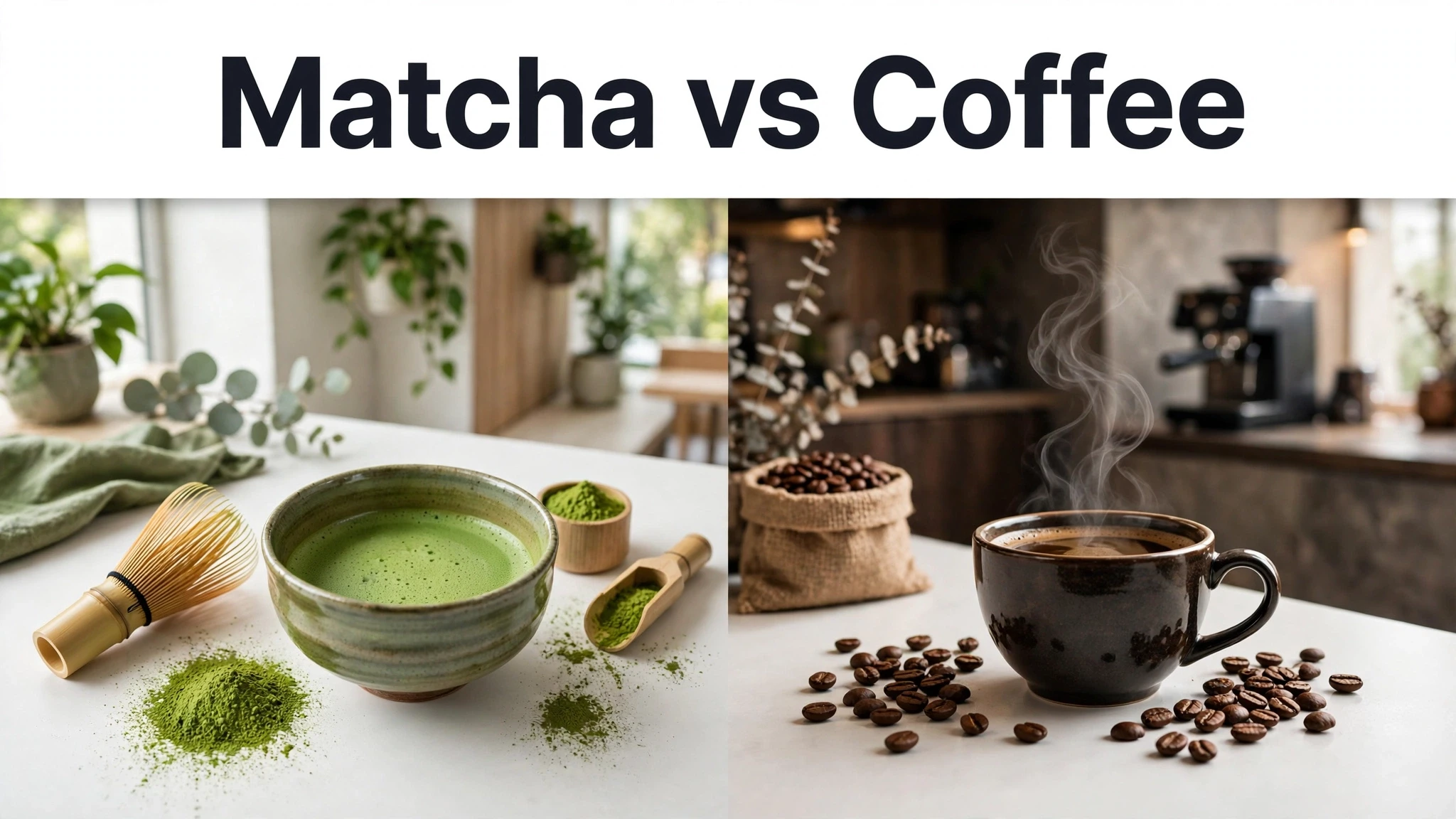
Matcha vs Coffee: Which Is Better for You in 2027
In this post
- What Matcha and Coffee Actually Are
- Caffeine and Energy: The Calm Buzz vs the Quick Hit
- Health Benefits and What the Evidence Actually Says
- Side Effects: Jitters, Sleep, and Stomach
- Taste, Cost, and Convenience in Daily Life
- Which Should You Choose, and Can You Drink Both?
- Matcha Lattes and Coffee Drinks Compared
- Caffeine Sensitivity and Finding Your Limit
- Making the Switch: How to Change Your Morning Drink
- My Take:
Matcha and coffee are two of the most popular drinks in the world, and they are often presented as rivals. Coffee is the familiar morning drink: strong, quick, and everywhere. Matcha is the green challenger: a powdered green tea from Japan, whisked with hot water, with a bright colour and a calm, focused energy that its fans praise. Both have caffeine, both have health claims, and both have devoted followers who insist theirs is better. The truth is more interesting than the rivalry suggests, because the two drinks do different things, and the better choice depends on what you want from your morning.
This guide compares matcha and coffee honestly, looking at caffeine, energy, health benefits, side effects, taste, cost, and convenience. It does not declare a winner, because there is not one. It gives you the facts, so that you can choose the drink that suits your body, your routine, and your taste. Whether you are a coffee lover curious about matcha, or a matcha fan wondering whether coffee is really worse, this comparison will help you decide.
What Matcha and Coffee Actually Are
Matcha is a finely ground powder made from green tea leaves that have been grown in shade, which increases their chlorophyll and amino acids. Unlike ordinary tea, where the leaves are steeped and discarded, matcha is whisked into water and drunk whole, so you consume the entire leaf. That is why it is bright green, and why it contains more of the leaf’s compounds than a cup of steeped tea. Traditional matcha is made with a bamboo whisk, called a chasen, and hot water, though it is now also used in lattes, smoothies, and desserts.
Coffee is made from roasted beans, ground and brewed with hot water, and it is one of the most widely consumed drinks in the world. Its flavour comes from the roast, the origin of the beans, and the brewing method, and it ranges from bright and fruity to dark and bitter. Coffee is usually drunk black, with milk, or with sugar, and it is the base of many drinks, from espresso to lattes. The two drinks come from different traditions, Japan and the coffee-growing regions of the world, and they have different cultures around them. Understanding what each one is, a whole leaf versus a brewed bean, is the first step to comparing them fairly.
Caffeine and Energy: The Calm Buzz vs the Quick Hit
The most important difference between matcha and coffee is how their caffeine feels. A cup of coffee contains about 95 milligrams of caffeine, while a serving of matcha contains about 70 milligrams, though the exact amounts vary. The difference is not only the amount, but the way it is delivered. Matcha contains an amino acid called L-theanine, which is said to promote calm focus, and which may slow the absorption of caffeine, producing a steadier, longer-lasting energy without the sharp spike and crash that coffee can cause. Coffee, by contrast, delivers its caffeine quickly, producing a fast lift, followed, for some people, by a crash, jitters, or anxiety.
That difference is real for many people, though the science is still developing, and individual responses vary. Some people find coffee gives them energy and focus, with no side effects. Others find it makes them jittery, anxious, or unable to sleep, and they prefer matcha’s steadier feeling. If you are sensitive to caffeine, matcha may suit you better, because it contains less caffeine per serving and the L-theanine may soften its effects. If you want a quick, strong lift, coffee is more effective. The best way to know is to try both, at the same time of day, and to notice how you feel two hours later, not only in the first twenty minutes.
Health Benefits and What the Evidence Actually Says
Both matcha and coffee have health claims, and both should be treated with care. Matcha is rich in antioxidants, particularly a type called catechins, and it contains vitamins and minerals from the whole tea leaf. Studies have linked green tea to heart health and to other benefits, though most of the research is on green tea in general, not on matcha specifically, and the effects are modest. Coffee is also rich in antioxidants, and large studies have linked moderate coffee drinking to a lower risk of several diseases, including type 2 diabetes and some liver conditions, though coffee is not a medicine, and the benefits should not be overstated.
It is important to be honest about the limits of this evidence. Neither drink is a cure, and neither will make you healthy on its own. The healthiest choice is the one that fits into a balanced diet, that you enjoy, and that does not cause you side effects. A plain cup of coffee or matcha, without sugar, is a low-calorie drink with some beneficial compounds. A sweetened latte, whether matcha or coffee, is a different thing, and its sugar and calories matter more than the base drink. When comparing health benefits, look at how you actually drink it, not at the claims on the packet.
Side Effects: Jitters, Sleep, and Stomach
Both drinks can cause side effects, and the ones you experience will tell you which suits you better. Coffee’s most common side effects are jitters, anxiety, a racing heart, and difficulty sleeping, especially if it is drunk late in the day or in large amounts. It can also cause stomach acidity and reflux in some people, because coffee is acidic. Matcha’s side effects are usually milder, but it can still cause jitters in sensitive people, and it contains tannins, which can interfere with iron absorption if it is drunk with meals. Matcha can also cause stomach discomfort if it is drunk on an empty stomach, especially in large amounts.
The timing matters for both drinks. Caffeine has a half-life of about five hours, meaning that half of it is still in your system five hours after you drink it, so a coffee at 4pm can still affect your sleep at 10pm. Matcha’s caffeine lasts just as long, even if it feels gentler. If you have trouble sleeping, avoid both drinks after midday, or switch to a decaffeinated option. If you have stomach problems, notice which drink bothers you more, and adjust accordingly. Listening to your body is more useful than any general claim about which drink is healthier.
Taste, Cost, and Convenience in Daily Life
Taste is a personal matter, and it is a major factor in the choice. Coffee has a wide range of flavours, from bright and fruity to dark and chocolatey, and it is familiar to most people. Matcha has a distinctive taste: grassy, slightly bitter, and umami, which some people love and others find strange. It takes time to acquire a taste for matcha, especially if it is made traditionally with water. A matcha latte, with milk and a little sweetness, is milder and is a good introduction. If you do not enjoy the taste, no health benefit will make you drink it regularly, and that is fine. The best drink is the one you enjoy.
Cost and convenience also matter. Coffee is widely available, inexpensive, and quick to make, especially if you use a simple method. Matcha is more expensive per serving, especially good-quality ceremonial grade matcha, and it requires a whisk and a bowl, though a milk frother or a jar can work. It is also less widely available in cafes, though that is changing. If you travel, coffee is easier to find. If you want a ritual, matcha’s preparation, whisking the powder into a froth, can be a calming part of the morning. Choose based on your life, not on a health claim, because the drink you will actually make every day is the right one.
Which Should You Choose, and Can You Drink Both?
The honest answer is that you can drink both, and many people do. Coffee in the morning, when you want a quick lift, and matcha in the afternoon, when you want a steadier energy without affecting your sleep as much, is a sensible combination. Or matcha on days when you feel anxious, and coffee on days when you need a stronger push. There is no rule that you must choose one, and there is no prize for loyalty to a drink. The best approach is to listen to your body, to notice how each drink affects your energy, your sleep, and your stomach, and to choose accordingly.
If you are switching from coffee to matcha, do it gradually, because a sudden drop in caffeine can cause headaches and tiredness. Replace one coffee a day with matcha, and see how you feel after a week. If you are trying matcha for the first time, buy a small amount of good-quality matcha, use hot but not boiling water, and whisk it well, because lumps and bitterness are the most common reasons people dislike it. And remember that both drinks are best without sugar, because sugar adds calories and can cause an energy crash. The better choice is the one that makes you feel good, that you enjoy, and that fits your life. That is the only comparison that matters.
Matcha Lattes and Coffee Drinks Compared
A matcha latte and a coffee drink look similar in a cafe: both are hot, milky, and served in a large cup, but they taste very different, and they behave differently in the body. A matcha latte is made by whisking powdered green tea with hot water, and then adding steamed milk, which softens the grassy, slightly bitter flavour of the matcha, and makes it smooth, and creamy. It is a gentle drink, with a calm, steady energy, and it is often sweetened, with honey, or sugar, because the matcha itself is not sweet. A coffee latte, by contrast, is made with espresso, and steamed milk, and it has a bolder, more bitter flavour, and a stronger caffeine hit, which comes faster, and fades faster, than the energy from matcha.
The choice between them depends on what you want from a drink. If you want a calm, sustained energy, and a gentle flavour, a matcha latte is a good choice. If you want a bold, rousing cup, and you enjoy the taste of coffee, a latte is the better option. It also helps to know that a matcha latte, made with whole milk, and sweetened, can be high in calories, just like a coffee latte, so it is not automatically healthier. Both drinks can be enjoyed, and both can be made at home, with a little practice, and a whisk, or a frother. Try both, and choose the one that suits your taste, and your day.
Caffeine Sensitivity and Finding Your Limit
Caffeine Sensitivity and Finding Your Limit is where many people form their lasting opinion of matcha and coffee, so it pays to understand what is really going on here instead of guessing.
A standard cup of black coffee brewed from freshly ground beans often comes up first when people discuss matcha and coffee, and the reason is simple: it is easy to understand, easy to try, and easy to explain to someone else. A good way to judge a standard cup of black coffee brewed from freshly ground beans is to ask what it does well and what it leaves out, since every part of matcha and coffee makes trade-offs and naming them sharpens judgement. A common mistake is rushing past a standard cup of black coffee brewed from freshly ground beans, so slowing down and giving it a fair try usually leads to a better judgement about matcha and coffee than a quick first impression.
What makes espresso shots that deliver caffeine quickly in a small, strong cup worth studying inside matcha and coffee is the way it balances simplicity and depth, because beginners can use it at once while experienced readers still find something new. Sharing espresso shots that deliver caffeine quickly in a small, strong cup with a friend or reading what others noticed about it can open up angles that were missed, and discussion is one of the fastest ways to deepen a grasp of matcha and coffee. Choosing espresso shots that deliver caffeine quickly in a small, strong cup over a flashier option is often the wiser move, because substance lasts longer than novelty, and matcha and coffee is best enjoyed when quality comes before hype.
With caffeine sensitivity and finding your limit understood, the next part of matcha and coffee becomes easier, because you now have a reference point to compare new ideas against.
Making the Switch: How to Change Your Morning Drink
Switching from coffee to matcha, or from matcha to coffee, is not only about taste. It is about habit, about routine, and about the way you start your day, and changing a morning habit takes time, and patience. The best way to switch is gradually, rather than suddenly, because a sudden change can cause headaches, fatigue, and irritability, especially if you are reducing caffeine. Start by replacing one cup a day, and see how you feel. If you drink three cups of coffee, replace one with matcha, and keep the other two, for a week or two. Then replace another, and so on, until you have made the switch, or found a balance that suits you. That gradual approach is kinder to your body, and it gives you time to learn to enjoy the new drink.
It also helps to learn to make the new drink well, because a badly made matcha, or a badly made coffee, will put you off, and you will conclude that you do not like it, when in fact you do not like the way it was made. Matcha needs the right temperature, the right amount of powder, and whisking, to be smooth and frothy. Coffee needs fresh beans, the right grind, and the right method, to taste its best. Take the time to learn, watch a video, ask a friend, or visit a cafe, and try the drink made well, before you decide. A good first experience will make the switch easier, and a bad one will make it harder, so it is worth getting it right.
There is also the question of cost, and of convenience. Matcha, especially good-quality ceremonial grade, can be expensive, and it requires a whisk, a bowl, and a little time. Coffee, especially if you buy beans and brew at home, can be cheaper, and faster, but it also requires equipment, and time. Compare the costs honestly, and think about what suits your life. If you are busy in the morning, a simple method, such as a French press, or a quick matcha whisked in a mug, may be best. If you enjoy a ritual, a pour over, or a traditional matcha ceremony, may be more satisfying. The best drink is the one that fits your life, and that you will actually make, every day.
It is also worth considering that you do not have to choose one or the other. Many people drink both, coffee on some days, matcha on others, or coffee in the morning and matcha in the afternoon, and that balance can work well. Coffee gives a quick boost, matcha gives a calm, sustained energy, and using both allows you to match the drink to the day. A busy morning may call for coffee, a long afternoon of focused work may call for matcha. That flexibility is a strength, not a failure to decide, and it is a sign that you are listening to your body, and to your needs, rather than following a rule. Do not feel that you must choose. Choose what works, day by day.
Finally, remember that changing a morning habit is about more than the drink. It is about the ritual, the pause, and the moment you take for yourself before the day begins. Whether that moment involves coffee or matcha, it should be enjoyable, and it should be yours. Make the drink well, take the time to enjoy it, and let it be a small, daily pleasure, rather than a chore. The switch, if you make it, should make your mornings better, not worse, and if it does not, then it is fine to switch back, or to find a balance. The drink serves you, not the other way around, and the best morning drink is the one that makes your day start well.
My Take:
If you ask me which is better, matcha or coffee, I’ll disappoint you: it depends on the day, and on the person, and anyone who gives you a single answer is selling something. I drink both. Coffee when I need to wake up fast and get to work. Matcha when I want to feel steady and focused without the edge. They’re not the same drink, and treating them as rivals misses the point. They’re different tools, and the sensible thing is to have both in the cupboard and to choose according to how you feel.
The thing that changed my mind about matcha was the afternoon. Coffee at 3pm ruined my sleep, every time, and I kept doing it anyway, because I wanted the lift. Matcha at 3pm gave me a gentler lift and let me sleep. That single difference, how I felt at 10pm, mattered more than any antioxidant claim. I think that’s the test that counts: not how a drink makes you feel in the first twenty minutes, but how it makes you feel hours later. Coffee wins the first twenty minutes. Matcha often wins the evening. Which one matters more depends on your life.
I want to be honest about the health claims, because they’re overstated on both sides. Matcha is not a miracle, and coffee is not poison. Both contain useful compounds, both have been linked to modest benefits in large studies, and neither will transform your health. The people selling matcha as a superfood and the people warning that coffee will ruin you are both exaggerating. A plain cup of either, without sugar, is a reasonable, low-calorie drink. A sweetened latte of either is a dessert. The sugar matters more than the base, and that’s the part most comparisons skip.
Taste is where I’ll be blunt. Matcha tastes strange the first time. Grassy, bitter, unfamiliar. If someone tells you they loved it instantly, they may be remembering the latte, not the plain tea. Give it three tries, try it as a latte first, and use good matcha, because cheap matcha tastes like lawn clippings and will put you off for life. Coffee is easier to love immediately, because most of us grew up with it. That familiarity is a real advantage, and it’s fine to prefer the drink you already enjoy. You don’t need to acquire a taste for something you don’t like.
So my advice is practical. Keep coffee for the mornings when you need it. Try matcha in the afternoon, or on days when coffee makes you jittery. Buy a small tin of decent matcha, not the cheapest, and learn to whisk it properly. Notice how you sleep, how your stomach feels, and how your energy holds up. Then decide. You might end up a coffee person who drinks matcha sometimes, or a matcha person who keeps coffee for weekends. Either way, you’ve made the choice based on your own body, not on a claim. That’s the only comparison that counts.
The cost of matcha is the part nobody warns you about, and it is worth facing honestly before you buy. Good matcha is expensive, because it is shade-grown, hand-picked, and stone-ground, and a small tin can cost as much as a bag of good coffee that lasts twice as long. Cheap matcha is cheap for a reason: it is often made from older leaves, or from a lower grade, and it tastes bitter, dull, and grassy in the wrong way. If you buy the cheapest tin and hate it, you have not learned that you dislike matcha. You have learned that you dislike bad matcha, and those are different things. A mid-priced tin from a reputable tea seller, used sparingly, is a better investment than a large cheap tin that puts you off for life. A little goes a long way, because a serving is only a gram or two, and a tin that seems small can last a month of daily cups.
Matcha is also useful beyond the cup, and that is where it earns its price. A spoonful in a smoothie adds colour and a gentle lift without changing the flavour much. Folded into yoghurt, or into pancake batter, or into a simple cake, it gives a green, slightly earthy note that suits sweet things surprisingly well. You do not need a recipe book for this. Start with a small amount, taste, and add more if you like it. And if you are buying matcha for the first time, look for a bright, vivid green, not a dull yellow-green, because colour is the simplest sign of quality, and a good seller will tell you the harvest date and the region. Store it in the fridge, in an airtight tin, away from light, and use it within a few weeks of opening, because matcha fades faster than coffee once it meets air. Buy small, buy well, and use it before it fades, and the cost will feel fair.
Switching gradually is the advice I would give first, because a morning habit is a powerful thing, and changing it suddenly is a shock to your body, and to your routine. If you drink coffee every morning, your body expects it, and taking it away suddenly will cause headaches, fatigue, and irritability, and you will conclude that matcha does not work, when in fact the problem is the sudden change. Replace one cup at a time, give yourself a week or two to adjust, and listen to how you feel. That patience will make the switch easier, and it will give you time to learn to enjoy the new drink, rather than resenting it. Good habits are built slowly, and a new morning drink is no exception.
I also think we should be honest about the fact that you do not have to choose, and that the pressure to pick a side, coffee or matcha, is unnecessary. Many people drink both, and they enjoy both, for different reasons, at different times. Coffee is quick, bold, and energising. Matcha is calm, sustained, and gentle. Both have their place, and using both is not indecision. It is flexibility, and it is a sign that you are paying attention to what you need, day by day. Do not let anyone make you feel that you must be a coffee person, or a matcha person. Be a person who enjoys a good drink, in the morning, and who chooses what suits the day. That is enough.
Another point I would make is about learning to make the drink well, because a badly made drink will put you off, and you will blame the drink, when you should blame the method. Matcha that is lumpy, bitter, or cold is not a fair test, and coffee that is stale, bitter, or weak is not either. Take the time to learn, to try a good version in a cafe, and to practise at home, before you decide. A good first experience matters, and it is worth investing a little time to get it right. The drink deserves a fair chance, and you deserve a good cup, whatever you choose to drink.
And the final thing I would say is to enjoy the ritual, because the morning drink is not only about caffeine, or about health. It is about the pause, the moment you take for yourself, before the day begins, and that moment should be pleasant. Whether you drink coffee or matcha, make it well, take your time, and enjoy it, without rushing, and without guilt. That small, daily pleasure is worth protecting, and it is one of the simplest ways to start your day well. Choose the drink that makes your morning better, and let the rest go. That is the best advice, and it is the simplest.
Frequently Asked Questions
Which is better, matcha or coffee?
Neither is universally better. Coffee gives a faster, stronger lift, while matcha gives a steadier energy with less caffeine per serving. The best choice depends on your sensitivity to caffeine, your sleep, and your taste.
Does matcha have less caffeine than coffee?
Yes, a serving of matcha has about 70 milligrams of caffeine, compared with about 95 milligrams in a cup of coffee. Matcha also contains L-theanine, which may make its energy feel steadier and longer-lasting.
Is matcha healthier than coffee?
Both contain antioxidants and have been linked to modest health benefits in studies. Neither is a cure or a miracle food. The healthiest choice is a plain cup without sugar, drunk in a way that suits your body and sleep.
Can matcha help you focus?
Many people find matcha gives calm, focused energy, possibly because of the combination of caffeine and L-theanine. The evidence is still developing, and responses vary, so try it yourself and notice how you feel.
Does coffee or matcha affect sleep more?
Both contain caffeine, which lasts about five hours in the body, so both can affect sleep if drunk late. Coffee’s stronger, faster hit is more likely to cause jitters, while matcha’s gentler delivery may be easier in the afternoon.
Can I drink both matcha and coffee?
Yes, many people drink both: coffee in the morning for a quick lift, and matcha in the afternoon for steadier energy. If switching, reduce coffee gradually to avoid headaches from a sudden drop in caffeine.