Mystery of Easter Island Statues
In this post
On a remote island in the Pacific Ocean stand nearly a thousand giant stone figures, gazing inland with solemn, elongated faces. They are the moai of Easter Island, known to its people as Rapa Nui. Some are over ten metres tall and weigh tens of tonnes. For centuries, visitors have asked the same questions: who carved them, how did they move them without wheels or large animals, why did they build them, and what happened to the society that made them? The answers, built from archaeology, oral history, and experiment, are more interesting than the myths. The moai were not built by aliens, nor by a lost continent. They were built by Polynesian settlers, skilled stoneworkers and navigators, who carved, transported, and erected them over several centuries, and whose society changed, but did not simply vanish, when statue building stopped.
Easter Island is one of the most isolated inhabited places on Earth, about 3,500 kilometres from South America and over 2,000 kilometres from the nearest inhabited island. Its Polynesian name, Rapa Nui, means “Great Rapa,” and its people, also called Rapa Nui, arrived by canoe, probably in the twelfth or thirteenth century, though earlier dates have been debated. They brought crops, chickens, and rats, and they found an island with palm forests, volcanic stone, and limited resources. From that base, they built a society that produced the moai, the largest stone statues in Polynesia, and a culture of carving, ceremony, and competition that lasted for centuries. Understanding the moai means understanding that society, not only the stones themselves.
What the Moai Are: Heads, Bodies, and Platforms
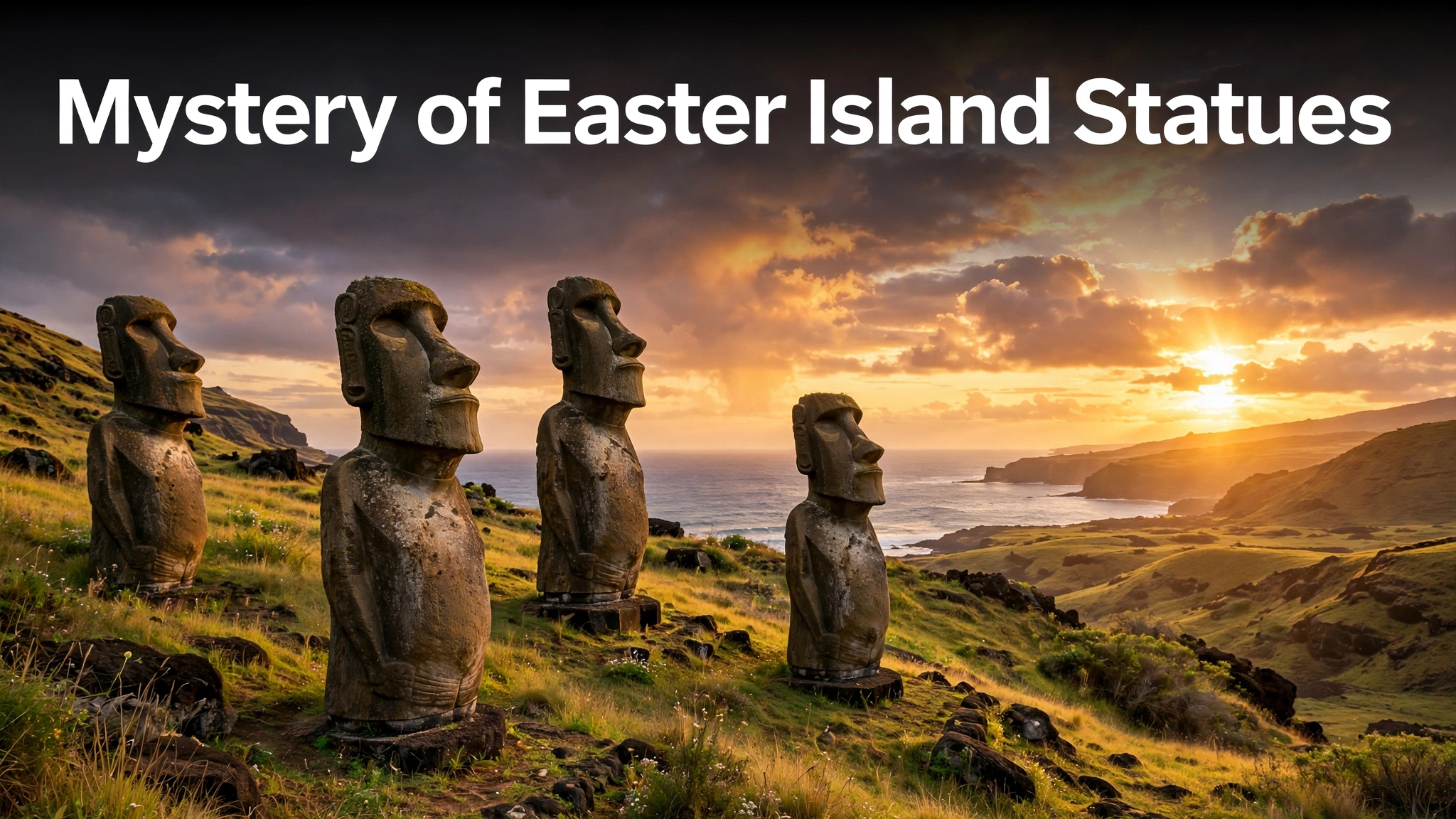
The common image of Easter Island “heads” is misleading. Most moai have full bodies buried underground, with torsos, arms, and hands carved in low relief, ending at the waist or below. Excavations have shown that the buried portions include detailed carvings, including belts, loincloths, and tattoos, and that many statues once stood on stone platforms called ahu, with their backs to the sea and their faces toward villages. The head appears disproportionately large, about three-eighths of the total height, because Polynesian art emphasises the head as the seat of power and identity. The statues are not portraits of individuals in a modern sense, but representations of ancestors, chiefs, or deified figures, embodying lineage and authority.
Most moai were carved from tuff, a soft volcanic rock, in a single quarry at Rano Raraku, an extinct volcanic crater on the eastern side of the island. About 400 statues remain in the quarry in various stages of completion, some still attached to the rock, which gives archaeologists a frozen workshop: they can see the carving sequence, from outline to detachment. The largest moai ever carved, still in the quarry and never finished, is reported to be about 21 metres long and would have weighed well over 100 tonnes if completed. Completed statues that were transported and erected are smaller, typically 4 to 10 metres tall, with the tallest erected example, Paro, reported at about 10 metres and around 82 tonnes. Their eyes were originally inlaid with white coral and dark obsidian or red scoria pupils, and many wore a red stone topknot called a pukao, carved from a different quarry, which may represent hair or a headdress.
The ahu platforms are as important as the statues. An ahu is a ceremonial platform, often with a sloping wall facing the sea and a flat top where moai stood in a row. The most famous, Ahu Tongariki, holds fifteen moai and is the largest ahu on the island. The statues faced inland, watching over villages, which suggests they were guardians and embodiments of ancestors, not markers facing the ocean for visitors. Behind the platform, there was often a village area, and in front, a plaza for ceremonies. The moai, ahu, and village formed a single ritual landscape, not isolated artworks placed at random.
How the Moai Were Carved
Carving a moai began in the quarry wall. Workers used basalt picks, called toki, to cut a trench around the outline of the statue, shaping the front while the back remained attached to the rock like a keel. Once the front was finished, the keel was broken, and the statue was slid down the slope to a temporary position, where the back was finished. The process required coordination, scaffolding, and time: estimates vary, but a single statue may have taken months of work by a team, depending on size and the number of workers. The quarry evidence shows that carving was systematic, not improvised, with standardised proportions and repeated designs, suggesting specialist carvers and a shared artistic tradition.
The stone itself helped. Tuff is relatively soft when freshly quarried and hardens on exposure to air, which makes it workable with stone tools yet durable once erected. Carvers did not need metal tools, which Polynesians did not have, because basalt is harder than tuff. They used water, sand, and abrasion for finishing, and they carved details such as ears, noses, and hands with care, even though the statues were meant to be seen from a distance. The buried bodies, once excavated, reveal that details continued below ground level, which means the statues were fully finished before transport, not rough blocks that were decorated after erection.
Red pukao topknots were carved separately at Puna Pau, a small volcanic crater, and transported to the ahu. Their weight, several tonnes each, and their cylindrical shape raise their own transport question, and experiments suggest they were rolled, using the same principles as moving the statues themselves. Eye inlays were added after erection, in a ceremony that may have “activated” the statue, giving it sight and presence. That ceremony matters for interpretation: a moai without eyes was not yet complete in a ritual sense. It was a body awaiting its ancestor’s gaze.
How the Moai Were Moved: Walking, Rolling, and Experiments
The transport question has produced the most speculation, including claims that the islanders used massive log rollers, cranes, or outside help. Archaeological evidence and experiments point to a simpler, ingenious method: the statues were “walked” upright, rocked forward and sideways by teams pulling ropes, much like moving a heavy refrigerator by rocking it. This hypothesis, tested by archaeologists Terry Hunt and Carl Lipo, showed that a small team could move a replica moai upright by rocking it, using ropes attached to the head and base. The statue’s shape, with a forward-leaning posture and a rounded base, makes rocking possible, and the quarry road evidence, including broken statues along ancient roads, matches the pattern expected from upright transport: statues that fell forward or sideways during a walk.
Other methods may also have been used for different statues or stages. Some researchers argue for a combination: statues may have been moved on wooden sledges, with logs as rollers, especially on flat ground, or dragged on their backs. The road network, wide and gently sloping, with no evidence of deep ruts from heavy sledges in some sections, supports upright walking for many statues, but does not rule out other techniques for others. The key point is that no single method needs to be universal, and none requires technology beyond what Polynesians possessed: rope, wood, stone, and coordinated human labour. The islanders were expert navigators who crossed thousands of kilometres of ocean by canoe; moving a stone statue a few kilometres, while difficult, was well within their organisational capacity.
The number of people needed is often exaggerated. Popular accounts imagine thousands of workers hauling each statue. Experiments suggest tens of people, not thousands, could walk a medium moai, with additional teams for support, road preparation, and food. That matters because it changes the picture of the society: statue building did not require a vast, coerced labour force, but a skilled, organised community that could mobilise labour seasonally, between farming and fishing. The statues were a collective project, but not necessarily a tyrannical one.
Why the Moai Were Built
Moai represented ancestors and authority. In Rapa Nui society, as in much of Polynesia, ancestors were believed to remain present and powerful after death, protecting and legitimising their descendants. A moai on an ahu embodied that ancestor, facing the village, watching over it, and asserting the lineage’s claim to land and resources. Building a larger or more numerous set of moai was a way for a clan to display status, honour its dead, and compete with other clans. That competition helps explain why statue building intensified over time, with larger statues and more elaborate platforms, even as resources became strained.
The statues also marked territory and ceremony. Ahu were places for gatherings, rituals, and burials, and the moai were part of a broader ceremonial system that included the birdman cult, which emerged later, petroglyphs, and oral traditions. The birdman competition, held at Orongo village on the crater rim, involved swimming to a nearby islet to collect the first sooty tern egg of the season, and the winner’s clan gained prestige for a year. That cult, which rose as moai building declined, shows a society adapting its rituals, not collapsing into nothing. The moai were not the whole culture; they were one phase of it.
It is a mistake to see the moai only as art or only as religion. They were political, social, and economic objects as well. Carving and transporting a moai required food for workers, timber for ropes and scaffolding, and coordination across clans. That investment signalled power. When a clan could no longer sustain that investment, or when priorities changed, statue building stopped. That stop, often dated to the seventeenth or eighteenth century, is sometimes misread as sudden collapse. In reality, the archaeological record shows gradual change, with some statues toppled, others left unfinished, and new rituals emerging. Societies change their monuments; that is not the same as disappearing.
The Collapse Myth: What Really Happened
The most persistent myth about Easter Island is that its people destroyed their own environment, cut down all their trees to move statues, and then collapsed into warfare and cannibalism, a cautionary tale for modern environmentalism. That story, popularised in the twentieth century, contains elements of truth but is now considered oversimplified and partly wrong by many archaeologists. Evidence suggests deforestation was gradual and multi-causal: Polynesian rats, introduced with settlers, ate palm seeds and prevented forest regeneration; islanders cleared land for farming; and statue transport, if it used timber, was one factor among several, not the sole cause. Climate variation, including droughts, also stressed the island.
Population estimates have also been revised. Early claims of a peak population of 15,000 or more, followed by a crash to a few thousand, are debated. More recent research suggests a smaller peak, perhaps several thousand, and a more gradual decline, influenced by European contact, disease, and slave raiding in the nineteenth century, which devastated the population far more rapidly than any earlier environmental change. Peruvian slave raids in the 1860s, in particular, removed a large proportion of the population, including many knowledge holders, and introduced diseases that further reduced numbers. By the late nineteenth century, the Rapa Nui population had fallen to about a hundred people in some counts, a catastrophe caused primarily by outside contact, not by statue building.
The toppling of moai also needs nuance. Many statues were toppled in the eighteenth and nineteenth centuries, possibly during internal conflict, but also possibly after European contact disrupted social order. Some were toppled by natural events, and at least one famous ahu, Ahu Tongariki, was swept inland by a tsunami in 1960 and later restored. The fact that many moai now stand again is due to modern restoration, often with international help, not to their original continuous standing. Visitors should therefore understand that the island they see today is partly a restored landscape, which is valuable, but not identical to the landscape at the height of moai building.
Easter Island Today: People, Preservation, and Tourism
Today, Rapa Nui is a special territory of Chile, and its people maintain a distinct culture, language, and identity, despite centuries of disruption. The island’s population is a few thousand, with tourism as a major income source. The moai and the Rapa Nui National Park are a UNESCO World Heritage Site, and preservation faces challenges: weathering, lichen, tourism pressure, and climate change, including sea-level rise threatening coastal ahu. Conservation work includes monitoring, stabilising statues, and controlling visitor access to fragile sites. Local Rapa Nui communities are central to that work, and visitors are asked to respect rules: do not climb on statues or platforms, do not touch carvings, and stay on marked paths.
Tourism brings both benefit and risk. It funds preservation and livelihoods, but it also strains water, waste, and infrastructure on a small island, and it can turn sacred sites into photo backdrops. Responsible visiting means learning before arriving, hiring local guides, respecting ceremonies, and understanding that the moai are not only tourist attractions but ancestors for living people. The island’s museum, Museo Antropologico Padre Sebastian Englert, provides context that a quick photograph cannot, including tools, oral histories, and the story of the island’s people beyond the statues.
Research continues. New techniques, including LiDAR scanning, DNA analysis, and dating of sediments, are refining the timeline of settlement, population, and environmental change. Each new finding tends to make the story more complex and more human, replacing a simple collapse tale with a story of adaptation, resilience, and survival. The Rapa Nui people did not vanish; they endured slave raids, disease, and colonisation, and they continue to shape their island’s future. That endurance is, in many ways, more remarkable than the statues themselves, though the statues remain their most visible achievement.
My Take:
My view is that Easter Island teaches us to distrust simple morality tales, even when they feel useful. The collapse story is tempting because it gives modern readers a clear warning: destroy your forests, build too many monuments, and you will fall. That warning feels relevant to climate change and overconsumption, so we repeat it. But if the story is partly wrong, using it as a warning backfires. It blames a small island society for a catastrophe that was largely caused by outside forces, rats, disease, and slave raids, and it lets larger, more powerful societies off the hook by suggesting that environmental collapse is a local failure rather than a global system. A true warning would be more honest: small societies can strain local resources, but the most devastating collapses often come from contact, exploitation, and disease imposed from outside. That is a harder lesson, but a more useful one.
I also think the moai deserve admiration for their engineering, not only for their mystery. Walking a ten-tonne statue upright with ropes is ingenious. It uses the statue’s own shape, gravity, and coordinated rhythm, rather than brute force alone. That ingenuity is characteristic of Polynesian culture more broadly: navigators who crossed the Pacific without compasses, using stars, waves, and birds; farmers who adapted crops to a small island; carvers who worked stone with stone. The moai are not proof of a lost advanced civilisation; they are proof that a so-called “primitive” society, a word I dislike for its condescension, possessed sophisticated knowledge, organisation, and art. Recognising that should change how we talk about indigenous knowledge in general. It is not a curiosity to be explained by aliens; it is a system to be studied on its own terms.
There is a third lesson about restoration and authenticity. Many moai visitors photograph today were re-erected in the twentieth century, with modern cranes and concrete. That does not make them fake, but it does mean we are seeing a restored vision of the past, shaped by modern choices about which ahu to rebuild and how. I think that is fine, provided we are honest about it. Heritage is always partly reconstruction, and the choice to restore is itself a cultural act, by Rapa Nui people and by Chile, to reclaim and present their history. The danger is only when restoration is presented as untouched antiquity, which misleads visitors about both the past and the present. Honesty about restoration actually increases respect: it shows a living people actively caring for their ancestors, not a dead civilisation frozen in time.
Finally, I am struck by how the moai gaze inland, not outward. They watch villages, not the sea. That orientation tells us what mattered to their builders: community, lineage, and home, not impressing visitors. Modern tourism reverses that gaze, turning the statues into objects for outsiders to photograph from the sea side. I think visitors should honour the original orientation by learning about the villages, the people, and the living culture behind the statues, not only by taking a photograph of a face against the sky. The mystery of Easter Island is not really a mystery anymore, at least not in the sense of “how did they do it?” We know, broadly, how they did it. The deeper mystery, and the more interesting one, is how a small, isolated society created something so enduring, survived so much disruption, and still maintains its identity today. That is not a puzzle to be solved and forgotten; it is a story to be respected and continued.
I also want to note the responsibility that comes with writing about Rapa Nui from far away. It is easy to treat the island as a case study, a warning, or a wonder, and to forget that real people live there now, with opinions about tourism, preservation, and representation. Their voices should be central, not an afterthought. If you visit, listen to local guides. If you read, seek Rapa Nui authors and scholars. If you share a photograph, share the context too: these are ancestors, not props. That respect costs nothing and changes everything, because it turns a mystery into a relationship, and a monument into a living heritage.
There is also a lesson about how we judge a society by its monuments. If future archaeologists judged our civilisation only by our largest structures, they would get a distorted picture, just as we do if we judge Rapa Nui only by the moai. A society is also its farms, its fishing, its language, its songs, its childcare, and its daily life, most of which leaves little stone trace. The moai are visible because they are stone and large, but they were not the whole of Rapa Nui life, and they should not be the whole of our understanding. When we visit, read, or teach about Easter Island, we should ask about the rest: what did people eat, how did they navigate, what did they sing, how did they raise children, how did they resolve disputes? Those questions are harder to answer from stones alone, which is why oral history, language, and living culture matter so much. A monument without its people is a sculpture; a monument with its people is a heritage.
I also think the island’s isolation is often romanticised in a way that misleads. Isolation did not make Rapa Nui people primitive or cut off from knowledge; Polynesian navigation connected islands across vast distances, and Rapa Nui was part of that network, even if it was at its far eastern edge. Isolation did make the island vulnerable, because a small population, limited resources, and distance from help meant that shocks, drought, disease, or slave raids hit harder and recovery was slower. That vulnerability is not unique to Easter Island; small island communities worldwide face similar risks today, from climate change, sea-level rise, and economic dependence on tourism. The lesson is not that isolation causes collapse, but that small, remote communities deserve particular support, respect for their autonomy, and protection from exploitation, because their margin for error is thinner than that of large mainland societies.
One final note for visitors and readers: the best way to honour the moai is to learn the name Rapa Nui, for both the island and its people, and to use it alongside Easter Island, which is a European name given because the island was encountered on Easter Sunday. Names matter, because they signal whose story is being told. A visitor who says Rapa Nui, who hires a local guide, who visits the museum, and who respects the platforms, is not only seeing statues, but participating, however briefly, in a living culture’s stewardship of its heritage. That participation is worth more than any photograph, and it is the difference between tourism that extracts and tourism that supports. The statues will outlast us all, if we care for them, but the people who care for them deserve our attention now, while they are here to guide us.
Frequently Asked Questions
How were the Easter Island statues moved? Most were likely walked upright by teams rocking them with ropes, a method tested successfully with replicas. Other methods, such as sledges or rollers, may also have been used for some statues.
Are the Easter Island statues only heads? No, most moai have full bodies buried underground, with torsos and carved details. Excavations have revealed the buried portions, including belts and tattoos.
Why were the moai built? They represented ancestors and chiefs, embodied lineage and authority, marked ceremonial platforms called ahu, and displayed clan status through size and number.
Did Easter Island society collapse because of deforestation? Deforestation was gradual and multi-causal, involving rats, farming, and climate, not only statue transport. The sharpest population decline came later, from European disease and slave raiding.
How many moai are there? Nearly 900 moai are recorded, including about 400 still in the Rano Raraku quarry in various stages of completion, plus transported and erected examples.
Who lives on Easter Island today? The Rapa Nui people live there today, as a special territory of Chile, maintaining their language and culture, with tourism and preservation as major concerns.