The Mystery of the Voynich Manuscript, Explained
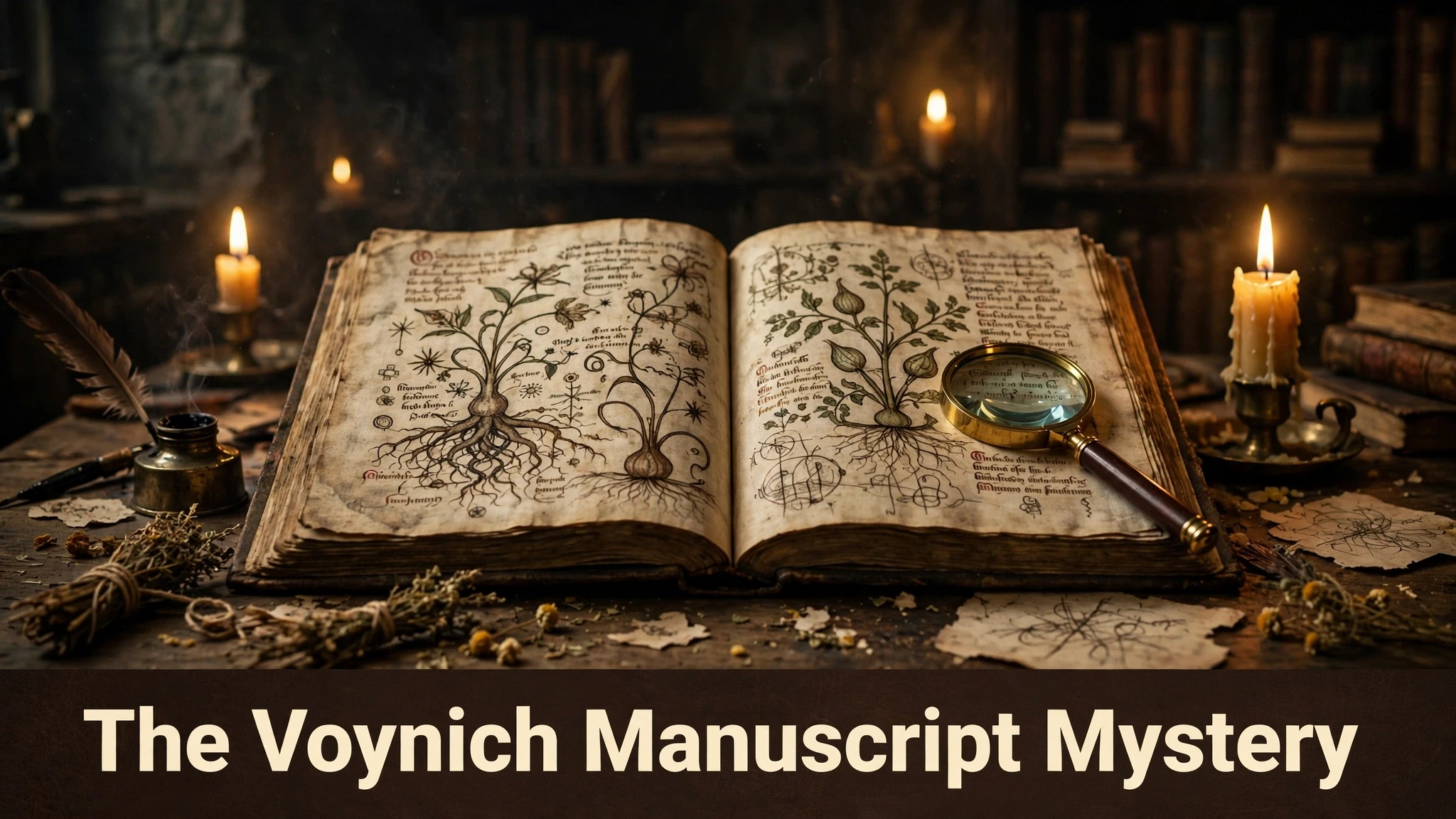
In this post
- What the Voynich Manuscript Is
- When It Was Made, and How We Know
- The Strange Pictures Inside
- The Attempts to Decode It
- The Main Theories About What It Is
- Why the Mystery Matters, and What Happens Next
- The Language Puzzle: Patterns in an Unknown Script
- Hoax or Treasure: How Experts Weigh the Evidence
- The People Who Tried: Codebreakers, Scholars, and Amateurs
- My Take:
There is a book in the world that nobody can read. It is written in a script no one recognises, in a language no one has identified, and it is filled with pictures of plants that do not exist, diagrams that make no sense, and women bathing in strange green pools. It is called the Voynich Manuscript, and it has defeated codebreakers, linguists, and computer scientists for more than a century. It is one of the greatest mysteries in history, and it is a real object, held in a library, that anyone can look at and no one can understand.
This guide explains the mystery of the Voynich Manuscript: what it is, when it was made, what is inside it, and the theories about what it says. It covers the history of the book, the attempts to decode it, and the claims that have been made and disproven. It is honest about what is known and what is not, because the Voynich Manuscript is a mystery precisely because so little is certain. Whether you are interested in codes, history, or simply a good puzzle, this is one of the best stories there is.
What the Voynich Manuscript Is
The Voynich Manuscript is a book of about 240 pages, written on vellum, which is animal skin prepared for writing, and it is about 23 centimetres tall. It is held at Yale University’s Beinecke Library, where it is catalogued as MS 408. The book is written in a script that has never been seen anywhere else, with about 20 to 25 characters, and it is filled with illustrations in colour. The text is written from left to right, in paragraphs, with some words underlined and some diagrams labelled. It looks like a real book, with a structure and a purpose, but its language is unknown, and its script is unique.
The manuscript is divided into sections, based on the illustrations. There is a herbal section, with drawings of plants, a section with astronomical diagrams, a biological section with drawings of women in pools and tubes, a cosmological section with diagrams of castles and stars, and a pharmaceutical section with drawings of plants and jars. There are also pages of text with no illustrations. The book has no title page, no author, and no date, and the first page is missing, which adds to the mystery. It is a complete, physical object, and its existence is not in doubt. What it says is the mystery.
When It Was Made, and How We Know
For many years, the date of the Voynich Manuscript was unknown, and theories ranged from the thirteenth century to the twentieth. In 2009, scientists at the University of Arizona tested the vellum using radiocarbon dating, and the results showed that the animal skin was made between 1404 and 1438, with a high degree of confidence. That means the book was made in the early fifteenth century, in the late medieval period, and it is not a modern forgery, at least in its materials. The ink and paint have also been tested, and they are consistent with a medieval origin.
That date is important, because it rules out many theories. The book was not made by a modern hoaxer, and it was not made in the twentieth century. It was made in a time when books were handwritten, when herbal medicine was a serious subject, and when the language of learning was Latin. The manuscript’s script, however, is not Latin, and it does not match any known medieval script. The vellum was made in the early 1400s, but the writing could have been added later, though most experts believe the book was written soon after the vellum was made. The date is one of the few certain facts about the manuscript, and it makes the mystery older and stranger.
The Strange Pictures Inside
The illustrations are one of the most puzzling parts of the manuscript, because they are detailed, colourful, and unlike anything else. The herbal section shows plants with roots, stems, leaves, and flowers, but most of the plants cannot be identified. Some look like a combination of two real plants, with the roots of one and the leaves of another. A few have been tentatively identified, but none with certainty. That is strange, because a herbal, a book about medicinal plants, should show plants that a reader could recognise and use. A herbal with imaginary plants is either a code, a fantasy, or a book whose purpose is not what it seems.
The biological section is even stranger. It shows naked women, in pools, in tubes, and in baths, connected by pipes and channels, in a way that suggests a system, but no one knows what system. The astronomical section shows diagrams of stars, with labels, and a series of circular diagrams that may be calendars or charts. The cosmological section shows castles, with towers and walls, and diagrams that may be maps. These pictures are not random. They are careful, consistent, and structured, which suggests that the book had a purpose, and that the author knew what they were doing. What that purpose was is unknown.
The Attempts to Decode It
The Voynich Manuscript has been studied by some of the best codebreakers in history, including William Friedman, who broke Japanese codes in the Second World War, and his wife Elsbeth, and by many linguists, historians, and computer scientists. They have tried every method: frequency analysis, which looks at how often each character appears, comparison with known languages, and computer analysis, which looks for patterns. The text has patterns that suggest it is a real language, not random characters: words repeat, some words appear in certain positions, and the structure resembles a natural language. But no one has found a key that turns the text into readable words.
Several claims of a solution have been made, and all have been disproven or remain unproven. A common pattern is that a researcher announces a solution, it is reported in the press, and then other experts show that the solution does not work, or that it is based on a misunderstanding. The most recent claims, using artificial intelligence, have also failed to produce a convincing translation. The manuscript has resisted every attempt, and that resistance is part of its fame. It is a code that has defeated a century of codebreakers, and that is a remarkable achievement, whether it was intended or not.
The Main Theories About What It Is
There are several main theories about the Voynich Manuscript, and each has supporters and problems. The first is that it is a real book, written in a lost language, or in a language that has not yet been identified. That would explain its structure, but it does not explain why no other book in that language exists. The second is that it is a cipher, a coded version of a known language, such as Latin or Italian, written in a made-up script. That would explain the patterns, but no one has found the cipher. The third is that it is a hoax, made to fool a buyer, perhaps in the fifteenth century, or later. That would explain the imaginary plants, but it does not explain the effort: a hoax of 240 pages, with consistent patterns, would be an enormous amount of work.
A fourth theory is that it is a glossolalia, a text written in a language invented by the author, perhaps for mystical or religious purposes. A fifth is that it is a herbal or medical book, written in a code to protect trade secrets, which was a common practice in medieval medicine. Each theory explains some of the evidence and fails to explain the rest, and that is why the mystery persists. The most honest answer is that we do not know what the Voynich Manuscript is, and that the theories are guesses, some more plausible than others, but none proven.
Why the Mystery Matters, and What Happens Next
The Voynich Manuscript matters because it is a reminder that the past is not fully known, and that there are objects in libraries that still defeat us. It matters to historians, because it may contain lost knowledge, or it may be a window into medieval thought. It matters to linguists, because it challenges our understanding of language. It matters to codebreakers, because it is a puzzle that has resisted solution. And it matters to the public, because it is a good story, a real mystery, with a real object at its centre, that anyone can look at.
What happens next is likely to be more of the same: more analysis, more claims, and more debate. Artificial intelligence may help, by finding patterns that humans have missed, but it is unlikely to solve the manuscript on its own, because a code needs a key, and a key needs a context. The manuscript is now available online, in high-resolution images, so anyone can study it, and that openness is a good thing. The mystery may be solved one day, by a researcher who notices something others missed, or it may never be solved, and that is also a kind of answer. A book that nobody can read is a reminder that some mysteries endure, and that endurance is part of their value.
The Language Puzzle: Patterns in an Unknown Script
Before moving on, it helps to slow down on the language puzzle: patterns in an unknown script, because this is the stage where small choices in the Voynich manuscript quietly decide whether the experience succeeds.
The value of a book of about 240 pages written in a script nobody can read becomes clearer when it is compared with a weaker alternative, because the contrast shows which details matter most inside the Voynich manuscript and which are only decoration. Beginners often get more from a book of about 240 pages written in a script nobody can read by taking notes, pausing to reflect, or talking it over with someone else, because the Voynich manuscript rewards attention more than speed. Over time, a book of about 240 pages written in a script nobody can read tends to be remembered for one strong quality rather than many average ones, and that single strength is usually the best guide to the Voynich manuscript as a whole.
A common mistake is rushing past drawings of plants that match no known species, so slowing down and giving it a fair try usually leads to a better judgement about the Voynich manuscript than a quick first impression. The test of drawings of plants that match no known species is whether it could be recommended to someone else, and if the answer is yes, then it has done exactly what good the Voynich manuscript is supposed to do. Many experienced people point to drawings of plants that match no known species early on, because it illustrates the main idea of the Voynich manuscript before any detail gets complicated or confusing.
Choosing circular diagrams that look like star charts and zodiac wheels over a flashier option is often the wiser move, because substance lasts longer than novelty, and the Voynich manuscript is best enjoyed when quality comes before hype. A useful example inside the Voynich manuscript is circular diagrams that look like star charts and zodiac wheels, which shows the subject from a practical angle rather than a theoretical one, so the lesson stays visible. The value of circular diagrams that look like star charts and zodiac wheels becomes clearer when it is compared with a weaker alternative, because the contrast shows which details matter most inside the Voynich manuscript and which are only decoration.
With the language puzzle: patterns in an unknown script understood, the next part of the Voynich manuscript becomes easier, because you now have a reference point to compare new ideas against.
Hoax or Treasure: How Experts Weigh the Evidence
There is more to hoax or treasure: how experts weigh the evidence than first appears, and a little patience here reveals patterns in the Voynich manuscript that keep showing up in later sections of this guide.
A common mistake is rushing past the vellum pages, dated by scientists to the early 1400s, so slowing down and giving it a fair try usually leads to a better judgement about the Voynich manuscript than a quick first impression. The test of the vellum pages, dated by scientists to the early 1400s is whether it could be recommended to someone else, and if the answer is yes, then it has done exactly what good the Voynich manuscript is supposed to do. Many experienced people point to the vellum pages, dated by scientists to the early 1400s early on, because it illustrates the main idea of the Voynich manuscript before any detail gets complicated or confusing.
Choosing Wilfrid Voynich, the bookseller who bought the manuscript in 1912 over a flashier option is often the wiser move, because substance lasts longer than novelty, and the Voynich manuscript is best enjoyed when quality comes before hype. A useful example inside the Voynich manuscript is Wilfrid Voynich, the bookseller who bought the manuscript in 1912, which shows the subject from a practical angle rather than a theoretical one, so the lesson stays visible. The value of Wilfrid Voynich, the bookseller who bought the manuscript in 1912 becomes clearer when it is compared with a weaker alternative, because the contrast shows which details matter most inside the Voynich manuscript and which are only decoration.
Taken together, these examples show that hoax or treasure: how experts weigh the evidence is less about perfection and more about paying attention, which is a theme that runs through all of the Voynich manuscript.
The People Who Tried: Codebreakers, Scholars, and Amateurs
The Voynich Manuscript has attracted some of the most brilliant minds in history, and their failures are as interesting as the manuscript itself. During the Second World War, codebreakers who had broken the Enigma code turned their attention to the Voynich, believing that their skills would solve it. They did not, and the manuscript resisted even the best cryptographers of the age, which is a remarkable fact, and one that suggests the manuscript is either not a simple code, or not a code at all. That failure is humbling, because it shows that skill, intelligence, and experience are not always enough, and that some problems resist even the best efforts.
Scholars have also tried, from many disciplines: linguists, historians, botanists, and astronomers, each bringing their own expertise, and each finding something interesting, but none finding the answer. A botanist may identify a plant, a historian may date the parchment, and a linguist may find a pattern, but the manuscript as a whole remains unread. That interdisciplinary effort is valuable, because it has taught us a great deal about the manuscript, about medieval science, and about the limits of knowledge, even if it has not solved the mystery. The manuscript is a reminder that knowledge is not always cumulative, and that some questions remain, despite our best efforts.
Amateurs have also played a role, and their enthusiasm is part of the story. From the nineteenth century to the present, amateur codebreakers, enthusiasts, and hobbyists have proposed solutions, some ingenious, some fanciful, and a few that were briefly believed, before being shown to be wrong. The internet has amplified this, with forums, blogs, and videos, in which new theories appear regularly, and are debated, and often dismissed. That enthusiasm is a good thing, because it keeps the mystery alive, and it brings fresh eyes to an old problem, but it also has a downside, because it can spread misinformation, and because a claimed solution, reported uncritically, can mislead the public. The best amateur work is careful, honest, and willing to be tested. The worst is sensational, and should be treated with scepticism.
One of the most interesting aspects is the psychology of the attempt: why do so many people, brilliant and ordinary, spend years on a manuscript that may never be solved? Part of it is the challenge, the idea that a puzzle that has resisted everyone else might yield to you. Part of it is curiosity, the desire to know what the manuscript says, and who wrote it. And part of it is the romance of mystery, the idea that there is a secret, waiting to be discovered, and that you could be the one to discover it. That motivation is human, and it is understandable, and it is the reason the manuscript continues to attract attention, centuries after it was written.
Finally, remember that the people who tried, and failed, are not failures. They are part of the story, and their work, even when it did not solve the manuscript, advanced our understanding, and inspired others to try. The manuscript is a test, not only of skill, but of humility, because it reminds us that some things are unknown, and may remain unknown, and that accepting that is a form of wisdom. The next person to try may succeed, or they may not, but the attempt itself is valuable, because it is a search for truth, and that search is worth pursuing, even when it does not find what it seeks.
My Take:
I first saw the Voynich Manuscript on a screen, late at night, and I remember the feeling exactly: this is a real book, made by a real person, six hundred years ago, and nobody alive can read a word of it. That feeling hasn’t left me. We live in a time when we assume everything can be googled, decoded, or explained, and here’s an object that refuses. It’s not a trick. It’s not a puzzle designed for us. It’s a book that was made for a purpose we don’t understand, in a language we don’t know, and it sits in a library in America, waiting. That refusal is what makes it fascinating.
Here’s what I think most people get wrong about it. They assume it must be a code, and that a code must have a solution. But a code is only useful if someone can read it, and a book that nobody can read is a strange thing to make. Maybe it wasn’t a code at all. Maybe it was a private language, a mystical text, a herbal written in a script only its author understood, or a hoax so elaborate that it fooled everyone for centuries. I think we should be open to the possibility that the manuscript was never meant to be read by us, and that its purpose was something we haven’t imagined. That doesn’t make it less interesting. It makes it more.
I’ll be honest about the claims of solutions, because they follow a pattern that’s worth recognising. Someone announces they’ve cracked it, the press reports it, and then the experts quietly show why it doesn’t work. I’ve seen it happen several times, and it’s a reminder to be sceptical of headlines. A real solution would be testable: it would produce readable text, consistently, across the whole book, and other experts would be able to repeat it. No claim has done that yet. When one does, you’ll know, because the whole field will agree. Until then, treat every announcement as a claim, not a solution.
What I find most moving about the manuscript is the care in it. The pictures are detailed, the script is consistent, the layout is thoughtful. Whoever made this spent months, perhaps years, on it. They believed it mattered. They believed someone would read it, or that it was worth making even if nobody did. That care is a human thing, and it’s visible on every page. Whether it was a herbal, a code, or a work of imagination, it was made with attention, and that attention deserves respect, even if we can’t understand what it says.
So my advice, if you’re curious, is to look at it yourself. The images are online, free, in high resolution. Spend an evening with the herbal pages, or the strange diagrams of women in pools, and notice what you notice. You won’t solve it, and that’s fine. Nobody has. But you’ll have looked at one of the strangest objects in history, and you’ll have felt what I felt that first night: that the past is not fully known, and that some mysteries are worth keeping. The Voynich Manuscript may never be read. That doesn’t make it a failure. It makes it a reminder.
The people who spent their lives on the Voynich manuscript are as interesting as the book itself, and their stories tell you something about why a mystery can hold a person for decades. Wilfrid Voynich, the bookseller who found it, spent years trying to prove it was the work of a famous medieval scholar, and his conviction shaped how the book was studied for a generation. William Friedman, the codebreaker who helped build American cryptology, worked on it in his spare time, and led a team that studied it for years, and concluded, honestly, that they could not read it. That honesty is rare, and it is admirable: a man who could break the codes of nations admitted that this one small book defeated him.
What the manuscript tells us, even unread, is also worth thinking about. Whoever made it spent a great deal of time, and money, on parchment, and on careful drawings, and they did so for a reason, and that reason mattered enough to them to produce a book of more than two hundred pages. It was not a joke, or a doodle. It was a serious work, made by someone who believed in what they were writing, and who expected someone to read it. That is the most human part of the mystery: a person, six hundred years ago, wrote something they thought was important, and we cannot read it, and we do not know who they were. The book is a reminder that the past is not a story we have finished. It is a conversation we are still having, with people who cannot answer.
The people are what I would remember, because the manuscript is not only a mystery. It is a mirror, in which we see our own desire to solve, to know, and to be the one who finds the answer. Codebreakers, scholars, and amateurs have all tried, and all have failed, and that failure is not a disgrace. It is a reminder that some problems are harder than we think, and that intelligence alone is not always enough. I find that humbling, and I find it hopeful, because it means that the world still contains mysteries, and that there are still questions worth asking, even if we cannot yet answer them. That is a good thing, and it is worth celebrating.
I also think we should be honest about the claims of solutions, because they appear regularly, and they are often reported as if the mystery has been solved, when it has not. A new theory, a new decoding, or a new identification is interesting, but it should be tested, and peer-reviewed, before it is believed, and the history of the Voynich is full of solutions that were announced, celebrated, and then shown to be wrong. Be sceptical of headlines, check the evidence, and wait for confirmation, before you conclude that the mystery is over. The manuscript has survived centuries of attempts, and it will survive many more, and a claim that it has been solved should be treated with care, not with excitement.
Another point I would make is about the value of the attempt, even when it fails, because the scholars who studied the Voynich learned a great deal, about medieval science, about language, and about the limits of cryptography, even though they did not solve it. That learning is valuable, and it is a reminder that research is not only about finding answers, but about asking better questions, and about understanding more, even when the central mystery remains. The manuscript has taught us a great deal, precisely because it resists solution, and that teaching is worth more than a quick answer would be.
And the final thing I would say is to enjoy the mystery, and to let it be a mystery, without needing to solve it. The Voynich Manuscript is beautiful, strange, and fascinating, and it is worth looking at, and wondering about, even if we never know what it says. Some mysteries are more interesting unsolved, because they invite imagination, and curiosity, and they remind us that the world is larger, and stranger, than we think. Look at the manuscript, wonder about it, and enjoy the not-knowing, because that wonder is a pleasure, and it is one that has lasted for centuries, and will last for centuries more.
Frequently Asked Questions
What is the Voynich Manuscript?
The Voynich Manuscript is a 240-page book from the early 1400s, written in an unknown script and language, filled with pictures of unidentifiable plants and strange diagrams. It is held at Yale University and has never been deciphered.
When was the Voynich Manuscript made?
Radiocarbon dating of the vellum shows it was made between 1404 and 1438. The ink and paint are consistent with a medieval origin, so it is not a modern forgery, at least in its materials.
Has anyone decoded the Voynich Manuscript?
No. Codebreakers, linguists, and computer scientists have tried for over a century, and several claims of a solution have been made, but none has produced a convincing, repeatable translation of the whole text.
What do the pictures in the Voynich Manuscript show?
The book contains a herbal section with unidentifiable plants, astronomical diagrams, a biological section with women in pools and tubes, and cosmological diagrams. The pictures are detailed and structured, but their meaning is unknown.
Is the Voynich Manuscript a hoax?
It may be, but a hoax of 240 pages with consistent linguistic patterns would be an enormous effort. Other theories include a lost language, a cipher, a private mystical language, or a coded medical book. None is proven.
Can I see the Voynich Manuscript?
Yes, high-resolution images of the whole manuscript are available online through Yale University’s Beinecke Library, so anyone can study the pages and illustrations.