Yeti: Mountain Evidence vs Myth
In this post
What People Mean When They Say Yeti
The word yeti usually refers to a large, ape-like creature said to live in the Himalayas, covered in hair, walking on two legs, and leaving large footprints in snow. In English it is also called the Abominable Snowman, a name invented by journalists in the early twentieth century, not by Himalayan people. In Nepali and Tibetan traditions, there are several related beings with different names, habits and sizes, and they are not all the same creature in local stories. Some are described as wild humans, some as large bears, and some as mountain spirits. Treating all of these as one animal, and then asking whether that animal exists, already oversimplifies the tradition.
Sherpa and other Himalayan communities have told stories of wild beings for generations, and those stories deserve respect as culture, not only as evidence. A story can carry moral lessons, warnings about dangerous mountains, respect for wild animals, and explanations for strange sounds and tracks, without being a zoological report. When outsiders arrive looking only for a monster, they often flatten this richness into a single question: real or fake? A fairer approach is to separate three questions: what do local traditions actually say, what physical evidence has been found, and what does that evidence best explain? The answers to those three questions are not identical, and keeping them apart is the key to the yeti mystery.
The modern yeti story also grew through mountaineering. British and other climbers in the Himalayas in the early twentieth century reported footprints, and newspapers amplified the reports. The famous 1951 photograph of a large footprint in snow, taken by Eric Shipton on an Everest expedition, became an icon, even though the photograph alone cannot prove what made the print. Later expeditions searched, found more prints, hair and stories, and returned with explanations that were often more ordinary than the headlines. The yeti therefore sits at the meeting point of folklore, exploration and media, and each of those forces shaped what the public believes.
Footprints: The Most Famous, Least Certain Evidence
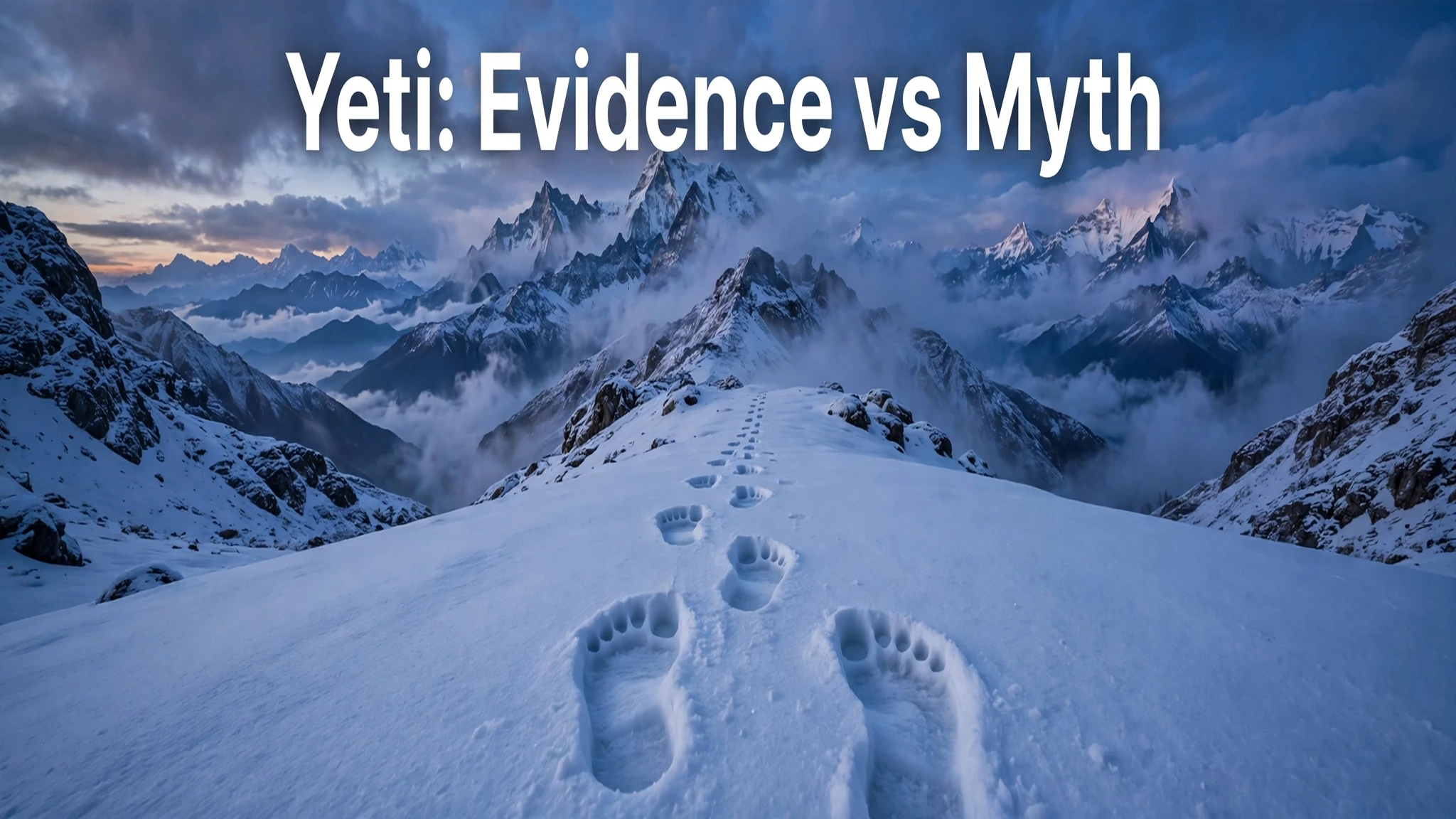
Footprints are the evidence most people picture, and they are also the easiest to misread. Snow is a poor recording medium: a print melts, refreezes, expands and distorts in sunlight, so a normal animal track can grow larger and stranger within hours. A bear’s hind foot, overlapped by its front foot, can look like a single huge, human-like print. A footprint in soft snow at an angle can appear longer than the foot that made it. Wind, melting and the weight of the photographer standing nearby can all change the shape. A photograph of a single print, without a clear trail, scale and surrounding tracks, is therefore weak evidence, however impressive it looks.
Trails are more informative than single prints, because a trail shows stride length, foot shape, gait and whether the animal walked on two legs or four. Many reported yeti trails, when examined by trackers and zoologists, have turned out to be bear trails, sometimes with the bear walking upright for a short distance, as bears occasionally do. Other trails were made by known animals in snow that had melted and refrozen, enlarging the prints. A few trails remain puzzling in detail, but a puzzle is not proof of an unknown ape; it is a reminder that snow, light and incomplete observation can combine to produce a strange result. Science needs a trail that can be followed, measured and compared, not a single dramatic photograph.
There is also a human factor. In thin air, cold and fatigue, even experienced climbers can misjudge size and distance. Excitement, expectation and the desire to find something famous can shape what a person reports. This is not an accusation of lying; it is a normal feature of human perception, especially in extreme environments. That is why modern researchers prefer physical samples that can be tested in a laboratory, where expectation cannot change the result, over eyewitness reports alone, however sincere the witness may be.
Hair, Bones and Scalps: What Laboratories Found
Hair samples attributed to yetis have been collected for decades, from monasteries, expeditions and local people. When modern DNA testing became possible, researchers tested many of these samples, and the results were consistently ordinary in an interesting way: most samples matched known animals, especially bears. A well-known study of hair samples, published in 2014 and widely reported, found that some samples matched a type of brown bear, while others matched common animals. A later, larger genetic study of supposed yeti samples in 2017 found that they matched Himalayan brown bears, Tibetan brown bears and other known species, not an unknown ape. No sample in those studies produced DNA from an unknown primate.
So-called yeti scalps kept in Himalayan monasteries tell a similar story. When examined, they were found to be made from the skin of known animals, shaped and preserved as sacred objects. That finding does not make the objects worthless; as religious and cultural artefacts they remain important, and their makers may never have claimed they were cut from a living yeti in the modern scientific sense. The lesson is about translation: an object can be sacred, old and meaningful without being biological proof of a new species. Treating a relic as a laboratory specimen, and then being disappointed when it is not, misses its original purpose.
Bones are the missing piece that would change the debate. A new large mammal should leave bones, teeth, droppings with DNA, and eventually a body. Despite decades of searching, no verified yeti skeleton, skull or body has been found. Supporters sometimes argue that the Himalayas are vast and that a rare, intelligent animal could avoid humans, and that is true up to a point. But large mammals, even rare ones, leave signs: the Himalayan brown bear, which is itself rare and shy, is known from bodies, bones, droppings and camera traps. An animal larger than a bear, living in the same mountains, would be expected to leave at least comparable signs over time. Its absence does not prove it cannot exist, but it raises the bar for belief.
Bears, Mist and the Psychology of the Mountains
The most successful natural explanation for yeti reports involves bears, and it is worth understanding in detail. The Himalayas are home to brown bears and Asiatic black bears, both of which can stand and walk briefly on two legs, leave large prints, and appear surprisingly human-like in silhouette, especially in mist or at a distance. A bear with mange, which causes hair loss, can look strangely thin and ape-like. A bear seen through falling snow, with its fur frosted, can look pale. A bear’s track in melting snow can look enormous. Combine these factors on a high, lonely slope, and a bear can become a yeti in a report, without any deception by the observer.
Altitude and isolation also affect perception. At high altitude, oxygen is low, sleep is poor, and the brain is more prone to misreading shapes and sounds. Wind in rock, falling ice and animal calls can sound like voices or footsteps. A climber who has heard yeti stories before an expedition is primed to interpret an unclear shape as a yeti, just as a person who has heard ghost stories is primed to interpret a noise in an old house as a ghost. This priming effect is well documented in psychology, and it applies to honest, experienced people as much as to anyone else. It does not mean every report is imagination; it means reports alone cannot settle the question.
Local knowledge complicates the bear explanation in a useful way. Himalayan herders and hunters know bears well, and they distinguish bears from yeti-like beings in their own stories. Some researchers argue that this distinction suggests there is something beyond bears in the tradition, perhaps a memory of an extinct ape, a rare bear behaviour, or a cultural figure that should not be reduced to a bear. That argument deserves respect, because local people are expert observers of their mountains. But expert observation still needs physical corroboration before science can accept a new species, and so far that corroboration has pointed back to bears.
Could an Unknown Ape Still Hide in the Himalayas?
The fair scientific position is not a flat no, but a careful probably not, with reasons. New large mammals are still discovered occasionally, usually small, nocturnal or in remote forests, not large, diurnal apes in well-travelled mountains. The Himalayas are remote, but they are also crossed by herders, climbers, pilgrims and researchers, and they are increasingly covered by camera traps, satellite images and wildlife surveys. A breeding population of large apes would need food, shelter and mates, and would leave droppings, hair, feeding signs and, eventually, remains. The longer such a population stays undetected despite growing search effort, the less likely it becomes, though it never reaches absolute zero in logic alone.
Some supporters point to extinct apes such as Gigantopithecus, a very large ape that lived in Asia hundreds of thousands of years ago, and suggest the yeti could be a surviving relative. That idea is imaginative, but it faces a large gap: there is no fossil evidence linking Gigantopithecus to the modern Himalayas, and no intermediate fossils showing a small, surviving population adapting to high, cold mountains. An extinct giant ape is real science; a living descendant in the Himalayas is speculation built on that science, not a conclusion from it. The distinction matters, because a true scientific hypothesis must make predictions that can be tested, such as where bones should be found, and so far those predictions have not been met.
DNA and camera traps have changed the search in a helpful way. Instead of expeditions chasing footprints, researchers can now place cameras, collect droppings and hair systematically, and test them without needing to see the animal. If a yeti exists, this is how it will most likely be found: not by a dramatic sighting, but by a DNA sample that matches no known animal, followed by a body or a clear photograph. Until that sample appears, the honest summary is that the yeti remains a cultural and historical mystery with natural explanations for most reports, not a confirmed animal.
Why the Yeti Story Endures, Even Without Proof
If the evidence is so weak, why does the yeti endure? Part of the answer is that the Himalayas themselves invite mystery. They are the highest mountains on Earth, with weather that changes in minutes, valleys that are hard to reach, and wildlife that is genuinely surprising, from snow leopards to red pandas. A place that already holds rare and beautiful animals makes a hidden animal seem plausible. The yeti also fits a universal human pattern: almost every mountain and forest culture has a wild-man story, from Bigfoot in North America to the Yowie in Australia. These stories may reflect a shared human imagination about what lives beyond the village, as much as they reflect local animals.
Media also keeps the yeti alive. A headline that says scientists found bear DNA is less exciting than a headline that asks whether the yeti is real, so the second headline is more likely to be shared, even when the article itself is careful. Films, cartoons and toys present the yeti as a friendly, furry character, which makes the idea familiar to children long before they meet the evidence. Familiarity can feel like evidence, even when it is only repetition. A child who grows up with yeti toys may, as an adult, feel that the yeti must be real because everyone has heard of it, which is a social proof fallacy, not a biological fact.
Finally, the yeti endures because uncertainty itself is attractive. A world in which every animal is catalogued can feel smaller than a world with one great mystery left. People who enjoy the yeti story are not necessarily irrational; many know the evidence is weak and enjoy the mystery anyway, as a kind of modern folklore. The problem only arises when folklore is presented as science, or when searching for a myth diverts money and attention from real, endangered Himalayan animals that need protection now, such as snow leopards, bears and red pandas. Those animals are real, rare and threatened, and they deserve the attention that a myth sometimes steals.
My Take:
My take is that the yeti is best understood as three things at once, and the confusion comes from forcing it to be only one. It is a cultural figure in Himalayan traditions, with meanings that go beyond zoology. It is a historical story shaped by mountaineers and newspapers, who turned local beings into a single monster for a global audience. And it is a scientific question about an unknown ape, for which the physical evidence so far points to bears and other known animals. If we keep those three layers separate, we can respect the culture, enjoy the history, and still be honest about the biology. If we collapse them, we end up either dismissing local stories as lies, which is disrespectful, or accepting a myth as a species, which is unscientific.
I am sympathetic to people who have seen something strange in the mountains and are convinced it was not a bear. Mountains distort perception, but they also hold real surprises, and a sincere witness deserves listening, not mockery. My standard, however, is not sincerity but corroboration. A sincere report is a starting point for investigation, not its conclusion. The yeti reports that have been investigated with DNA, tracking and camera work have, so far, ended with bears, which tells me that the most respectful response to a witness is to investigate carefully, not to agree immediately. Agreement without evidence helps no one, least of all the witness, whose story becomes a headline and then a disappointment.
My worry is about opportunity cost. Every expedition, documentary and article that chases the yeti is time and money not spent on snow leopards, whose numbers are genuinely uncertain, or on Himalayan brown bears, which are themselves rare and threatened. Those animals are not hypothetical; they are losing habitat, facing conflict with herders, and needing corridors, compensation schemes and research. If the yeti search inspired people to care about the Himalayas and then directed that care to real animals, it would be a net good. Too often, though, the mystery remains the star, and the real animals remain background. I would rather see a yeti documentary end with a snow leopard than with a footprint.
That said, I do not want a world without yeti stories. A child who hears about a wild mountain being learns to imagine that mountains hold secrets, and that imagination can grow into curiosity about real wildlife, geology and culture. The story is valuable as story, as art, as a reason to look closely at a trail and ask what made it. The mistake is only when we demand that a story also be a species. We can keep the yeti in books, films and fireside tales, where it belongs and thrives, while keeping our science for bears, leopards and the many real wonders of the Himalayas that do not need invention to be extraordinary.
There is also a lesson here about how science handles absence. Saying there is no good evidence for the yeti is not the same as saying the Himalayas hold no surprises. New species are still found, ranges expand, and behaviours are still documented. The scientific position is open to a DNA sample, a body or a clear, repeatable camera-trap image that changes the picture. That openness is a strength, not a weakness, because it means belief can change with evidence. If a future sample did match an unknown primate, I would be delighted to change my mind, and so would most scientists. Delight at being wrong is part of what makes science trustworthy: it follows evidence, even when evidence spoils a good story.
Finally, I think the yeti teaches us to be better listeners. Himalayan people who tell yeti stories are not failed scientists; they are storytellers, herders and neighbours with their own ways of knowing mountains. Listening to them properly means asking what the story means to them, not only whether it proves a new ape. It means learning about bears from them, about sacred places, about weather and risk, and about why some mountains should be approached with respect. If we listen in that fuller way, the yeti stops being a monster to hunt and becomes a doorway into a richer understanding of the Himalayas. And that understanding, unlike a footprint in melting snow, does not disappear in the sun.
There is one more distinction worth making, between a mystery that invites investigation and a mystery that resists it. The yeti, as a scientific question, invites investigation: collect hair, test DNA, place cameras, follow trails, and see what the evidence says. So far, that investigation has returned bears, which is a result, not a failure. A mystery that resists investigation would be one where every test is dismissed as a cover-up, every bear result is called a mistake, and no evidence could ever change belief. That second kind of mystery is not science; it is a story protected from testing. I think yeti enthusiasts should be proud of the first kind and wary of the second, because the first kind respects both the witness and the evidence, while the second kind respects neither.
I also think about the mountains themselves, apart from any creature. The Himalayas are home to snow leopards that are rarely seen, to bears that are rarely counted, to herders who cross passes in weather that would stop most travellers, and to monasteries that have preserved stories for centuries. Those realities are more than enough to fill a lifetime of exploration, without needing an unknown ape. If the yeti search leads a reader to learn about snow leopard conservation, about Sherpa culture, or about how DNA testing works, then the search has done good work, even if it never finds its monster. The best outcome of a yeti story may not be a yeti at all, but a deeper respect for the mountains and the people and animals who actually live there.
That respect also means not using Himalayan stories as mere raw material for Western monster hunts. A story told in a monastery or a herder’s camp belongs first to the people who tell it, and outsiders who borrow it owe them accurate retelling, fair credit and a share of any benefit. If a documentary profits from yeti folklore, it should also support the community whose folklore it used, whether through conservation funding, education or simply honest acknowledgement. A mystery pursued ethically leaves the mountains and their people better off, even if it never finds its creature, while a mystery pursued exploitatively leaves only footprints of its own.
Frequently Asked Questions
Has yeti DNA ever been found?
No verified yeti DNA has been found. Hair samples attributed to yetis, when DNA-tested in published studies, have matched known animals, most often bears, rather than an unknown primate.
What explains most yeti footprints?
Melting and refreezing snow can enlarge tracks, and bear tracks, especially overlapping front and hind prints or a bear walking briefly upright, can look like a single large human-like print.
Is the Abominable Snowman the same as the yeti?
The Abominable Snowman is an English name popularised by journalists, while yeti and related names come from Himalayan traditions that describe several different beings, not always one identical creature.
Could the yeti be a surviving Gigantopithecus?
That idea is speculation. Gigantopithecus was a real extinct ape, but there is no fossil evidence linking it to a living Himalayan population, and no intermediate evidence for such survival.
Why has no yeti body ever been found?
A breeding population of large mammals would be expected to leave bones, droppings, hair and feeding signs over time. None verified for an unknown ape has been found, despite decades of searching and growing camera-trap coverage.
Are yeti stories still culturally important?
Yes. Yeti-related stories, sacred objects and traditions remain meaningful in Himalayan cultures as folklore, moral teaching and respect for wild mountains, even though they are not biological proof of a new species.