Why Do Fireflies Glow? The Science
In this post
- Light Without Heat: The Basic Idea
- Luciferin, Luciferase and the Chemistry in Plain Words
- A Language of Flashes: Finding a Mate in the Dark
- Warnings, Defence and the Glow of the Young
- Why Fireflies Glow in Some Places and Not Others
- Fireflies in Culture, Science and the Night Sky
- Fireflies, Light Pollution and the Future of Dark Nights
- My Take:
Light Without Heat: The Basic Idea
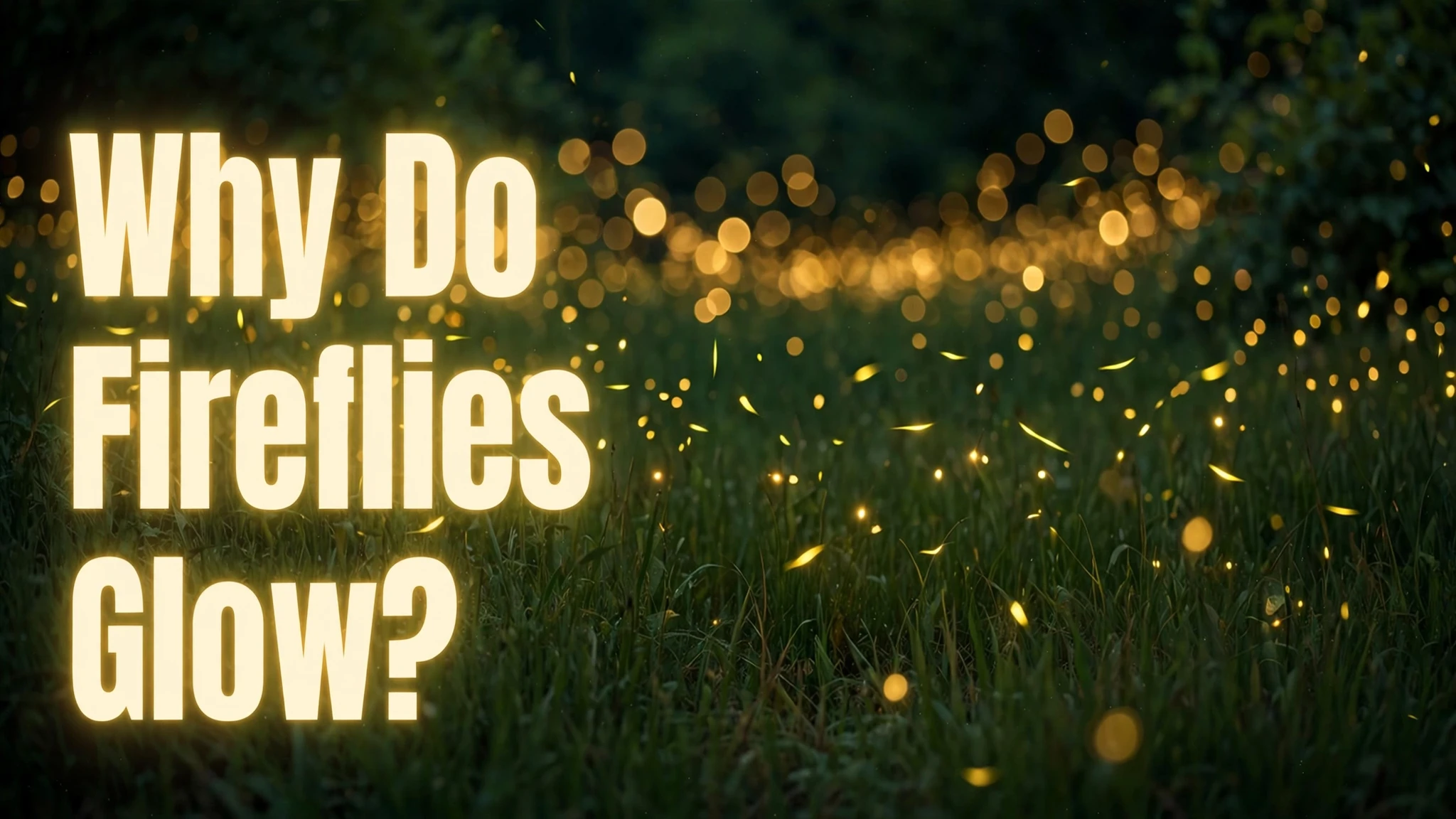
A firefly’s glow is a chemical light, not an electric light and not a reflection. Inside special light organs, usually in the lower abdomen, a chemical reaction produces light with very little heat. This process is called bioluminescence, and it is the same broad family of chemistry that makes some fungi, jellyfish and deep-sea fish glow, though the exact chemicals and organs differ. The key point is efficiency: a normal light bulb wastes much of its energy as heat, while a firefly’s reaction converts a large share of its chemical energy directly into light. That is why a child can hold a firefly, in the old stories at least, without being burned, and why the insect itself is not cooked by its own signal.
The glow is also controlled. A firefly does not shine continuously like a lamp left on. It flashes in patterns, switching its light organ on and off by controlling oxygen supply to the reaction. When oxygen reaches the light-producing cells, the reaction proceeds and light appears. When oxygen is restricted, the light stops. This control is precise enough that different species produce different flash rhythms: a long steady glow, a quick double blink, a slow pulse repeated every few seconds. Those rhythms are not decoration; they are messages, and other fireflies of the same species can read them.
It is worth correcting a common confusion at the start. Fireflies are beetles, not flies, and their larvae are sometimes called glow-worms. Adult fireflies in many species have wings and fly, while females of some species are wingless and glow from the ground. The light organ’s colour also varies: most fireflies glow yellow-green, but some glow orange or, rarely, a different shade, depending on the chemistry and structure of the organ. Colour, rhythm and timing together form a kind of identity card that helps a firefly find a mate of its own species in a dark field full of other glowing insects.
Luciferin, Luciferase and the Chemistry in Plain Words
The reaction needs four main players, and their names are worth learning because they appear in almost every explanation of bioluminescence. The first is luciferin, the light-making chemical itself. The second is luciferase, an enzyme, which is a protein that speeds up a chemical reaction without being used up in it. The third is oxygen from the air. The fourth is ATP, the cell’s usual energy currency, which provides the energy to start the process. When luciferase helps luciferin react with oxygen, using energy from ATP, the luciferin enters an excited state and then releases that energy as a photon, a particle of light, as it returns to its normal state.
A useful analogy is a match, but only up to a point. Striking a match also releases stored chemical energy as light, but it releases much of it as heat and it cannot be switched on and off cleanly. The firefly reaction is more like a chemical torch with a tap: the enzyme opens the tap, oxygen flows, light is made, and the tap closes. Because the reaction happens in cells designed for it, with light-producing molecules arranged to emit outward, very little energy is lost as heat. Scientists call this high quantum efficiency, which simply means that most of the chemical events produce a photon rather than wasted warmth.
Researchers have borrowed this chemistry for medicine and laboratory work. The luciferase gene can be inserted into cells or organisms so that they glow when a particular gene is switched on, letting scientists watch biological processes in living tissue. This is a good example of a natural invention being reused by humans, but it also shows why firefly chemistry is studied beyond curiosity: a clean, controllable light reaction is a valuable tool. It does not mean fireflies glow for human benefit; they evolved the reaction long before laboratories existed, for reasons of survival and reproduction.
A Language of Flashes: Finding a Mate in the Dark
For most adult fireflies, the main job of glowing is finding a mate. Males typically fly and flash a species-specific pattern while searching. Females, often perched on grass or low plants, watch and reply with a flash of their own, timed in a particular way after the male’s signal. If the timing and pattern match, the male moves closer, flashes again, and the pair continues this exchange until they meet. If the pattern is wrong, the female does not reply, or replies in a way that does not encourage approach. This flash dialogue prevents wasted mating attempts between different species, which would produce no viable offspring.
The precision matters because many firefly species share the same meadow on the same summer night. Without distinct signals, a male could spend the night chasing the wrong species, and a female could attract males that cannot father her offspring. Natural selection has therefore sharpened the signals: flash duration, interval, number of flashes, flight path while flashing, and the time of evening when flashing begins all help separate species. Some species flash early at dusk, others later in full darkness. Some fly in a J-shaped swoop while flashing, others hover. Together, these details form a private channel in a crowded night.
There is also a darker side to this language: deception. Females of some predatory firefly species mimic the reply flashes of other species, luring males in to eat them. The famous example is in the genus Photuris, whose females copy the responses of Photinus males and then prey on the males that approach. This is not cruelty in a human sense; it is a feeding strategy that exploits a communication system. It also shows that a signal, once it becomes reliable, becomes a target for exploitation, a pattern found in animal communication far beyond fireflies.
Warnings, Defence and the Glow of the Young
Mating is not the only reason to glow. Many fireflies are chemically defended: they taste bitter or are mildly toxic to predators, because they contain defensive chemicals called lucibufagins, which are related to compounds found in toads. A predator that eats one firefly and finds it unpleasant learns to avoid glowing insects afterwards. The glow therefore works as a warning signal as well as a mating signal, advertising that the insect is not worth eating. This is similar to the bright colours of poison frogs or the black-and-yellow bands of a wasp: a visible sign that says, in effect, do not bother.
Larvae glow too, and for a similar defensive reason. Firefly larvae live on the ground, hunt snails, slugs and worms, and glow steadily or in pulses from light organs along their bodies. A larva cannot fly away from a predator, so a warning glow is valuable: it tells a hunting toad, spider or bird that this small, soft creature may taste bad. Some larvae also use light while hunting, though the evidence is less clear than for defence, and researchers are careful not to claim that larvae use light as a lure without strong proof. The safest summary is that glowing helps larvae survive, mainly by warning predators, while adults add mating to the list of uses.
The chemistry of defence also explains why some other animals mimic fireflies or learn from them. A predator that has learned to avoid fireflies may also avoid other glowing or similarly coloured insects, which benefits those insects without them needing to be toxic themselves. This kind of mimicry and learning is common in nature, and it means a firefly’s glow protects more than the single insect: it teaches a lesson that other insects can benefit from, at least until a predator learns to tell the difference.
Why Fireflies Glow in Some Places and Not Others
Fireflies are not found everywhere. They need moist habitats with places for larvae to live and hunt: meadows, marsh edges, forest floors, stream banks and gardens with leaf litter and long grass. Larvae need damp soil, snails and shelter, and adults need dark nights to be seen. A dry, paved, brightly lit area offers little of this. That is why firefly displays are famous in parts of North America, East Asia and elsewhere with warm, humid summers, and why they are rare or absent in very dry regions, high mountains and intensely lit cities.
Light pollution is a growing problem for fireflies. Street lights, garden lights and illuminated buildings can wash out flash signals, making it harder for males and females to find each other. In a bright area, a female’s reply may be drowned out, or a male may be drawn to an artificial light instead of a mate. This is not only an aesthetic loss; if mating fails, fewer larvae are born the next year, and the population can decline even if the habitat looks green and healthy. Reducing unnecessary outdoor lighting during firefly season, shielding lights, and using warmer, dimmer lights near meadows are practical steps that cost little and help a great deal.
Habitat loss and pesticides add further pressure. Mowing a meadow short, draining a marsh, clearing leaf litter, or spraying broad insecticides can remove larval food and shelter in one season. Because fireflies spend most of their lives as larvae, often one or two years underground or in leaf litter, damage to the ground matters more than damage to the flying adults. A garden that keeps a wild corner, leaves fallen leaves in autumn, avoids pesticides, and turns off lights at night can therefore be a real firefly habitat, not merely a decorative gesture.
Fireflies in Culture, Science and the Night Sky
Humans have watched fireflies for centuries, and the insects appear in poetry, festivals and childhood memories in many countries. In Japan, firefly viewing, called hotaru-gari, is a traditional summer activity, and fireflies appear in art and literature as symbols of fleeting summer beauty. In parts of North America, catching fireflies in jars on summer evenings is a common childhood memory, though modern advice is to watch and release them quickly, because handling and confinement stress the insects and can shorten their short adult lives. The cultural point is consistent: fireflies turn an ordinary night into an event, and that emotional value helps conservation, because people protect what they love and remember.
Science also uses fireflies as indicators. Because they need dark, moist, unpolluted habitats, a healthy firefly population can signal a healthy local environment, while a sudden decline can warn of light pollution, pesticide use or habitat change. Scientists do not rely on fireflies alone, but they are a visible, popular indicator that volunteers can count on summer nights. Citizen science projects that ask people to record flash patterns and locations help researchers map species and track changes, turning a pleasant evening walk into useful data.
The deeper scientific interest is in the chemistry itself. Bioluminescence has evolved independently many times in nature, in bacteria, fungi, jellyfish, fish and insects, which suggests that making light is a powerful advantage in the dark. Studying how different organisms solve the same problem, with different chemicals, helps scientists understand evolution and design better laboratory tools. A firefly is therefore not only a summer curiosity; it is a working example of a solution that nature found, refined and reused, and that humans are still learning to copy.
Fireflies, Light Pollution and the Future of Dark Nights
The future of fireflies will be decided less by their chemistry, which is already excellent, than by whether humans leave them enough darkness and damp habitat to use it. Light pollution is increasing in many regions, as cities expand and outdoor lighting grows, and habitat loss continues as wetlands are drained and meadows are built over. Climate change adds uncertainty, shifting rainfall, temperature and the timing of seasons in ways that may affect larval development and adult emergence. None of these trends is irreversible in a single garden or town, but together they point to a need for deliberate dark-sky policies: shielded lights, curfews for non-essential lighting, and protection for wetlands and meadows as firefly habitat, not only as scenery.
There are encouraging signs. Dark-sky reserves and parks, where lighting is controlled to protect night skies for astronomy and wildlife, are growing in number, and many towns have adopted lighting ordinances that reduce glare and skyglow. Gardeners, farmers and park managers are learning that leaving a wild margin, reducing mowing and avoiding broad pesticides helps pollinators and fireflies at the same time. Citizen science counts give researchers data that would otherwise be impossible to collect, and they give participants a reason to look closely at their local night. If those trends continue, fireflies could become a flagship for a broader dark-night movement, in which darkness is valued as a natural resource, like clean water and clean air, rather than as a problem to be lit away.
My Take:
My take is that fireflies glow for the most ordinary and the most profound reason at once: to be found in the dark by the right other firefly, and to warn the wrong predator to stay away. I love that a single chemical reaction serves two opposite jobs, attraction and repulsion, depending on who is watching. A male firefly’s flash says come closer to a female of his species, and stay away to a toad that has learned the taste. The same light is an invitation and a warning, and the difference lies entirely in the reader. That is a useful reminder that communication is never only about the sender; it is about who is listening and what they have learned.
I also think fireflies expose a quiet arrogance in how we light our world. We treat outdoor light as safety and progress, and often it is, but we rarely ask what it costs the creatures that evolved to use darkness. A street light that stays on all night in a meadow is not neutral; it is noise in a conversation that has run for millions of years. I am not arguing for darkness everywhere, and I would not ask a town to switch off lights that keep people safe. I am arguing for thoughtfulness: shield a light, dim it, switch it off when no one needs it, and leave a dark corridor where fireflies can still talk. Small changes in lighting are cheap, and they preserve a conversation we did not invent and cannot easily restart once it stops.
My worry is that fireflies are disappearing quietly, in a way that is easy to miss. Unlike a large animal whose absence is obvious, a meadow with fewer flashes still looks green in daylight. A child who never sees a firefly display will not know what was lost, and that is the saddest kind of extinction: not a dramatic event, but a gradual dimming that no one notices until the night is simply dark. That is why I value counting projects and childhood memories so much. A person who counted flashes as a child will notice when the count falls, and will ask why. Memory becomes a baseline, and baselines are what conservation needs most.
On a more hopeful note, I think fireflies are one of the easiest conservation successes available to an ordinary person. You do not need to travel to a reserve or donate a large sum to help them. Leave a wild corner, keep leaves on the ground, avoid spraying, and turn off a garden light during summer evenings. Those four actions are within reach of millions of gardens, and together they could rebuild habitat street by street. I find that encouraging, because so much environmental news feels distant and overwhelming, while firefly help is local, visible and fast: within a season or two, a dark, damp corner may reward you with light.
There is also a scientific humility in the firefly story that I appreciate. Humans invented electric light only recently, and we still waste much of it as heat. Fireflies solved the same problem with chemistry, millions of years ago, at far higher efficiency, and they packaged it in an insect smaller than a thumbnail. When scientists borrow luciferase for laboratories, they are not improving on nature so much as borrowing a tool that nature perfected. I think that should make us slower to dismiss small creatures as simple. A firefly is not a simple bug with a light; it is a chemist, a linguist and a warning sign in one tiny body.
Finally, I return to the experience itself. Watching fireflies is one of the few natural spectacles that requires no equipment, no ticket and no expertise, only darkness and patience. You sit, you wait, and the field begins to answer in light. In a world of screens and constant noise, that quiet exchange feels almost radical. If we lose fireflies, we lose more than a species; we lose a reason to sit outside in the dark and pay attention. Protecting them is therefore not only about beetles and chemistry. It is about protecting the kind of night in which a human can still be surprised by light that was not made by us, and that surprise is worth keeping.
There is a final thought about fireflies that I keep returning to: they remind us that darkness is not emptiness, but a medium for communication. Humans tend to treat night as the absence of day, a time when nothing happens until morning. For fireflies, moths, owls and countless other creatures, night is a busy, information-rich world, with signals, warnings and courtships that daylight would drown out. Artificial light does not merely make the night brighter; it erases that information world, like shouting over a conversation. When we flood a meadow with light, we are not adding safety alone; we are removing a language. That framing changes the question from whether we like light to whether we need it in that place, at that brightness, at that hour.
I also think fireflies offer a model for how to notice environmental change without instruments. A person does not need a laboratory to count flashes in a garden, to note that a field that glowed ten years ago is now dark, or to ask a neighbour why the meadow was mowed in June. Those observations, shared with a local nature group or a citizen science project, become data, and data becomes evidence for shielding a light, delaying a mow, or protecting a marsh. In a world where environmental problems often feel too large for one person, fireflies give a problem at garden scale, with a solution at garden scale, and a reward that is visible on a summer night. That combination of small action and visible reward is rare, and it is worth celebrating, because it teaches people that their choices matter, not in the abstract, but in light.
That small, local scale is also why I remain optimistic. A single garden cannot stop global light pollution, but a street of gardens that shield lights and leave wild corners can restore a local population, and a town that adopts a lighting curfew can restore a meadow. Fireflies do not need perfection; they need darkness, damp soil and time, and those are things ordinary people can provide without waiting for a treaty or a technology. If enough gardens provide them, the night will answer in light, one flash at a time, and that answer will be visible proof that small actions, repeated, can still change a landscape for the better.
Frequently Asked Questions
What chemical makes fireflies glow?
Fireflies use luciferin, a light-making chemical, with the enzyme luciferase, oxygen and cellular energy. The reaction releases light with very little heat, a process called bioluminescence.
Why do fireflies flash instead of glowing all the time?
Flashing is controlled by oxygen supply to the light organ. Patterns of flashes let males and females of the same species recognise each other and avoid mating with the wrong species.
Are fireflies flies or beetles?
Fireflies are beetles, not true flies. Their larvae are often called glow-worms, and adult females of some species are wingless and glow from the ground.
Do fireflies glow to warn predators?
Yes, in part. Many fireflies taste bitter or are mildly toxic, and their glow warns predators that have learned to avoid them. Larvae also glow, mainly as a warning while they cannot fly away.
How does light pollution harm fireflies?
Artificial light can drown out flash signals, making it harder for males and females to find each other. Failed mating means fewer larvae the next year, so populations can fall even where habitat looks intact.
Can I help fireflies in my own garden?
Yes. Keep a wild, damp corner with leaf litter, avoid broad insecticides, mow less often, and switch off or shield outdoor lights during firefly season. These steps protect larvae and keep flash signals visible.