Oasis: The Life Story Behind the Britpop Legends
In this post
Oasis are one of the biggest and most loved British bands of all time, and they are also one of the most argued about. They were formed in Manchester in 1991 by two brothers, Noel and Liam Gallagher, who loved the Beatles, who loved rock and roll, and who wanted to be the biggest band in the world. Within a few years, they were, with hit albums, with songs that everyone knew, and with concerts that became legends, including two nights at Knebworth in 1996 in front of a quarter of a million people.
Their story is about the Gallagher brothers, about their talent, their fights, their humour, and their refusal to be polite or quiet. It is about a band that made music that was simple, direct, and full of feeling, about songs like Wonderwall, Don’t Look Back in Anger, and Live Forever, and about a rivalry with Blur that became known as the Battle of Britpop. It is also about how a band that seemed unstoppable fell apart, when the brothers could no longer work together, and how they came back together decades later.
What makes their story worth telling is the music and the attitude. Oasis did not try to be clever or complicated. They wrote big choruses, they played loud guitars, and they sang about life, love, and hope in a way that millions of people understood. They were working-class lads from Manchester who became stars, and they never forgot where they came from. This is the story of how Oasis became legends, and why their songs are still sung today.
Two Brothers Growing Up in Burnage, Manchester
Noel Gallagher was born on 29 May 1967 in Manchester, and Liam Gallagher was born on 21 September 1972, also in Manchester, and they grew up with their older brother Paul in Burnage, a working-class area of the city. Their parents were Irish, their father was often absent and violent, and their mother Peggy raised the boys largely on her own, working hard to give them a stable home. The brothers were different from each other from the start: Noel was quiet, thoughtful, and musical, while Liam was loud, confident, and rebellious, and they fought as brothers do, but they also shared a love of music.
Noel learned to play the guitar as a teenager, and he was inspired by the Beatles, by the Smiths, and by the Stone Roses, a Manchester band that had become famous in the late 1980s. He worked as a roadie for the Inspiral Carpets, a Manchester band, and he learned how a touring band worked, how to set up equipment, and how to live on the road. He also wrote songs in his spare time, filling notebooks with lyrics and melodies, and he dreamed of forming a band of his own, even though he had no record deal and no money.
Liam was still at school when he joined a local band called the Rain, with his friends Paul Arthurs, Paul McGuigan, and Tony McCarroll, and he became the singer, even though he had little experience. He had a distinctive voice, a swagger, and a stage presence that made him a natural frontman, and he loved the idea of being in a band. The Rain played in small venues in Manchester, and they were a decent local band, but they were not yet Oasis, and they were not yet famous.
In 1991, Noel saw the Rain play, and he offered to join them, on the condition that he would be the songwriter and the leader, and that they would change their name to Oasis. The other members agreed, and Oasis was born, with Liam on vocals, Noel on guitar and songwriting, Paul Arthurs on guitar, Paul McGuigan on bass, and Tony McCarroll on drums. They rehearsed in Manchester, they wrote songs, and they began to play gigs, building a following in the city and dreaming of something bigger.
The band’s early touring was also a time of learning how to live on the road, how to play night after night in different cities, how to deal with small crowds and large crowds, and how to keep their energy up even when they were tired, and they learned that a band is a family on the road, and that you have to look after each other if you want to survive a long tour.
Definitely Maybe was recorded quickly, with the band playing live in the studio, and with a sound that was loud, raw, and full of energy, and that rawness was part of its appeal, because it sounded like a band playing in a room, not like a record made by computers, and fans loved it for that honesty and that power.
Definitely Maybe and the Sound of a New Generation
In 1993, Oasis were discovered by the record producer Alan McGee, who saw them play in Glasgow and signed them to his label, Creation Records, on the spot. McGee was impressed by their energy, their songs, and their attitude, and he believed that they could become a major band. Oasis recorded their first single, Supersonic, in late 1993, and it was released in April 1994, reaching the top thirty in the UK and introducing their sound to a wider audience: loud guitars, a big chorus, and Liam’s sneering, confident vocal.
Their debut album, Definitely Maybe, was released in August 1994, and it became the fastest-selling debut album in British history at the time, reaching number one in the UK. The album included the songs Rock ‘n’ Roll Star, Live Forever, Supersonic, and Cigarettes and Alcohol, and it was full of energy, confidence, and swagger. It spoke to young people who felt that life could be better, that they could be rock and roll stars, and that they did not have to accept a boring life. It was a perfect debut, and it made Oasis one of the most talked-about bands in Britain.
The band toured the album in Britain and America, and they built a reputation as a wild, exciting live act, with Liam strutting on stage, Noel playing loud guitar, and the band playing with a volume and a power that thrilled their fans. They also became known for their interviews, in which they were funny, rude, and outspoken, saying what they thought about other bands, about the music business, and about life. They were not polite pop stars. They were working-class lads from Manchester, and they acted like it.
Definitely Maybe also showed Noel Gallagher’s gift for songwriting. He wrote songs with big choruses, with simple, direct lyrics, and with melodies that people could sing along to, and he did it again and again. He was influenced by the Beatles, by the Stones, and by many other bands, but he made the sound his own, and he wrote songs that felt both familiar and new. The album is still regarded as one of the greatest debut albums ever made, and it is still loved by fans today.
The recording of Morning Glory was also a time of intense creativity for Noel, who wrote many of the songs quickly, in hotel rooms and in the studio, and who was inspired by the success of the first album, by the love of his fans, and by the feeling that Oasis were on the verge of something huge, and that feeling comes through in the music, which is confident, joyful, and full of life.
Don’t Look Back in Anger, sung by Noel rather than Liam, became another anthem, with its piano introduction and its message about not holding on to anger, and it is still sung at concerts, at memorials, and at moments when people need a song about hope and about moving forward together.
What’s the Story Morning Glory and Wonderwall
In 1995, Oasis released their second album, (What’s the Story) Morning Glory?, and it became one of the best-selling albums in British history, with more than twenty-two million copies sold around the world. The album included the songs Wonderwall, Don’t Look Back in Anger, Champagne Supernova, and Some Might Say, and it was a huge success, reaching number one in the UK and in many other countries. Wonderwall became their most famous song, a gentle, acoustic ballad that is still sung by millions of people, at weddings, at parties, and at concerts.
The album was recorded with a new drummer, Alan White, who had replaced Tony McCarroll, and it had a bigger, more polished sound than Definitely Maybe, with strings, with piano, and with layers of guitars. Noel wrote the songs, Liam sang them, and the band played them with confidence and with joy. The album captured a moment in British music, when Britpop was at its peak, when bands like Oasis, Blur, Pulp, and Suede were the biggest names in the country, and when British music felt exciting and new again.
The success brought fame, money, and pressure, and the band became the biggest in Britain. They played huge concerts, they appeared on television, and they were followed by the press wherever they went. They also became involved in a famous rivalry with Blur, another British band, when both bands released singles on the same day in August 1995, in what became known as the Battle of Britpop. Blur won the singles chart that week, but Oasis won the album chart, and the rivalry made both bands even more famous.
In 1996, Oasis played two nights at Knebworth House, in front of 250,000 people, in what became one of the most famous concerts in British history. The shows were a peak for the band, a moment when they were the biggest band in the country, playing to a quarter of a million people over two nights, with support from other bands, and with a set list that included all their greatest hits. It was a triumph, but it was also a high point that would be hard to match, and the band would soon begin to struggle with the pressure of being so big.
The band’s later albums also showed Noel’s growth as a songwriter, with songs that were more varied, more thoughtful, and more mature than their early work, even if they did not always match the impact of Definitely Maybe and Morning Glory, and they proved that Oasis were not a one-trick band, but a group that could keep writing good songs for many years.
The brothers’ fights were often reported in the newspapers, with headlines about their arguments, their insults, and their walkouts, and while the press loved the drama, the fights also hurt the band, because they made it hard to record, hard to tour, and hard to enjoy the music that had brought them together in the first place.
Be Here Now, Fights, and the Long Decline
In 1997, Oasis released their third album, Be Here Now, which was one of the most anticipated albums in British history, selling more than eight hundred thousand copies in its first week in the UK. The album was loud, long, and overproduced, with songs like D’You Know What I Mean? and Stand by Me, and it was initially praised, but over time, it came to be seen as a disappointment, a record that was too big, too bloated, and too self-indulgent. Noel himself later said that he was not happy with the album, and that the band had lost their way.
The late 1990s were a difficult time for Oasis. The brothers fought constantly, in public and in private, and their arguments became legendary, with Liam and Noel insulting each other in interviews, walking off stage, and refusing to speak to each other. The band’s line-up changed, with Paul Arthurs and Paul McGuigan leaving in 1999, and new members joining, including Gem Archer and Andy Bell, but the core of the band remained the Gallagher brothers, and their relationship was the heart of the band, for better and for worse.
They released more albums in the 2000s, including Standing on the Shoulder of Giants in 2000, Heathen Chemistry in 2002, Don’t Believe the Truth in 2005, and Dig Out Your Soul in 2008, and they had hit singles like The Hindu Times, Lyla, and The Importance of Being Idle, but they were no longer the biggest band in Britain, and their music was no longer as fresh as it had been in the mid-1990s. They were still a major live act, playing stadiums and festivals, but the magic of the early years had faded, and the brothers were growing tired of each other.
In August 2009, after a fight backstage at a festival in Paris, Noel Gallagher announced that he was leaving Oasis, saying that he could no longer work with Liam. The band broke up, and the brothers went their separate ways, with Liam forming a new band called Beady Eye, and Noel forming Noel Gallagher’s High Flying Birds, both of which had some success, but neither of which matched Oasis. The break-up was sad for fans, who had loved the band for almost twenty years, and who hoped that the brothers would one day make up.
Liam’s solo career also showed his growth as a singer and as a performer, with albums that were praised by critics and loved by fans, and with live shows that proved he could still command a stage on his own, without his brother, and that he was more than just the singer in Oasis, but an artist in his own right.
Solo Years, Reunion, and the Legacy of Oasis
After the break-up, Liam and Noel both made solo music, and they both toured, playing Oasis songs as well as their own new material. Liam released albums like As You Were in 2017, which was a success, and he became known as a solo artist in his own right, with a loyal fan base and a reputation as a great live performer. Noel released albums with his High Flying Birds, including his debut in 2011, and he became known as a thoughtful, melodic songwriter, with a more mature sound than Oasis had in their early years.
The brothers did not speak for many years, and their feud was widely reported, with both of them insulting each other in interviews and on social media. Fans hoped for a reunion, but it seemed unlikely, because the brothers were so stubborn, and because their relationship was so damaged. They both said, at different times, that a reunion would never happen, and many people believed them, thinking that Oasis was over for good, and that the brothers would never play together again.
In 2024, however, Oasis announced that they would reunite for a tour in 2025, with concerts in Britain, Ireland, and around the world, and the news was greeted with huge excitement by fans, who bought tickets in record numbers. The reunion was a major event, and it showed that, despite all the fights, the brothers still wanted to play together, and that their fans still wanted to hear them. The tour was a success, and it reminded everyone why Oasis had been so loved in the first place.
Oasis left behind a body of music that is still loved today, with songs like Wonderwall, Don’t Look Back in Anger, Live Forever, and Champagne Supernova still played on the radio, still sung by fans, and still loved by new generations. They sold more than seventy million records around the world, they played to millions of people, and they became one of the biggest British bands of all time. Their story is about talent, about brotherhood, about fights, and about music that spoke to millions of people, and it will be remembered for as long as people listen to rock music.
Their songs have also become part of British culture, played at football matches, at pubs, at parties, and at school, and known by people who may never have bought an Oasis album, which shows how deeply their music has entered the life of the country, and how much it means to people from all walks of life.
What Oasis Leave Behind
Oasis left behind a legacy that is still felt in British music today. They showed that a working-class band from Manchester could become the biggest in the world, that simple, direct songs with big choruses could speak to millions of people, and that rock and roll could still be exciting, loud, and fun in the 1990s. They influenced many bands that came after them, from the Arctic Monkeys to Kasabian to many others, and they are still cited as an influence by young musicians today.
Their legacy is also about the Gallagher brothers, about their talent, their humour, and their refusal to be quiet. They were not polite, they were not careful, and they were not afraid to say what they thought, and that honesty made them loved by their fans, even when it got them into trouble. They were real people, with real flaws, and they made real music, and that is why their fans stayed loyal, even through the fights and the break-up.
For young musicians, Oasis are an example of what is possible if you believe in yourself, if you write good songs, and if you work hard. They started in a small rehearsal room in Manchester, they played in small clubs, they got a record deal, and they became legends. They did it with talent, with hard work, and with a love of music. They also did it with attitude, with style, and with a sense of fun. They were not perfect, and their story has sad parts, but their music remains, and it will remain for as long as people listen to rock music.
The band’s early gigs in Manchester were also important, because they taught Oasis how to play to a small crowd, how to win over people who had never heard them before, and how to build a following one gig at a time, which is a skill that many bands never learn.
They also learned how to handle success, how to deal with fame, and how to stay true to themselves even when the whole world was watching, which is a hard thing for young men from Manchester who had suddenly become stars.
My Take:
When I think about Oasis, the first thing I think about is Wonderwall. It is a song that everyone knows, a song that is played at weddings, at parties, and at concerts, and a song that still makes people sing along. I love that song, because it is simple, it is beautiful, and it is full of feeling. When I hear it, I think about being young, about hoping for something better, and about the feeling that life could be wonderful. That is a powerful song, and it is one of the reasons Oasis have lasted so long.
I admire Noel Gallagher most of all, because he was the songwriter, the guitarist, and the brains behind the band. He wrote Wonderwall, Don’t Look Back in Anger, Live Forever, and many other great songs, and he did it with a gift for melody and for simple, direct lyrics. He was influenced by the Beatles, but he made the sound his own, and he wrote songs that felt both familiar and new. I respect that kind of talent, because it takes more than luck to write a song that millions of people will sing for thirty years.
I also think about Liam Gallagher, because his voice is one of the most distinctive in rock. He sings with a sneer, with a swagger, and with a confidence that makes the songs feel alive. When I hear him sing Live Forever, I hear a young man who believes that he will live forever, and who wants the listener to believe it too. He was also a great performer, with a stage presence that made him a rock star, and with a personality that made him loved by fans. I think he is one of the best frontmen of his generation.
I think about the Gallagher brothers together, because their relationship is the heart of Oasis. They are brothers, they love each other, and they fight like brothers do, but their fights became public, and they became part of the band’s story. I think that is sad, because they are talented, and they made great music together, and their fights stopped them from making more. I wish they had found a way to work together sooner, but I am glad that they eventually reunited, because their music deserves to be heard live again.
There is a part of their story that I find moving, and that is their working-class background. They grew up in Burnage, in Manchester, in a family that struggled, with a father who was violent and absent, and a mother who worked hard to raise them. They did not come from money, they did not come from privilege, and they did not have connections. They made it because they were talented, because they worked hard, and because they believed in themselves. That is a hopeful message for young people from similar backgrounds. You do not need money to make great music. You need talent, work, and belief.
I also think about Knebworth, because it was one of the greatest moments in British music history. Two nights, 250,000 people, a band at the peak of its powers, playing to a crowd that stretched as far as the eye could see. I wish I could have been there, because I think it would have been an unforgettable experience. It was a moment when Oasis were the biggest band in the country, and when British music felt exciting and new. That is a legacy that will never be forgotten.
I think about the Battle of Britpop, too, because it was a fun, silly, and exciting time in British music. Oasis and Blur released singles on the same day, the press made a big deal of it, and the whole country talked about it. Blur won the singles chart, Oasis won the album chart, and both bands became even more famous. I think that rivalry was good for music, because it made people care about bands, about songs, and about British music. It was a time when music mattered, and when people argued about it in pubs and in schools.
If I have a criticism, it is that Oasis sometimes get treated as perfect, and they were not perfect. They made mistakes, they argued, they were sometimes rude, and they were sometimes unkind to each other and to other people. They also made albums that were not as good as their best work, especially Be Here Now, which was too long and too overproduced. I do not want to pretend that every Oasis album is a masterpiece. Some are better than others, and some are hard work. But their best music is truly great, and that is what matters.
Another thing I think about is how their music has lasted. Wonderwall was released in 1995, thirty years ago, and it is still one of the most played songs in the world. It is still sung by teenagers, still played on the radio, and still loved by people who were not born when it was made. That is a rare thing. Most music fades after a few years. Oasis music does not fade. It stays, because the songs are well written, because the melodies are strong, and because the feelings in them are true.
I think about their influence, too. They changed the way British bands sounded, the way young people dressed, and the way music was talked about. They showed that a band could be working-class, could be loud, and could be successful, all at the same time. Many bands that came after them learned from them, from the Arctic Monkeys to Kasabian, and many still do. They opened a door, and many other artists walked through it. That is a legacy that goes beyond their own songs.
For a young reader, I think the lesson from Oasis is about believing in yourself. They were two brothers from Manchester who believed that they could be the biggest band in the world, and they were right. They believed in their songs, they believed in their talent, and they worked hard to make it happen. That is a useful lesson for anyone who has a dream. You have to believe in yourself, you have to work hard, and you have to keep going, even when people tell you that you cannot do it.
I also think their story teaches something about brotherhood and about forgiveness. Noel and Liam fought for years, they did not speak, and they said terrible things about each other, but eventually, they came back together, and they played together again. That is a hopeful message. Families fight, brothers fight, but they can also make up, and they can find a way to work together again. I am glad that Oasis reunited, because their music deserves to be heard, and because their fans deserve to see them together.
In the end, I think Oasis will be remembered as one of the greatest British bands ever, not only because they sold the most records, but because they made the best songs, because they played the biggest concerts, and because their music still makes people happy. They were two brothers from Manchester who became legends, and they became legends because they were talented, because they worked hard, and because they made music that spoke to people. I love their music, I respect their story, and I will keep listening to them for as long as I can.
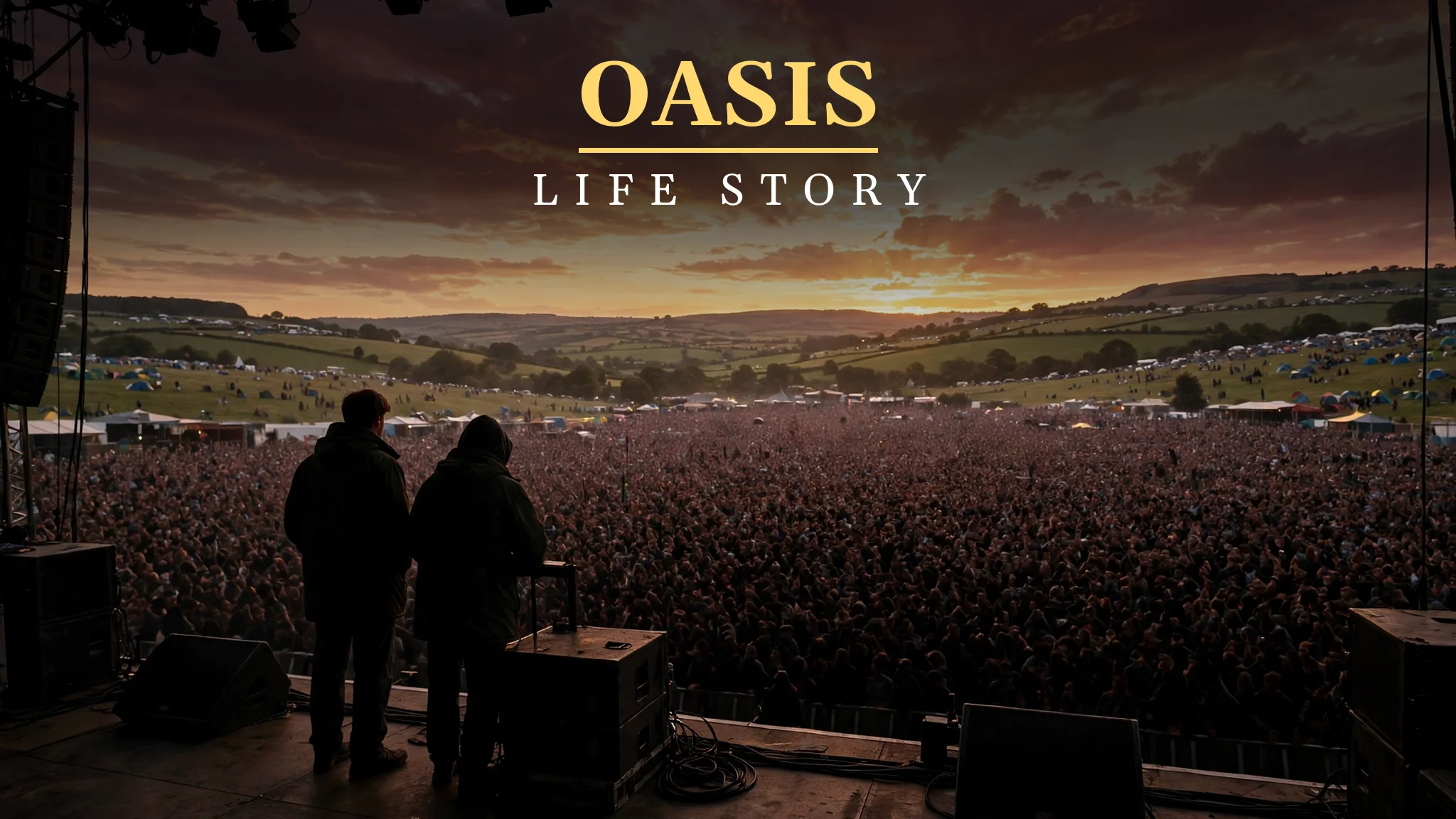
One more thought stays with me. When I think about Oasis, I think about the image of two men on a stage at sunset, looking out over a huge crowd in green fields, and I think about how that image captures their music: big, hopeful, and full of light. Their music is like that sunset, warm and beautiful, and it is still there, still shining, still loved. I think that is a beautiful image, and it is one I will always remember.
I also think about the fans, because Oasis fans are among the most loyal in music, and they have kept the band’s music alive for decades, singing the songs, going to concerts, and teaching their children the words. They waited for a reunion for fifteen years, and when it finally came, they bought tickets in record numbers, because they loved the band that much. That loyalty is a sign of how much the music means to people, and it is a legacy that no amount of money can buy. I am glad to be one of those fans.
I think about the future, too. Oasis have reunited, they are touring again, and they are playing their classic songs for new generations. One day, they will stop again, and that will be a sad day for British music. But their songs will remain, their albums will remain, and their concerts will be remembered. They have left a legacy that will last for generations, and they have shown that rock music can be simple, can be direct, and can be beautiful. I am grateful that I have been able to hear their music, and I am grateful that they made it.
Finally, I want to say that Oasis teach me something about hope. Their songs are about hoping for a better life, about living forever, about not looking back in anger, and about believing that tomorrow will be better than today. That is a hopeful message, and it is one that I need to hear, especially in hard times. Oasis give me hope, and they give millions of other people hope too, and that is a gift that is worth more than any record sale or any award. I will keep listening to them, and I will keep hoping.
I also think about the way Oasis wrote about ordinary life, about cigarettes and alcohol, about living forever, and about not looking back in anger, and how those simple subjects became great songs because they were written with honesty and with a big chorus that everyone could sing.
I think about their Manchester roots, too, because Manchester has produced so many great bands, from the Smiths to the Stone Roses to Oasis, and Oasis are proud of that history, and they carry it with them wherever they go, as a reminder of where they came from and who they are.
I also think about the way Oasis made British music exciting again in the 1990s, when many people thought that guitar music was dead, and they proved that a loud band with big songs could still fill stadiums, sell millions of records, and make young people care about music in a way that had not happened for years.
I think about their humour, too, because the Gallagher brothers are funny, quick, and outspoken, and their interviews are still quoted today, not only because they are rude, but because they are honest, and because they say what many people think but are afraid to say out loud.
I think about the reunion tour and how it felt to see two brothers who had not spoken for years standing on the same stage again, playing the songs that made them famous, and how that moment gave hope to fans who had waited fifteen years to see them together, and who had never given up on the band.
Finally, I want to say that Oasis remind me that simple songs, sung with feeling, can change lives, and that a big chorus, a loud guitar, and an honest voice are sometimes all you need to make music that lasts for decades.
I also think about the way their songs are sung by crowds at football matches, where thousands of people sing Wonderwall together, and how that shows that their music belongs to everyone, not just to the band, and that it has become a part of British life in a way that few songs ever do.
That shared singing, in stadiums and in pubs and in living rooms, is the true measure of Oasis, and it is why I believe their songs will still be sung long after the band has stopped playing.
Frequently Asked Questions
How did Oasis form in Manchester?
Oasis formed in 1991 when Noel Gallagher joined his brother Liam’s band the Rain, on the condition that he would write the songs and lead the band, with Paul Arthurs, Paul McGuigan, and Tony McCarroll completing the original line-up.
What was Oasis’ debut album and why was it so important?
Definitely Maybe, released in August 1994, became the fastest-selling debut album in British history at the time, with songs like Live Forever and Supersonic, and it made Oasis one of the most talked-about bands in Britain.
What is Wonderwall and why is it so famous?
Wonderwall, from their second album (What’s the Story) Morning Glory? in 1995, is a gentle acoustic ballad that became their most famous song, still sung at weddings, parties, and concerts around the world thirty years later.
What was the Battle of Britpop between Oasis and Blur?
In August 1995 Oasis and Blur released singles on the same day, Blur won the singles chart that week, Oasis won the album chart, and the rivalry became known as the Battle of Britpop, making both bands even more famous.
What happened at Knebworth in 1996?
Oasis played two nights at Knebworth House in front of 250,000 people, one of the most famous concerts in British history, at the peak of their fame, with a set list of all their greatest hits.
Why did Oasis break up in 2009?
After years of fighting, Noel Gallagher left the band in August 2009 following a backstage fight with Liam at a festival in Paris, saying he could no longer work with his brother, and the band split up.
Did Oasis ever reunite after breaking up?
Yes, after fifteen years apart and solo careers for both brothers, Oasis announced a reunion tour in 2024, playing concerts in 2025 in Britain, Ireland, and around the world to huge excitement from fans.


