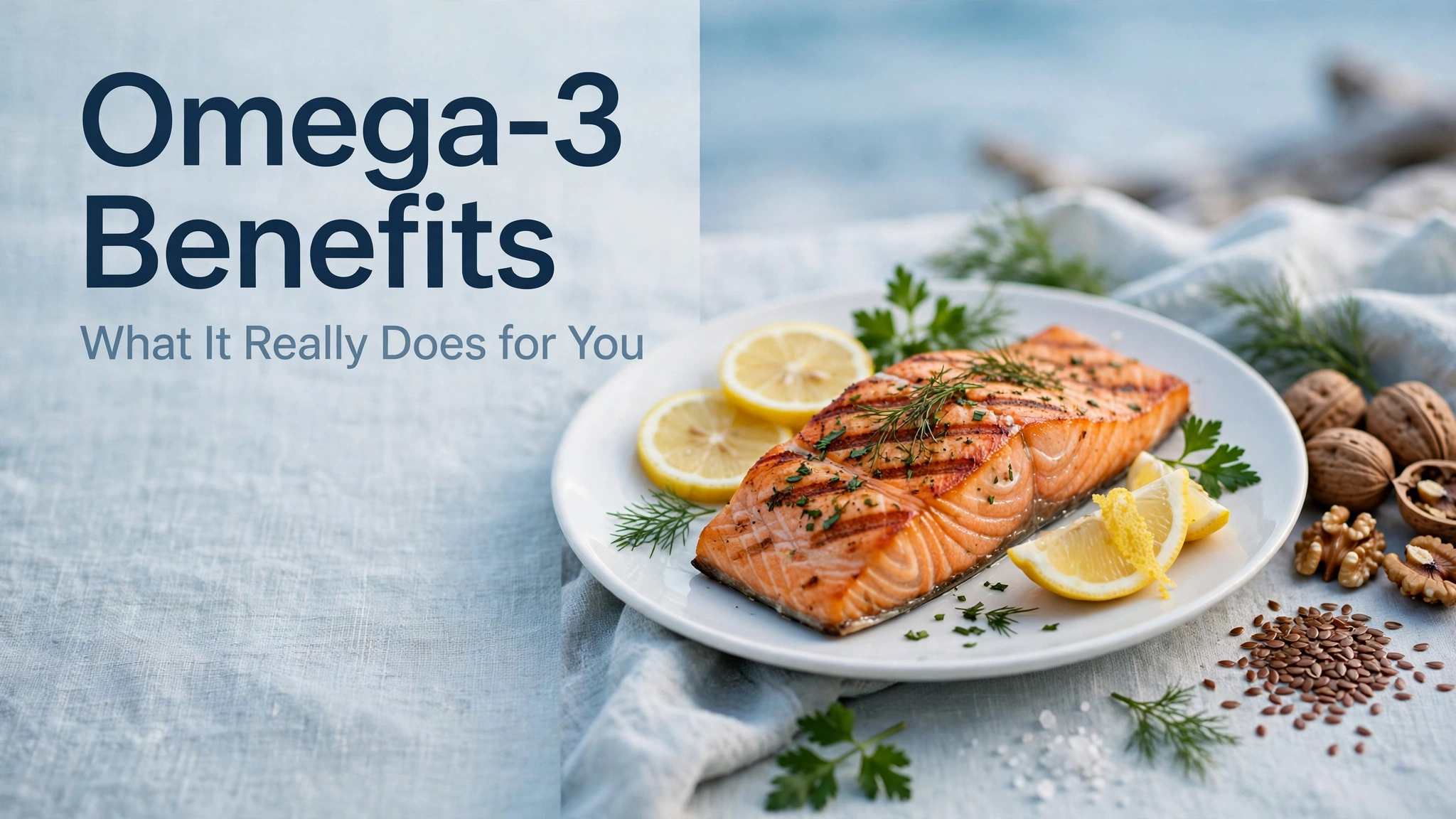
Omega-3 Benefits Explained: What It Really Does for You
In this post
- EPA, DHA and ALA: Three Fats, Three Different Jobs
- Omega-3 and Heart Health: What the Research Shows
- Brain, Mood and Memory: The Evidence So Far
- How Much Omega-3 Do You Need and Where to Get It
- Fish Oil Supplements: Worth It or a Waste of Money
- Mercury, Sustainability and Choosing Fish Wisely
- Omega-3 for Children, Pregnancy and Older Adults
- My Take:
Omega-3 is one of the few nutrients that almost every health expert agrees on, and that is rare. Doctors, dietitians and researchers argue about many things, but they largely agree that omega-3 fats are important, that most people do not eat enough of them, and that eating more oily fish is one of the simplest ways to improve a diet. The agreement is reassuring, but it also hides a lot of confusion, because omega-3 is not one thing. It is a family of fats with different names, different sources and different effects, and the supplements that promise to deliver them vary enormously in quality.
The three main omega-3 fats are EPA, DHA and ALA, and they are not interchangeable. EPA and DHA come mainly from oily fish and algae, and they are the forms the body uses most directly. ALA comes from plants such as flaxseed, chia seeds and walnuts, and the body has to convert it into EPA and DHA, a process that is inefficient. That single fact explains many of the arguments about omega-3: a person who eats flaxseed is not getting the same thing as a person who eats salmon, even though both foods are described as rich in omega-3.
This article explains the difference between the three fats, what the research actually shows about heart, brain and eye health, how much omega-3 you need and where to get it, whether supplements are worth taking, what to know about mercury and sustainability, and how vegetarians and vegans can get enough. It is general information, not medical advice, and it is written to cut through the marketing and give you the facts that matter.
This article is general information only. It is not individual medical advice. Talk to your doctor or pharmacist before starting a supplement, especially if you are pregnant, take blood-thinning medicine, or have a health condition.
EPA, DHA and ALA: Three Fats, Three Different Jobs
Omega-3 fats are a type of polyunsaturated fat, which means they have a particular chemical structure that makes them flexible and fluid. The body cannot make them from scratch, so they must come from food, which is why they are called essential fats. EPA, eicosapentaenoic acid, and DHA, docosahexaenoic acid, are the long-chain omega-3s found in oily fish and algae. ALA, alpha-linolenic acid, is the plant omega-3 found in flaxseed, chia seeds, walnuts and some vegetable oils.
DHA is especially important for the brain and the eyes. It is a major structural component of the brain and the retina, and it is crucial during pregnancy and early childhood, when the brain is developing rapidly. EPA is more involved in reducing inflammation and supporting heart health, and it is the form most studied for mood and cardiovascular effects. ALA is useful, but the body converts only a small percentage of it, often less than ten percent, into EPA and DHA, and the conversion is even less efficient in some people. That does not make plant sources worthless. It means they are not a direct replacement for fish or algae.
The practical point is simple: if you want EPA and DHA, the most reliable sources are oily fish and algae-based supplements. If you eat a plant-based diet, you need to be deliberate about it, eating ALA-rich foods every day and considering an algae oil supplement, which provides DHA and EPA directly from the same source that fish get theirs. Fish do not make omega-3 themselves. They get it from eating algae, and algae oil cuts out the middleman.
Omega-3 and Heart Health: What the Research Shows
The link between omega-3 and heart health is one of the oldest and most studied in nutrition, and it began with observations of populations that ate a lot of fish. People in Japan and in Mediterranean fishing communities, who ate oily fish regularly, had lower rates of heart disease than people who ate little fish, and researchers began to study whether omega-3 was the reason. The early results were promising, and fish oil became one of the most popular supplements in the world.
The research since then has been more mixed than the early excitement suggested. Large studies have found that eating oily fish is linked to a lower risk of heart disease, and that omega-3 can lower triglycerides, a type of fat in the blood, and can slightly lower blood pressure. But the evidence for fish oil supplements preventing heart attacks is weaker, and some large trials have found little or no benefit for people who already have heart disease. The difference between eating fish and taking a capsule matters: fish provides omega-3 along with protein, selenium, vitamin D and other nutrients, and it often replaces less healthy foods such as processed meat.
The honest summary is that oily fish is good for the heart, and that the benefit is real but modest. Eating two portions of oily fish a week is a sensible, evidence-based habit, and it is recommended by health authorities in many countries. Taking a fish oil capsule is not the same as eating fish, and it is not a substitute for the other things that protect the heart, such as not smoking, exercising, maintaining a healthy weight and controlling blood pressure. Omega-3 helps, but it is one part of a larger pattern.
Brain, Mood and Memory: The Evidence So Far
DHA is a major building block of the brain, making up a large share of the fat in brain tissue, and it is essential for normal brain development. During pregnancy, the mother’s DHA intake affects the baby’s brain and eye development, and health authorities recommend that pregnant women eat oily fish or take a DHA supplement. In early childhood, DHA continues to be important for vision and cognitive development, and it is added to many infant formulas for that reason.
In adults, the evidence for omega-3 and brain health is promising but not conclusive. Some studies have found that people who eat more fish have a lower risk of cognitive decline and dementia, and that omega-3 supplements may help with memory in older adults. Other studies have found little effect, and the results depend on the dose, the form, and whether the person was already low in omega-3. The research is still developing, and it would be wrong to say that fish oil prevents dementia or improves memory in healthy adults. The evidence is suggestive, not proven.
The research on mood is similar. Some studies have found that EPA-rich fish oil can help with depression, especially as an addition to standard treatment, and that people with depression often have lower omega-3 levels. But the effects are modest, the studies vary in quality, and fish oil is not a treatment for depression on its own. Anyone with depression should seek professional help, and omega-3 should be seen as a possible supporting factor, not as a therapy. The brain needs omega-3, but it also needs sleep, exercise, social connection and, when necessary, medical treatment.
How Much Omega-3 Do You Need and Where to Get It
Most health authorities recommend eating two portions of oily fish a week, with one portion being around 140 grams. Oily fish includes salmon, mackerel, sardines, trout, herring and anchovies, and these are the richest sources of EPA and DHA. A single portion of salmon can provide more than a gram of EPA and DHA, which is more than the daily amount most guidelines suggest. White fish such as cod and haddock contain much less omega-3, and they are not a substitute for oily fish.
For people who do not eat fish, the options are plant sources and supplements. Flaxseed, chia seeds, walnuts and hemp seeds provide ALA, and they are healthy foods in their own right, but they do not provide EPA and DHA directly. Algae oil supplements do, and they are the best option for vegetarians and vegans. Fish oil capsules are the most common supplement, and they typically provide 250 to 500 milligrams of EPA and DHA per capsule, though the amount varies by brand and should be checked on the label.
The recommended daily intake for EPA and DHA is around 250 to 500 milligrams for most adults, though some guidelines suggest higher amounts for people with heart disease or high triglycerides, and these higher doses should only be taken under medical supervision. There is no need to take very high doses, and taking more than a few grams a day can increase the risk of bleeding and can cause side effects such as a fishy aftertaste, nausea and loose stools. The goal is to meet the requirement, not to exceed it by a large amount.
Fish Oil Supplements: Worth It or a Waste of Money
Fish oil is one of the best-selling supplements in the world, and the question of whether it is worth taking depends on who you are and what you eat. If you eat oily fish twice a week, you probably do not need a supplement, because you are already getting enough EPA and DHA from food. If you rarely or never eat fish, a supplement can help fill the gap, and it is a reasonable choice, especially for vegetarians and vegans who use algae oil instead.
Quality matters, and it varies a lot. Some fish oil products contain less EPA and DHA than the label claims, and some contain oxidised oil, which has gone rancid and may do more harm than good. Look for products that state the amount of EPA and DHA per capsule, not just the total amount of fish oil, and choose brands that are independently tested for purity and freshness. Store the capsules in a cool, dark place, and discard them if they smell strongly fishy or if they are past their expiry date. A rancid fish oil capsule is not a health product.
There is also the question of cost. A good quality fish oil supplement is not expensive, but it is still money spent every month, and for many people the same money spent on a weekly portion of sardines or mackerel would provide more nutrition. The best advice is to prioritise food, use a supplement to fill a genuine gap, and be sceptical of products that promise dramatic benefits. Fish oil is a useful supplement, but it is not a miracle, and it will not compensate for a poor diet.
Mercury, Sustainability and Choosing Fish Wisely
One of the main concerns about eating fish is mercury, a toxic metal that accumulates in large, long-lived fish. The fish with the highest mercury levels are shark, swordfish, king mackerel and tilefish, and health authorities advise pregnant women and young children to avoid these. The oily fish that are richest in omega-3, such as salmon, sardines, anchovies and trout, are generally low in mercury, because they are smaller and shorter-lived, and they are considered safe to eat twice a week.
Sustainability is another concern. Some fish stocks are overfished, and the way fish are caught or farmed affects the environment. Choosing fish that is certified as sustainable, eating smaller fish such as sardines and anchovies, and varying the types of fish you eat are all sensible steps. Farmed salmon is widely available and is a good source of omega-3, though its nutritional profile depends on what the fish are fed, and wild salmon tends to have a slightly different fatty acid profile. The details matter less than the overall habit: eating oily fish regularly, from sustainable sources, is a good choice for health and for the planet.
For people who are concerned about mercury or sustainability, algae oil is a good alternative, because it provides EPA and DHA without the fish, and it is the original source of omega-3 in the marine food chain. It is more expensive than fish oil, but it is a clean and sustainable option, and it is suitable for vegetarians and vegans. The choice between fish, fish oil and algae oil is a personal one, and the best choice is the one you will actually stick to.
Omega-3 for Children, Pregnancy and Older Adults
Omega-3 is important at every stage of life, but it is especially important during pregnancy and early childhood. DHA is crucial for the baby’s brain and eye development, and health authorities recommend that pregnant women eat two portions of fish a week, including one portion of oily fish, or take a DHA supplement if they do not eat fish. Pregnant women should avoid high-mercury fish, and they should talk to their doctor about supplements, because the right dose and the right form matter.
In children, omega-3 supports brain development and vision, and some studies have suggested it may help with attention and behaviour, though the evidence is mixed. Children who eat fish regularly are likely to get enough, and supplements are generally not needed unless a doctor recommends them. The best approach for children is to introduce oily fish early, in forms they enjoy, and to make it a normal part of the family diet rather than a special health food.
In older adults, omega-3 may help with brain health, eye health and inflammation, and some studies have found that higher omega-3 levels are linked to a lower risk of cognitive decline. The evidence is not conclusive, but eating fish regularly is a sensible habit at any age. For older adults who do not eat fish, a supplement can be a reasonable option, and it is worth discussing with a doctor, especially if they take blood-thinning medicine, because high doses of omega-3 can increase bleeding risk.
My Take:
I think omega-3 is the nutrient that the health world gets most right, and that is worth saying, because so much health advice is exaggerated or wrong. The advice to eat oily fish twice a week is simple, it is backed by decades of research, and it is achievable for most people. It is not a miracle cure, it is not a expensive supplement, and it is not a complicated diet. It is a piece of fish, twice a week, and that is the kind of advice I trust, because it is practical and it is honest about what it can and cannot do.
What I find most useful about omega-3 is the distinction between EPA, DHA and ALA, because that distinction is where most of the confusion lives. I have seen many people who eat flaxseed every day and believe they are getting the same omega-3 as someone who eats salmon, and they are not. Flaxseed is a healthy food, and I eat it myself, but it is not a replacement for EPA and DHA, because the body converts only a small amount of ALA. I think that fact should be explained more clearly, because it affects real decisions, especially for vegetarians and vegans who need to know whether they should take an algae oil supplement.
I am also sceptical about fish oil supplements, not because they are useless, but because they are oversold. The marketing promises better memory, better mood, a healthier heart and sharper eyes, and the evidence supports some of those claims modestly and others barely at all. I think a supplement makes sense if you do not eat fish, and I think algae oil is a good option for people who do not eat animal products. But I do not think a capsule is a substitute for eating fish, and I do not think taking a high dose will undo the effects of a poor diet. The fish is better than the capsule, and the capsule is better than nothing, and that is the honest hierarchy.
The heart health research is a good example of why I am careful with health claims. The early studies were exciting, and the later studies were more modest, and the current position is that eating fish helps the heart, but fish oil capsules may not prevent heart attacks in people who already have heart disease. That is not a failure. It is how science works: the first result is often the most optimistic, and the truth emerges over time. I would rather give people that honest, slightly complicated answer than a simple, confident one that is wrong.
I also think the sustainability and mercury questions deserve more attention, because they are the reason some people avoid fish altogether. The good news is that the fish richest in omega-3, such as sardines, anchovies and salmon, are among the lowest in mercury, and they are among the most sustainable choices. That is a fortunate coincidence, and it means the health advice and the environmental advice point in the same direction. Eat small, oily fish, choose sustainable sources, and you are doing something good for yourself and for the planet at the same time.
My honest opinion is that omega-3 is worth paying attention to, but it is not worth obsessing over. If you eat oily fish twice a week, you are doing enough, and you can stop worrying about it. If you do not eat fish, a supplement is a sensible choice, and algae oil is the best option if you do not eat animal products. If you are pregnant, talk to your doctor about DHA, because it matters for your baby’s development. Beyond that, the rest is detail, and the detail matters less than the habit. Health is built on simple, repeatable habits, and eating oily fish is one of the simplest and most useful of them.
Make fish ordinary, not a project, and the omega-3 question largely answers itself. Sardines on toast, salmon once a week, mackerel when you see it fresh: the people who eat fish regularly are not the ones who read the most articles about it, they are the ones who like the taste and have made it part of the week. Enjoyment is the mechanism, because a habit you like is a habit you keep, and a habit you keep beats a supplement you forget. The goal is not to optimise a nutrient, it is to have a normal, repeatable meal you actually look forward to, and the fish, eaten that way, does the work without any fuss at all.
I also think the pregnancy advice is the part that matters most, because DHA during pregnancy and early childhood is one of the few areas where the evidence is genuinely strong. A baby’s brain and eyes need DHA to develop properly, and a mother who eats oily fish or takes a DHA supplement is giving her child a real advantage. I think that message should be louder than the marketing about memory and mood in healthy adults, because it is the message that affects the next generation. If you are pregnant, talk to your doctor about DHA, eat low-mercury oily fish, and do not leave it to chance.
Quality is the part of the fish oil story people overlook, and it matters more than the brand name on the bottle. Not all fish oil is the same: some products contain less EPA and DHA than the label claims, and some contain oil that has gone rancid, which is a serious problem, because a person buying a cheap, oxidised product may be doing more harm than good and will never know. The fix is to buy from a reputable brand, check the EPA and DHA content on the label, and store the capsules properly, away from heat and light. Or, better still, eat the fish, which does not have a freshness problem in the same way and provides far more nutrition than a capsule ever will, including protein and other nutrients no pill contains.
Eat oily fish twice a week, choose sustainable sources, and use a supplement only to fill a genuine gap. Simple, honest, and backed by evidence, which is more than most health advice can claim.
I will keep eating oily fish myself, because it is one of the few health habits that is simple, enjoyable and well supported. A piece of salmon, a tin of sardines, a handful of walnuts: these are ordinary foods, and they do more for my health than most of the supplements on the shelf.
Frequently Asked Questions
What is the difference between EPA, DHA and ALA?
EPA and DHA are long-chain omega-3s from oily fish and algae, used directly by the body. ALA is the plant omega-3 from flaxseed, chia and walnuts, and the body converts only a small amount of it into EPA and DHA.
How much oily fish should I eat each week?
Most health authorities recommend two portions of oily fish a week, about 140 grams per portion. Oily fish includes salmon, mackerel, sardines, trout, herring and anchovies.
Do I need a fish oil supplement if I eat fish?
Probably not. If you eat oily fish twice a week, you are likely getting enough EPA and DHA. A supplement is most useful if you rarely or never eat fish.
Is omega-3 good for the brain?
DHA is a major building block of the brain and is essential during pregnancy and childhood. In adults, the evidence for memory and mood benefits is promising but not conclusive.
Is algae oil as good as fish oil?
Yes. Algae oil provides EPA and DHA directly, and it is the original source of omega-3 in the marine food chain. It is the best option for vegetarians and vegans.
Which fish are low in mercury?
Salmon, sardines, anchovies, trout and herring are generally low in mercury. Shark, swordfish, king mackerel and tilefish are high in mercury and should be avoided by pregnant women and young children.
Sources
- https://ods.od.nih.gov/factsheets/Omega3FattyAcids-HealthProfessional/
- https://www.nhs.uk/live-well/eat-well/food-types/fish-and-shellfish-nutrition/
- https://www.mayoclinic.org/drugs-supplements-fish-oil/art-20364810
- https://www.healthline.com/nutrition/omega-3-guide
- https://medlineplus.gov/ency/article/002447.htm