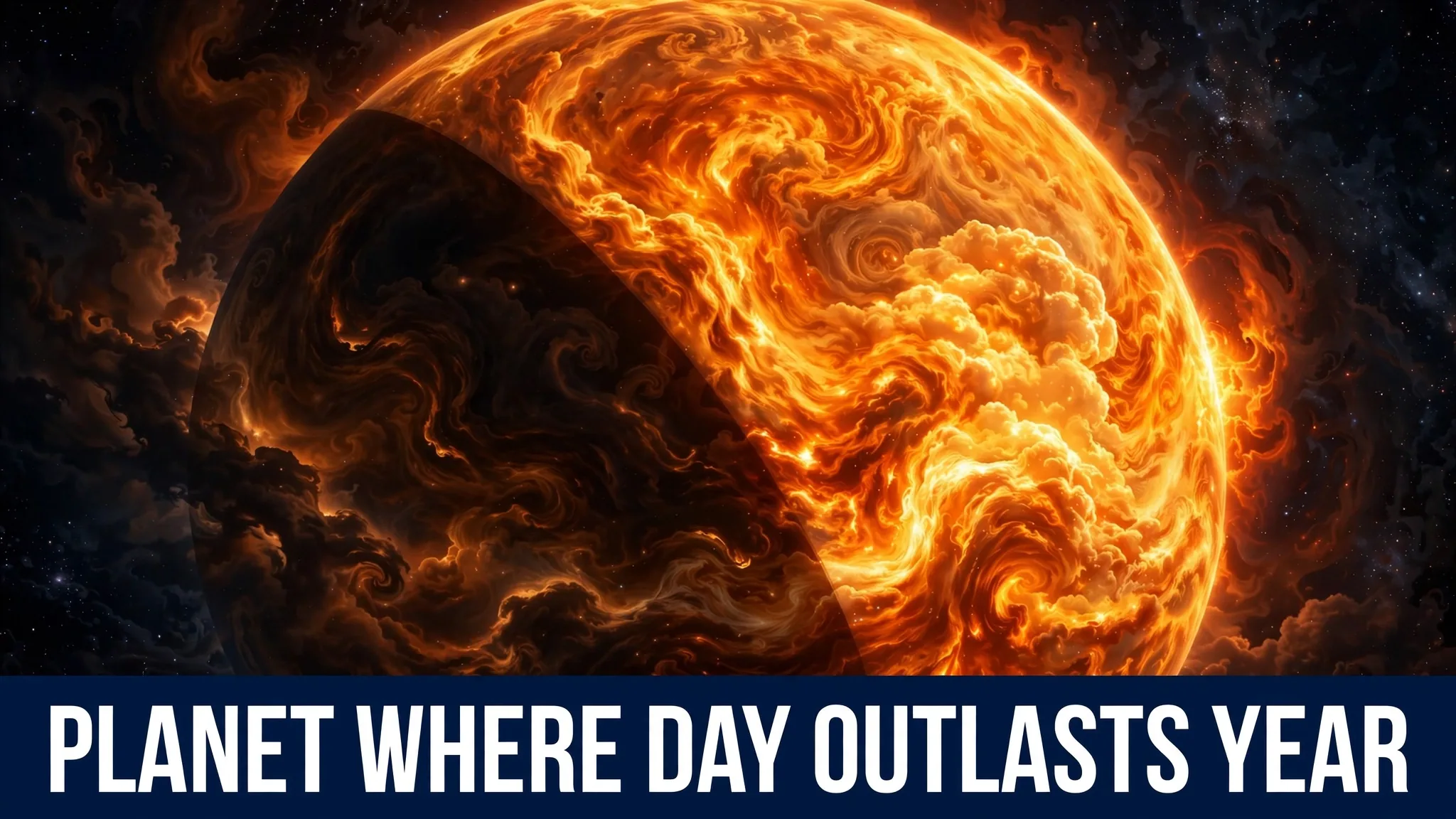
Planet Where Day Outlasts Year
In this post
- What Is a Year?
- What Is a Day?
- Which Planet Are We Talking About?
- How Hot Is It on Venus?
- Could You Stand There for One Minute?
- What Are the Two Numbers?
- Wait — Is There a Catch?
- Which Way Does Venus Spin?
- Where Does the Sun Rise on Venus?
- How Many Sunrises Fit in One Year?
- Why Does Venus Spin Backwards?
- Is the Spin Still Changing?
- Does Venus Have Seasons?
- Could Anyone Ever Watch a Venus Sunrise?
- Sources
Look at a clock. Now look at a calendar.
A clock counts the hours of one day. A calendar counts the days of one year. On Earth, the two tools agree with each other. One day is short. One year is long. A year holds about 365 days, and that feels normal to us.
But there is a planet where the clock and the calendar argue. On that planet, one single day lasts longer than a whole year. It sounds like a trick. It is not a trick.
Let us go one small step at a time. Slowly. The way a child learns to tell the time.
What Is a Year?
A year is a trip.
A planet travels around the Sun. One full trip is one year. Earth needs about 365 days for this trip. It is a long trip, because the Sun is far away and the path around it is huge.
A planet that sits closer to the Sun has a smaller path. A smaller path means a shorter trip. A shorter trip means a shorter year.
Hold on to that idea. A year is one trip around the Sun.
What Is a Day?
A day is a spin.
A planet turns, like a top turns. One full turn is one day. Earth turns fast, so one turn takes just 24 hours. We get a fresh morning every single day.
On Earth, the spin is quick. The trip is slow. That is why one year can hold so many days.
But what if a planet spins very, very slowly? What if the spin is even slower than the trip? Then the numbers stop behaving. And the strange part starts.
Which Planet Are We Talking About?
The planet is Venus.
Venus is our nearest neighbour in space, and the second planet from the Sun. People often call it the twin of Earth. Why? Because of its size. Venus is about 12,104 kilometres across. Earth is about 12,756 kilometres across. Nearly the same. Like two sisters.
But sisters can be very different people. And this sister keeps the oddest time in the whole solar system.
How Hot Is It on Venus?
Venus is the hottest planet of all.
The ground there sits at about 467 degrees Celsius. That is 872 degrees Fahrenheit. Think of lead — a heavy, hard metal. On Venus, lead would melt into puddles.
Why is it so hot? Blame the air. The air of Venus is mostly carbon dioxide, and it works like a thick blanket wrapped around the whole planet. Heat gets in. Heat cannot get out. So the heat just grows and grows.
And the clouds above are worse than the air below. They are not made of water. They are made of sulfuric acid. Even the rain on Venus would burn.
Could You Stand There for One Minute?
No. Not even for one minute.
The air would crush you. The pressure on the surface of Venus is about 93 times the air pressure at sea level on Earth. It is the same squeeze you would feel more than 3,000 feet under the sea.
Robots have tried to land there. The Soviet Union sent down its Venera probes. The strongest of them lasted only about two hours before the heat and pressure destroyed it.
So no person could ever stand on Venus. When this post asks you to picture yourself there, it is only a game of imagination. A pretend picture. Nothing more.
What Are the Two Numbers?
Now put the clock next to the calendar.
First, the trip. Venus sits close to the Sun, so its path is small and its year is short. One Venus year takes about 225 Earth days.
Next, the spin. Venus turns like a tired old top. One full spin takes about 243 Earth days.
Read those two numbers once more. Slowly.
The spin: 243 days. The trip: 225 days.
The spin takes longer than the trip. Venus completes a whole trip around the Sun — a whole year — and it still has not finished turning around even once. On Earth, one year holds about 365 days. On Venus, one year cannot hold even one full spin.
That is the whole secret, in plain words. On Venus, a day — one full spin — lasts longer than a year.
Wait — Is There a Catch?
Yes. There is a catch. The word “day” hides two different meanings.
Meaning one is the spin day: one complete turn of the planet. On Venus, that is the 243 Earth days we just counted.
Meaning two is the sunrise day: the time from one sunrise to the next sunrise. That is the day a person standing there would actually feel on their skin.
On Earth, the two meanings are almost the same — about 24 hours each — so we never notice any difference. On Venus, they split far apart.
Frankly, this is the part I have to read twice every time. The planet gives you sunrises faster than it gives you full turns, and both numbers are real at once.
Why does the sunrise come back sooner? The answer sits in the direction of the spin.
Which Way Does Venus Spin?
Venus spins backwards.
Almost every planet turns one way. Venus turns the opposite way, while still travelling forwards around the Sun. Scientists call this a retrograde spin.
Picture it like this. You are walking slowly around a campfire. At the same time, you are turning your own body — but you turn it the wrong way. Because you keep walking around the fire, the fire swings back in front of your face early. It returns before your body has finished one full turn.
Venus does the same thing with the Sun. Its backward spin and its forward trip work together. So the Sun comes back into its sky long before one full spin is done.
The result: from one sunrise to the next on Venus takes about 117 Earth days. Not 243. Only 117. A spin day still beats the year — but a sunrise day does not.
Where Does the Sun Rise on Venus?
Because the spin runs backwards, the sunrise is backwards too.
On Earth, the Sun rises in the east and sets in the west. On Venus, the Sun rises in the west and sets in the east. Exactly the wrong way round.
Imagine a morning there — only in imagination, remember. Light grows in the west. The Sun climbs, slowly, so slowly. Weeks pass, and it is still climbing. That is a Venus morning.
How Many Sunrises Fit in One Year?
Let us count, with the calendar in hand.
One Venus year is 225 Earth days. One sunrise day is about 117 Earth days. So a Venus year holds about two sunrises. Just two mornings. Just two evenings.
And in that same year, the planet has still not completed one single full turn. Two sunrises — but not one spin. On Venus, the clock and the calendar really do argue.
Why Does Venus Spin Backwards?
Nobody knows. Not for certain.
Encyclopaedia Britannica says it plainly: astronomers still have no fully satisfactory explanation for the way Venus rotates.
There is one famous idea, and it is a violent one. Long ago, Venus was young and still forming from rocky pieces. One of the largest of those pieces may have crashed straight into it. A hit that size could have knocked the young planet over, slowed its turning right down, or even reversed it.
It is a gripping idea, and plenty of scientists find it persuasive. But be careful with it: it is a theory. It is not a proven fact. Nobody watched it happen, and nobody has found final proof.
Other ideas point to gentler forces — the gravitational pull between Venus, Earth and the Sun, and the push and drag of Venus’s own heavy, moving air. The question is still open.
Is the Spin Still Changing?
Yes, a little — and scientists have measured it.
Measurements of the spin taken in 1990–92 were compared with measurements taken in 2006–08. The spin had slowed by about six and a half minutes between the two sets.
Six and a half minutes sounds like nothing. But it proves something important: Venus is not finished changing. Its slow turning is still being watched, still being measured, today.
Does Venus Have Seasons?
No, not really.
Earth leans on its axis as it spins, and that lean gives us spring, summer, autumn and winter. Venus barely leans at all. Its axial tilt is only about three degrees — far too small to make seasons.
So there is no spring to wait for. No autumn to cool things down. Just the same crushing heat, from one endless stretch of daylight to the next.
Could Anyone Ever Watch a Venus Sunrise?
Only inside the imagination. The real Venus would destroy any visitor long before sunrise — heat that melts lead, pressure like the deep sea, clouds of acid.
But imagination costs nothing, so picture it one last time: a world turning slower than it travels, the Sun rising in the west, about two mornings in a year, and a single day that refuses to end before the year does. Earth’s twin in size — and like nothing else we know when it comes to time.
Frequently Asked Questions
Does one day on Venus really last longer than one year there? Yes, if “day” means one full spin. Venus needs about 243 Earth days to turn once, yet only about 225 Earth days to travel around the Sun once, so the spin outlasts the year.
How much time passes between one sunrise and the next on Venus? About 117 Earth days. The backwards spin brings the Sun back sooner than a full turn would, so a Venus year holds roughly two sunrises.
Why does the Sun come up in the west on Venus? Because Venus rotates backwards compared with Earth and most other planets. A backwards spin flips the sunrise: up in the west, down in the east.
What made Venus turn backwards? Science does not have a settled answer. The most talked-about idea is a giant collision in the planet’s early days that tipped it over and slowed or reversed its spin — but that is still a theory, not a proven fact.
Could human beings ever live on the surface of Venus? No. The surface is hot enough to melt lead, the pressure is about 93 times Earth’s sea-level pressure, and the clouds are sulfuric acid. The longest any landed probe survived there was about two hours.
Sources
- NASA Science, “Venus: Facts”: https://science.nasa.gov/venus/venus-facts/
- NASA Space Place, “All About Venus”: https://spaceplace.nasa.gov/all-about-venus
- Encyclopaedia Britannica, “Venus”: https://www.britannica.com/place/Venus-planet
- The picture on this page is an original illustration made for Talha M Blog.