Probiotics vs Prebiotics: What Is the Difference
In this post
Probiotics and prebiotics sound almost identical, and they are often sold together, but they are not the same thing. The difference is simple once you know it: probiotics are live bacteria that are good for your gut, and prebiotics are the fibres that feed those bacteria. One is the garden, and the other is the fertiliser. You can have one without the other, but they work best together, and understanding the difference is the key to making good choices about food and supplements.
The confusion is understandable, because the two words are used interchangeably in marketing, and many products contain both. A yoghurt might be described as probiotic because it contains live cultures, and a fibre supplement might be described as prebiotic because it feeds gut bacteria. Both claims can be true, but they mean different things, and a person who buys a probiotic hoping it will feed their gut bacteria, or a prebiotic hoping it will replace them, is buying the wrong product for the wrong reason.
This article explains the difference clearly, what each one does, which foods contain them, when supplements help and when they do not, how to choose a product that is worth the money, and what the gut microbiome actually is. It is general information, not medical advice, and it is written to help you understand your gut without needing a science degree.
This article is general information only. It is not individual medical advice. Talk to your doctor before starting a supplement, especially if you are pregnant, take medicine, or have a digestive or immune condition.
Probiotics: The Live Bacteria in Your Gut
Probiotics are live microorganisms, usually bacteria, that are intended to benefit health when taken in adequate amounts. The word comes from the Latin pro, meaning for, and the Greek biotic, meaning life, and it describes bacteria that are good for you, rather than the ones that cause illness. The most common probiotic bacteria belong to two groups, Lactobacillus and Bifidobacterium, and different strains within those groups have different effects. The strain matters, because a probiotic that helps with one problem may not help with another.
Your gut is home to trillions of bacteria, fungi and other microorganisms, collectively known as the gut microbiome, and this community plays a large role in digestion, immunity and even mood. The microbiome helps break down food, produces vitamins such as vitamin K and some B vitamins, protects against harmful bacteria, and communicates with the immune system. When the microbiome is disrupted, by antibiotics, illness or a poor diet, digestion can suffer, and probiotics are sometimes used to help restore balance.
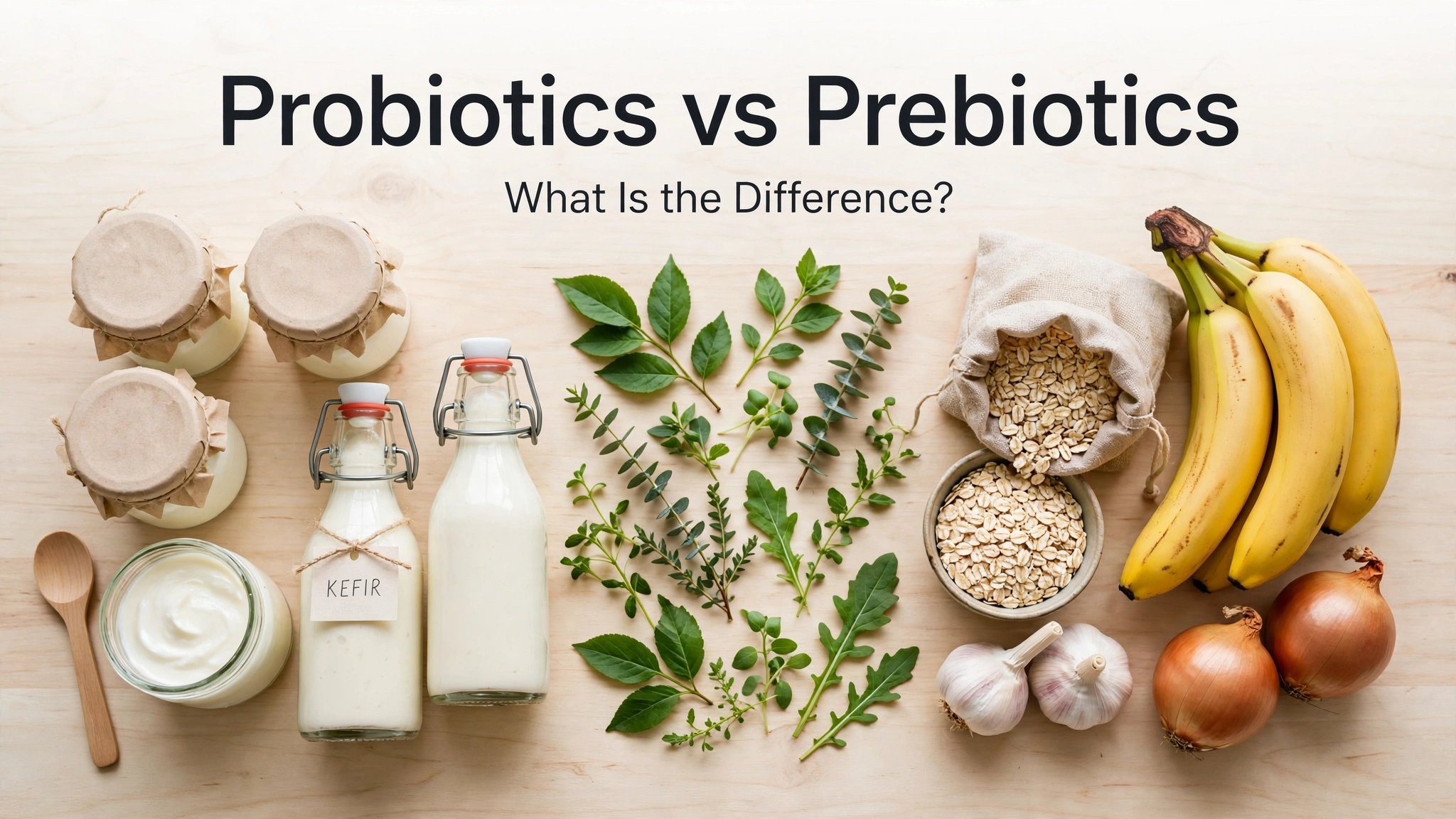
Probiotic foods have been eaten for thousands of years, long before anyone knew what bacteria were. Yoghurt, kefir, kimchi, sauerkraut, miso and kombucha are all fermented foods that contain live bacteria, and they have been part of traditional diets around the world. The bacteria in these foods are not identical to the strains in supplements, but they contribute to a diverse diet, and a diverse diet is one of the best things for the microbiome. Eating fermented foods regularly is a simple, food-first way to support gut health.
Prebiotics: The Fibre That Feeds Good Bacteria
Prebiotics are not bacteria at all. They are types of fibre that the human body cannot digest, but that gut bacteria can ferment and use as food. The most common prebiotics are inulin, fructooligosaccharides and galactooligosaccharides, and they are found in foods such as garlic, onions, leeks, asparagus, bananas, oats and Jerusalem artichokes. When you eat these foods, the fibre passes through the stomach and small intestine largely unchanged, and it reaches the colon, where gut bacteria break it down.
The process of fermentation produces short-chain fatty acids, especially butyrate, which nourish the cells lining the colon and help keep the gut barrier strong. A strong gut barrier is important because it prevents harmful substances from leaking into the bloodstream, and it supports the immune system. Prebiotics also encourage the growth of beneficial bacteria, particularly Bifidobacterium, and they can increase the diversity of the microbiome, which is generally a sign of a healthy gut.
The practical point is that prebiotics are food for the bacteria you already have, and they are one of the reasons a high-fibre diet is good for gut health. A person who eats a varied diet with plenty of vegetables, fruits, legumes and whole grains is already eating prebiotics every day, whether they know the word or not. A person who eats very little fibre is starving their gut bacteria, and no probiotic supplement can fully compensate for that. The fibre comes first, and the bacteria come second.
The Garden Analogy: Why You Need Both
The easiest way to remember the difference is to think of your gut as a garden. Probiotics are the seeds: live bacteria that you add to the garden in the hope that they will grow. Prebiotics are the fertiliser and the water: the food and the conditions that help the seeds grow and thrive. You can plant seeds in poor soil and they will struggle. You can fertilise an empty garden and nothing will grow. The best results come from doing both: adding good bacteria and feeding them well.
This analogy also explains why a probiotic supplement alone often disappoints. Most probiotic bacteria do not colonise the gut permanently. They pass through, they have effects while they are there, and then they are gone. That does not mean they are useless, but it does mean they are not a permanent fix. If the diet does not support them, if there is not enough fibre to feed them, they will not stay, and the benefit will fade when the supplement stops. A lasting change in gut health comes from a lasting change in diet, not from a bottle.
Synbiotics, products that contain both probiotics and prebiotics, are based on this idea, and they make sense in theory. The prebiotic is supposed to help the probiotic survive and grow, and the combination may be more effective than either alone. The evidence for synbiotics is still developing, and the quality of the products varies, but the logic is sound. The best synbiotic, however, is not a capsule. It is a meal that contains both fermented foods and fibre-rich vegetables, such as a bowl of kimchi with brown rice, or yoghurt with oats and banana.
Best Food Sources for Each
The best probiotic foods are fermented foods that contain live cultures. Yoghurt with live active cultures is the most familiar, and it is a good source of Lactobacillus and other bacteria. Kefir, a fermented milk drink, contains a wider range of bacteria and yeasts than yoghurt, and it is often better tolerated by people who are sensitive to dairy. Kimchi, the Korean fermented vegetable dish, sauerkraut, the German fermented cabbage, and miso, the Japanese fermented soybean paste, are all rich in live bacteria, and they add flavour and variety to a diet.
The best prebiotic foods are those rich in the fibres that gut bacteria love. Garlic and onions are among the richest sources, and they are used in cooking around the world. Leeks, asparagus and Jerusalem artichokes are also excellent, and they are worth trying if they are available. Bananas, especially slightly underripe ones, contain resistant starch that feeds gut bacteria, and oats, barley and whole grains provide beta-glucan and other fibres. Legumes such as lentils, chickpeas and beans are among the best prebiotic foods of all, because they are rich in fibre and they support a diverse microbiome.
The practical advice is to eat a variety of both, every day, rather than focusing on a single superfood. A diet that includes yoghurt or kefir, a fermented vegetable, and a range of fibre-rich plant foods will support the gut far better than any single product. Variety is the key, because different bacteria feed on different fibres, and a diverse diet supports a diverse microbiome. The goal is not to eat one perfect food. It is to eat many good foods, consistently, over time.
When Probiotics Actually Help
Probiotics are not a cure-all, but there are situations where the evidence is reasonably strong. The best evidence is for antibiotic-associated diarrhoea, where certain probiotic strains can reduce the risk of diarrhoea that occurs when antibiotics disrupt the gut microbiome. The evidence is also reasonable for infectious diarrhoea, for some types of irritable bowel syndrome, and for certain vaginal and urinary infections. In these cases, the benefit is modest, and the specific strain matters, so a general probiotic may not help.
The evidence is weaker for many of the other claims made for probiotics, including weight loss, mood, immunity and general wellbeing. Some studies suggest a benefit, but the results are inconsistent, and the effects are small. The gut-brain connection is real, and the microbiome does influence mood and behaviour, but the idea that a probiotic capsule can treat anxiety or depression is not supported by strong evidence. Anyone with a mental health condition should seek professional help, not a supplement.
It is also worth knowing that probiotics are not risk-free for everyone. People with a weakened immune system, people who are seriously ill, and premature babies should be cautious, because there have been rare cases of infection from probiotic bacteria. For healthy adults, probiotics are generally safe, but they can cause bloating and gas, especially when first started. The practical advice is to use probiotics for a specific, evidence-based reason, to choose a product with the right strain, and to talk to a doctor if you have a health condition.
How to Choose a Supplement That Is Worth It
Choosing a probiotic supplement is difficult, because the market is crowded and the labels are confusing. The first thing to look for is the strain, not just the genus. A label that says Lactobacillus is not specific enough. A label that says Lactobacillus rhamnosus GG, with the strain code, tells you exactly what you are getting, and it allows you to check whether that strain has been studied for your problem. If the label does not name the strain, the product is not worth buying.
The second thing to look for is the dose, measured in colony-forming units, or CFUs. Most studies use doses of between one billion and ten billion CFUs per day, and a product that provides far less than this is unlikely to help. More is not always better, and very high doses are not necessarily more effective, but a dose that is too low is a waste of money. The product should also state that the bacteria are live at the time of expiry, not just at the time of manufacture, because probiotics can die during storage.
Storage matters too. Some probiotics need to be refrigerated, and others are shelf-stable, and the label should say which. A product that has been stored badly may contain few live bacteria, even if the label promises billions. Choose a reputable brand, look for independent testing, and be sceptical of products that promise to treat many different conditions. A good probiotic is specific, it is well-labelled, and it is used for a reason. A bad one is vague, expensive and promising.
The Gut-Brain Connection: What We Know and What We Do Not
One of the most fascinating areas of gut research is the connection between the gut and the brain, often called the gut-brain axis. The gut and the brain communicate through nerves, hormones and immune signals, and the microbiome plays a part in that communication. Gut bacteria produce substances that can affect mood, stress and behaviour, and changes in the microbiome have been linked to conditions such as anxiety, depression and irritable bowel syndrome. This research is real, and it is one of the most exciting areas in medicine, but it is also very new, and it is often overstated.
The problem is that the connection is complex, and it works in both directions. Stress can change the microbiome, and the microbiome can affect stress, and it is difficult to know which comes first. Animal studies have shown dramatic effects, but human studies are smaller and less clear, and the idea that a probiotic can treat anxiety or depression is not supported by strong evidence. A person with a mental health condition should seek professional help, and a probiotic should not be seen as a treatment for it.
What is clear is that a healthy gut supports overall health, and that a varied, fibre-rich diet is good for both the gut and the brain. The foods that feed gut bacteria, such as vegetables, fruits, legumes and whole grains, are also the foods that support brain health, and the lifestyle factors that help the gut, such as sleep, exercise and stress management, also help the brain. The gut-brain connection is real, but the best way to support it is through the basics, not through a single supplement.
My Take:
I think the probiotics industry is one of the most confusing in all of health, because it takes a real and fascinating science and turns it into a shelf full of products that promise everything and prove very little. The real science is that the gut microbiome matters, that it affects digestion, immunity and mood, and that diet is the most important factor in shaping it. The marketing is that a single capsule can fix your gut, your mood, your weight and your immune system, and that is not true. I think people deserve to know the difference, because the confusion costs them money and it distracts them from the things that actually work.
What I find most useful is the garden analogy, because it makes the whole topic clear in a single image. Probiotics are the seeds, prebiotics are the fertiliser, and a garden needs both. I have seen many people who take a probiotic every day but eat almost no fibre, and they wonder why it does not work. The answer is that they are planting seeds in dry soil. The bacteria need food, and the food is fibre from vegetables, fruits, legumes and whole grains. That is not a complicated message, but it is the message that matters most, and it is the one that the supplement industry rarely emphasises, because fibre is cheap and it cannot be patented.
I am also sceptical about the strain issue, because it is where the industry is least honest. Most probiotic products do not name the strain, or they name a strain that has never been studied for the problem they claim to treat. That is like selling a medicine without saying which medicine it is. I think a product that does not name its strain is not worth buying, and I think the companies that do name their strains and that fund proper research deserve credit. The difference between a good probiotic and a bad one is not the price. It is the specificity, and specificity is what the consumer should look for.
The evidence for antibiotics is the part I find most convincing, because it is specific, it is practical, and it is based on a clear mechanism. Antibiotics kill bacteria, including the good ones, and a probiotic can help reduce the diarrhoea that follows. That is a real benefit, and it is one that doctors sometimes recommend. But I do not think that benefit justifies taking a probiotic every day for general health, because the evidence for general health is weak. I think probiotics should be used like a tool: for a specific job, for a specific time, and then stopped when the job is done.
I also think the food-first approach is the most sensible, because fermented foods and fibre-rich foods provide benefits that a capsule cannot. A bowl of yoghurt with oats and banana provides probiotics, prebiotics, protein, calcium and fibre in a single meal, and it costs far less than a supplement. Kimchi with rice, kefir with fruit, sauerkraut with a meal: these are foods that people have eaten for centuries, and they support the gut in a way that is natural and sustainable. I am not against supplements, but I think they should be the backup, not the main plan.
My honest opinion is that gut health is important, but it is not as mysterious as the marketing makes it seem. Eat a varied diet with plenty of fibre, include fermented foods, limit highly processed foods, take antibiotics only when necessary, and your gut will usually look after itself. If you have a digestive problem, see a doctor, because the cause may be something a probiotic cannot fix. And if you do take a probiotic, choose one with a named strain, a sensible dose, and a specific reason. That is the practical, honest approach, and it is the one I would recommend to anyone who asks me about probiotics.
Finally, I think the most important lesson from this topic is about how to read health claims. When a product promises to help with digestion, immunity, mood, weight and skin, all at once, it is almost certainly promising too much. Real treatments are specific, and they work for specific problems. Probiotics are a good example: they help with some things, they do not help with others, and the difference matters. Learning to ask which strain, which dose and which problem is a skill that will serve you well far beyond the probiotic shelf, and it is a skill worth developing.
I also think the gut-brain research is exciting, but I worry about how it is reported, because the headlines often promise more than the science delivers. When a study in mice shows that a probiotic reduces anxiety, the headline becomes that probiotics cure anxiety, and that is not what the study showed. I think people should be excited about this research, because it is genuinely interesting, but they should also be patient, because human studies take years, and the answers are not yet clear. The gut and the brain are connected, but the connection is complicated, and a single capsule is unlikely to fix it.
Antibiotics are the one place where probiotics have a clear, practical job, and it is worth naming it precisely. Antibiotics save lives, but they also disrupt the gut, and a probiotic taken during and after a course can reduce the risk of diarrhoea, which is a specific, evidence-based use. That is the kind of use worth discussing with a doctor or pharmacist, because the strain, the timing, and the dose all matter, and a random bottle from a shelf is not the same as a considered choice. It is not a reason to take a probiotic every day for the rest of your life, but it is a reason to know that probiotics exist, that they have a place in medicine, and that the place is narrower, and more useful, than the advertising suggests.
Feed your gut with fibre, include fermented foods, use probiotics for a specific reason, and stay sceptical of any product that promises to fix everything at once. A gut looked after that way rarely needs a miracle, because it already has what it needs.
Your gut will thank you for the fibre, the variety and the fermented foods far more than it will ever thank you for a capsule.
Frequently Asked Questions
What is the difference between probiotics and prebiotics?
Probiotics are live beneficial bacteria. Prebiotics are fibres that feed those bacteria. Probiotics add bacteria to the gut, and prebiotics feed the bacteria that are already there.
What foods are probiotics?
Yoghurt with live cultures, kefir, kimchi, sauerkraut, miso and kombucha are all probiotic foods that contain live bacteria.
What foods are prebiotics?
Garlic, onions, leeks, asparagus, bananas, oats, barley, lentils, chickpeas and beans are rich in prebiotic fibres.
Do probiotics help with diarrhoea from antibiotics?
Yes. Certain strains can reduce the risk of antibiotic-associated diarrhoea, and this is one of the best-supported uses of probiotics.
How do I choose a good probiotic supplement?
Look for a product that names the specific strain, provides a dose of at least one billion CFUs, states that the bacteria are live at expiry, and is from a reputable brand.
Are probiotics safe for everyone?
They are generally safe for healthy adults, but people with a weakened immune system or serious illness should talk to a doctor first, because there have been rare cases of infection.
Sources
- https://ods.od.nih.gov/factsheets/Probiotics-HealthProfessional/
- https://www.nhs.uk/live-well/eat-well/food-types/
- https://www.mayoclinic.org/healthy-lifestyle/nutrition-and-healthy-eating/expert-answers/probiotics/faq-20058065
- https://www.healthline.com/nutrition/probiotics-101
- https://medlineplus.gov/druginfo/natural/790.html