Rue McClanahan: The Life Story Behind the Golden Girls Star
In this post
- An Oklahoma Childhood and a Dream of Acting
- Broadway, Television, and the Long Road to Fame
- The Golden Girls and Blanche Devereaux
- Later Years, Broadway, and a Life of Advocacy
- A Quiet Goodbye and a Lasting Laugh
- What Her Life Still Means
- The Southern Belle Who Broke the Rules
- Mama’s Family, Soap Operas, and a Versatile Career
- A Friendship That Lasted Beyond the Show
- My Take:
Rue McClanahan played Blanche Devereaux, the flirtatious Southern belle of The Golden Girls, with a humour and a warmth that made audiences love her, even when Blanche was vain, selfish, or outrageous. She was a woman who could deliver a dirty joke with a smile, who could be sexy and funny at the same time, and who could make a room full of people laugh with a single look. She was not a shy actress. She was bold, she was confident, and she was unforgettable.
She was born in Oklahoma, and she grew up in a small town where she learned to be independent, to speak her mind, and to dream of a life on the stage. She studied acting in Oklahoma and in New York, she worked on Broadway, she appeared on television in the 1970s, and she became a star in her fifties, first as Vivian on Maude, and then as Blanche on The Golden Girls. She was a woman who worked hard for many years before fame found her, and she enjoyed every minute of it when it did.
What makes her story worth telling is the joy in it, and the way she played a woman who loved life, loved men, and loved herself, at an age when television rarely showed older women as sexy or funny. She was an actress who broke rules about age and about femininity, and she did it with a laugh. This is the story of a girl from Oklahoma who became one of the most beloved characters on American television.
An Oklahoma Childhood and a Dream of Acting
Eddi-Rue McClanahan was born on 21 February 1934 in Healdton, Oklahoma, a small town in the southern part of the state, and she grew up in Ardmore, Oklahoma, where her father worked as a building contractor and her mother was a homemaker. She was a lively and funny child, with a love of performing that showed itself early. She liked to make people laugh, she liked to dress up, and she liked to be the centre of attention in a friendly way. She was not a shy girl. She was a girl who knew what she wanted, and who was willing to work hard to get it.
She attended school in Ardmore, and she was a good student, though she was more interested in theatre, in music, and in ideas than in ordinary schoolwork. She took part in school plays, she sang in the choir, and she began to think seriously about a life in acting. She was a girl who liked to think, who liked to argue, and who liked to make people laugh with a dry and clever humour. She was not the most popular girl in school, and she did not try to be. She was herself, and she was comfortable with that, even when other people did not understand her.
After high school, she went to the University of Tulsa, where she studied drama and where she learned the techniques of acting. She was a serious student, and she worked hard at her craft, even when she was still a young woman. She later moved to New York to study acting, and she began to work in the theatre, taking small roles and learning from every production. She was in her early twenties, and she was starting a career in a hard and competitive world, but she was patient, she was determined, and she was willing to work hard.
She made her Broadway debut in the 1950s, and she began to work steadily in the theatre, appearing in plays and in musicals, and earning praise for her singing and her acting. She was not a traditional leading lady. She was a character actress with a strong voice and a warm presence, and she played women who were funny, complex, and a little bit outrageous. Directors noticed her, and audiences remembered her, even when her part was small. She was building a career, one role at a time, and she was learning how to make a character feel real.
Broadway, Television, and the Long Road to Fame
In the 1960s and 1970s, Rue McClanahan worked in the theatre in New York and in television, and she became known as a reliable and talented actress who could do comedy and drama. She appeared on Broadway in plays such as Jimmy Shine, and she worked in off-Broadway productions, where she learned how to work with a live audience and how to make a character grow night after night. She was a hard worker, and she was a quick learner, and she earned the respect of her fellow performers.
She also began to appear on television, where her relaxed and funny style worked very well. She appeared in soap operas, including Another World, where she played Caroline Johnson, and she learned how television worked, how to perform for a camera, and how to work with a crew. She was not yet a star, but she was learning, and she was building a reputation as an actress who could be relied upon to do a good job, no matter how small the part was. She was a woman who had been working for more than twenty years, and she was still waiting for the role that would make her famous.
In the 1970s, she was cast as Vivian Harmon in the television series Maude, playing the best friend of Maude Findlay, played by Bea Arthur. Vivian was a funny and warm woman, and Rue played her with a humour and a lightness that made audiences love her. She appeared on the show from 1973 to 1978, and she became known to millions of viewers across America. She was in her late thirties and early forties, and she was finally becoming a familiar face on television, after many years of hard work in the theatre.
She also appeared in other television shows during this period, including Mama’s Family, where she played Fran Crowley, and she continued to work in the theatre, where she felt most at home. She was a versatile actress, and she could play many different kinds of characters, from a Southern belle to a best friend to a mother. She was not a star who needed the spotlight. She was a worker who loved her craft, and who did it with joy and with professionalism.
The Golden Girls and Blanche Devereaux
In 1985, Rue McClanahan was cast as Blanche Devereaux in The Golden Girls, a television comedy about four older women sharing a house in Miami, Florida. Blanche was a flirtatious and vain Southern belle from Georgia, a woman who loved men, loved clothes, and loved herself, and who was funny, sexy, and a little bit outrageous. Rue played her with a humour and a warmth that made audiences love her, even when Blanche was selfish or vain. She was in her early fifties, and she was playing a woman who was still sexy, still funny, and still full of life, at an age when television rarely showed older women that way.
The show ran for seven seasons, from 1985 to 1992, and it became one of the most beloved comedies in television history, watched by millions of people around the world. Rue shared the stage with Bea Arthur as Dorothy, Betty White as Rose, and Estelle Getty as Sophia, and together they made a show that was funny, warm, and groundbreaking, because it featured four older women as the stars, women who were funny, who had love lives, and who were not afraid to be themselves. Rue was the flirtatious one, the one who told stories about her many boyfriends, and who made audiences laugh with her Southern charm and her bold humour.
She won an Emmy Award for Best Actress in a Comedy Series in 1987 for her work as Blanche, and she became known to a new generation as Blanche Devereaux, a role that would define the last part of her career. She was proud of the role, and she spoke about Blanche as a character who was fun to play, because she was free, she was confident, and she was not afraid to enjoy life. She played Blanche with a joy that came from her own personality, and she made the character feel real, not only a caricature of a Southern belle.
The show also changed the way older women were shown on television. Before The Golden Girls, older women were rarely the stars of a comedy, and they were rarely shown as sexy or funny. After the show, they were everywhere, and television began to reflect the real lives of older women in America. Rue was part of that change, and she was proud of it. She showed that a woman in her fifties and sixties could be funny, sexy, and full of life, and that she did not need to be young to be loved.
Later Years, Broadway, and a Life of Advocacy
After The Golden Girls ended in 1992, Rue McClanahan continued to work in television, in the theatre, and in film, and she remained a respected actress. She appeared in the spin-off series The Golden Palace, where she reprised her role as Blanche, and she appeared in guest roles on other television shows, where she brought her humour and her warmth to every part she played. She was in her sixties and seventies, and she was still working, still learning, and still making people laugh.
She also returned to Broadway, appearing in plays such as The Women and in other productions, where she showed that she was still a great stage actress. She was a woman who had started her career on Broadway, and she returned to it throughout her life, because she loved the feeling of a live audience and the chance to grow a character night after night. She was not a television star who had forgotten the theatre. She was a theatre actress who had become a television star, and she never forgot where she came from.
She was also known for her advocacy, especially for animal rights and for gay rights. She was a passionate supporter of animal welfare, and she worked with organisations that helped animals, including the Best Friends Animal Society, with her friend Betty White. She was also a supporter of gay rights, and she spoke out in favour of equality and acceptance, at a time when many people in Hollywood were afraid to do so. She was a woman who cared deeply about others, and who used her fame to help people and animals who needed her.
She was married six times, and she spoke honestly about her marriages, about the difficulties of balancing a demanding career with a personal life, and about the lessons she had learned. She had a son, Mark Bish, from her first marriage, and she was a devoted mother, though her career often kept her away from home. She was a woman who lived fully, who loved deeply, and who was not afraid to talk about her life with humour and honesty.
A Quiet Goodbye and a Lasting Laugh
Rue McClanahan died on 3 June 2010 in New York City, at the age of seventy-six, after suffering a stroke. Her death was mourned across America, and tributes came from actors, comedians, and ordinary viewers who had loved her work on Maude and on The Golden Girls. She was buried in Oklahoma, her home state, and her legacy was remembered in the many performances, shows, and causes she had left behind. She had been a Broadway actress, a television star, and an activist, and she had done it all with humour, warmth, and dignity.
She is remembered today as Blanche Devereaux, one of the most beloved characters in television history, and as a woman who changed how older women were shown on screen. She played a flirtatious Southern belle with a humour and a confidence that made audiences love her, and she showed that a woman in her fifties and sixties could be sexy, funny, and full of life. That lesson is still relevant today, when television often forgets older women.
Her influence can be seen in the work of actresses who admire her example, and in the many people who love The Golden Girls and who still watch it today. She showed that comedy could be bold, that a woman could be funny about sex and about love at any age, and that she did not need to be young to be loved. That is a legacy that does not fade, and it is why her name is still spoken with affection.
What Her Life Still Means
Rue McClanahan’s story matters because it shows that a woman can be funny, sexy, and strong at any age, and that she does not need to apologise for enjoying life. She played Blanche with a joy and a confidence that made audiences laugh, and she showed that older women are not only grandmothers in the background. They are people with full lives, with desires, with humour, and with stories to tell. That lesson is still relevant today, when Hollywood often forgets older actresses.
She is remembered for Blanche, for Vivian, for her Broadway work, and for her advocacy, but she is also remembered for the way she lived: with humour, with warmth, and with a deep love for life. She was a woman who made America laugh, and who made television better, and that is a legacy that does not fade.
The Southern Belle Who Broke the Rules
Rue McClanahan’s Blanche Devereaux is often remembered as a flirtatious Southern belle, but that description only tells part of the story, because Blanche was also a woman who broke rules about age, about sex, and about what an older woman could be on television. In the 1980s, television rarely showed women in their fifties and sixties as sexy, as funny about sex, or as confident about their desires. Blanche was all of those things, and Rue played her with a joy and a boldness that made audiences laugh, even when the jokes were a little bit naughty. She did not apologise for Blanche’s love life. She celebrated it, and she made it funny, and that celebration was a quiet revolution in how older women were portrayed.
Blanche’s stories about her many boyfriends, about her life in Georgia, and about her marriages were a staple of the show, and Rue delivered them with a Southern charm that made them feel like stories told by a friend, not like jokes written for a television show. She had grown up in Oklahoma, not in Georgia, but she understood the Southern belle, she understood the accent, the manners, and the humour, and she brought that understanding to the role. She was not mocking Southern women. She was celebrating them, showing that a Southern woman could be funny, sexy, and smart, all at the same time, and that she did not need to be young to be loved.
Her performance also showed that comedy about sex does not have to be cruel or mean. Blanche’s jokes were about her own life, about her own desires, and about her own mistakes, and she told them with a smile, not with bitterness. She was a woman who enjoyed life, who loved men, and who was not ashamed of that love, and Rue played her with a warmth that made the character feel real, not only a caricature. That warmth is why audiences loved Blanche, even when she was vain or selfish, because they saw a woman who was honest about who she was, and who was not afraid to enjoy herself.
In her later years, Rue spoke about Blanche with affection, and she said that playing her was one of the great joys of her life, because Blanche allowed her to be bold, to be funny, and to be free in a way that other roles had not. She was in her fifties and sixties when she played Blanche, and she was doing some of her best work, proving that a woman’s career does not end at fifty, and that her best roles can come late in life. That is a hopeful message for anyone who feels that their best years are behind them, and it is one reason Blanche remains such a beloved character today, long after The Golden Girls ended.
Mama’s Family, Soap Operas, and a Versatile Career
Rue McClanahan’s career was more versatile than many people realise, because she worked in soap operas, in sitcoms, on Broadway, and in film, and she brought the same humour and warmth to each kind of work. She appeared in Another World, a daytime soap opera, where she played Caroline Johnson, and she learned how to work quickly, how to memorise lines, and how to perform for a camera in a fast-paced environment. Soap operas are hard work, with long days and many scenes, and they teach an actor discipline, professionalism, and the ability to adapt. Rue learned those lessons, and she carried them with her to Maude and to The Golden Girls, where she was known for her preparation and her reliability.
She also appeared in Mama’s Family, where she played Fran Crowley, a funny and warm character, and she showed that she could play many different kinds of women, from a best friend to a mother to a Southern belle. She was not a one-note actress. She was a versatile performer, and she could do comedy, drama, and musical theatre, all with the same skill. That versatility is one reason her career lasted for more than fifty years, from Broadway in the 1950s to television in the 2010s, and it is one reason she is admired by other actors, who saw her as a professional who could do anything, and who did it with joy and with humour.
A Friendship That Lasted Beyond the Show
Rue McClanahan’s friendship with Betty White, her co-star on The Golden Girls, was one of the warmest in Hollywood, and it lasted long after the show ended. They shared a love of animals, they worked together on animal rights causes, and they supported each other through the ups and downs of a long career. They were not only colleagues who played friends on television. They were real friends, who laughed together, who helped each other, and who understood what it meant to be a woman in her sixties and seventies, still working, still funny, and still full of life. That friendship is a beautiful part of Rue’s story, and it shows that the warmth audiences saw on screen was real, not only acted. She was a friend, and she was loved, by her co-stars and by millions of viewers who felt as if they were part of that friendship too.
My Take:
I think Rue McClanahan’s story is one that makes me smile, and I think that smile is exactly what she gave to her audiences for more than fifty years. She played Blanche Devereaux, a flirtatious Southern belle who loved men, loved clothes, and loved herself, and she played her with a humour and a confidence that made audiences love her, even when Blanche was vain or outrageous. I admire that, because it takes courage to play a character who is sexy and funny at an age when television rarely shows older women that way. She did it, and she did it with joy, and she made it look easy.
What moves me most is how long she worked before she became famous. She started on Broadway in the 1950s, she worked in the theatre for twenty years, she appeared on television in the 1970s, and she was in her early fifties when The Golden Girls began. I think about what that must have felt like, to work hard for so many years, to be good at your job, and to not be recognised as a star. Most people would have given up, or they would have become bitter. She did not. She kept working, she kept learning, and she kept waiting for the right role. When Blanche finally came, she was ready, because she had spent thirty years preparing for it. That patience is a lesson I want to remember.
I love Blanche, because Blanche is a character who is unapologetically herself. She loves men, she loves to flirt, she loves to dress up, and she is not ashamed of any of it. I think that is a powerful thing to show on television, especially for an older woman. So many older women are shown as sweet grandmothers, or as background characters, but Blanche was the centre of the story, she was funny, she was sexy, and she was full of life. Rue played her with a Southern charm that made the character feel real, not only a caricature. She brought her own warmth and her own humour to the role, and it showed in every scene.
I also think about Vivian on Maude, and about how that role prepared her for Blanche. Vivian was a best friend, a funny and warm woman, and Rue played her with a lightness that made audiences love her. She learned how to work in a television comedy, how to work with Bea Arthur, and how to make a character funny without trying too hard. Those lessons helped her when she took on Blanche, a bigger and bolder role, and she was ready for it because she had already learned how to do it well. That is a reminder that every role, even a small one, can teach you something that you will use later.
Her advocacy also matters to me. She was a passionate supporter of animal rights, and she worked with Betty White and with the Best Friends Animal Society to help animals. She was also a supporter of gay rights, and she spoke out in favour of equality at a time when many people were afraid to do so. I think that shows a kindness and a courage that is easy to overlook when we talk about her comedy. She was not only a funny woman. She was a kind woman, and she cared deeply about people and animals who needed help. That generosity is part of her legacy, and it is one reason I admire her as a person.
What I learn from her is that you can be funny and sexy at any age, and that you do not need to apologise for enjoying life. She played Blanche with a joy that was infectious, and she showed that a woman in her fifties and sixties could be flirtatious, could be confident, and could be loved. I think we are often told that women should become quieter and more modest as they get older, but her life shows that you can become bolder, funnier, and more yourself as you age. That is a hopeful message, and it is one I want to remember.
I also learn from her that a career can be built on patience and on hard work. She worked for thirty years before she became a star, and she did it without giving up. She took small roles, she learned from every production, and she kept going, even when fame did not come quickly. That is a lesson for anyone who feels that success is taking too long. Keep working, keep learning, and keep being yourself, and the right role may come, even if it comes late. She proved that, and she proved it with a laugh.
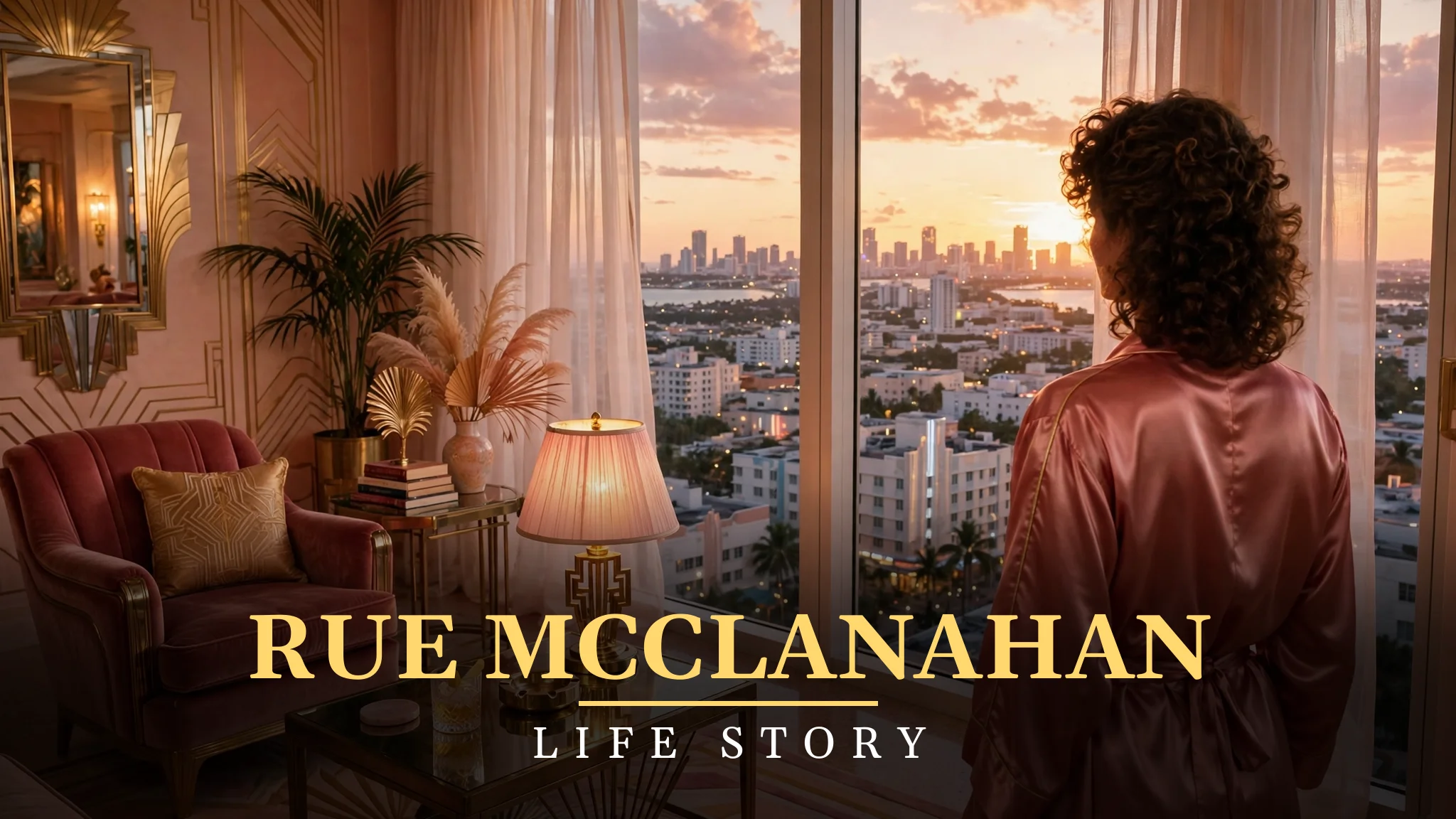
When I think of Rue McClanahan now, I think of a curly-haired woman in a pink satin robe, standing in an art-deco Miami apartment at sunset, looking out over the city. She is not performing. She is thinking, she is enjoying the moment, and she is at peace. That image stays with me, because it captures her warmth, her confidence, and her love of life. She was a woman who loved Miami, who loved her friends, and who loved to laugh, and that is a beautiful thing to remember.
I hope readers who meet her for the first time will watch The Golden Girls, and I hope they will watch Maude, and I hope they will learn about her Broadway work and her advocacy. I hope they will see that she was more than Blanche Devereaux. She was a great actress, a great friend, an activist, and a woman who lived her life with humour and with joy. That is why I think her story matters, and that is why I think it will still matter many years from now, when new generations are still laughing at Blanche’s stories.
In the end, I think Rue McClanahan teaches us to enjoy life, to laugh loudly, and to not be afraid of being ourselves, no matter how old we are. She enjoyed life, she laughed, and she was herself, and she left a legacy of laughter that is still felt today. I will remember her as Blanche, as Vivian, and as a woman who showed us that a Southern belle can be funny, sexy, and strong at any age. That is a life worth celebrating, and it is a life I am glad to have learned about.
I also think about how Rue McClanahan’s story connects to the way we think about Southern women on television today, and to how often they are shown as stereotypes, rather than as real people. Blanche was a stereotype in some ways, a flirtatious Southern belle, but Rue played her with a warmth and a intelligence that made her feel real, not only a caricature. She showed that a Southern woman could be funny, sexy, and smart, all at the same time, and that she did not need to be young to be loved. That is a powerful example for any actress who has been asked to play a stereotype, and it shows that a great performer can take a simple character and make her feel like a real person, with a full inner life.
Another thought that stays with me is her work in the theatre, and how she returned to Broadway throughout her life, even after she became a television star. She loved the stage, she loved the feeling of a live audience, and she believed that an actress should never stop learning. She appeared in plays in New York, she worked with younger actors, and she shared what she had learned about comedy, about timing, and about honesty. That dedication to the theatre is part of her legacy, and it is one reason I admire her as a person, not only as a television star. She was a theatre actress first, and she never forgot where she came from.
I also wonder what she would say to a young actress today who is funny, who is bold, and who is not sure if she will succeed. I think she would tell her to work hard, to be herself, to not be afraid to be sexy or funny, and to keep going, even when the roles are small and the pay is low. She would tell her to learn her craft, to listen to other actors, and to trust that her talent will be recognised, even if it takes a long time. She would tell her that a career is built one role at a time, and that every role, even a small one, can teach you something that you will use later. That advice is simple, but it is true, and it is advice I want to remember.
When I think of Rue now, I do not only think of Blanche. I think of a young girl in Oklahoma, dreaming of the stage, and of a woman in her seventies, still performing on Broadway, still making people laugh, and still loving her work. Those images, taken together, show a whole life, from a small town in Oklahoma to the bright lights of Broadway and television, and they show a woman who never gave up on her dream. That is a beautiful thing, and it is a legacy I will carry with me.
I hope that people who read her story will watch The Golden Girls, will learn about her Broadway work, and will understand that she was more than Blanche Devereaux. She was a great actress, a great friend, an activist, and a woman who lived her life with humour and with joy. Her life is proof that you can be funny and sexy at any age, and that you do not need to apologise for enjoying life. That is a legacy worth remembering, and a legacy I am glad to have learned about.
I also think about how Rue McClanahan’s versatility is a lesson for young actors, and for anyone who wants a long career in any field. She worked in soap operas, in sitcoms, on Broadway, and in film, and she did each kind of work with the same professionalism and the same joy. She did not limit herself to one kind of role, and she did not turn down work because it was not glamorous. She took the work, she learned from it, and she used it to grow as an actress. That willingness to do many different kinds of work, to learn from each one, is a powerful example, and it is one reason her career lasted for more than fifty years. She was a worker, and she was proud of it.
I also want to remember her as a friend, because that part of her story is often overlooked when we focus on her roles. She was a close friend of Betty White, and they worked together on The Golden Girls and on animal rights causes, and they supported each other through the ups and downs of a long career. She was also a friend to many other actors, who remembered her as warm, funny, and generous. That friendship, that willingness to support others, is a mark of a great person, not only a great performer. She was kind, she was funny, and she cared deeply about the people around her, and that caring is part of why she was loved by so many people.
I also think about the way she is remembered today, and how often people who watch The Golden Girls still talk about Blanche, still laugh at her stories, and still feel as if they know her. That kind of lasting fame is rare, and it is a testament to the quality of her work and to the joy she brought to millions of people. She made America laugh, and America has never forgotten her, and that is a legacy worth celebrating.
I also think about how Rue McClanahan’s friendship with Betty White is remembered today, and how often people who watch The Golden Girls still talk about the chemistry between the four women, as if they were real friends, not only actors playing a part. That chemistry was real, because the actresses liked each other, respected each other, and enjoyed working together, and that enjoyment showed on screen. Rue was a central part of that friendship, with her warmth, her humour, and her generosity, and she helped make the show feel like a family, not only a workplace. That is a rare gift, and it is one reason The Golden Girls is still loved today, long after it ended.
Frequently Asked Questions
What role did Rue McClanahan play in The Golden Girls?
In The Golden Girls from 1985 to 1992, Rue McClanahan played Blanche Devereaux, a flirtatious Southern belle from Georgia who lives in Miami with her friends Dorothy, Rose, and Sophia. Blanche loved men, clothes, and herself, and she was funny, sexy, and a little bit outrageous. Rue won an Emmy Award in 1987 for her work as Blanche.
How did Rue McClanahan become famous before The Golden Girls?
She became known as Vivian Harmon in the television series Maude from 1973 to 1978, playing the best friend of Maude Findlay, played by Bea Arthur. Before that, she worked on Broadway and in soap operas including Another World. Her long stage and television career prepared her for the role of Blanche in her early fifties.
Did Rue McClanahan work on Broadway?
Yes, she made her Broadway debut in the 1950s and appeared in plays including Jimmy Shine, and she returned to Broadway throughout her life, including in The Women. She was a theatre actress first, and she loved the feeling of a live audience. Her stage work gave her the skills she later used on television.
What advocacy was Rue McClanahan known for?
She was known for her support of animal rights, working with organisations including the Best Friends Animal Society, alongside her friend Betty White. She was also a supporter of gay rights, speaking out in favour of equality and acceptance at a time when many in Hollywood were afraid to do so. She used her fame to help people and animals.
Was Rue McClanahan married, and did she have children?
She was married six times, and she spoke honestly about her marriages and about the lessons she had learned. She had a son, Mark Bish, from her first marriage, and she was a devoted mother, though her career often kept her away from home. She lived fully and loved deeply throughout her life.
When did Rue McClanahan die?
Rue McClanahan was born on 21 February 1934 in Healdton, Oklahoma, and she died on 3 June 2010 in New York City, at the age of seventy-six, after suffering a stroke. She had been a Broadway actress, a television star on Maude and The Golden Girls, and an activist, and she is remembered as Blanche Devereaux.


