Betty White: The Life Story Behind the TV's Beloved Star
In this post
- An Oak Park Childhood and a Love of Animals
- Radio, Early Television, and Life with Elizabeth
- The Mary Tyler Moore Show and Sue Ann Nivens
- The Golden Girls and Rose Nylund
- Hot in Cleveland and a Second Wind in Her Nineties
- What Her Life Still Means
- A Life in Service to Animals
- The Saturday Night Live Moment at Eighty-Eight
- My Take:
Betty White was America’s sweetheart for more than eighty years, and she earned that title by being kind, funny, and endlessly hardworking. She began her career in radio in the 1930s, she became a television star in the 1950s, and she was still making people laugh in her nineties, in Hot in Cleveland and in commercials that introduced her to a new generation. She was not a star who faded away. She was a star who kept growing, kept learning, and kept making people happy, decade after decade.
She was born in Illinois, and she grew up in California in a family where she learned to love animals, to love performing, and to work hard. She wanted to be a park ranger, she wanted to be a singer, and she became a television pioneer instead, hosting her own show, producing her own programmes, and breaking rules about what women could do on television. She was a woman who did not wait for permission. She made her own opportunities, and she shared them with others.
What makes her story worth telling is the length of it, and the joy in it. She lived for ninety-nine years, she worked for more than eighty of them, and she did it with a smile that never seemed forced. She loved animals, she loved people, and she loved to make them laugh. This is the story of a woman who became a legend by being herself, kindly and funny, for almost a century.
An Oak Park Childhood and a Love of Animals
Betty Marion White was born on 17 January 1922 in Oak Park, Illinois, a suburb of Chicago, and she grew up in Los Angeles, California, after her family moved there when she was still a young child. Her father, Horace White, worked as a travelling salesman, and her mother, Tess, was a homemaker. The family lived a comfortable and happy life, and Betty grew up in a home where she was encouraged to be curious, to be kind, and to follow her interests. She was an only child, and she was loved deeply by her parents, who supported her dreams even when they seemed unusual.
She loved animals from a very young age, and she often said that she wanted to work with animals when she grew up. She visited the zoo, she played with pets, and she dreamed of becoming a park ranger, a job that was not open to women at the time. She was disappointed when she learned that she could not become a ranger, but she did not give up her love of animals. She kept that love for the rest of her life, and she became one of the most famous animal advocates in America, working with zoos, with animal charities, and with organisations that protected wildlife.
She attended school in Los Angeles, where she was a good student and where she discovered a love for performing. She took part in school plays, she sang, and she wrote for the school newspaper. She was a bright and funny girl, with a quick wit and a warm personality, and teachers noticed her talent. She graduated from Beverly Hills High School in 1939, and she began to think seriously about a career in entertainment, even though the world was about to change with the Second World War.
When the war began, she volunteered for the American Women’s Voluntary Services, driving trucks and helping with the war effort, and she learned about service, about hard work, and about helping others. She was a young woman who wanted to contribute, and she did, in a practical and direct way. That experience of service stayed with her, and it shaped the way she lived her life, with a sense of duty and a willingness to help, whether it was people or animals who needed her.
Radio, Early Television, and Life with Elizabeth
Betty White began her career in radio in the late 1930s and 1940s, working as a singer and as a performer on radio shows in Los Angeles. Radio was a popular medium at the time, and it taught her how to use her voice, how to tell a story, and how to make an audience laugh without being seen. She was a natural performer, with a warm voice and a quick wit, and she became known in the radio world as a reliable and talented young woman who could do many different kinds of work.
When television began to grow in the late 1940s and early 1950s, Betty was one of the first performers to embrace it. She appeared on television shows, she hosted programmes, and she learned how the new medium worked. In 1953, she starred in her own sitcom, Life with Elizabeth, where she played Elizabeth, a young wife, and she also served as a producer on the show, making her one of the first women to produce a television sitcom. That was a remarkable achievement in the 1950s, when women were rarely given that kind of power in television, and it showed that Betty was not only a performer. She was a businesswoman, and she understood how television worked.
Life with Elizabeth ran for two seasons, and it made Betty a familiar face in American homes. She was funny, she was warm, and she was natural on camera, and audiences loved her. She also hosted a talk show, The Betty White Show, and she appeared on game shows, on variety shows, and on other programmes, becoming one of the most visible women on early television. She was a pioneer, and she was doing it all with a smile and with a professionalism that earned her the respect of her fellow performers.
She married Allen Ludden, a television host, in 1963, after having been married twice before, and their marriage lasted until his death in 1981. Allen was the love of her life, and she spoke about him with great affection for the rest of her life. She did not remarry after his death, and she often said that he was the one, and that she did not need another husband. Their marriage was a partnership built on love, on humour, and on mutual respect, and it gave her a foundation that supported her through the ups and downs of a long career.
The Mary Tyler Moore Show and Sue Ann Nivens
In the 1970s, Betty White joined the cast of The Mary Tyler Moore Show, playing Sue Ann Nivens, the host of a cooking show called The Happy Homemaker, a woman who was sweet and cheerful on camera and sharp and competitive off camera. The role was perfect for her, because it allowed her to play a character who was both funny and a little bit naughty, a woman who was not as innocent as she seemed. She played Sue Ann with a wit and a timing that made audiences laugh, and she won Emmy Awards for her work on the show.
Sue Ann was a character who could be sweet one moment and scheming the next, and Betty played her with a skill that came from decades of experience in television. She was in her fifties, and she was playing a woman who was still flirtatious, still ambitious, and still funny, and she did it with a joy that made the character unforgettable. She was not a background actress. She was a star, and she shared the stage with Mary Tyler Moore and the rest of the cast as an equal, in a show that is still regarded as one of the best comedies in television history.
The show ran from 1970 to 1977, and Betty’s work on it earned her two Emmy Awards, and it introduced her to a new generation of viewers who had not seen her early television work. She was a woman who had been on television since the 1950s, and she was still doing great work in the 1970s, still learning, and still making people laugh. She was not a star who had faded. She was a star who had grown, and who had found a new role that suited her perfectly.
She also appeared on other television shows during this period, including game shows, where she was a frequent guest, and she became known as a witty and charming panellist. She was a familiar face on television, and she was loved for her humour, her warmth, and her ability to make people laugh without trying too hard. She was a performer who had been working for more than thirty years, and she was still at the top of her game.
The Golden Girls and Rose Nylund
In 1985, Betty White was cast as Rose Nylund in The Golden Girls, a television comedy about four older women sharing a house in Miami, Florida. Rose was a sweet and naive woman from St. Olaf, Minnesota, who told long and funny stories about her hometown, and who was kind, optimistic, and a little bit confused by the modern world. Betty played her with a warmth and a humour that made audiences love her, and Rose became one of the most beloved characters in television history.
The show ran for seven seasons, from 1985 to 1992, and it became a sensation, watched by millions of people around the world. Betty shared the stage with Bea Arthur as Dorothy, Rue McClanahan as Blanche, and Estelle Getty as Sophia, and together they made a show that was funny, warm, and groundbreaking, because it featured four older women as the stars, women who were funny, who had love lives, and who were not afraid to be themselves. Betty was the sweetest of the four, and she played Rose with a innocence that was both funny and touching.
She won an Emmy Award for her work on the show, and she became known to a new generation as Rose, a role that would define the last part of her career. She was in her sixties when the show began, and she was still making people laugh, still working hard, and still proving that a woman could be a star at any age. She was not a young star. She was a great star, and she was doing some of her best work in her sixties and seventies.
After The Golden Girls ended, she continued to work in television, appearing in guest roles, in voice work for animated films, and in other shows. She was a familiar and loved figure, and she was honoured with awards for her work, including a Screen Actors Guild Lifetime Achievement Award and a Grammy Award for her audiobook. She was a legend, and she was treated as one, but she remained humble, funny, and warm, and she never forgot where she came from.
Hot in Cleveland and a Second Wind in Her Nineties
In 2010, when Betty White was eighty-eight years old, she was cast in the television series Hot in Cleveland, playing Elka Ostrovsky, a sharp-tongued caretaker with a mysterious past. The role was a surprise, because Elka was not sweet like Rose. She was sarcastic, funny, and a little bit naughty, and Betty played her with a wit and a timing that made audiences laugh. The show ran for six seasons, from 2010 to 2015, and it introduced Betty to a new generation of young viewers who had not seen her earlier work.
Her appearance on Saturday Night Live in 2010, when she was eighty-eight, also became a major event, after a campaign on social media called for her to host the show. She hosted with humour and grace, and her performance was praised, and it showed that she was still a great comedian, even in her late eighties. She was not a star who had retired. She was a star who was still working, still learning, and still making people laugh, and she was doing it with a joy that inspired everyone who watched her.
She continued to work in her nineties, appearing in commercials, in voice roles, and in television specials, and she remained a beloved figure in American life. She was honoured with a star on the Hollywood Walk of Fame, she was given a day in her honour, and she was celebrated as a national treasure. She was a woman who had worked for more than eighty years, from radio in the 1930s to television in the 2010s, and she had done it with a smile that never faded.
She died on 31 December 2021 in Los Angeles, California, at the age of ninety-nine, only a few weeks before her hundredth birthday. Her death was mourned across America and around the world, and tributes came from actors, comedians, animal lovers, and ordinary people who had grown up watching her shows. She was buried in California, and her legacy was remembered in the many television shows, films, and animal welfare efforts she had left behind. She had lived for almost a century, and she had spent most of it making people happy.
What Her Life Still Means
Betty White is remembered today as one of the greatest television stars in American history, and as a woman who worked for more than eighty years, from radio to television to the age of streaming. She played Elizabeth, Sue Ann, Rose, and Elka, and each role was different, yet each one showed her warmth, her humour, and her talent. She showed that a woman could be funny, kind, and successful at any age, and that a career could last for a lifetime if you kept working and kept learning.
Her influence can be seen in the work of comedians who admire her example, and in the many people who love animals because she taught them to care. She was a passionate advocate for animal welfare, working with zoos and with charities, and she used her fame to help animals who could not speak for themselves. That legacy is as important as her television work, and it shows that she was not only a funny woman. She was a kind woman, and she cared deeply about the world around her.
She is remembered for Rose Nylund, for Sue Ann Nivens, for Hot in Cleveland, and for her love of animals, but she is also remembered for the way she lived: with humour, with kindness, and with a deep love for her work and her audience. She was a woman who made America laugh for almost a century, and that is a legacy that does not fade.
A Life in Service to Animals
Betty White’s love of animals was not a hobby. It was a central part of her life, and it shaped her career, her choices, and her legacy in ways that are still felt today. She had wanted to be a park ranger as a young girl, and when she learned that women could not do that job at the time, she did not give up her love of animals. She found other ways to work with them, through zoos, through charities, and through her own advocacy, and she became one of the most famous animal lovers in America. She worked with the Los Angeles Zoo, she served on its board, and she helped raise money for animal care and for conservation, and she did it for decades, not only for a short time.
She also worked with the Morris Animal Foundation, with the Best Friends Animal Society, and with many other organisations that protected animals, and she used her fame to bring attention to their work. She appeared in commercials for animal charities, she spoke at events, and she donated her time and her money to help animals who needed care. She was not a celebrity who lent her name to a cause for a single photo. She was a person who cared deeply, who visited zoos, who knew the animals by name, and who worked hard to improve their lives. That dedication is rare, and it is one reason she is admired by animal lovers around the world.
Her love of animals also showed in her personal life. She had pets throughout her life, including dogs, and she spoke about them with affection and with humour. She said that animals were honest, that they did not judge, and that they loved unconditionally, and she believed that people could learn a great deal from them. She was a vegetarian, and she spoke about the importance of treating animals with kindness, not only in zoos, but in farms, in homes, and in the wild. She was a voice for creatures who could not speak for themselves, and she used that voice with generosity and with passion.
In her later years, she continued to work for animals, even when she was in her nineties, and she remained a trustee of the Greater Los Angeles Zoo Association, a role she took seriously. She attended meetings, she raised money, and she spoke about the importance of conservation, even when her health was fragile. She was a woman who had worked for more than eighty years in entertainment, and who had spent much of that time working for animals as well, and that dual legacy, as a television star and as an animal advocate, is one that should be remembered together. She made people laugh, and she made the world a better place for animals, and both of those things matter.
The Saturday Night Live Moment at Eighty-Eight
Betty White’s appearance as host of Saturday Night Live in 2010, when she was eighty-eight years old, is one of the most joyful moments in television history, and it deserves to be remembered, because it showed that a woman in her late eighties could still be funny, still be relevant, and still be loved by a young audience. The campaign to get her to host the show began on social media, where young fans who had grown up watching The Golden Girls asked for her to be given the chance, and the show’s producers listened. She hosted with humour, with grace, and with a timing that made audiences laugh, and her performance was praised by critics and by viewers, who saw that she was not a relic from the past. She was a living, funny, and talented performer, who had been working for more than seventy years and who was still at the top of her game.
That moment also showed the power of social media to bring people together, and to give a voice to fans who wanted to see a beloved star honoured. It was not a network executive who decided to give Betty the show. It was the fans, who organised, who campaigned, and who made their voices heard, and the network listened. That is a beautiful story, and it is a reminder that audiences have power, and that they can use it to celebrate the people they love. Betty was grateful for the chance, she enjoyed every minute of it, and she proved, once again, that age is not a barrier to doing great work, and that a funny woman can be funny at any age.
My Take:
I think Betty White’s story is one that makes me feel happy, and I think that happiness is exactly what she gave to the world for more than eighty years. She was kind, she was funny, and she was hardworking, and she did it all with a smile that never seemed forced. I admire her deeply, because she was a woman who loved her work, who loved animals, who loved people, and who kept going, decade after decade, without ever losing her joy. That is a rare thing, and it is worth celebrating.
What moves me most is how long her career lasted. She started in radio in the 1930s, she became a television star in the 1950s, she won Emmys in the 1970s, she became Rose in the 1980s, and she was still starring in Hot in Cleveland in her nineties. I try to imagine what that means, to work for more than eighty years, to live through the rise of radio, the rise of television, the rise of cable, and the rise of streaming, and to still be relevant in each era. That is not luck. That is hard work, adaptability, and a willingness to keep learning. She did not stop, and she did not become bitter. She kept going, and she kept growing, and she kept making people laugh.
I love Rose Nylund, because Rose is a character who is sweet, naive, and kind, and who tells long stories about St. Olaf that make everyone laugh. Betty played her with a warmth that made Rose feel like a real person, not only a character in a comedy. I think that performance works because Betty understood Rose. She understood what it means to be kind, to be optimistic, and to see the good in people, even when the world is complicated. She brought that understanding to the role, and it showed in every scene. Rose is not a simple character. She is a woman who loves deeply, who trusts people, and who is funny because she is honest. Betty played her perfectly.
I also love Sue Ann Nivens, because Sue Ann is the opposite of Rose. Sue Ann is sweet on camera and sharp off camera, and Betty played that duality with a wit that made audiences laugh. I think that role showed her range as an actress, and it showed that she could play a character who was not only sweet. She could play a woman who was ambitious, who was competitive, and who was funny in a different way. That range is remarkable, and it is one reason her career lasted so long. She was not a one-note actress. She was a great actress, and she could do many different kinds of comedy.
Her love of animals also matters to me deeply. She wanted to be a park ranger when she was young, and she was disappointed when she learned that women could not do that job at the time. She did not give up her love of animals. She kept it, and she became one of the most famous animal advocates in America, working with zoos, with charities, and with organisations that protected wildlife. I think that shows a kindness that is easy to overlook when we talk about her television work. She was not only a funny woman. She was a kind woman, and she cared deeply about creatures who could not speak for themselves. That generosity is part of her legacy, and it is one reason I admire her as a person.
I am also struck by her marriage to Allen Ludden, and by the way she spoke about him after his death. She said that he was the one, and that she did not need another husband, and she lived the rest of her life without remarrying, carrying his memory with her. I think that is a beautiful kind of love, a love that lasts even after death, and it tells me something about her loyalty and her depth. She was not a woman who moved quickly from one relationship to another. She loved deeply, and she honoured that love for the rest of her life. That is a rare and beautiful thing.
What I learn from her is that kindness and humour can go together, and that they can last for a lifetime. She was kind to her cast, she was kind to her audience, and she was kind to animals, and she was funny in a way that made people feel good, not bad. I think we need more comedy like hers today, comedy that is warm, that is generous, and that makes us laugh without making us feel angry or divided. She showed us how to do that, and her example is still there for us to learn from.
I also learn from her that it is never too late to have a second wind. She was eighty-eight when she hosted Saturday Night Live, and she was eighty-eight when Hot in Cleveland began, and she did some of her best work in her nineties. I think that is a hopeful message for anyone who feels that their best years are behind them. Your best years can be ahead of you, if you keep going, keep learning, and keep sharing what you love with others. She proved that, and she proved it with a smile.
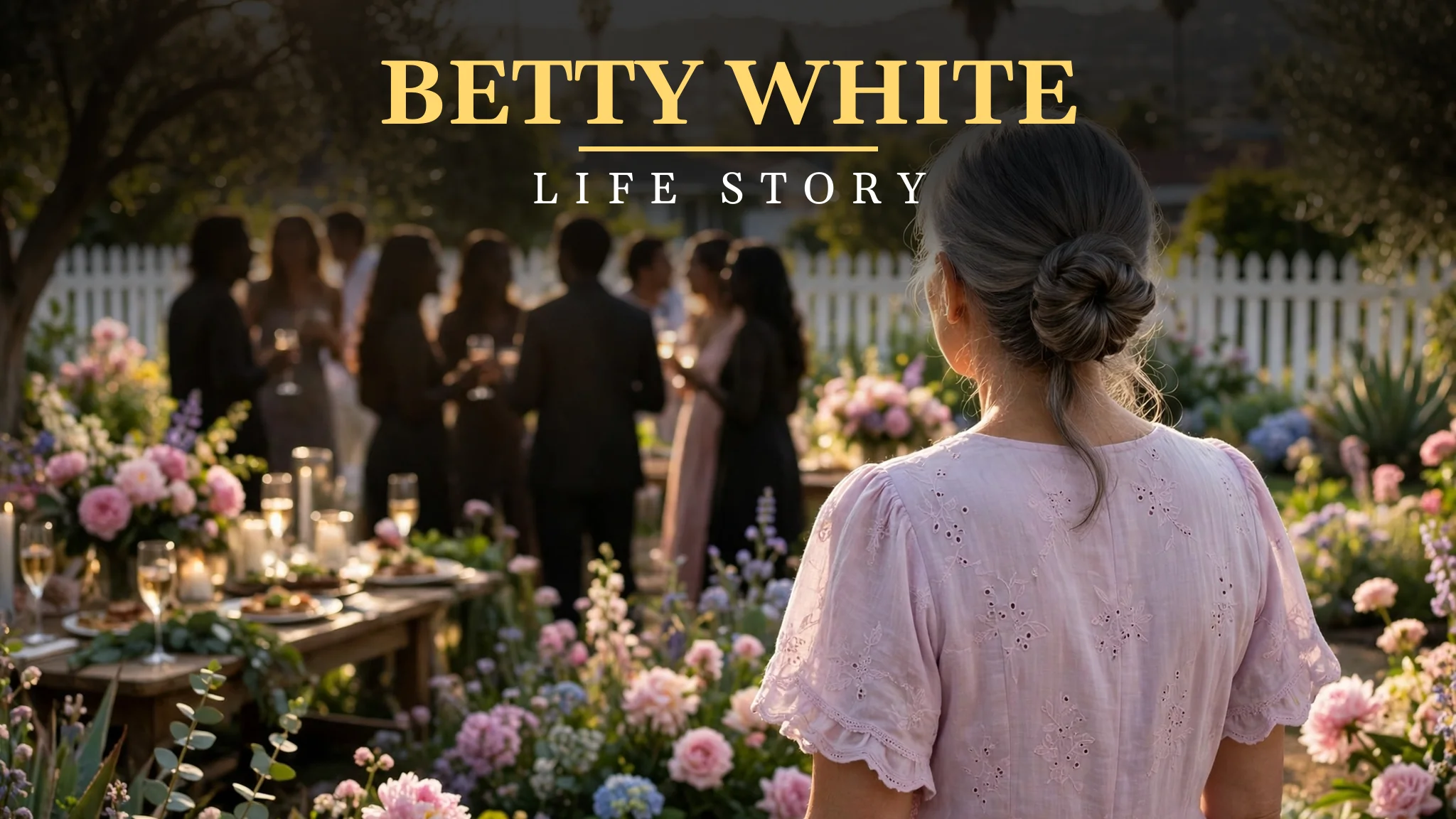
When I think of Betty White now, I think of an older woman in a pale pink dress, standing in a sunny garden party among pink flowers, with guests around her and a white picket fence behind her. She is smiling, she is happy, and she is enjoying the moment. That image stays with me, because it captures her warmth, her joy, and her love of life. She was a woman who made a garden party feel like a celebration, and who made a television show feel like a family gathering. That is a gift, and it is a gift I will remember.
I hope readers who meet her for the first time will watch The Golden Girls, and I hope they will watch The Mary Tyler Moore Show, and I hope they will watch Hot in Cleveland, and I hope they will learn about her work for animals. I hope they will see that she was more than Rose Nylund. She was a pioneer, a producer, an animal advocate, and a woman who worked for more than eighty years and who never lost her smile. That is why I think her story matters, and that is why I think it will still matter many years from now, when new generations are still laughing at Rose’s stories about St. Olaf.
In the end, I think Betty White teaches us to be kind, to be funny, and to keep going, no matter how old we are. She was kind, she was funny, and she kept going for almost a century, and she left a legacy of laughter and love that is still felt today. I will remember her as Rose, as Sue Ann, as Elka, and as a woman who showed us that a long life, lived with humour and kindness, is a life well lived. That is a life worth celebrating, and it is a life I am glad to have learned about.
I also think about how Betty White’s story connects to the way we think about ageing today, and to how often older people are treated as if they have nothing left to offer. She proved, again and again, that an older person can be funny, smart, and relevant, and that a career does not have to end at sixty or seventy. She was eighty-eight when she hosted Saturday Night Live, and she was eighty-eight when Hot in Cleveland began, and she did some of her best work in her nineties. I think that is a powerful message for anyone who feels that they are too old to start something new, or too old to be noticed. You are never too old, if you keep learning, keep working, and keep sharing what you love.
Another thought that stays with me is her friendship with other Golden Girls, especially Bea Arthur and Rue McClanahan, and the way those friendships lasted long after the show ended. They were not only colleagues. They were friends, they supported each other, and they laughed together, even when they disagreed. I think that friendship is part of why The Golden Girls worked so well, because the chemistry between the four women was real, and audiences could feel it. Betty was the sweetest of the four, but she was also a strong and funny woman, and she held her own alongside three other great actresses. That generosity, that willingness to share the stage, is a mark of a great performer, and it is one reason I admire her so much.
I also wonder what she would say to a young person today who wants to work with animals, or who wants to be a performer, or who wants to do both. I think she would tell them to follow their heart, to work hard, and to not give up when things get hard. She would tell them to be kind, to be funny, and to keep learning, and to remember that a long career is built one day at a time, not in a single moment. She would tell them that it is okay to be different, to love animals, to love performing, and to do both, if that is what makes you happy. That advice is simple, but it is true, and it is advice I want to remember.
When I think of Betty now, I do not only think of Rose. I think of a young girl visiting the zoo, dreaming of becoming a park ranger, and of a woman in her nineties, still working for animals, still making people laugh, and still smiling. Those images, taken together, show a whole life, from a childhood dream to a lifetime of work, and they show a woman who never gave up on what she loved. That is a beautiful thing, and it is a legacy I will carry with me long after I finish writing about her.
I hope that people who read her story will watch her shows, will learn about her animal work, and will understand that she was more than a sweet old lady. She was a pioneer, a producer, an animal advocate, and a woman who worked for more than eighty years and who never lost her smile. Her life is proof that kindness and humour can last for a lifetime, and that a long life, lived with love, is a life well lived. That is a legacy worth celebrating, and a legacy I am glad to have learned about.
I also think about how Betty White’s Saturday Night Live appearance at eighty-eight is a reminder that fans have power, and that they can use it to celebrate the people they love. Young fans organised on social media, they asked for her to host, and the network listened. That is a beautiful story, and it shows that audiences are not passive. They can make things happen, and they can give a beloved star a moment she deserves. Betty was grateful, she enjoyed every minute, and she proved, once again, that age is not a barrier to doing great work. That moment is still talked about today, and it is still a source of joy for people who watched it.
I also want to remember her as an animal advocate, because that part of her story is as important as her television work. She loved animals, she worked for zoos, she raised money for conservation, and she used her fame to help creatures who could not speak for themselves. That generosity, that willingness to use her platform to help others, is a mark of a great person, not only a great performer. She was kind, she was funny, and she cared deeply about the world around her, and that caring is part of why she was loved by so many people, not only as a television star, but as a human being.
Frequently Asked Questions
What role did Betty White play in The Golden Girls?
In The Golden Girls from 1985 to 1992, Betty White played Rose Nylund, a sweet and naive woman from St. Olaf, Minnesota, who lives in Miami with her friends Dorothy, Blanche, and Sophia. Rose told long and funny stories about her hometown, and she was kind, optimistic, and a little bit confused by the modern world. Betty won an Emmy Award for her work on the show.
How long did Betty White’s career last?
Her career lasted for more than eighty years, from radio in the late 1930s to television in the 2010s, including Hot in Cleveland from 2010 to 2015. She worked in radio, early television, sitcoms, game shows, and voice work, and she was still performing in her nineties. Her long career is one of the longest in American entertainment history.
Was Betty White a producer as well as an actress?
Yes, she starred in and produced Life with Elizabeth in 1953, making her one of the first women to produce a television sitcom. She understood how television worked, and she used that knowledge throughout her career. Her early work as a producer showed that she was not only a performer, but a businesswoman as well.
What did Betty White do for animals?
She was a passionate advocate for animal welfare, working with zoos, with animal charities, and with organisations that protected wildlife. She had wanted to be a park ranger as a young girl, and she kept her love of animals for her whole life. She used her fame to raise money and attention for animal causes, and she was honoured for that work.
Who was Betty White married to?
She was married three times, most famously to television host Allen Ludden from 1963 until his death in 1981. She spoke about Allen as the love of her life, and she did not remarry after his death. Their marriage was built on love, humour, and mutual respect, and it gave her a foundation for her long career.
When did Betty White die, and how old was she?
Betty White was born on 17 January 1922 in Oak Park, Illinois, and she died on 31 December 2021 in Los Angeles, California, at the age of ninety-nine, only a few weeks before her hundredth birthday. She had worked for more than eighty years, and she is remembered as one of the greatest television stars in American history.


