Estelle Getty: The Life Story Behind the Golden Girls Star
In this post
- A New York Childhood and a Love of Performing
- Forty Years in the Theatre and Small Roles
- Torch Song Trilogy and a Breakthrough on Stage
- The Golden Girls and Sophia Petrillo
- Later Years, Health, and a Quiet Goodbye
- What Her Life Still Means
- Picture It: Sicily, and the Power of a Story
- A Secretary, a Student, and a Star
- My Take:
Estelle Getty played Sophia Petrillo, the sharp-tongued Sicilian mother on The Golden Girls, with a wit and a warmth that made audiences love her, even though she was the youngest of the four actresses and was playing a woman much older than herself. She wore a wig, she used a cane, she spoke with an accent, and she delivered lines about her life in Sicily that made people laugh every week. She was a small woman with a big personality, and she became one of the most beloved characters on American television.
She was born in New York City, and she grew up in a Jewish family where she learned to be funny, to be direct, and to stand up for herself. She worked as a secretary, she studied acting, she performed in the theatre in New York, and she built a career slowly, one small role at a time, for more than forty years before fame found her. She was sixty-two when The Golden Girls began, and she was playing an eighty-year-old woman, and she did it so well that audiences believed she really was Sophia.
What makes her story worth telling is the patience in it, and the way she kept working, kept learning, and kept believing in herself, even when the roles were small and the pay was low. She was an actress who did not give up, who did not become bitter, and who finally found the role that made her a star late in life. This is the story of a woman who waited forty years for her big break, and who made the most of it when it came.
A New York Childhood and a Love of Performing
Estelle Scher was born on 25 July 1923 in New York City, and she grew up in a Jewish family in the Lower East Side, where she learned to be funny, to be direct, and to stand up for herself. Her father, Charles Scher, ran a glass business, and her mother, Sarah, was a homemaker. The family lived a modest and happy life, and Estelle grew up in a home where laughter, argument, and love were part of daily life. She was a lively and funny child, with a love of performing that showed itself early, and she liked to make people laugh with stories, with jokes, and with imitations of the people around her.
She attended school in New York, and she was a good student, though she was more interested in theatre, in music, and in ideas than in ordinary schoolwork. She took part in school plays, she sang, and she began to think seriously about a life in acting. She was a girl who liked to think, who liked to argue, and who liked to make people laugh with a dry and clever humour. She was not the most popular girl in school, and she did not try to be. She was herself, and she was comfortable with that, even when other people did not understand her.
After school, she worked as a secretary during the day, and she studied acting at night, taking classes and auditioning for small roles in the theatre. She was in her early twenties, and she was trying to balance a practical job with a dream of performing. She was not a glamorous leading lady, and she knew it, but she was funny, she was brave, and she was willing to work hard. She took small roles, she worked in off-Broadway productions, and she built a reputation as an actress who was reliable, funny, and professional.
She married Arthur Gettleman in 1947, and they had two sons together, Carl and Barry. Her husband supported her acting career, and she balanced her work with her role as a mother in a way that many working women found difficult. She was proud of her family, and she spoke about the importance of supporting the next generation. She had lived through a time when her own career had been slow, and she wanted her sons to have the freedom to follow their dreams. She was a mother as well as an actress, and she did both with care and with humour.
Forty Years in the Theatre and Small Roles
For more than forty years, Estelle Getty worked in the theatre in New York, in small roles, in off-Broadway productions, and in regional theatre, building a career one role at a time. She was not a star, and she was not famous, but she was a working actress, and she was respected by her fellow performers for her professionalism, her humour, and her ability to make a small part feel important. She played mothers, neighbours, and funny women, and she brought a warmth and a wit to every role she played, even when the part was small.
She appeared on Broadway in the 1980s in the play Torch Song Trilogy, written by Harvey Fierstein, playing the mother of a gay man, a role that was both funny and touching. Her performance was praised, and it showed that she could play a serious role with the same skill she brought to comedy. She was in her late fifties, and she was still learning, still growing, and still making audiences laugh and cry. She was a woman who had been working for decades, and she was still doing some of her best work.
She also appeared in films and on television in small roles, including in the film Tootsie in 1982, where she played a small part, and in other productions where she was a familiar face to casting directors, even if audiences did not know her name. She was a character actress, and she was proud of it. She did not need to be a star to be a good actress. She needed to be honest, to be funny, and to be real, and she did that in every role, no matter how small it was.
Her long years in the theatre taught her patience, and they taught her how to work with other actors, how to listen, and how to make a scene work. She was not a young actress who had been discovered overnight. She was a woman who had spent forty years learning her craft, and who was ready when the right role finally came. That readiness is a lesson I want to remember: keep working, even when no one is watching, because the right chance may come late, and you need to be ready for it.
Torch Song Trilogy and a Breakthrough on Stage
Estelle Getty’s breakthrough on stage came with Torch Song Trilogy, a play by Harvey Fierstein about a gay man and his family, which opened on Broadway in 1982. She played Mrs. Beckoff, the mother, a Jewish woman who struggles to accept her son’s sexuality, and who eventually learns to love him for who he is. The role was both funny and serious, and Estelle played it with a warmth and an honesty that made audiences laugh and cry. Her performance was praised, and it earned her a nomination for a Tony Award, though she did not win.
The play was a success, and it ran for more than a thousand performances on Broadway, and it became a landmark in American theatre, because it dealt with gay life in a funny and honest way, at a time when such stories were rarely told on stage. Estelle’s performance was at the heart of it, and it showed that she could play a mother who was both funny and complex, a woman who loved her son and who was learning to accept him. She was in her late fifties, and she was doing some of the best work of her career, after more than thirty years in the theatre.
She also appeared in the film version of Torch Song Trilogy in 1988, reprising her role as Mrs. Beckoff, and her performance was praised again. She was a woman who had spent her life in the theatre, and she was finally being recognised for her talent, not only by audiences, but by critics and by the industry. She was not a young star. She was a great actress, and she was proving it with every performance.
The success of Torch Song Trilogy also brought her to the attention of television producers, who were looking for an actress to play an older mother in a new comedy series. She was cast in The Golden Girls, and that role would change her life forever, making her a star at the age of sixty-two, after more than forty years of work. She was ready for it, because she had spent her whole life preparing for it, and she made the most of it when it came.
The Golden Girls and Sophia Petrillo
In 1985, Estelle Getty was cast as Sophia Petrillo in The Golden Girls, a television comedy about four older women sharing a house in Miami, Florida. Sophia was the mother of Dorothy, played by Bea Arthur, an eighty-year-old Sicilian woman who had suffered a stroke, who lived with her daughter, and who told long and funny stories about her life in Sicily, always beginning with the words “Picture it: Sicily”. Estelle played her with a wit, a warmth, and a humour that made audiences love her, even though she was only sixty-two and was playing a woman almost twenty years older than herself.
The show ran for seven seasons, from 1985 to 1992, and it became one of the most beloved comedies in television history, watched by millions of people around the world. Estelle shared the stage with Bea Arthur as Dorothy, Betty White as Rose, and Rue McClanahan as Blanche, and together they made a show that was funny, warm, and groundbreaking, because it featured four older women as the stars, women who were funny, who had love lives, and who were not afraid to be themselves. Estelle was the smallest of the four, and she was the oldest character, and she played Sophia with a sharp tongue and a kind heart that made her unforgettable.
She won an Emmy Award for Best Supporting Actress in a Comedy Series in 1988 for her work as Sophia, and she became known to a new generation as Sophia Petrillo, a role that would define the last part of her career. She was proud of the role, and she spoke about Sophia as a character who was fun to play, because she was free, she was funny, and she was not afraid to speak her mind. She played Sophia with a joy that came from her own personality, and she made the character feel real, not only a caricature of an old Sicilian mother.
The show also changed the way older women were shown on television. Before The Golden Girls, older women were rarely the stars of a comedy, and they were rarely shown as funny or sharp. After the show, they were everywhere, and television began to reflect the real lives of older women in America. Estelle was part of that change, and she was proud of it. She showed that a woman in her sixties could be a star, could be funny, and could be loved by millions of people, even when she was playing a woman much older than herself.
Later Years, Health, and a Quiet Goodbye
After The Golden Girls ended in 1992, Estelle Getty continued to work in television, appearing in the spin-off series The Golden Palace, where she reprised her role as Sophia, and in guest roles on other shows. She was in her seventies, and she was still working, still making people laugh, and still proving that a woman could be a star at any age. She was a legend, and she was treated as one, but she remained humble, funny, and warm, and she never forgot where she came from.
Her health began to decline in the late 1990s and early 2000s, and she was diagnosed with Lewy body dementia, a disease that affects memory and thinking, and that made it harder for her to work and to remember her lines. She retired from acting, and she spent her later years with her family, in Los Angeles, where she was cared for by her sons and by her husband, Arthur, who had supported her throughout her career. She was a woman who had worked for more than fifty years, and who had finally found fame late in life, and she faced her illness with courage and with dignity.
She died on 22 July 2008 in Los Angeles, California, at the age of eighty-four, only a few days before her eighty-fifth birthday, after suffering from Lewy body dementia. Her death was mourned across America, and tributes came from actors, comedians, and ordinary viewers who had loved her work on The Golden Girls and on Torch Song Trilogy. She was buried in California, and her legacy was remembered in the many performances, shows, and causes she had left behind. She had been a theatre actress, a television star, and a mother, and she had done it all with humour, warmth, and dignity.
What Her Life Still Means
Estelle Getty is remembered today as Sophia Petrillo, one of the most beloved characters in television history, and as a woman who became a star at sixty-two, after more than forty years of work in the theatre. She played an eighty-year-old woman with a wit and a warmth that made audiences love her, and she showed that a woman could be funny, sharp, and full of life at any age. That lesson is still relevant today, when television often forgets older women.
Her influence can be seen in the work of actresses who admire her example, and in the many people who love The Golden Girls and who still watch it today. She showed that patience and hard work can be rewarded, even late in life, and that a career built on honesty and humour can last for decades. She also showed that it is possible to play a character much older than yourself, and to make that character feel real, if you understand her heart and her humour.
She is remembered for Sophia, for Mrs. Beckoff, and for her long years in the theatre, but she is also remembered for the way she lived: with humour, with warmth, and with a deep love for her family and her work. She was a woman who waited forty years for her big break, and who made the most of it when it came, and that is a legacy that does not fade.
Picture It: Sicily, and the Power of a Story
Estelle Getty’s most famous line, “Picture it: Sicily”, is more than a catchphrase. It is a window into how Sophia Petrillo told stories, and into how Estelle herself understood the power of a good story to make people laugh, to make them think, and to bring them together. Sophia’s stories about Sicily were long, they were funny, and they were often a little bit outrageous, and they always began with those three words, which told the audience to imagine a place, a time, and a life that was very different from their own. Estelle delivered those stories with a timing that made them feel like they were being told by a real grandmother, not by an actress reciting lines, and that is why they became so beloved.
The stories were also a way for Sophia to share her history, to talk about her life as an immigrant, about her family in Sicily, and about the lessons she had learned along the way. She told stories about her mother, about her husband, about her neighbours, and about the funny and sad things that had happened to her, and she told them with a humour that made the audience laugh, even when the stories were about hard times. Estelle understood that a story is not only entertainment. It is a way of passing on wisdom, of keeping a culture alive, and of connecting generations. She brought that understanding to every story Sophia told, and it showed in her performances.
Her own life was also a story worth telling, though she told it less often than Sophia told hers. She had grown up in New York, in a Jewish family, she had worked as a secretary, she had studied acting at night, and she had spent forty years in the theatre before she became famous. That story, of patience, of hard work, and of believing in yourself, is as powerful as any of Sophia’s stories about Sicily, and it is a story that should be remembered alongside them. She was a woman who waited, who worked, and who finally found her moment, and she did it with humour and with grace.
In her later years, when her health declined, her stories became harder to tell, and her memory began to fade, and that loss is sad, because stories were her gift, and they were the way she connected with people. Yet her stories are still there, in the episodes of The Golden Girls, in the recordings of her performances, and in the memories of the people who loved her. They are still making people laugh, still teaching them about life, and still reminding them that a good story, told well, can last forever. That is a legacy that does not fade, and it is one that Estelle Getty left for all of us.
A Secretary, a Student, and a Star
Estelle Getty’s early life as a secretary, studying acting at night, is a part of her story that deserves more attention, because it shows how ordinary her beginnings were, and how extraordinary her determination was. She worked during the day, typing and filing, and she studied at night, auditioning for small roles, and learning her craft one class at a time. She was not a young star who was discovered overnight. She was a working woman who made herself into an actress, through patience, through hard work, and through a belief that her talent mattered, even when no one else seemed to notice it. That determination is a lesson for anyone who is working a day job while dreaming of something else. Keep working, keep learning, and keep believing, because your chance may come late, but it may come.
She also balanced her work with her role as a wife and a mother, raising two sons while also pursuing a career in the theatre, and she did it with care and with humour. She was proud of her family, and she spoke about the importance of supporting the next generation, even when her own career was slow. She did not give up on her dreams for her family, and she did not give up on her family for her dreams. She tried to hold both, and she did it with a grace that is easy to overlook when we focus only on her fame. Her life is a reminder that a career and a family can go together, if you do both with honesty and with love.
My Take:
I think Estelle Getty’s story is one that makes me think about patience, and about what it means to wait for a long time for something you love. She worked in the theatre for more than forty years, in small roles, in off-Broadway productions, and in regional theatre, and she was not famous, she was not a star, and she was not rich. She was a working actress, and she kept going, even when the roles were small and the pay was low. I admire that patience deeply, because it is easy to give up when success does not come quickly, and it is much harder to keep going, year after year, believing that your work matters even when no one is watching. She kept going, and she was right to keep going, because her big break came when she was sixty-two, and she made the most of it.
What moves me most is that she was the youngest of the four Golden Girls, yet she played the oldest character. She was sixty-two, playing an eighty-year-old woman, wearing a wig, using a cane, and speaking with an accent, and audiences believed her completely. I think that shows her skill as an actress, and it shows her understanding of what it means to be old. She did not play Sophia as a caricature. She played her as a real person, with a sharp tongue, a kind heart, and a long memory of a life in Sicily. She brought her own humour and her own warmth to the role, and it showed in every scene. That is a remarkable achievement, and it is one reason I admire her so much.
I love her stories about Sicily, always beginning with “Picture it: Sicily”. Those stories were funny, they were long, and they were a little bit outrageous, and they became one of the most famous catchphrases in television history. I think they worked because Estelle understood Sophia. She understood what it means to be an immigrant mother, to have a long memory, and to tell stories that make people laugh and think. She told those stories with a joy that made audiences love her, and she made Sophia feel like a real grandmother, not only a character in a comedy. That is a gift, and it is a gift I will remember.
I also think about Torch Song Trilogy, and about how important that play was. She played Mrs. Beckoff, a Jewish mother who struggles to accept her gay son, and she played her with a warmth and an honesty that made audiences laugh and cry. I think that role showed her range as an actress, and it showed that she could play a serious role with the same skill she brought to comedy. It was also a brave role, because it dealt with gay life in a funny and honest way, at a time when such stories were rarely told on stage. She was part of that change, and she was proud of it. That courage matters, and it is part of why I admire her.
Her illness in later years is the hardest part of her story to think about, and I do not want to look away from it. She was diagnosed with Lewy body dementia, a disease that affects memory and thinking, and it made it harder for her to work and to remember her lines. She retired, and she spent her later years with her family, facing a difficult illness with courage and dignity. I think about what that must have felt like, for a woman who had spent her whole life remembering lines, telling stories, and making people laugh, to lose her memory. That is a sad and painful thing, and I feel a real sympathy for her and for her family. She faced it with grace, and she is remembered not for her illness, but for her work and her humour.
What I learn from her is that it is never too late to become a star. She was sixty-two when The Golden Girls began, and she had been working for more than forty years. She did not give up, she did not become bitter, and she did not stop believing in herself. When the right role came, she was ready, because she had spent her whole life preparing for it. That is a hopeful message for anyone who feels that success is taking too long, or that their best years are behind them. Your best years can be ahead of you, if you keep working and keep believing.
I also learn from her that small roles matter. She played small parts for forty years, and each one taught her something, each one made her a better actress, and each one prepared her for Sophia. I think we are often told to chase big roles, to be a star quickly, but her life shows that small work, done well, can lead to great work later. She did small work with honesty and humour, and that work built a foundation that made her great when the big role finally came. That is a lesson I want to remember.
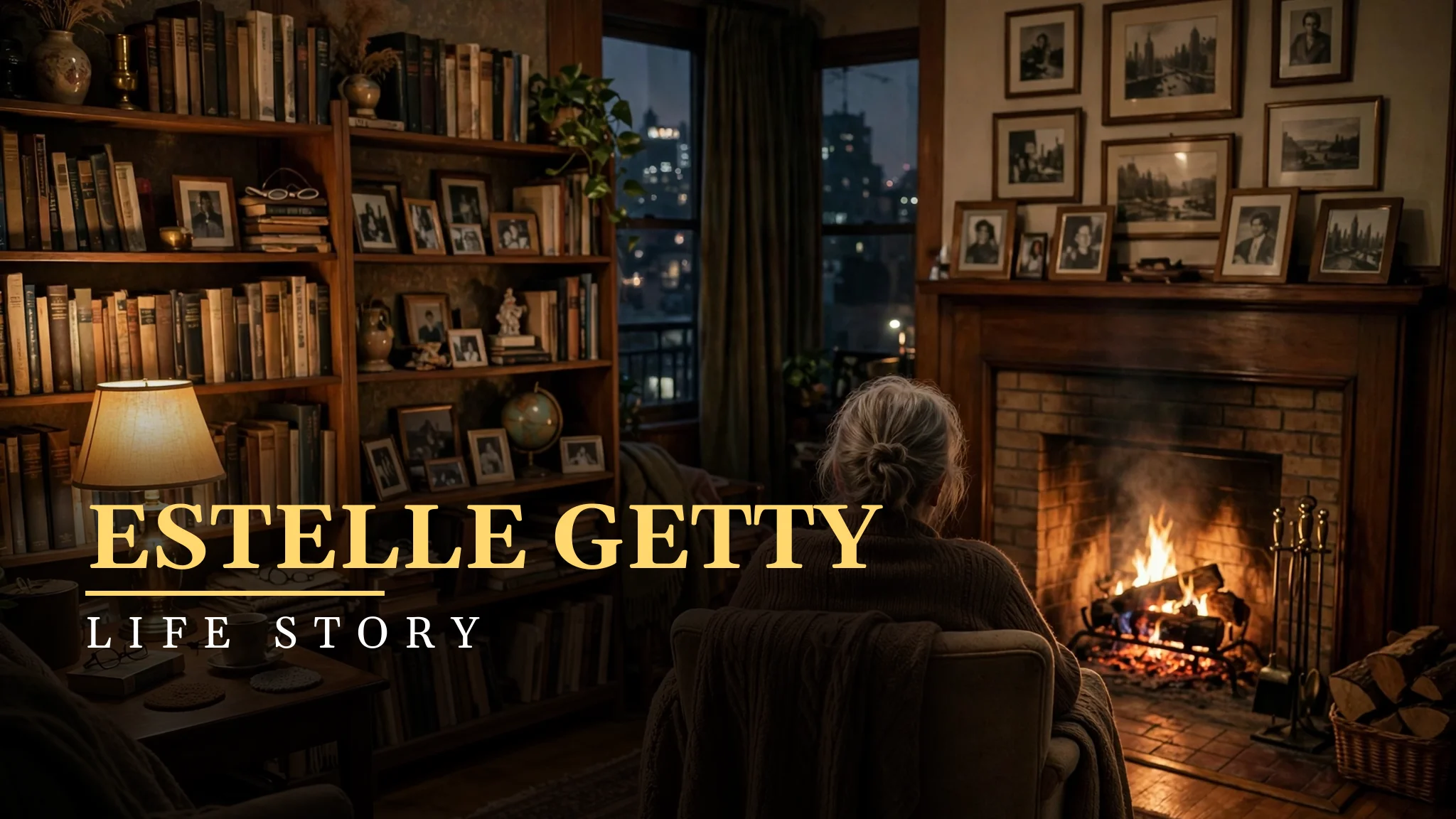
When I think of Estelle Getty now, I think of an older woman sitting in an armchair by a glowing fireplace, in a cosy room filled with bookshelves and framed photos, with a night city outside the window. She is not performing. She is thinking, she is remembering, and she is at peace. That image stays with me, because it captures her warmth, her thoughtfulness, and her love of family and home. She was a woman who worked hard, who laughed loudly, and who lived fully, and that is a beautiful thing to remember.
I hope readers who meet her for the first time will watch The Golden Girls, and I hope they will watch Torch Song Trilogy, and I hope they will learn about her long years in the theatre. I hope they will see that she was more than Sophia Petrillo. She was a great actress, a devoted mother, and a woman who waited forty years for her big break and made the most of it when it came. That is why I think her story matters, and that is why I think it will still matter many years from now, when new generations are still laughing at Sophia’s stories about Sicily.
In the end, I think Estelle Getty teaches us to be patient, to work hard, and to believe in ourselves, even when success takes a long time. She was patient, she worked hard, and she believed, and she became a star at sixty-two, after more than forty years of work. I will remember her as Sophia, as Mrs. Beckoff, and as a woman who showed us that a long wait can be worth it, if you keep going and keep laughing. That is a life worth celebrating, and it is a life I am glad to have learned about.
I also think about how Estelle Getty’s story connects to the way we think about immigrants and about mothers on television today, and to how often their stories are told in a simple or stereotypical way. Sophia was a Sicilian immigrant, a mother, and a grandmother, and Estelle played her with a warmth and a humour that made her feel real, not only a caricature. She told stories about Sicily, about her family, and about her life, and she did it with a love that made audiences feel as if they were part of her family. That is a powerful example for any actress who has been asked to play an immigrant mother, and it shows that a great performer can take a simple character and make her feel like a real person, with a full inner life and a long history.
Another thought that stays with me is her work in Torch Song Trilogy, and how brave it was to play a mother learning to accept her gay son, at a time when such stories were rarely told on stage. She played Mrs. Beckoff with an honesty that made audiences laugh and cry, and she showed that a mother can learn, can grow, and can change, even when she is old and set in her ways. That is a hopeful message, and it is one that is still relevant today, when many families are still learning to accept each other. She was part of that change, and she was proud of it, and her performance helped many people understand what it means to love someone for who they are.
I also wonder what she would say to a young actress today who is working in small roles, who is not famous, and who is wondering if she will ever get her big break. I think she would tell her to keep working, to keep learning, and to keep believing in herself, even when the roles are small and the pay is low. She would tell her that a career is built one role at a time, and that every role, even a small one, can teach you something that you will use later. She would tell her that patience is not the same as giving up, and that a long wait can be worth it, if you keep going and keep laughing. That advice is simple, but it is true, and it is advice I want to remember.
When I think of Estelle now, I do not only think of Sophia. I think of a young woman in New York, working as a secretary during the day and studying acting at night, dreaming of a life on stage, and of a woman in her eighties, sitting by a fireplace, remembering her life and her family. Those images, taken together, show a whole life, from a small apartment in New York to the bright lights of Broadway and television, and they show a woman who never gave up on her dream. That is a beautiful thing, and it is a legacy I will carry with me.
I hope that people who read her story will watch The Golden Girls, will watch Torch Song Trilogy, and will understand that she was more than Sophia Petrillo. She was a great actress, a devoted mother, and a woman who waited forty years for her big break and made the most of it when it came. Her life is proof that patience, hard work, and humour can lead to a great career, even late in life. That is a legacy worth remembering, and a legacy I am glad to have learned about.
I also think about how Estelle Getty’s early life as a secretary is a reminder that many great careers start in ordinary jobs, and that a day job is not a sign of failure. It is a sign of practicality, of responsibility, and of a willingness to work hard while you pursue your dream. She typed during the day, she studied at night, and she kept going, even when the roles were small and the pay was low. That persistence is a lesson for anyone who is working a job they do not love while dreaming of something else. Keep going, keep learning, and keep believing, because your chance may come, even if it takes forty years. She proved that, and she proved it with a smile.
I also want to remember her as a mother, because that part of her life is often overlooked when we focus on her fame. She had two sons, she raised them while also working as an actress, and she balanced those two roles with care and with love. She was proud of her family, and she spoke about the importance of supporting the next generation, even when her own career was slow. She did not give up on her dreams for her family, and she did not give up on her family for her dreams. She tried to hold both, and she did it with grace. That is a legacy that goes beyond the stage, and it is one I admire deeply.
Frequently Asked Questions
What role did Estelle Getty play in The Golden Girls?
In The Golden Girls from 1985 to 1992, Estelle Getty played Sophia Petrillo, the eighty-year-old Sicilian mother of Dorothy, who lives with her daughter and her friends Blanche and Rose in Miami. Sophia told long and funny stories about her life in Sicily, always beginning with “Picture it: Sicily”. Estelle won an Emmy Award in 1988 for her work as Sophia.
How old was Estelle Getty when she became famous on The Golden Girls?
She was sixty-two years old when The Golden Girls began in 1985, after working in the theatre for more than forty years. She was the youngest of the four main actresses, yet she played the oldest character, Sophia, who was eighty. Her late fame showed that a career could start late and still be great.
Did Estelle Getty work on Broadway before television?
Yes, she worked in the theatre in New York for more than forty years, and she appeared on Broadway in Torch Song Trilogy in 1982, playing Mrs. Beckoff, the mother of a gay man. Her performance was praised and earned her a Tony Award nomination. She also appeared in the film version of Torch Song Trilogy in 1988.
What illness did Estelle Getty suffer from in her later years?
In her later years, she was diagnosed with Lewy body dementia, a disease that affects memory and thinking, and that made it harder for her to work and to remember her lines. She retired from acting and spent her later years with her family in Los Angeles. She died in 2008 after living with the disease for several years.
Was Estelle Getty married, and did she have children?
Yes, she was married to Arthur Gettleman from 1947 until her death in 2008, and they had two sons together, Carl and Barry. Her husband supported her acting career, and she balanced her work with her role as a mother. She was proud of her family and spoke about the importance of supporting the next generation.
When did Estelle Getty die?
Estelle Getty was born on 25 July 1923 in New York City, and she died on 22 July 2008 in Los Angeles, California, at the age of eighty-four, only a few days before her eighty-fifth birthday. She had been a theatre actress for more than forty years and a television star on The Golden Girls, and she is remembered as Sophia Petrillo.


