Snow Day Activities for Kids Indoors 2026
In this post
- Blanket Forts, Obstacle Courses and Active Indoor Play
- Crafts, Art and Building Projects for Snowy Days
- Baking, Cooking and Kitchen Science on a Snow Day
- Reading, Storytelling and Quiet Snow Day Time
- Screen Time, Learning and Making Snow Days Special
- Snow Day Safety, Sibling Squabbles and Short Trips Outside
- My Take:
A snow day arrives with a particular kind of excitement: school is closed, the world outside is white and quiet, and children wake up to a day that feels like a gift. Parents, however, often feel a different emotion after the first hour, when the excitement turns into restlessness and the question becomes: what do we do all day indoors? The answer does not need to be expensive, complicated, or perfectly planned. Children do not need a day of scheduled entertainment. They need a mix of active play, creative projects, cosy downtime, and a little independence, with adults providing materials, ideas, and a rhythm to the day. This guide offers snow day activities for kids indoors, organised by type and age, with practical tips for parents who want a happy snow day without spending the whole day as an entertainer.
The first thing to understand about snow days is that they work best with a loose plan, not a strict timetable. Children enjoy knowing roughly what will happen next, but they resist a day that feels like school with a different name. A good snow day rhythm might look like this: active play in the morning, a creative project before lunch, quiet time after lunch, baking or cooking in the afternoon, and a film or family game in the evening. Within each block, children should have choices, because choice is what turns an activity from a chore into fun. Offering two or three options and letting children pick is far more effective than announcing a single activity and expecting enthusiasm, especially for older children who want a sense of control over their unexpected holiday.
Safety and practicality also matter on snow days. Indoor activities should use materials that are safe for the child’s age, with scissors, hot ovens, and small parts supervised appropriately. The house does not need to stay tidy all day; a snow day is a good time to accept some mess in exchange for fun, and to involve children in tidying up afterwards as part of the day’s routine. Screens have a place on a snow day, especially for films and educational content, but a day spent entirely in front of a screen usually leaves children more restless, not less. The activities below balance screens with hands-on play, movement, and imagination, so that by bedtime, children feel they have had a real day, not just a long wait for school to reopen.
Blanket Forts, Obstacle Courses and Active Indoor Play
The classic snow day activity, and still one of the best, is building a blanket fort. Give children blankets, sheets, cushions, chairs, and clothes pegs or clips, and let them design a structure. Younger children enjoy a simple fort with a roof and a cosy interior for toys and books, while older children may build multi-room forts with entrances, windows, and a “rules” sign. Once the fort is built, it becomes a base for other activities: reading inside it, eating lunch in it, or playing board games in it. The fort itself is the activity, and the pride children feel in building it is a large part of the fun. Adults should check that the structure is stable and that heavy objects are not balanced where they could fall, but otherwise, stepping back and letting children build is the best approach.
Indoor obstacle courses are another excellent way to burn energy when going outside is not possible or is limited to short bursts. Use cushions to jump over, tape lines on the floor to balance along, chairs to crawl under, and a laundry basket to throw soft balls into. Time children if they enjoy competition, or let them design the course themselves, which is often more engaging than following an adult’s design. Movement breaks are essential on snow days, because children who sit all day become fidgety and frustrated, while children who have moved, jumped, and stretched are calmer and more focused for quieter activities afterwards. Even ten minutes of active play every hour or two makes a noticeable difference to the mood of the house.
Other active indoor ideas include dance parties, with children choosing music and inventing dances, indoor bowling with plastic bottles and a soft ball, and scavenger hunts, where children search for items of a certain colour, shape, or starting letter around the house. Scavenger hunts can be adapted for all ages: picture clues for young children, riddles for older children, and timed challenges for competitive siblings. Yoga or stretching sessions designed for children, available as videos or books, offer a calmer form of movement and can be a good transition between active play and quiet time. The key to active indoor play is to use what the house already contains. No special equipment is needed, and the most successful activities are usually those children help to invent.
Crafts, Art and Building Projects for Snowy Days
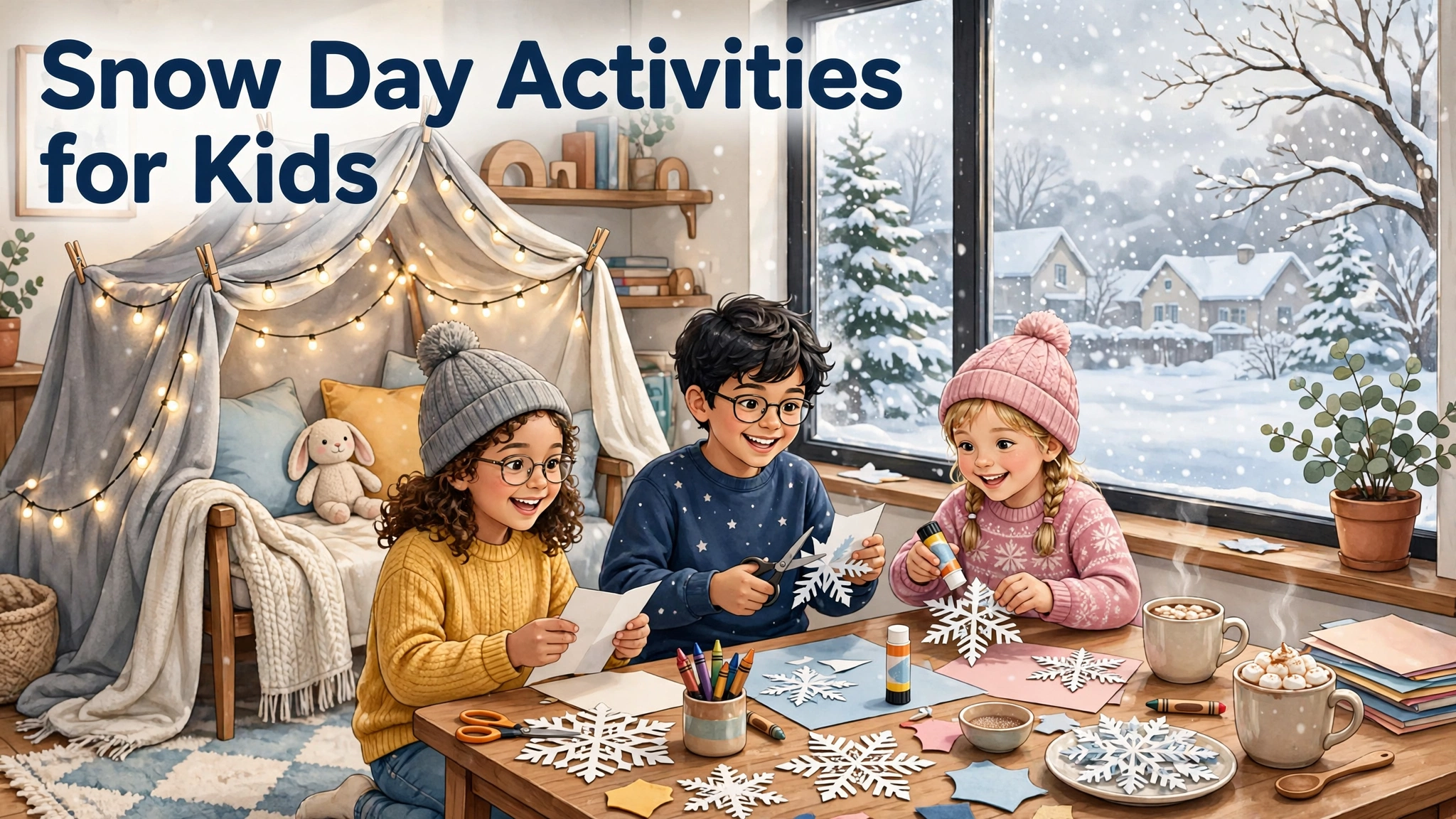
Crafts are the heart of many snow days, because they give children something to make, keep, and show proudly. Paper snowflakes are the obvious snow day craft, and they remain popular for good reason: folding paper and cutting patterns, with adult supervision for scissors, produces beautiful, unique results, and no two snowflakes are alike. Children can hang their snowflakes in windows, creating an indoor snowfall that mirrors the one outside. Other paper crafts include making greeting cards, paper chains, and winter scenes with coloured paper, cotton wool for snow, and glitter glue used sparingly to avoid excessive mess.
Painting and drawing projects suit quieter parts of the day. Provide large paper, paints or crayons, and a theme, such as “draw your dream snow day” or “paint a winter animal”, but allow children to depart from the theme if they wish. Process matters more than product on a snow day; a child who paints freely for an hour has had a better creative experience than one who is forced to copy a perfect example. Building projects offer another kind of creativity: LEGO and other construction toys, cardboard box cities, marble runs made from tubes and boxes, and simple science builds such as bridges from spaghetti or towers from cups. These projects develop problem-solving and patience, and they can occupy children for long stretches, especially when siblings or friends collaborate.
For older children, more challenging crafts work well: knitting or sewing a simple project, making friendship bracelets, building a model, or starting a comic strip or storybook with illustrations. These projects give older children a sense of achievement and a reason to return to the activity after breaks, which helps structure a long day. Adults should provide materials and occasional help without taking over the project. A craft that an adult finishes for a child teaches the child that their work was not good enough, while a craft that a child finishes themselves, however imperfect, teaches pride and persistence. Displaying finished crafts, on a wall, a shelf, or a clothesline across a room, shows children that their work is valued and turns the house into a snow day gallery.
Baking, Cooking and Kitchen Science on a Snow Day
Baking is a snow day tradition for good reason: it warms the house, fills it with wonderful smells, and produces something delicious to eat together. Simple recipes work best, especially with younger children. Cookies, cupcakes, banana bread, and simple bread rolls are all achievable, with children measuring, mixing, and decorating under supervision. Older children can take more responsibility, following a recipe with occasional checks, while younger children enjoy stirring, pouring, and decorating. Kitchen safety is essential: hot ovens and sharp knives are adult jobs, hands should be washed before cooking, and children should understand that the kitchen has rules even on a fun day. The mess is part of the experience, and cleaning up together afterwards teaches responsibility without spoiling the fun.
Cooking a meal together is another valuable snow day activity. Children can help make soup, pasta, sandwiches, or a simple pizza, learning where food comes from and how a meal is assembled. Making hot chocolate from scratch, with milk, cocoa, and marshmallows, is a perfect snow day drink project, and it pairs naturally with the baking activity. For families who enjoy science, kitchen experiments add excitement: making ice cream in a bag with ice and salt, observing how salt melts ice on a tray, or growing simple crystals, all use everyday materials and teach curiosity. These experiments should be chosen for safety and age-appropriateness, with adults supervising any use of hot water or sharp tools.
Food activities also offer a chance to talk about winter, seasons, and where ingredients come from, without turning the day into a lesson. Children who bake bread learn that dough rises, that ovens transform ingredients, and that patience is rewarded with a warm loaf. Those are real lessons, but they are learned through doing, not through being taught. Parents should also be realistic about time: a baking project that takes three hours may suit a long snow day, while a thirty-minute cookie recipe suits a shorter window. Choosing a project that fits the children’s energy and attention span is more important than choosing an impressive recipe. A simple batch of cookies, made happily, beats a complicated cake that ends in tears and a messy kitchen.
Reading, Storytelling and Quiet Snow Day Time
Quiet time is not wasted time on a snow day. Children need rest, especially after active play and creative projects, and a house that is noisy all day can become overwhelming. Reading is the classic quiet snow day activity, and snow days are an ideal time to start a new book, finish a series, or read aloud as a family. For younger children, picture books about winter, snow, and animals are perfect, and reading aloud with voices and sound effects turns a book into a performance. For older children, a chapter book, a graphic novel, or a magazine about their interests can absorb them for hours, especially if they have a cosy reading spot, such as a blanket fort or a window seat with a view of the snow.
Storytelling and imaginative play extend reading into creation. Children can invent stories together, taking turns to add a sentence, act out a story with toys, or write and illustrate a short book. Puppet shows with socks or paper puppets, shadow plays with a torch and a sheet, and “radio shows” recorded on a phone all encourage language, confidence, and humour. Board games, card games, and puzzles are also excellent quiet activities, teaching turn-taking, strategy, and patience, and they work well for mixed-age groups when games are chosen appropriately. A large puzzle, left out on a table for the whole day, allows family members to add pieces whenever they pass, creating a shared project that grows slowly and satisfyingly.
Quiet time should be offered, not imposed as a punishment. A good approach is to create a cosy environment, with blankets, cushions, and warm drinks, and to join children in quiet activity yourself, reading your own book or doing a puzzle, rather than using quiet time to do chores noisily elsewhere. Children mirror adult behaviour, and a parent who reads quietly is more persuasive than a parent who orders quiet while watching television loudly. Screen-based quiet time also has a place: a family film in the evening, with popcorn and blankets, is a perfect snow day ending, and educational documentaries about winter animals, space, or nature can be both relaxing and interesting. The balance to aim for is a day with both lively and quiet periods, so that children go to bed tired in a good way, having played, made, read, and rested.
Screen Time, Learning and Making Snow Days Special
Screens on a snow day deserve a balanced, guilt-free approach. A snow day is not a normal school day, and there is no need to ban screens entirely to prove that the day was worthwhile. Educational apps, documentaries, virtual museum tours, and creative tools such as drawing apps or music-making apps can be genuinely enriching, especially when adults choose them thoughtfully and discuss them with children afterwards. Video calls with grandparents, cousins, or friends also use screens socially, allowing children to share their snow day excitement with people they cannot visit. The problem is not screens themselves, but a day in which screens replace all other activity, leaving children restless and parents frustrated.
A useful approach is to agree on screen times at the start of the day, such as a film in the evening and a limited period of games or apps in the afternoon, with the rest of the day reserved for hands-on activities. That agreement prevents arguments later, because children know what to expect and when their screen time will come. Parents should also consider their own screen use on snow days. A parent who spends the day on a phone while telling children to play creatively sends a confusing message, while a parent who joins in activities, even briefly, models engagement. Snow days are rare, and they offer a chance for families to spend time together that busy school weeks do not allow. Using that time well does not require perfection, but it does require presence.
Learning can be woven into snow days without making them feel like school. Measuring snowfall, tracking temperature, observing birds or animal tracks from a window, and keeping a snow day diary all combine observation, maths, and writing in a natural way. Children can photograph the snow, draw what they see, and write a short account of the day, creating a keepsake to look back on. Older children might research a winter topic that interests them, from how snowflakes form to how animals survive winter, and share what they learn over dinner. These activities work because they start from children’s curiosity, not from a worksheet. A snow day that ends with a child saying “I learned something interesting today” without realising they were learning is a snow day well spent.
Finally, making snow days special is about small touches, not grand plans. A special breakfast, such as pancakes or hot chocolate, marks the day as different from normal. A blanket fort, a film night, a baking project, and a story before bed create a rhythm that children will remember. Taking photographs of the day, including the mess and the laughter, preserves memories that families enjoy revisiting. And if the snow day extends to a second day, repeating favourite activities is fine; children often enjoy doing the same fort, the same baking, or the same game again, with variations. Snow days are gifts of unexpected time, and the best way to honour them is not to fill every minute, but to spend the minutes well, together, indoors, while snow falls quietly outside.
Snow Day Safety, Sibling Squabbles and Short Trips Outside
Even an indoor snow day needs a few safety and harmony rules. Sibling arguments are normal when children spend a whole day together indoors, and parents can reduce them by giving each child some separate space and some separate choices, rather than forcing constant togetherness. If two children want different activities, let them do different activities in different rooms for a while; togetherness imposed all day breeds resentment, while time apart makes reunion more pleasant. A simple rule, such as taking turns choosing the next activity, prevents many arguments before they start, and a calm adult response to a squabble, rather than taking sides loudly, models the conflict skills children are still learning.
Short trips outside, when conditions allow, can transform an indoor snow day. Even fifteen minutes of playing in snow, building a small snowman, or simply walking around the block in warm clothing gives children fresh air, exercise, and a story to bring back indoors. Parents should check conditions first: avoid going out in blizzards, high winds, or icy conditions where walking is dangerous, dress children in waterproof layers with hats and gloves, and set a time limit so that children come in before they become wet and cold. Coming back inside to warm drinks, dry clothes, and a blanket fort feels like a reward after outdoor play, and the contrast between cold outside and warmth inside is one of the great pleasures of a snow day. The best indoor snow days usually include at least one brief, safe taste of the snow itself.
My Take:
My opinion on snow days is that they are far more valuable than adults usually admit, and that we risk ruining them by treating them as problems to be solved rather than as gifts to be enjoyed. When school closes for snow, the adult instinct is often to worry: about work, about childcare, about lost learning, about a house full of restless children. Those worries are understandable, but they can blind us to what a snow day actually offers: a rare, unscheduled day in the middle of a busy winter, when families are together without the usual rush of mornings, homework, and activities. I think snow days should be protected as family time, not apologised for as disruption, and that children who remember happy snow days will carry those memories far longer than they will remember a single missed school day.
I am also convinced that the best snow day activities are the simplest ones, and that the snow day industry of expensive kits, elaborate schedules, and Pinterest-perfect crafts often misses the point. A blanket fort made from household sheets is more fun than a bought play tent, because the child built it. A batch of simple cookies, mixed by small hands and eaten warm, is more satisfying than a complicated recipe that an adult mostly makes. Paper snowflakes, cut with concentration and hung in a window, are more beautiful than any shop-bought decoration, because each one is unique. Simplicity is not a fallback when you cannot afford something better. It is the thing itself. Children do not need perfection. They need materials, time, and permission to make a mess.
On screens, my view is deliberately moderate, because I think both extremes are wrong. Banning screens entirely on a snow day turns parents into police officers and makes screens seem forbidden and therefore desirable, while allowing unlimited screens turns a snow day into a grey blur of content that children barely remember. The middle path, agreed screen times for a film or a game, with the rest of the day for hands-on play, works because it respects children’s desire for screens without letting screens dominate. I also think parents should be honest about their own screen use. A snow day is a good time for adults to put their phones down too, to build a fort, to bake, to read aloud, and to show children that undivided attention is the best gift an adult can give. Children notice attention far more than they notice activities.
I have strong views on tidiness on snow days, and they can be summed up simply: let the house get messy, and tidy up together later. A snow day spent worrying about cushions on the floor, flour on the counter, and paper scraps under the table is a snow day spent worrying about the wrong things. Mess is evidence that children played, created, and explored, and it can be cleared in twenty minutes at the end of the day, especially when children help. The memory of a fort, a baking project, or a game will last for years. The memory of a tidy living room on a snow day will last for nobody. I would always choose the fort over the tidy room, and I think most adults, if they are honest about their own childhoods, would agree.
On learning, I believe snow days teach things that school cannot easily teach: independence, creativity, boredom tolerance, and family cooperation. A child who spends an hour figuring out how to build a stable fort, or who invents a game when the planned activity fails, is learning problem-solving in its most practical form. A child who feels bored and then finds something to do has learned a skill that will serve them for life, because adult life contains plenty of unstructured time. Parents who rush to fill every minute of a snow day with planned activities may prevent that learning. Sometimes the best thing an adult can do on a snow day is to provide materials, suggest one idea, and then step back. Boredom, handled well, becomes imagination, and imagination is the root of all later creativity.
Finally, I think snow days deserve to be remembered and celebrated as part of family culture. Take photographs, keep a snow day diary, save a paper snowflake, or simply tell the story of the day at dinner. Those small acts of remembering turn a single day into a family story that can be retold next winter: “Remember the snow day when we built the giant fort and baked cookies?” Stories like that bind families together, and they cost nothing. Snow will melt, school will reopen, and normal life will resume, as it always does. But the fort will be remembered, the cookies will be remembered, and the feeling of a day spent together, indoors, while snow fell outside, will remain. That is why I take snow days seriously, and why I hope this guide helps families enjoy them rather than merely survive them.
One more thought: snow days are a perfect time to connect children with grandparents or relatives they cannot visit, through a video call from inside the blanket fort. A child showing a grandparent their paper snowflakes, their baking, or their fort on camera creates a shared memory across distance, and it teaches children that family connection does not require travel or expense. Those calls, short and joyful, often become the part of the day adults remember most fondly, because they combine everything a snow day is for: warmth, creativity, and togetherness, extended beyond the walls of one house to the wider family.
And one final belief: a snow day should end with a story, told at dinner or at bedtime, about what happened that day. It does not need to be dramatic. “We built a fort, it fell down, we rebuilt it stronger, and then we ate warm cookies inside it” is a perfect story, because it is true, it is shared, and it will be retold next winter when snow falls again. Families are built from such small stories, repeated over years, and snow days supply them generously. Keep the story, and the snow day will never really end.
Frequently Asked Questions
What are the best indoor activities for kids on a snow day?
Blanket forts, obstacle courses, crafts such as paper snowflakes, baking, board games, puzzles, reading and family films all work well. A mix of active play, creative projects and quiet time, with choices for children, usually produces the happiest snow day.
How can I keep children entertained all day without screens?
Plan a loose rhythm rather than a strict timetable: active play in the morning, a craft before lunch, quiet time after lunch, baking in the afternoon and a game or film in the evening. Offer two or three choices in each block and let children help invent activities.
Are snow day crafts safe for young children?
Most crafts are safe with age-appropriate supervision. Scissors, hot ovens and small parts need adult supervision, and materials should be chosen for the child’s age. Simple crafts such as paper snowflakes, drawing and building with large blocks suit younger children well.
How much screen time is reasonable on a snow day?
There is no single rule, but many families agree screen times at the start of the day, such as a film in the evening and a limited period of games or educational apps, with the rest of the day for hands-on play. Agreeing times in advance prevents arguments later.
What should I do if my children get bored on a snow day?
Boredom is normal and can be useful. Provide materials such as blankets, paper, boxes and building toys, suggest one idea, and then step back. Children who work through boredom often invent their own games, which builds creativity and independence.
Can snow days include learning without feeling like school?
Yes. Measuring snowfall, observing winter wildlife from a window, keeping a snow day diary, baking, and researching a winter topic children are curious about all combine learning with fun, because they start from children’s interests rather than worksheets.