The Who: The Life Story Behind the Mod Rock Legends
In this post
The Who are one of the loudest, wildest, and most exciting rock bands in history, and they are also one of the most important. They started in London in the early 1960s as a band for mods, young people who loved sharp clothes, scooters, and loud music, and they became a band that smashed guitars, broke drum kits, and played with a volume and an energy that no one had heard before. They made songs about being young, about being angry, and about wanting to be heard, and those songs are still played today.
Their story is about Roger Daltrey, the singer with a powerful voice and a strong stage presence, about Pete Townshend, the guitarist and songwriter who wrote most of their songs and who created the rock operas Tommy and Quadrophenia, about John Entwistle, the quiet bass player who was one of the greatest ever, and about Keith Moon, the wild drummer who played like no one else and who died young. It is a story of friendship, of genius, of excess, and of a band that survived the death of its drummer and kept going.
What makes their story worth telling is the music and the live shows. They made My Generation, Baba O’Riley, Won’t Get Fooled Again, and Behind Blue Eyes, songs that are still anthems for young people. They made albums that changed rock music, and they played concerts at Woodstock, at the Isle of Wight, and in stadiums around the world. This is the story of how four young men from London became The Who, and how The Who became legends.
Four Young Men From Shepherd’s Bush
Roger Daltrey was born on 1 March 1944 in Hammersmith, in west London, and he grew up in Shepherd’s Bush, a working-class area of the city. He was a strong, confident boy who loved music, and he learned to play the guitar, forming a band at school and playing in local clubs. He was expelled from school, he worked as a sheet metal worker, and he dreamed of a career in music, even though he had no money and no connections. He was determined, he was tough, and he was ready to work hard to make his band a success.
Pete Townshend was born on 19 May 1945 in Chiswick, in west London, into a musical family, with a father who played saxophone in a dance band and a mother who sang. He grew up loving music, he learned to play the guitar and the piano, and he went to art school, where he was influenced by modern art, by pop art, and by ideas about music as a form of art. He was clever, he was thoughtful, and he was a talented songwriter who would become the creative heart of the band.
John Entwistle was born on 9 October 1944 in Chiswick, and he grew up loving music, playing the piano, the trumpet, and the French horn before he took up the bass guitar. He was quiet, he was shy, and he was a brilliant musician, with a style of bass playing that was melodic, fast, and unlike anyone else’s. He became known as the Ox, because he was strong and steady, and he was the calm centre of a wild band, a musician who could play complex lines while standing still on stage.
Keith Moon was born on 23 August 1946 in Wembley, in north-west London, and he grew up loving drums, playing in local bands, and developing a style that was wild, fast, and chaotic. He was a funny, energetic, and unpredictable young man, who loved to joke, to party, and to make people laugh, and he was also a brilliant drummer who played like no one else, filling every gap with rolls and crashes. He joined the band in 1964, after answering an advertisement, and he became the final member of the classic line-up of The Who.
The four men met in London in the early 1960s, when Daltrey’s band, the Detours, was playing in local clubs, and Townshend and Entwistle joined, followed by Moon. They changed their name to The Who in 1964, and they began to play in London clubs, building a following among mods, young people who loved fashion, scooters, and loud music. They were a loud, energetic band, and they were different from other groups of the time, because they played with volume, with attitude, and with a sense of danger.
The band’s early days in London were also a time of learning how to be a group, how to rehearse, how to travel, and how to handle the small amounts of money they earned from playing in clubs, and they learned that a band is not only about music, but also about trust, about showing up on time, and about working together even when you are tired, hungry, and far from home, and those lessons stayed with them for the rest of their career.
Mods, My Generation, and Smashing Guitars
In 1964, The Who became the house band at the Railway Hotel in Harrow, and they built a following of mods who came to see them every week. They wore sharp suits, they rode scooters, and they played loud, fast music that made the crowd dance. Their manager, Kit Lambert, and his partner Chris Stamp, saw their potential, and they helped them to get a record deal with Brunswick Records. The band’s early singles, including I Can’t Explain and Anyway, Anyhow, Anywhere, were hits, and they showed a band that was young, loud, and full of energy.
In 1965, they released My Generation, a song written by Pete Townshend that became their anthem and one of the most famous rock songs ever made. The song was about being young, about not wanting to grow old, and about being misunderstood by older people, with the famous line, hope I die before I get old, and with Daltrey stuttering the words in a way that made the song even more powerful. The song reached number two in the UK, and it became a rallying cry for young people, a song that said what they felt but could not say themselves.
The Who also became famous for their live shows, in which Townshend would smash his guitar at the end of a set, and Moon would kick over his drum kit, destroying their instruments in a wild, theatrical display. The smashing started by accident, when Townshend broke the neck of his guitar on a low ceiling, and the crowd loved it, so he made it a part of the show. It was expensive, it was dramatic, and it became their trademark, a symbol of their anger, their energy, and their refusal to be polite or safe.
They released their first album, My Generation, in 1965, and they followed it with more hits, including Substitute, I’m a Boy, and Happy Jack, and with the album A Quick One in 1966, which included a short rock opera called A Quick One, While He’s Away. They were becoming one of the biggest bands in Britain, and they were known for their loud live shows, their mod style, and their songs about youth. They were also touring America, where they built a following, and where they played at the Monterey Pop Festival in 1967, smashing their instruments in front of an American audience for the first time.
Townshend wrote Tommy over a long period, working on the story, the music, and the characters, and he was inspired by his interest in spirituality, in the teachings of Meher Baba, and in the idea that a person who cannot see or hear can still find a kind of inner vision, and that idea gave the album a depth that went beyond a simple story about a boy who plays pinball.
Tommy, the Rock Opera That Changed Everything
In 1969, The Who released Tommy, a double album and a rock opera written by Pete Townshend about a deaf, dumb, and blind boy who becomes a pinball champion and then a spiritual leader. The album was ambitious, it was strange, and it was a huge success, reaching the top five in the UK and the United States, and it included the hit single Pinball Wizard, a song that is still one of their best-known. Tommy showed that a rock band could make a concept album, that it could tell a story, and that it could be both popular and artistic.
The album was followed by a film version in 1975, directed by Ken Russell, with Roger Daltrey playing Tommy, and with appearances by Elton John, Tina Turner, and other stars. The film was a success, and it brought Tommy to a wider audience, and it showed that The Who were not only a band, but also a creative force in film and theatre. They also performed Tommy live, in full, at concerts and at the Metropolitan Opera in New York, and those performances were legendary, with the band playing the whole album from start to finish.
Tommy changed the band’s career, because it made them serious artists, not just a pop band, and it gave them a new level of respect. They were no longer only known for smashing guitars. They were known for making ambitious, thoughtful music, and for pushing the limits of what rock could do. Townshend became known as one of the greatest songwriters in rock, and Daltrey became known as one of the greatest singers, with a voice that could carry a whole opera.
The success of Tommy also brought money, fame, and pressure, and the band had to decide what to do next. They toured the album, they played in stadiums and arenas, and they became one of the biggest live acts in the world. They were at the top of their game, and they knew it, but they also knew that they had to keep growing, keep writing, and keep making music that mattered. Tommy was a peak, but it was not the end. It was the start of a new chapter.
The band’s touring in these years was relentless, with long tours of America, Britain, and Europe, with nights in hotels, with days on the road, and with concerts that lasted for hours, and they learned how to pace themselves, how to look after their voices and their instruments, and how to give a great show every night, even when they were exhausted, because their fans expected the best and they wanted to give it to them.
Live at Leeds, Who’s Next, and the Peak Years
In 1970, The Who released Live at Leeds, a live album recorded at Leeds University, which is now regarded as one of the greatest live albums ever made. The album captured the band at their best, loud, energetic, and tight, playing songs like Young Man Blues, Substitute, and My Generation, and it showed why they were known as one of the best live bands in the world. The album was a success, and it is still loved by fans today, because it captures the raw power of The Who on stage.
In 1971, they released Who’s Next, an album that is now regarded as one of their best, with songs like Baba O’Riley, with its famous synthesiser introduction, Won’t Get Fooled Again, with its long, powerful climax, and Behind Blue Eyes, a beautiful ballad that showed a softer side of the band. The album was originally part of a larger project called Lifehouse, which Townshend had planned as a rock opera and a film, but the project was abandoned, and the best songs were released as Who’s Next. The album was a huge success, and it is still one of the most loved rock albums ever made.
The early 1970s were the peak years for The Who. They were touring the world, playing in stadiums, and making hit records, and they were known as one of the greatest rock bands in the world. They played at Woodstock in 1969, at the Isle of Wight Festival in 1970, and in many other famous concerts, and their live shows were legendary for their volume, their energy, and their drama. They were a band that had to be seen live, because their records only told half the story.
In 1973, they released Quadrophenia, another rock opera, this time about a young mod in London in the 1960s, struggling with identity, with his parents, and with his place in the world. The album was a success, and it included the songs The Real Me, 5:15, and Love, Reign O’er Me, and it was later made into a successful film in 1979. Quadrophenia showed that Townshend could still write ambitious, thoughtful music, and that the band could still make albums that mattered. It was a high point, and it is still regarded as one of their best works.
Moon’s drumming was so distinctive that other drummers found it almost impossible to copy, because he did not play a simple beat, but instead played fills, rolls, and crashes in almost every bar, creating a wall of sound that drove the band forward, and that style became a major part of The Who’s identity, and a major reason why their live shows were so exciting to watch and to hear.
Keith Moon’s Death and the Band After Him
Keith Moon was one of the greatest drummers in rock history, but he was also a troubled man, who drank heavily, used drugs, and lived a wild, chaotic life. He was funny, he was generous, and he was loved by his bandmates, but his lifestyle was taking a toll on his health, and he was becoming unreliable on tour. He died on 7 September 1978, at the age of thirty-two, after taking an overdose of a drug prescribed to help him stop drinking. His death was a shock, and it was a great loss to the band and to rock music.
The band decided to continue without Moon, and they hired the drummer Kenney Jones, who had played with the Small Faces, to replace him. They released the album Face Dances in 1981, and It’s Hard in 1982, and they toured, but the magic was not the same without Moon. The band’s sound had changed, and the chemistry was different, and the members were growing apart. In 1982, they announced a farewell tour, and they played their last concert in Toronto in December 1982, ending the first chapter of their career.
The band reunited in 1989 for a twenty-fifth anniversary tour, playing Tommy in full, and they have continued to play together in various forms ever since, with Roger Daltrey and Pete Townshend as the core members, and with other musicians, including Zak Starkey, the son of Ringo Starr, on drums. They have released new music, including the album Endless Wire in 2006 and Who in 2019, and they have toured the world, playing to new generations of fans.
John Entwistle, the quiet bass player, died on 27 June 2002, at the age of fifty-seven, in Las Vegas, just before a tour was due to start. His death was another great loss, and it left Daltrey and Townshend as the only surviving members of the classic line-up. They decided to continue, as a tribute to Entwistle and Moon, and they have kept playing, with a band that includes other musicians, and with a set list that includes all their classic songs. They are still The Who, and they are still loud.
Their songs have also been used in films, in television shows, and in advertisements, introducing their music to new audiences who may never have seen them live, and songs like Baba O’Riley and Won’t Get Fooled Again have become familiar to people who were born long after the band first recorded them, which shows how timeless their music really is.
What The Who Leave Behind
The Who left behind a body of music that is still loved today. They made My Generation, Baba O’Riley, Won’t Get Fooled Again, Behind Blue Eyes, and Pinball Wizard, songs that are still played on the radio, still sung by fans, and still loved by new generations. They made the rock operas Tommy and Quadrophenia, which changed the way rock albums were made, and they made Live at Leeds, one of the greatest live albums ever made. They sold more than one hundred million records around the world, and they played to millions of people in stadiums.
Their legacy is also about live performance. They were one of the loudest bands ever, they smashed their instruments, they played with energy and with drama, and they showed that a rock concert could be a theatrical event. They influenced many bands that came after them, from punk to hard rock to alternative rock, and they are still cited as an influence by musicians today. They showed that a band could be both popular and artistic, that it could write songs about youth, and that it could make music that lasted.
For young musicians, The Who are an example of what is possible if you are talented, if you work hard, and if you believe in your own ideas. They started in a small club in London, they played for mods, they wrote songs about being young, and they became legends. They did it with talent, with hard work, and with a love of music. They also did it with courage, with style, and with a sense of fun. They were not perfect, and their story has sad parts, but their music remains, and it will remain for as long as people listen to rock music.
The Who’s music also reminds me that rock and roll is not only about notes and words, but also about attitude, about standing up for yourself, and about refusing to be silent when you have something to say, and that attitude is something that young people still need today, in a world that often tells them to be quiet and to fit in.
They also showed that a band can be both a commercial success and an artistic one, that it can sell millions of records and still make music that is thoughtful, ambitious, and true to itself, and that is a balance that few bands have ever achieved as well as The Who did.
My Take:
When I think about The Who, the first thing I think about is volume. Their music is loud, it is powerful, and it shakes you. When I hear My Generation, I hear a young man shouting that he does not want to be told what to do. When I hear Baba O’Riley, I hear a synthesiser and a guitar building to a climax that still gives me chills. When I hear Won’t Get Fooled Again, I hear a song that is angry, defiant, and full of power. I think their volume is the reason they have lasted, because loud music is something you feel in your body, not just in your ears.
I admire Pete Townshend most of all, because he was the songwriter, the guitarist, and the thinker behind the band. He wrote My Generation, he wrote Tommy, he wrote Quadrophenia, and he wrote Who’s Next, and those are among the greatest works in rock history. He was clever, he was thoughtful, and he was ambitious, and he was not afraid to try big ideas, like a rock opera about a deaf, dumb, and blind boy. I respect that kind of ambition, because it takes courage to try something new, and it takes talent to make it work.
I also think about Roger Daltrey, because his voice is one of the greatest in rock. He could sing softly, he could sing loudly, and he could scream with power, and he could make a song feel alive. When I hear him sing Behind Blue Eyes, I hear a voice that is gentle and sad. When I hear him sing Won’t Get Fooled Again, I hear a voice that is strong and defiant. He was also a great performer, with long blonde hair, a bare chest, and a stage presence that made him a rock star. I think he is one of the best frontmen ever.
I think about John Entwistle, too, because he is often overlooked, and he should not be. He was one of the greatest bass players ever, with a style that was melodic, fast, and unlike anyone else’s. He played complex lines while standing still, and he gave the band its musical depth. He was quiet, he was shy, and he was a brilliant musician, and his death in 2002 was a great loss. I think he deserves more credit than he often gets, because without him, the band would not have sounded the same.
I think about Keith Moon, because he was one of the most exciting drummers ever, and also one of the saddest stories in rock. He played drums like no one else, filling every gap with rolls and crashes, and he made the band sound wild and alive. He was also funny, generous, and loved by his friends, but he drank too much, he used drugs, and he died at thirty-two. His death is a reminder that talent is not enough, and that fame can be dangerous. I wish he had lived longer, and I wish he had been able to enjoy the success he helped to create.
There is a part of their story that I find sad, and that is the way the band fell apart after Moon died. They tried to continue with a new drummer, but the magic was gone, and they broke up in 1982. They reunited later, but it was never the same without Moon and Entwistle. I think that is a human story, and it is a sad one. It shows that a band is more than its songs. It is a group of friends, and when a friend dies, the band changes forever. I respect Daltrey and Townshend for keeping going, as a tribute to their friends, but I also feel sad that the original four will never play together again.
I also think about Tommy, because it is one of the most ambitious albums ever made. It is a rock opera about a boy who cannot see, hear, or speak, and who becomes a pinball champion and then a spiritual leader. That is a strange idea, but Townshend made it work, with great songs, with a clear story, and with a sense of drama. I think Tommy shows what rock music can do when it tries to be art, and not just entertainment. It is a masterpiece, and it is one of the reasons The Who are remembered as more than just a loud band.
I think about their live shows, too, because they were legendary. They smashed guitars, they kicked over drum kits, they played at maximum volume, and they made their concerts into an event. I wish I could have seen them live in their prime, because I think it would have been an unforgettable experience. They did not just play songs. They performed, they acted, and they made the audience feel part of the show. That is a rare talent, and it is why their live album, Live at Leeds, is still regarded as one of the best ever made.
If I have a criticism, it is that The Who sometimes get treated as perfect, and they were not perfect. They made mistakes, they argued, they were sometimes selfish, and they were sometimes unkind to each other. They also lived a wild life that caused harm to themselves and to others. I do not want to pretend that they were saints. They were four young men who became famous very quickly, and they had to learn how to handle it. They did not always handle it well. But their music was great, and their story is human, and that is why I love them.
Another thing I think about is how their music has lasted. My Generation was released in 1965, more than sixty years ago, and it is still played today, still sung by young people, and still loved by fans who were not born when it was made. That is a rare thing. Most music fades after a few years. The Who’s music does not fade. It stays, because the songs are well written, because the playing is superb, and because the feelings in them are true. I think that is the best test of great music. It lasts, and it keeps finding new listeners.
I think about their influence, too. They changed the way rock bands played, the way concerts were staged, and the way young people saw themselves. They showed that a band could be loud, could be rebellious, and could be successful, all at the same time. Many bands that came after them learned from them, from punk to hard rock to alternative rock, and many still do. They opened a door, and many other artists walked through it. That is a legacy that goes beyond their own songs.
For a young reader, I think the lesson from The Who is about being yourself and about speaking up. They wrote songs about being young, about being angry, and about not wanting to be told what to do, and those songs gave a voice to millions of young people. They did not try to be polite or safe. They were themselves, they were loud, and they were honest. That is a useful lesson for anyone who feels that they are not being heard. You can speak up, you can be loud, and you can make yourself heard, if you have something to say.
I also think their story teaches something about friendship and about loss. They lost Keith Moon, they lost John Entwistle, and they lost each other for a while, but their music remained, and it continued to speak to people. That is a hopeful message. Even when friends die, even when bands break up, the music they made together can live on, and it can help other people. The Who’s music has helped millions of people, and it will keep helping them for generations.
In the end, I think The Who will be remembered as one of the greatest rock bands ever, not only because they sold the most records, but because they made the loudest music, because they played the most exciting concerts, and because their songs still make people feel alive. They were four young men from London who became legends, and they became legends because they were talented, because they worked hard, and because they made music that spoke to people. I love their music, I respect their story, and I will keep listening to them for as long as I can.
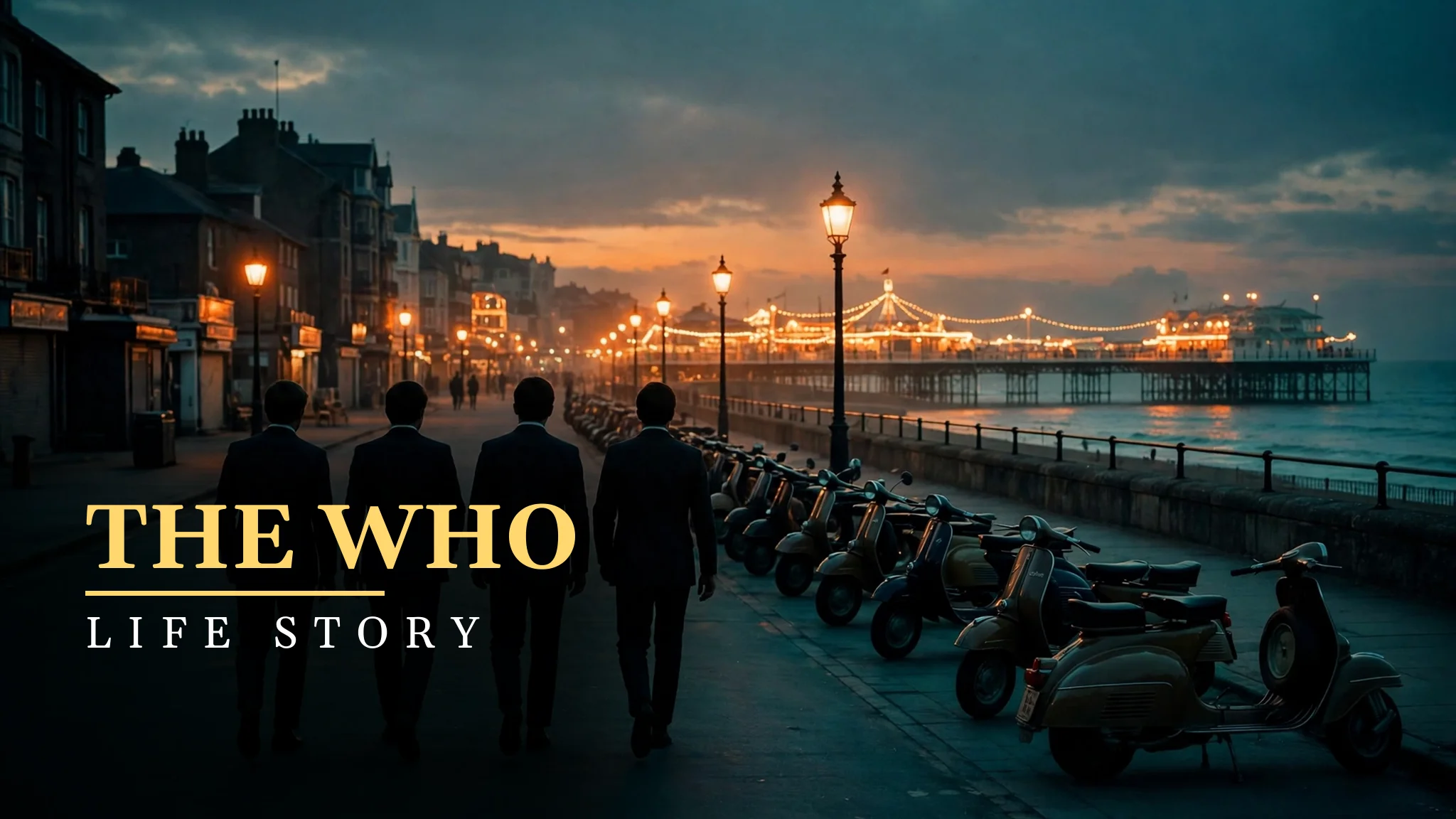
One more thought stays with me. When I think about The Who, I think about the image of four men in suits walking along a seafront, past a row of scooters, towards a lit pier, and I think about how that image captures their music: stylish, youthful, rebellious, and full of energy. Their music is like that walk, confident and forward, with the sea on one side and the lights ahead. I think that is a beautiful image, and it is one I will always remember.
I also think about the mod movement, because The Who were the band of the mods, young people who loved sharp clothes, scooters, and loud music, and who wanted to be different from their parents. The Who gave those young people a soundtrack, and they gave them an identity. That is a powerful thing for a band to do, and it is why their early music still matters. They were not just making songs. They were making a culture, and that culture is still loved today.
I think about the future, too. Roger Daltrey and Pete Townshend are still alive, still playing, and still making music in their eighties, and they are still The Who, even without Moon and Entwistle. One day, they will stop, and that will be a sad day for rock music. But their songs will remain, their albums will remain, and their concerts will be remembered. They have left a legacy that will last for generations, and they have shown that rock music can be loud, can be thoughtful, and can be beautiful. I am grateful that I have been able to hear their music.
Finally, I want to say that The Who teach me something about ageing. They have grown older in public, they have lost friends, they have faced illness, and they have kept going. They have not pretended to be young. They have been themselves, at every age, and they have kept playing. That is a hopeful message for anyone who is getting older. You do not have to stop doing what you love. You can keep doing it, in your own way, for as long as you can. The Who have shown that, and I respect them for it.
I also think about what it means to be a fan of The Who for a whole lifetime. Many fans first saw them as teenagers, and they are now in their seventies, still going to concerts, still singing the songs, and still loving the band. That kind of loyalty is rare, and it is a sign of how much the music means to people. The Who have been a part of their fans’ lives for decades, through good times and bad times, and that is a special bond. I think that is the real legacy of The Who. They are not only a band. They are a part of people’s lives.
I also think about the way The Who used the synthesiser on Baba O’Riley, because it was a new sound at the time, and it showed that Townshend was not afraid to try new instruments and new technology, even in a rock band that was known for guitars and drums, and that willingness to experiment is part of why their music still sounds fresh today.
I think about their film Quadrophenia, too, because it captured the mod movement in a way that no other film has, showing young people in London in the 1960s, with their scooters, their clothes, and their music, and it is still loved by fans who see themselves in that story, even if they were born long after the 1960s ended.
Frequently Asked Questions
How did The Who get their start with the mod movement?
The Who became the house band for mods in London in 1964, playing loud, fast music in sharp suits, building a following among young people who loved scooters, fashion, and rock, and recording their first hits with manager Kit Lambert.
What is My Generation about and why is it so famous?
My Generation, released in 1965 and written by Pete Townshend, is an anthem about being young, misunderstood, and unwilling to grow old, with Roger Daltrey stuttering the words, and it became a rallying cry for a whole generation.
What is Tommy and why did it change The Who’s career?
Tommy, released in 1969, is a double album rock opera about a deaf, dumb, and blind boy who becomes a pinball champion, including Pinball Wizard, and it made The Who serious artists who could tell a story through rock music.
Why did The Who smash their guitars on stage?
Pete Townshend first broke his guitar by accident on a low ceiling, the crowd loved it, and smashing guitars and drum kits became their trademark, a dramatic symbol of their anger, energy, and refusal to be polite.
What was Live at Leeds and why is it so loved?
Live at Leeds, recorded at Leeds University in 1970, captures The Who at their loudest and tightest, and it is regarded as one of the greatest live albums ever made, showing why they were known as a great live band.
What happened to Keith Moon and John Entwistle?
Keith Moon, the wild drummer, died in 1978 at thirty-two after an overdose, and John Entwistle, the quiet bass player, died in 2002 at fifty-seven, leaving Roger Daltrey and Pete Townshend as the surviving members of the classic line-up.
Are The Who still playing today?
Yes, Roger Daltrey and Pete Townshend still tour as The Who with other musicians, including Zak Starkey on drums, releasing new albums like Who in 2019 and playing their classic songs for new generations.


