The Searchers: The Life Story Behind the Needles and Pins Band
In this post
- A Band From the Cavern
- Needles and Pins and the American Success
- The Changing Sixties and the End of the Hits
- Sixty Years on the Road
- What the Searchers Left Behind
- The Jangle: How the Searchers’ Guitars Changed Pop
- The Searchers in America and the British Invasion
- The Searchers’ Later Records and the Changing Sound
- My Take:
In the early 1960s, the city of Liverpool was full of young bands playing in cellars, pubs, and dance halls. Most of those bands are forgotten now, but one of them, the Searchers, made records that are still played today. Their sound was bright and clear, built on the ringing sound of electric guitars, and their harmonies were as sweet as any band of the time. Songs like Sweets for My Sweet, Needles and Pins, and Don’t Throw Your Love Away were hits in Britain and America, and they helped to define the sound of Merseybeat, the music that came out of Liverpool in the years before and after the Beatles.
The Searchers were not as famous as the Beatles, and they never wanted to be. They were a hard-working band who played night after night, who made good records, and who kept going for more than sixty years. John McNally, the band’s rhythm guitarist, was with the group from the very beginning until the band retired in 2019, and his loyalty to the band is one of the great stories in British music. The Searchers were a band that loved to play, and they played until they could play no more.
This is the story of the Searchers: how they began in Liverpool, how they became famous, how they survived the changes of the 1960s and beyond, and how they kept touring long after most of their rivals had stopped. It is a story about hard work, about friendship, and about a band that never forgot where they came from.
A Band From the Cavern
The Searchers began in Liverpool in the late 1950s, when a group of young men started playing together in the city’s clubs. John McNally was born in Liverpool in 1941, and he played rhythm guitar. Mike Pender was born in Liverpool in 1941, and he played lead guitar and sang. Chris Curtis was born in Oldham in 1941, and he played drums and sang. Tony Jackson was born in Liverpool in 1938, and he played bass and sang. The four men came together through the Liverpool music scene, and they took their name from the film The Searchers, a Western starring John Wayne. It was a name that sounded tough and romantic, and it suited a band of young men from Liverpool.
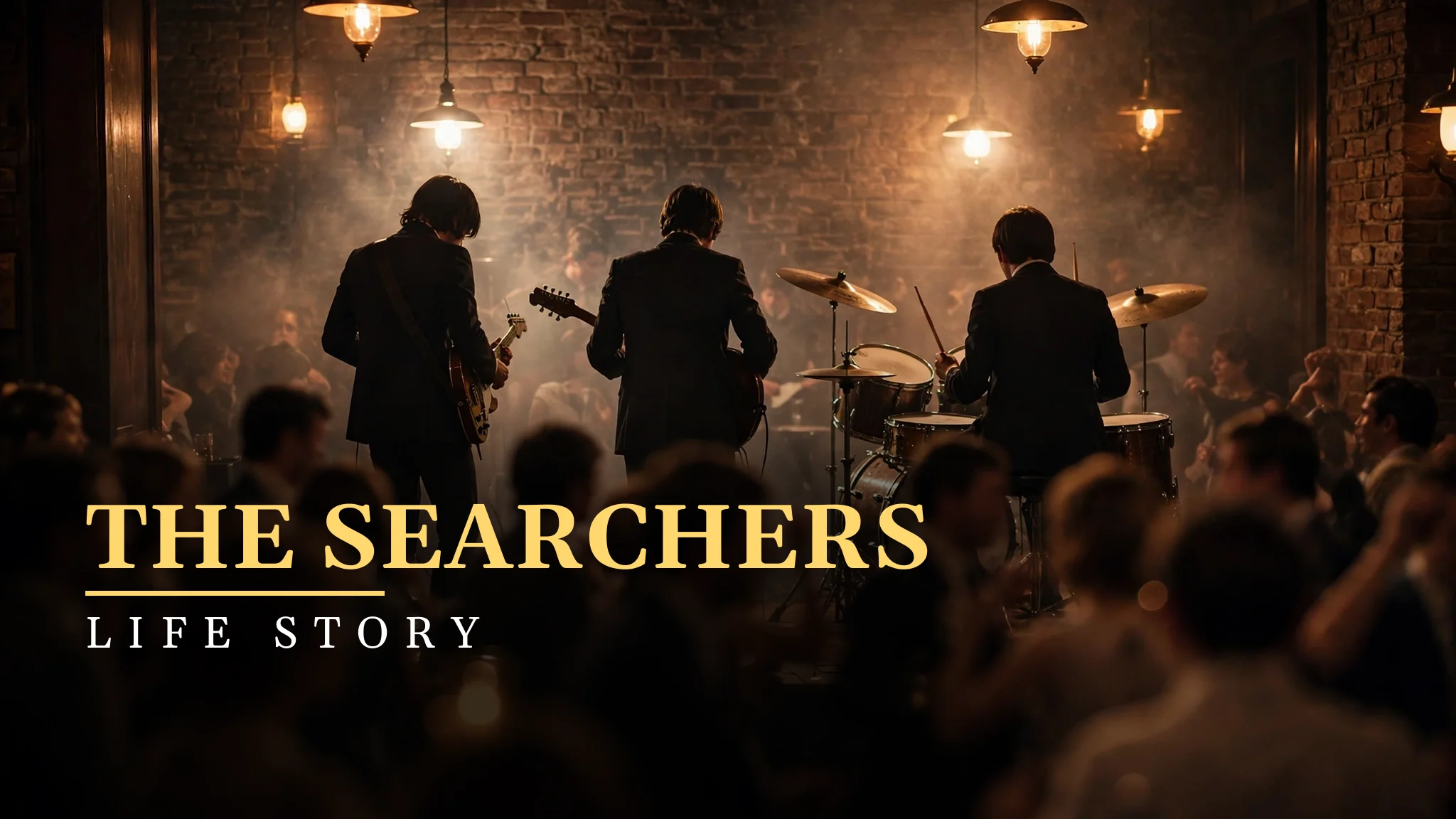
The band played in the Cavern Club, the famous cellar club in Liverpool where the Beatles also played. The Cavern was a dark, crowded place, full of young people who loved American rock and roll, and the bands that played there had to be loud, fast, and exciting. The Searchers learned their trade in the Cavern, playing covers of American songs and developing their own sound. The sound was built on the jangling guitars of McNally and Pender, and on the harmonies of the band’s singers. It was a bright, clear sound, and it stood out from the other bands in Liverpool.
In 1963, the band signed a record deal with Pye Records, and they released their first single, Sweets for My Sweet, a cover of a song by the Drifters. The record reached number one in Britain, and the band were suddenly famous. The song’s sweet harmonies and bright guitars made it a perfect pop record, and it was played on the radio again and again. The band had been working for years, and now, at last, the work was paying off. They were part of the great wave of Liverpool bands that were taking over British music, and they were proud to be from the city that had given the world the Beatles.
The band’s early success was built on hard work. They toured Britain constantly, playing in dance halls and theatres, and they recorded new songs at a fast pace. They were not a band that relied on a single star. They were a group, and the sound of the group was what mattered. That sound, the jangling guitars and the sweet harmonies, would become their trademark, and it would influence many other bands in the years to come.
Needles and Pins and the American Success
In early 1964, the Searchers released Needles and Pins, a song written by the American songwriters Sonny Bono and Jack Nitzsche, and it became one of their most famous records. The song’s opening guitar riff is one of the most recognisable in British pop music, and the band’s harmonies are beautiful. The record reached number one in Britain, and it also became a hit in America, where it reached the top twenty. Needles and Pins is still the song that most people think of when they hear the name the Searchers, and it is a perfect example of the band’s sound.
The band followed Needles and Pins with Don’t Throw Your Love Away, which also reached number one in Britain, and When You Walk in the Room, which became another hit. The band were now one of the biggest groups in Britain, and they toured America, where they played to large crowds of young fans. The American audiences loved the band’s bright, clear sound, and the Searchers were welcomed as part of the British Invasion, the wave of British bands that were taking over American music in 1964 and 1965.
The band’s sound was different from the Beatles’ sound, and that was part of its appeal. The Beatles were clever and experimental, and their songs were full of surprises. The Searchers were simpler and more direct. Their songs were about love, about longing, and about the pain of losing someone, and they sang them with a sincerity that was easy to believe. The band’s harmonies were warm and human, and the guitars rang out like bells. It was a sound that made people feel good, and it was a sound that has lasted.
But the band was about to face a change. Tony Jackson, the bass player and one of the band’s singers, left the group in 1964. He was replaced by Frank Allen, who had been in the band Cliff Bennett and the Rebel Rousers. Allen was a fine bass player and singer, and he fitted into the band well. The change was a sad moment, but the band carried on, and they continued to have hits. The Searchers were a band that knew how to survive change, and that skill would serve them well in the years to come.
The Changing Sixties and the End of the Hits
By the mid-1960s, the music world was changing fast. The Beatles were making more experimental records, and new bands were appearing with different sounds. The Searchers’ bright, jangling pop began to sound old-fashioned to some listeners, and the hits became harder to come by. The band released new singles, including Take It or Leave It and Have You Ever Loved Somebody, but they did not reach the top of the charts as the earlier records had. The band were still popular live, and they toured constantly, but the record sales were slowing down.
The band tried new sounds, and they recorded songs with a more psychedelic feel, but the public did not always follow them. It is a common problem for bands that become famous with one sound: the public wants them to stay the same, but the band wants to grow and change. The Searchers were caught in that trap, and they found it hard to escape. They were a good band, with good songs, but the fashion had moved on, and they were no longer at the centre of it.
In the late 1960s, Chris Curtis, the band’s drummer, left the group. Curtis had been one of the band’s founders, and his departure was a sad moment. The band carried on with new drummers, and they continued to tour, but the classic line-up was gone. The band’s story in the late 1960s is a story of a group that was still working hard, still playing well, and still loved by its fans, but no longer at the top of the charts. It is a story that many bands from the 1960s share, and it is a hard one to live through.
But the Searchers did not give up. They kept touring, they kept recording, and they kept the band’s name alive. They played in Britain, in Europe, and in America, and they built a loyal audience of fans who loved the old songs. The band’s music had become part of the history of British pop, and the people who loved it did not want to let it go. The Searchers were no longer chart stars, but they were still a working band, and they were proud of that.
Sixty Years on the Road
In 1985, Mike Pender left the band, and John McNally became the only original member left. Pender had been one of the band’s founders, and his departure was a major moment. But McNally did not give up. He kept the band going with new members, and he continued to tour. The band’s line-up changed over the years, but McNally was always there, playing rhythm guitar and singing the old songs. His loyalty to the band was remarkable, and it is one of the reasons the Searchers lasted as long as they did.
The band toured for decades, playing the old hits to audiences who still loved them. They played in theatres, in clubs, and at festivals, and they were welcomed wherever they went. The audiences were a mix of older fans who remembered the 1960s and younger people who had discovered the music through their parents. The band’s songs had become part of the soundtrack of British life, and the people who came to the concerts wanted to hear them one more time. The Searchers gave them what they wanted, and they did it with skill and with warmth.
In 2019, the band announced that they would retire. John McNally was seventy-eight years old, and he had been playing in the band for more than sixty years. The farewell tour was a celebration of the band’s long career, and the audiences were full of people who had loved the band for decades. The final concert was an emotional moment, and it marked the end of one of the longest careers in British pop music. The Searchers had started in the Cavern Club in Liverpool, and they had ended as one of the most enduring bands in the history of British music.
The band’s retirement was not a sad ending. It was a fitting end to a long and honourable career. The Searchers had never been the biggest band in the world, but they had been a good band, a hard-working band, and a band that had given joy to millions of people. They had lasted for sixty years, and that is an achievement that very few bands can match. John McNally’s loyalty, and the band’s love of the music, had carried them through six decades, and that is something to be proud of.
What the Searchers Left Behind
The legacy of the Searchers is in the sound. The jangling guitars, the sweet harmonies, and the clear, bright pop songs influenced many other bands. The Byrds, the American band who became famous in the mid-1960s, were influenced by the Searchers’ guitar sound, and the jangling guitar became a key part of the sound of folk rock and later of indie music. The Searchers did not invent the jangling guitar, but they made it popular, and they showed how beautiful it could sound. That influence is still heard today, in the music of bands who play bright, melodic pop with ringing guitars.
The band also left a lesson about endurance. The Searchers lasted for more than sixty years, and they did it by working hard, by respecting the audience, and by never giving up. They were not a band that relied on fashion, and they were not a band that tried to be something they were not. They were a band from Liverpool who made good pop music, and they kept making it for as long as they could. That is a simple lesson, but it is a powerful one, and it is one that many younger bands could learn from.
The band’s songs are still played today, and they still sound fresh. Needles and Pins, Sweets for My Sweet, and Don’t Throw Your Love Away are part of the history of British pop, and they will be for a long time. The Searchers were masters of the pop song, and their records are a testament to their skill. They may not have been the most famous band from Liverpool, but they were one of the best, and their music deserves to be remembered.
The Jangle: How the Searchers’ Guitars Changed Pop
The Searchers’ sound was built on the guitars, and the guitars were built on a simple idea: two electric guitars playing bright, ringing notes that sounded like bells. John McNally played rhythm guitar, and Mike Pender played lead, and together they created a sound that was clear, melodic, and instantly recognisable. The sound was called jangle, and it became the band’s trademark. When you heard a Searchers record, you knew it was them, because no other band sounded quite like that. The jangle was the heart of the band’s music, and it is why their records still sound so fresh today.
The jangling guitar sound was not an accident. It came from the band’s love of American music, especially the folk and country records that featured bright, ringing guitars. The band listened to those records, and they tried to capture that sound with their own instruments. They used twelve-string guitars, which have a fuller, richer sound than a normal six-string guitar, and they played with a clean, precise style. The result was a sound that was both simple and beautiful, and it influenced many other bands in the years to come.
The most famous example of the jangle is the opening riff of Needles and Pins, a short, bright guitar figure that is one of the most recognisable in British pop music. The riff is simple, but it is perfect, and it sets the tone for the whole record. The band’s other hits, like Sweets for My Sweet and When You Walk in the Room, also feature the jangling guitars, and they are part of what makes those records so memorable. The Searchers did not just play songs. They played a sound, and that sound became a part of pop music history.
The Searchers in America and the British Invasion
The Searchers were part of the British Invasion, the wave of British bands that took over American music in 1964 and 1965. The band toured America, and they played to large crowds of young fans who loved their bright, clear sound. The American audiences were excited by the British bands, and the Searchers were welcomed as part of that wave. They appeared on television, they were featured in magazines, and their records sold well in the United States. Needles and Pins reached the top twenty in America, and the band’s other records were also popular.
The American tours were hard work, and the band were away from home for long periods. They travelled by plane, by bus, and by car, and they played night after night in different cities. It was exciting, but it was also exhausting, and the band had to learn how to cope with the pressure of being famous in a foreign country. They did it with professionalism and with humour, and they were welcomed wherever they went. The American fans loved the band’s harmonies and their guitars, and the band loved the American audiences.
The British Invasion was a remarkable moment in music history, and the Searchers were a part of it. The Beatles were the leaders, but the Searchers, Gerry and the Pacemakers, the Dave Clark Five, and many other bands were also there, and they all contributed to the sound that took over America. The Searchers’ part in that story is often forgotten, but it should not be. They were a good band, they made great records, and they helped to show the world that British pop music was something special. Their American success was real, and it is a part of their legacy that deserves to be remembered.
The Searchers’ Later Records and the Changing Sound
In the late 1960s and 1970s, the Searchers continued to record, even though the hits had stopped coming. They released albums and singles that showed a band trying new sounds and new ideas. Some of the records were more psychedelic, some were more country-influenced, and some were closer to the folk-rock that was becoming popular. The band were not afraid to experiment, and they were willing to take risks. The records did not sell as well as the early hits, but they showed a band that was still creative, still curious, and still trying to grow.
The band’s later records are not as famous as Needles and Pins, but they are worth listening to, because they show a band that was more than just a hit machine. The Searchers were musicians, and they wanted to make music that interested them, even if the public did not always follow. That willingness to experiment is a sign of a real band, and it is a part of the Searchers’ story that deserves to be remembered. A band that only repeats its hits is a band that has stopped growing, and the Searchers never stopped growing.
The band also recorded songs written by other songwriters, and they continued to work with good producers. Their later albums were well made, and they showed the band’s professionalism and their love of music. The records may not have been hits, but they were honest, and they were made with care. That is a valuable lesson: a record does not have to be a hit to be good, and a band does not have to be at the top of the charts to be worth listening to. The Searchers proved that, and their later records are a testament to their dedication.
The band’s changing sound also reflected the changes in the music world. The 1960s were a time of rapid change, and the Searchers changed with them, trying new styles and new ideas. They were not a band that stood still, and they were not afraid of the future. That openness to change is a part of why they lasted for so long. A band that refuses to change will be left behind, but a band that is willing to try new things can survive for decades. The Searchers were willing, and they survived.
The Searchers also played an important part in the story of British music television. In the mid-1960s, the band appeared on shows like Top of the Pops, Ready Steady Go!, and the American programme Shindig, and those appearances helped to spread their music to audiences who had never seen them live. Television was a new and powerful medium, and the band understood how to use it. They were professional, they were well rehearsed, and they gave a good performance every time. Those television appearances are a part of the band’s legacy, and they are a reminder of a time when a band could become famous by playing well on a small black-and-white screen.
My Take:
When I think about the Searchers, I think about a band that never gave up. That is the first thing that comes to mind, and it is the thing I admire most. They were famous in 1963 and 1964, and then the hits stopped coming, and most bands would have broken up. The Searchers did not break up. They kept playing, they kept touring, and they kept the band alive for more than sixty years. John McNally was in the band from the beginning to the end, and that kind of loyalty is very rare. I think about how many people give up when things get hard, and I think about McNally, who kept going for six decades, and I feel a deep respect for him.
I love the band’s sound, too. The jangling guitars, the sweet harmonies, the clear, bright pop songs: it is a sound that makes me happy. Needles and Pins is a perfect pop record, and it is one that I never get tired of hearing. The opening guitar riff is like a bell ringing, and the harmonies are warm and human. I think the band’s sound is a reminder that pop music does not need to be complicated to be good. It needs to be well made, it needs to be honest, and it needs to be sung with feeling. The Searchers understood that, and their records prove it.
I also think about Liverpool, and about what it means to be from a city that gave the world the Beatles. The Searchers were from the same city, they played in the same clubs, and they were part of the same wave of music. But they were always in the Beatles’ shadow, and that must have been hard. I wonder how it felt to be a good band from Liverpool, knowing that the most famous band in the world was also from Liverpool, and that you would always be compared to them. The Searchers did not let that stop them. They made their own music, they found their own audience, and they built a career that lasted longer than almost any other band from that time. That is a quiet kind of triumph, and I admire it.
There is a sadness in the band’s story, too, and I do not want to ignore it. The band lost members, they lost the charts, and they lost the fame. They went from playing to thousands of people to playing in smaller halls, and they had to accept that the world had moved on. That must have been hard, especially for men who had once been at the top. But they handled it with dignity. They did not complain, they did not blame anyone, and they did not pretend that the past was still the present. They kept working, and they kept playing the songs that people loved. That is a lesson in how to age gracefully, and it is one that I think about often.
I also think about the band’s influence, and about how many musicians learned from them without knowing it. The Byrds, one of the most important American bands of the 1960s, were influenced by the Searchers’ guitar sound, and the jangling guitar became a key part of folk rock and indie music. That means that the Searchers’ sound is still alive today, in the music of bands who have never heard of the Searchers. I find that beautiful. A band makes a sound, the sound travels, and it lives on in other people’s music, even when the band itself is forgotten. That is a kind of immortality, and it is one that the Searchers earned.
I feel happy when I think about the band’s farewell tour in 2019, and about the audiences who came to say goodbye. It must have been a wonderful feeling for John McNally, after sixty years, to stand on stage and see people who had loved the band for decades. It must have been sad, too, to know that it was the end. But it was a fitting end, and it was an ending that the band chose for themselves. They did not break up in anger, and they did not fade away. They said goodbye, they played the old songs one last time, and they left the stage with dignity. I think that is the best way for a band to end, and I am glad that the Searchers did it that way.
If I could say one thing to a young musician today, it would be this: keep going. The Searchers’ story is a story of a band that kept going when it would have been easier to stop. They kept playing, they kept touring, and they kept the music alive for sixty years. That is not a glamorous lesson, but it is a true one. The people who succeed are not always the most talented. They are often the ones who refuse to stop, who keep working, and who love the music enough to carry on when nobody is watching. The Searchers did that, and their story is a testament to the power of persistence.
In the end, I think the Searchers teach us that a band does not have to be the biggest to be the best, and it does not have to be famous to be worthwhile. The Searchers were a good band, a hard-working band, and a band that gave joy to millions of people. Their songs are still played, their sound is still heard, and their story is still told. That is a wonderful legacy, and it is one that they earned by working hard, by staying loyal to each other, and by never forgetting where they came from. I am glad that they kept going for sixty years, and I am glad that their music is still with us.
I also think about the band’s American tours, and about how exciting it must have been to be part of the British Invasion. The Searchers were young men from Liverpool, and suddenly they were playing in America, appearing on television, and being treated like stars. That is a remarkable experience, and it is one that very few people ever have. I think about how it must have felt to walk onto a stage in New York or Los Angeles, thousands of miles from home, and to hear an audience singing your songs. That must have been a wonderful feeling, and I am glad that the band got to experience it. The British Invasion was a moment in history, and the Searchers were a part of it.
There is a lesson in the Searchers’ story about the importance of being yourself. The band did not try to be the Beatles, and they did not try to be anyone else. They were a band from Liverpool with a bright, jangling sound, and they were proud of it. That honesty is why their music has lasted. The bands that try to copy someone else are forgotten, but the bands that sound like themselves are remembered. The Searchers sounded like themselves, and that is why their records are still played today. I think that is a lesson for anyone who creates something: be yourself, and the right people will find you.
I also think about John McNally, and about his loyalty to the band. He was there from the beginning to the end, for more than sixty years, and he never gave up. That is an extraordinary achievement, and it is a sign of his character. He loved the band, he loved the music, and he loved the audience, and he kept going for as long as he could. I think about how many people give up when things get hard, and I think about McNally, who kept playing for six decades, and I feel a deep respect for him. He is a model of persistence, and his story is an inspiration.
One more thought stays with me, and it is about the Cavern Club, and about the place where the band began. The Cavern was a dark, crowded cellar in Liverpool, and it was where the Searchers learned to play. It was not a glamorous place, but it was a place where young musicians could learn their trade, and where they could find an audience. I think about all the bands that played in the Cavern, and about how many of them are forgotten, and I am glad that the Searchers are not among them. They started in a cellar, and they ended as one of the longest-lasting bands in British music. That is a remarkable journey, and it began in a small, dark room in Liverpool.
In the end, I think the Searchers teach us that a band does not have to be the biggest to be the best, and that a long career is built on hard work, on loyalty, and on a love of music. The Searchers were a good band, a hard-working band, and a band that gave joy to millions of people. Their songs are still played, their sound is still heard, and their story is still told. That is a fine inheritance, earned through hard work, loyalty to each other, and respect for the audience. I am glad that they kept going for sixty years, and I am glad that their music is still with us.
I also think about the band’s later records, and about how they show a band that was still trying, still experimenting, and still growing. The Searchers did not just repeat their hits. They tried new sounds, they worked with new songwriters, and they made records that interested them, even when the public did not follow. I admire that, because it is easy to repeat what worked before, and it is hard to try something new. The band tried, and even when the records did not sell, they were honest, and they were made with care. That is a lesson for any artist: do not be afraid to experiment, and do not be afraid to fail. The trying is what matters, and the Searchers kept trying for sixty years.
There is a lesson in the Searchers’ story about the importance of being a professional. The band were known for being reliable, for being well rehearsed, and for giving a good show every night. They did not cancel concerts, they did not turn up late, and they did not give a poor performance. That professionalism is a key part of their success, and it is why they were trusted by promoters and by audiences. A band that is professional is a band that lasts, and the Searchers proved it. I think that is a valuable lesson for anyone in any field: do your work well, do it on time, and treat people with respect, and you will be rewarded.
I also think about the band’s fans, and about how the music has been passed down. The people who loved the Searchers in the 1960s played the records for their children, and the children played them for their children. The songs have travelled through time, from one generation to the next, and they are still loved today. That is a wonderful thing, and it is a sign that the music was good. A song that is still sung sixty years after it was written is a song that has done its job, and the Searchers wrote several of those songs.
One more thought stays with me, and it is about the importance of a band’s name. The Searchers took their name from a film, a Western starring John Wayne, and the name suited them. It was tough, romantic, and memorable, and it gave the band an identity. A good name is important for a band, because it is the first thing people hear, and it is the thing they remember. The Searchers had a good name, and they lived up to it. They searched for a sound, they searched for an audience, and they searched for a way to keep going. They found all three, and they kept searching for sixty years.
I also think about the city of Liverpool, and about what it meant to the band. The Searchers were from Liverpool, and they were proud of it. They played in the Cavern, they sang about their city, and they carried its spirit with them wherever they went. Liverpool is a city with a great musical history, and the Searchers are a part of that history. They were not the most famous band from Liverpool, but they were one of the best, and they were one of the longest-lasting. That is a wonderful achievement, and it is one that the city should be proud of.
Finally, I want to say that the Searchers were a band that gave people joy, and that is the most important thing I can say about them. They made songs that made people dance, sing, and smile, and they did it with skill and with heart. Their story has sadness in it, as all real stories do, but the music is still joyful, and that joy is what I remember. When I hear Needles and Pins, I hear two guitars ringing like bells, and voices singing in harmony, and I am glad that they did, and glad that the song is still here for us to hear.
Frequently Asked Questions
Who were the Searchers?
The Searchers were a British pop band from Liverpool, formed in the late 1950s. Their classic line-up was John McNally on rhythm guitar, Mike Pender on lead guitar and vocals, Chris Curtis on drums and vocals, and Tony Jackson on bass and vocals. They were part of the Merseybeat scene that also produced the Beatles.
What are the Searchers’ most famous songs?
The Searchers’ most famous songs include Sweets for My Sweet, Needles and Pins, Don’t Throw Your Love Away, and When You Walk in the Room. Needles and Pins is their best-known record, and it reached number one in Britain in 1964.
What is Merseybeat?
Merseybeat was the name given to the pop music that came out of Liverpool in the early 1960s, named after the River Mersey. The Beatles were the most famous Merseybeat band, but the Searchers, Gerry and the Pacemakers, and many other Liverpool bands were also part of the scene.
How long did the Searchers last?
The Searchers lasted for more than sixty years, from the late 1950s until their retirement in 2019. John McNally was in the band from the beginning to the end, and he played rhythm guitar for the whole of the band’s career. The farewell tour in 2019 marked the end of one of the longest careers in British pop music.
Did the Searchers influence other bands?
Yes, the Searchers’ jangling guitar sound influenced many other bands, including the Byrds in America, who became famous for their bright, ringing guitars in the mid-1960s. The jangling guitar sound later became a key part of folk rock and indie music, and it is still heard today.
Why did the Searchers retire?
The Searchers retired in 2019 because John McNally, the band’s only remaining original member, was seventy-eight years old and had been playing in the band for more than sixty years. The farewell tour was a celebration of the band’s long career, and it allowed the band to say goodbye to their fans with dignity.
Where did the Searchers get their name?
The band took their name from the film The Searchers, a Western starring John Wayne, released in 1956. The name sounded tough and romantic, and it suited a young band from Liverpool who wanted to make their mark on the world.


