The Wombats: The Life Story Behind the Let's Dance to Joy Division Band
In this post
- Three Strangers in a Liverpool Classroom
- The Wombat in the Room
- 2007: The Year the Joke Landed
- Tokyo and the Second Album’s Wider Lens
- Los Angeles, Greek Tragedy, and Growing Older in Public
- The Quiet Years That Were Not Quiet at All
- What the Crowd Does When That Song Starts
- Murphy’s Notebook: Jokes, Small Details, Honest Lines
- My Take:
Joy Division never made anybody dance. That was the whole point of them. Their songs sounded like empty rooms at two in the morning, all cold bass and Ian Curtis singing as though the light had gone out for good. So when a young band from Liverpool wrote a chorus telling a crowded room to dance to Joy Division, the joke landed before the first verse had even finished. It was funny because it was wrong, and it was catchy because the band behind it knew exactly how a great pop chorus works. The song was called Let’s Dance to Joy Division, and it turned three students into one of the most recognisable names in British indie music.
The three students were Matthew Murphy, Dan Haggis and Tord Øverland Knudsen. Murphy sang and played guitar, and he wrote the words. Haggis sat behind the drums. Knudsen, a bass player from Norway who had come to Liverpool to study, held the bottom end together. They found each other at the Liverpool Institute for Performing Arts in 2003, a school for musicians and performers that Paul McCartney had helped to set up in the city where the Beatles began. Liverpool has never let a band forget its musical past. Every rehearsal room there sits in the shadow of four lads from the sixties, and every new group has to decide whether to run from that shadow or use it. The Wombats did neither. They laughed at it, and then they got on with writing songs that sounded like a Friday night.
What followed was not a short burst of fame followed by silence. Plenty of bands from 2007 burned brightly for one summer and then vanished, but the Wombats kept returning with new records, new tours and the same restless energy. By 2025 they had released seven studio albums, and their concerts still ended with thousands of people shouting the words to a song about dancing to miserable music. The joke had become a career, and the career had become a kind of proof: a band can be silly and serious at the same time, and the audience will follow it for twenty years if the tunes hold up.
Three Strangers in a Liverpool Classroom
In 2003, Matthew Murphy was a guitar player with a notebook full of jokes and observations, the kind of songwriter who notices the awkward thing somebody said at a party and turns it into a chorus. Dan Haggis was a drummer with a hard, straight-ahead style, the sort of player who drives a song forward rather than decorating it. Tord Øverland Knudsen had travelled from Norway to study music in England, and he brought a bass player’s patience with him, a willingness to sit underneath a song and make it move. None of the three arrived in Liverpool as stars. They arrived as students, sharing classrooms, rehearsal rooms and cheap flats, and the band grew out of that ordinary student life the way most good bands do: slowly, then all at once.
The Liverpool Institute for Performing Arts, usually shortened to LIPA, gave them something more useful than a diploma. It gave them a room full of other young musicians, a timetable that left evenings free, and a city with pubs and clubs that would let an unknown band play on a Tuesday. Liverpool in the early 2000s was full of guitar bands trying to be noticed, and the competition was fierce. A new group had to be loud enough to be heard over the next group, and funny enough to be remembered the morning after. The Wombats learned that lesson on small stages, in front of audiences that were mostly other students, and they learned it quickly.
Their early material was already unmistakable. The guitars were fast and bright, the drums hit hard, and Murphy’s voice had a yelping, excitable quality that made even a complaint sound like a celebration. The words were about the stuff of student life: nights out that went wrong, crushes that went nowhere, friends who talked too much, and the strange feeling of being young in a city that never seemed to sleep. Other bands at the time were writing about politics or poetry. The Wombats wrote about the night before, and the audience recognised itself in every line.
By 2005, two years after they first played together, the band had a record deal and a set of songs that were ready to be heard beyond Liverpool. That is a fast rise by any measure, but it did not feel fast to the three of them. They had spent those two years rehearsing, gigging, arguing about arrangements, and learning how to turn a good idea into a finished song. The deal simply meant that the next step would be bigger, with more people listening and more pressure to deliver.
The Wombat in the Room
Every band needs a name, and the Wombats picked one that sounded like a punchline. A wombat is a stocky, waddling marsupial from Australia, an animal nobody would describe as cool. That was the point. In a year when indie bands were calling themselves things that sounded dark and important, three lads from Liverpool chose an animal that looks faintly embarrassed by its own existence. The name told you everything about the band before you heard a note: they were not going to pretend to be tortured geniuses, they were going to make you laugh, and the laughter was going to be the delivery system for some very sharp pop songs.
A silly name is also a practical tool. Nobody forgets it. A promoter remembers it, a festival booker remembers it, and a fan who heard one song on the radio can find the band again without guessing the spelling. The Wombats understood that instinctively. They leaned into the joke rather than apologising for it, and the joke became a kind of armour. Critics who wanted to dismiss them as a novelty act had to get past the fact that the songs were genuinely well built, with choruses that stuck in the head for days and arrangements that left no wasted space.
Underneath the humour, the musicianship was serious. Murphy’s guitar parts were short, spiky and melodic, never showing off, always serving the song. Knudsen’s bass lines were busy and musical, pushing the songs along from underneath rather than simply following the guitar. Haggis played the drums like a man in a hurry, all drive and attack, and that urgency gave the band its signature rush. Put together, the three of them made a sound that was bigger than a trio has any right to be, and that fullness is a large part of why their records still sound exciting today.
2007: The Year the Joke Landed
The debut album arrived in 2007, and it had a title that was almost as funny as the band’s name: A Guide to Love, Loss and Desperation. It sounded like a handbook nobody would want to read, and that was the joke. Inside it were the songs the band had been sharpening for years, and they landed with real force. The album reached number eleven in the British charts, a remarkable result for a first record by a band that had started out playing student bars, and it announced the Wombats as far more than a one-song act.
The album opened with Tales of Girls, Boys and Marsupials, a burst of speed that set the tone in under three minutes. Kill the Director followed with a driving, frustrated energy, and Moving to New York offered a brighter, more hopeful kind of rush, a song about packing up and starting again somewhere new. Backfire at the Disco took a night out that collapses into chaos and turned it into a singalong, the kind of song where the crowd knows the words before the second chorus. Each track had its own shape, and together they added up to a portrait of being young, broke, hopeful and slightly ridiculous.
At the centre of the record sat Let’s Dance to Joy Division. The idea is simple enough to explain in one sentence: a party where the DJ puts on the saddest band in history, and everybody dances anyway. But the execution is what made it last. The guitars sparkle, the drums push, and Murphy delivers the words with a grin you can hear. The song works because it is true. Everyone has danced to a sad song at a party, pretending to have a good time, and the Wombats simply said the quiet part out loud. It became one of the defining songs of 2007, and it has never really gone away. It turns up at weddings, at festivals, on radio playlists, and in the heads of people who have not thought about indie music in years.
Success arrived quickly, and it changed the band’s life in practical ways. They went from small clubs to festival stages, from sharing a van to playing rooms where the crowd stretched further than the eye could see. They toured the album hard, and the touring taught them how to be a professional band: how to play the same songs night after night without losing the spark, how to look after their voices and their tempers, and how to enjoy the strange business of being recognised by strangers. It was exhilarating, and it was exhausting, and it set the pattern for everything that came after.
Tokyo and the Second Album’s Wider Lens
Four years passed before the second album, and in that time the band grew up in the ways that matter. This Modern Glitch arrived in 2011, and it sounded like a group that had travelled, listened harder, and learned how to polish a song without sanding away its edges. The record reached number three in Britain, higher than the debut, and it proved that the Wombats were not a one-album curiosity. They had a second act in them, and it was stronger than the first.
Tokyo was the song that carried the album furthest. It is a bright, restless track about a city that never stops, and about the feeling of wanting to escape to somewhere bigger and stranger than home. The chorus lifts the way a good pop chorus should, and the song found its way onto the radio, into films and television shows, and into the setlists of every festival the band played. Jump into the Fog offered something moodier, a song with shadows in it, while Techno Fan nodded towards dance music, a reminder that the band had always loved a beat you could move to.
The touring behind This Modern Glitch took the Wombats further than they had ever been. They played bigger rooms in Britain, and they played to audiences in Europe, America and Australia who had found them through the internet and through word of mouth. A band that starts in Liverpool student bars does not expect to be singing its songs to crowds on the other side of the world, but that is what happened, and the experience changed the way they wrote. The songs got a little wider, a little more open, as though the band had learned that their audience was no longer just the kids in the front row of a Liverpool club.
There was pressure, too, and it would be dishonest to pretend otherwise. A second album is the moment when a band finds out whether the first one was luck or talent, and the Wombats answered that question by making a record that was more ambitious and more confident. The friendships inside the band were tested by the sheer amount of time spent together on the road, in vans and hotels and airports, but the three of them had something that many bands lack: they actually liked each other, and they liked the music they made together. That fondness carried them through the hardest stretches.
Los Angeles, Greek Tragedy, and Growing Older in Public
By 2015, Matthew Murphy was spending time in Los Angeles, and the city’s sunshine worked its way into the band’s third album. Glitterbug sounded brighter and glossier than anything the Wombats had made before, with synthesisers sitting alongside the guitars and a polish that suited the songs. It reached the top five in Britain, and it gave the band a new signature song in Greek Tragedy, a track about a relationship falling apart that somehow manages to be funny, catchy and sad all at once.
Greek Tragedy deserves a closer look, because it shows how far Murphy had come as a writer. The song takes a classical idea, the tragedy, and drops it into an ordinary break-up, with all the small humiliations and misunderstandings that real endings involve. The melody is one of the band’s best, the kind that sounds inevitable once you have heard it, and listeners kept returning to it long after the album’s release. It became one of their most streamed songs, and it introduced the band to a younger audience who had missed the 2007 wave entirely.
The album that followed, Beautiful People Will Ruin Your Life, arrived in 2018, and it had a warmer, more reflective feeling. Cheetah Tongue was one of its sharpest moments, a fast song with a sting in its tail, but the record as a whole sounded like a band that was comfortable in its own skin. The Wombats were no longer the new kids. They were veterans, and they were writing about adult life: relationships that last, relationships that fail, and the strange business of getting older while your audience stays young. The humour was still there, but it had deepened, and the songs had more room to breathe.
These middle years matter because they are where most bands fade. The first rush of fame passes, the charts move on to the next new thing, and a group has to decide whether to keep going for the love of it or to stop. The Wombats kept going, and they did it without bitterness. They toured, they recorded, and they treated each new album as a fresh start rather than a victory lap. That attitude is rarer than it sounds, and it is a large part of why they are still here.
The Quiet Years That Were Not Quiet at All
The pandemic stopped live music for everyone, and for a band that lives on stage, that was a strange and difficult pause. The Wombats used the time to write, and the result was Fix Yourself, Not the World, released in 2022. The title says a lot about where Murphy’s head was: a record about change, about hope, and about the things a person can actually control when the world feels out of control. It reached the top three in Britain, which is a remarkable result for a band fifteen years into its career, and it showed that the audience had not gone anywhere.
Then, in 2025, came Oh! The Ocean, another full album, and another round of touring. Plenty of groups from the Wombats’ generation had stopped making new music by then, content to play the old hits on the festival circuit. The Wombats chose the harder path. They kept writing, kept recording, and kept putting new songs in front of audiences who could easily have asked for the old ones instead. The critics noticed, and the new record was praised for its energy and its craft, but the more important verdict came from the crowds, who sang along to the new material as though they had known it for years.
There is a lesson in this part of the story, and it is not a complicated one. A band that keeps making new work stays alive in a way that a band living off its past cannot. The Wombats understood that early, and they have never stopped. Their later albums are not footnotes to the debut. They are the reason the band still matters, because they prove that the joke at the start was attached to real songwriters who kept getting better.
The three of them have also grown into different people since 2003. They are older, they have families and lives outside the band, and they no longer live in the student flats where it all began. What has not changed is the way they work together. Murphy still brings the words and the melodies, Haggis still drives the songs forward, and Knudsen still finds the bass line that makes a chorus lift. The chemistry that worked in a Liverpool rehearsal room still works on a festival stage, and that continuity is the quiet engine of the whole story.
What the Crowd Does When That Song Starts
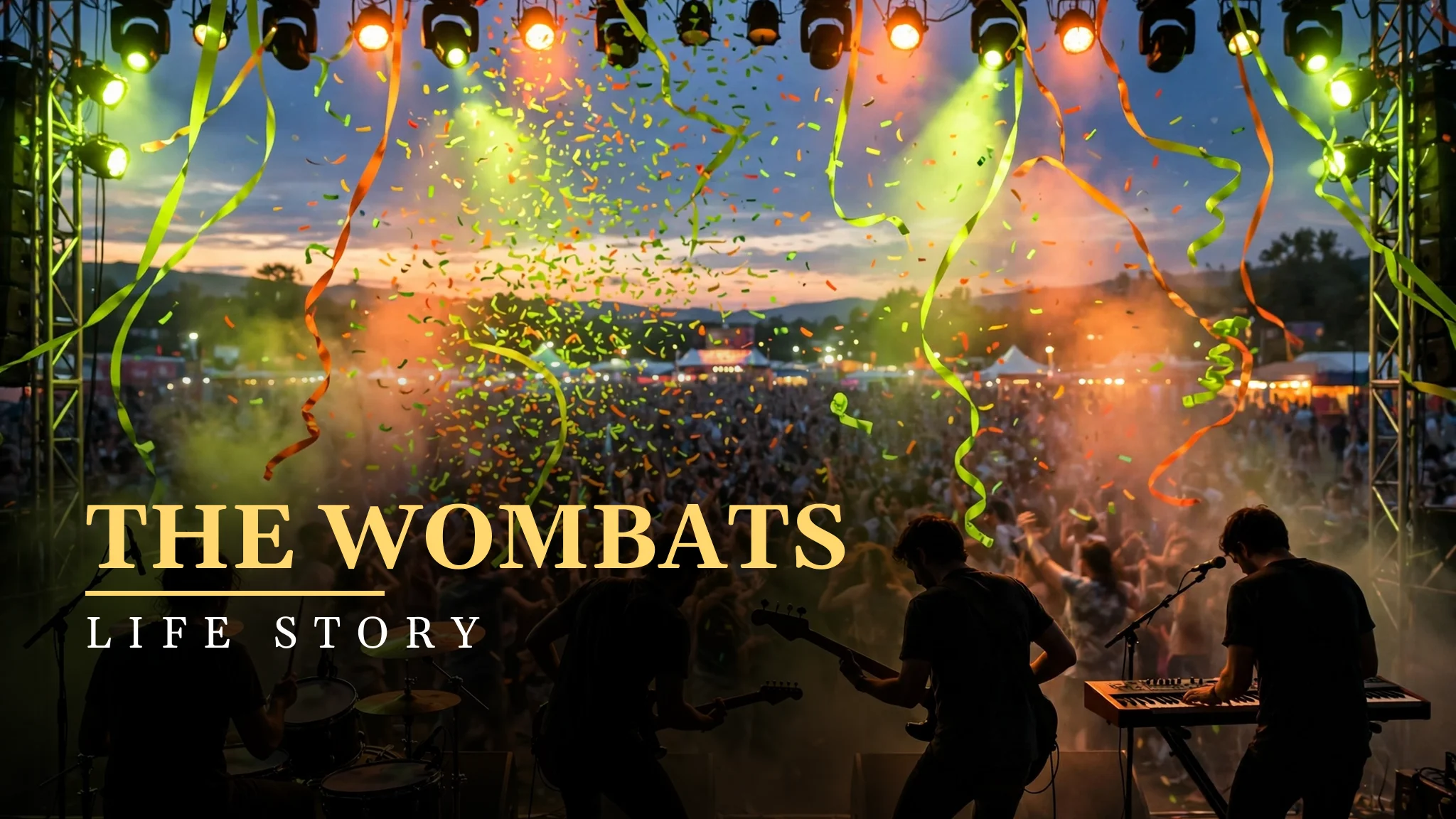
Ask anyone who has seen the Wombats live what the best moment is, and the answer is almost always the same. It is the moment when the opening notes of Let’s Dance to Joy Division ring out, and the whole room changes. People who have been standing politely suddenly start jumping. Strangers put their arms around each other. The singing gets louder than the band, and for three minutes, the room belongs to the crowd as much as to the people on stage. It is a small, joyful riot, and it has happened hundreds of times in hundreds of places.
Murphy is a large part of why the shows work. He talks to the audience like they are old friends, cracking jokes between songs, telling small stories about the tour, and making each night feel specific to the people in that room. He does not hide behind cool detachment. He is warm, funny and slightly chaotic on stage, and the crowd responds to that openness by giving more back. Haggis and Knudsen hold the music together with the confidence of musicians who have played these songs thousands of times, and that steadiness lets Murphy take risks with the performance.
The band’s concerts have always been about the songs rather than the spectacle. There are no elaborate costumes, no giant screens trying to distract you, no sense that the music is the least important part of the evening. The guitars are loud, the drums are hard, and the choruses are built for a thousand voices at once. Old songs sit next to new ones without any fuss, and the audience treats both the same way, which is the highest compliment a crowd can pay a band that has been going for twenty years.
The crowds themselves have changed over time, and that is one of the most interesting things about a Wombats show in recent years. The front rows now hold two generations at once: fans who were students in 2007, and younger listeners who found the band through streaming, through a friend, or through a parent’s record collection. They sing the same words, and they mean them in slightly different ways, and the band plays to both groups without choosing between them. That is a rare achievement, and it is why the Wombats still fill festival fields.
Murphy’s Notebook: Jokes, Small Details, Honest Lines
At the centre of all of this sits Matthew Murphy’s writing, and it is worth spending a moment on what makes it different. Most pop lyrics aim for the grand statement. Murphy aims for the small, true detail: the awkward text message, the party that went wrong, the thing you said that you wished you could take back. His songs are full of jokes, but the jokes are not decoration. They are the way he tells the truth, and they let him write about embarrassment, longing and disappointment without sounding miserable about any of it.
His voice is part of the trick. It is bright and excitable, with a yelp in it that makes even a sad line sound like it is being delivered with a grin. When he sings about dancing to Joy Division, you can hear a young man laughing at himself, and that laughter is catching. The listener starts smiling, and then starts singing, and by the end of the chorus the joke has become a celebration. Very few singers can pull that off. It takes confidence, timing, and a willingness to look slightly ridiculous, and Murphy has all three.
Murphy has also tried his hand at music outside the band, writing and recording under his own name and working with other artists. Those projects show a songwriter who is always curious, always listening for a new sound or a new idea, but they also show why the band matters so much to him. On his own, he is a clever writer. With Haggis and Knudsen, he is part of something bigger, a trio where each person makes the other two better. The drums give his melodies urgency, the bass gives them depth, and the three of them together give a joke the weight of a real song.
Today, Murphy is still writing, still singing, and still standing at the front of a band he started as a student. He does not chase the spotlight for its own sake, and he shares the stage generously with his bandmates. That generosity, more than any single song, explains why the Wombats have lasted. A frontman who understands that a band is a team, and who writes songs that treat the audience like friends, is a frontman whose band will keep being invited back. The Wombats were invited back for twenty years, and on the evidence of Oh! The Ocean, they will keep being invited back for a while yet.
My Take:
When I listen to The Wombats, I feel young. That is the plainest way to put it, and also the truest. Their music is fast, it is funny, and it is full of energy. Let’s Dance to Joy Division makes me want to dance, Moving to New York makes me smile, and the whole sound of the band feels like a good night out with friends. So much new music takes itself very seriously, which makes a group that only wants its listeners smiling feel oddly precious.
I admire the band most for the joy of their debut. A Guide to Love, Loss and Desperation is an album that sounds as if it was made by people who were having the time of their lives, and that joy is catching. The tunes hook you, the instruments hit hard, and the record as a whole feels like a celebration. Catching that kind of spark on a studio recording strikes me as genuinely difficult. Plenty of groups reach for happiness in their songs and only manage to sound strained. The Wombats sound natural, as if the joy is real, and that is because it was real. They were students, they were in Liverpool, and they were making the music they loved.
I also admire Matthew Murphy as a songwriter, because he writes songs that are funny and honest at the same time. He writes about parties, about love, about the strange things that happen when you are young, and he writes about them with humour. That humour is a gift. Many songwriters write about love in a serious way, and they forget to be funny. Murphy remembers to be funny, and that makes his songs feel real. When he sings Let’s Dance to Joy Division, I hear a young man who is laughing at himself, and that laughter is catching.
What I find interesting in their story is the way they have grown up. Their early songs were about student life, about nights out, and about being young. Their later songs are about adult life, about relationships, about the world we live in. That growth is natural, and it is honest. The band did not try to stay young forever. The listeners aged alongside them, and the writing matured in step. I respect them for that. It is easy to keep writing the same songs. It is harder to write new songs about a new stage of life, and The Wombats have done it well.
I have mixed feelings about the years after the debut. The band made good records, but they did not have the same impact as the first album. That is not a criticism of the band. It is a fact of music. A debut album that is as joyful as A Guide to Love, Loss and Desperation is hard to follow, and the band knew that. They carried on recording and carrying on playing live, and that persistence is the point. One famous chorus should never be the whole measure of what a group has done. It should be judged by its whole career, and The Wombats have had a good career.
For a young musician, I think the lesson of The Wombats is to have fun. Music does not always have to be serious. It can be loud, it can be funny, and it can make people dance. When musicians are clearly having fun, the people watching tend to have fun as well. The Wombats understood that, and their best songs are full of joy. That joy is not a small thing. That lightness is a present, and plenty of groups never think to hand it over.
There is a lesson about friendship tucked inside this band’s history, too. Murphy, Haggis, and Knudsen met at university, and they have been together for more than twenty years. That is a long friendship, and it has survived touring, recording, and many changes in the music world. The reason is simple: they get along, and they love the same music. Three people who genuinely like each other can hold a band together through almost any trouble that comes along.
In the end, I think The Wombats matter because they made a record that still makes people happy, and because they are still here, making music. Let’s Dance to Joy Division will be played at parties and at festivals for many years to come, and that is a wonderful legacy. But the full story is the story of three students from Liverpool who loved music, who made a joyful album, and who kept going. I admire that arc, and it still puts a smile on my face whenever one of their records starts.
When I listen to The Wombats, I feel young, and that feeling is the simplest and most important thing I can say about them. Their music is fast, it is funny, and it is full of energy. Let’s Dance to Joy Division makes me want to dance, Moving to New York makes me smile, and the whole sound of the band feels like a good night out with friends. In a world where so much music is serious, there is something valuable about a band that simply wants to make people happy, and The Wombats do that better than almost anyone.
I admire the band most for the joy of their debut. A Guide to Love, Loss and Desperation is an album that sounds as if it was made by people who were having the time of their lives, and that joy is catching. The tunes hook you, the instruments hit hard, and the record as a whole feels like a celebration. Catching that kind of spark on a studio recording strikes me as genuinely difficult. Plenty of groups reach for happiness in their songs and only manage to sound strained. The Wombats sound natural, as if the joy is real, and that is because it was real. They were students, they were in Liverpool, and they were making the music they loved.
I also admire Matthew Murphy as a songwriter, because he writes songs that are funny and honest at the same time. He writes about parties, about love, about the strange things that happen when you are young, and he writes about them with humour. That humour is a gift. Many songwriters write about love in a serious way, and they forget to be funny. Murphy remembers to be funny, and that makes his songs feel real. When he sings Let’s Dance to Joy Division, I hear a young man who is laughing at himself, and that laughter is catching.
What I find interesting in their story is the way they have grown up. Their early songs were about student life, about nights out, and about being young. Their later songs are about adult life, about relationships, about the world we live in. That growth is natural, and it is honest. The band did not try to stay young forever. The listeners aged alongside them, and the writing matured in step. I respect them for that. It is easy to keep writing the same songs. It is harder to write new songs about a new stage of life, and The Wombats have done it well.
I have mixed feelings about the years after the debut. The band made good records, but they did not have the same impact as the first album. That is not a criticism of the band. It is a fact of music. A debut album that is as joyful as A Guide to Love, Loss and Desperation is hard to follow, and the band knew that. They carried on recording and carrying on playing live, and that persistence is the point. One famous chorus should never be the whole measure of what a group has done. It should be judged by its whole career, and The Wombats have had a good career.
For a young musician, I think the lesson of The Wombats is to have fun. Music does not always have to be serious. It can be loud, it can be funny, and it can make people dance. When musicians are clearly having fun, the people watching tend to have fun as well. The Wombats understood that, and their best songs are full of joy. That joy is not a small thing. That lightness is a present to the listener, and plenty of groups never hand it over because they are busy trying to look important.
There is a lesson about friendship tucked inside this band’s history, too. Murphy, Haggis, and Knudsen met at university, and they have been together for more than twenty years. That is a long friendship, and it has survived touring, recording, and many changes in the music world. The reason is simple: they get along, and they love the same music. Three people who genuinely like each other can hold a band together through almost any trouble that comes along. The Wombats have proved that, and they continue to prove it.
I think about Liverpool, and about what it means to come from a city that is full of humour and full of music. The Wombats are a Liverpool band, and their songs have the wit of that city in them. That deep link to home explains a great deal of why the songs feel so genuine. They never write about somewhere they have not actually lived. Home is their subject, and that truthfulness is what keeps the songs alive. Listeners keep faith with a group that never pretends to be something it is not.
I think about Greek Tragedy, and about how a song can find a new life years after it was released. The song became one of the band’s most streamed records, long after Glitterbug came out, because new listeners discovered it and shared it. That is a wonderful thing. It shows that a good song does not have a deadline. It can wait, and it can find its audience when the time is right. Greek Tragedy waited, and then it found millions of listeners. That is a happy story, and it is one that gives hope to any songwriter.
In the end, I think The Wombats matter because they made a record that still makes people happy, and because they are still here, making music. Let’s Dance to Joy Division will be played at parties and at festivals for many years to come, and that is a wonderful legacy. But the full story is the story of three students from Liverpool who loved music, who made a joyful album, and who kept going. I admire that arc, and it still puts a smile on my face whenever one of their records starts.
A final idea keeps coming back to me, and it concerns what one plain song can do. Let’s Dance to Joy Division is not a complicated record. It has a fast beat, a catchy chorus, and a lot of energy. That is all it needs. A great song does not have to be complex. A chorus has to stick in the head, and it has to stir some real feeling. The Wombats understood that, and they wrote a song that does both. I feel lucky that the song exists, and luckier still that the band keep playing it live.
The records they made after the early fame deserve a proper mention here, because most people skip past them unfairly. Fix Yourself, Not the World is a thoughtful record, written during a hard time, and it shows a band that is still thinking and still writing. That is a hard thing to do after fifteen years, and The Wombats do it well. They are still learning, and they are still pushing themselves. That is something lovely, and it ought to be cheered rather than taken for granted.
One more reflection, and it is about the audience. The Wombats’ fans are loyal, and they have followed the band for nearly twenty years. Such faithfulness from an audience is a reward, and this band earned it through years of effort and strong writing. A band that treats its fans well will keep them, and The Wombats have always treated their fans well, by playing live, by making new music, and by having a good time on stage. That is a simple formula, and it works.
I think about the band’s name, and about how a wombat, an animal from Australia, gave three students in Liverpool a name that the whole world would know. The whole tale has a mischievous flavour, which suits songs that are noisy, cheerful and full of bounce. A band that can laugh at its own name is a band that understands that music should be fun, and The Wombats understand that better than almost anyone. Their name is a reminder not to take yourself too seriously, and that is a good lesson for any band.
Frequently Asked Questions
Where are The Wombats from?
The Wombats formed in Liverpool, England, in 2003. Matthew Murphy, Dan Haggis, and Tord Øverland Knudsen met at the Liverpool Institute for Performing Arts.
What is The Wombats’ most famous song?
Let’s Dance to Joy Division, from A Guide to Love, Loss and Desperation in 2007, is their most famous song. It is a joyful and funny record about dancing to sad music.
What was The Wombats’ first album?
Their first album was A Guide to Love, Loss and Desperation, released in 2007. It included Let’s Dance to Joy Division, Moving to New York, and Backfire at the Disco.
What is the song Tokyo by The Wombats about?
Tokyo, from This Modern Glitch in 2011, is a bright and energetic song about escape and about a city. It became one of the band’s most loved songs and a favourite at their live shows.
Are The Wombats still making music?
Yes, The Wombats continue to record and tour. They released Fix Yourself, Not the World in 2022 and Oh! The Ocean in 2025, and they remain popular festival headliners.
Who is the singer of The Wombats?
Matthew Murphy is the singer and guitarist of The Wombats. He writes most of the band’s songs and is known for his funny and honest lyrics about young life.


