What Is Dark Matter? Explained Simply
In this post
The Short Answer: Something Invisible With Gravity
Dark matter is the name scientists give to something in the universe that we cannot see directly, but whose gravity we can measure. It does not shine like a star, reflect light like a planet, or show up in telescopes as ordinary matter does. Yet galaxies behave as if they contain far more mass than the stars, gas and dust we can observe. Something else must be providing extra gravity, holding galaxies together and shaping how they move. That something is called dark matter, and the word dark simply means it does not emit or reflect enough light for us to detect in the usual way.
It is important to say what dark matter is not. It is not dark energy, which is a separate idea used to explain why the expansion of the universe is accelerating. Dark matter pulls things together through gravity, while dark energy is associated with pushing expansion faster. Confusing the two is common, because both names contain dark and both concern unknowns, but they play opposite roles in the cosmic story. Dark matter helps structures form; dark energy, in the standard picture, works against that formation on the largest scales by stretching space.
It is also not simply dim ordinary matter that we have overlooked. Astronomers have searched for faint stars, cold gas, black holes and other ordinary objects that could supply the missing gravity, and the totals fall short. The amount of ordinary matter in the universe, measured from the early universe’s leftover light and from the abundances of light elements, is only about a sixth of the total matter implied by gravity. The rest must be something else, something that interacts very weakly with light and with ordinary matter, except through gravity. That conclusion, reached by several independent lines of evidence, is why dark matter is taken seriously, even though no one has yet caught a dark matter particle in a detector.
The First Clue: Galaxies Spin Too Fast
The earliest strong clue came from how galaxies rotate. In a spiral galaxy like our Milky Way, stars orbit the centre, and their speeds can be measured from the Doppler shift of their light: light from a star moving toward us is shifted slightly blue, and light from a star moving away is shifted slightly red. If most of a galaxy’s mass were concentrated in its bright centre, stars farther out should orbit more slowly, just as outer planets in our solar system orbit the Sun more slowly than inner planets. In the 1970s, astronomer Vera Rubin and her colleagues measured rotation speeds in many spiral galaxies and found a surprise: outer stars move almost as fast as inner stars, and the speed stays roughly flat far from the centre.
A flat rotation curve implies that mass keeps increasing with distance from the centre, even where there are few stars. The galaxy must be embedded in a large halo of unseen mass, extending far beyond its visible disc. Without that halo, the fast outer stars would fly off into space, because the visible mass alone could not hold them. With the halo, their speeds make sense. This was not a single galaxy’s quirk; the pattern repeated across many galaxies, with different sizes and shapes, which made it hard to dismiss as a measurement error or a special case.
Later measurements strengthened the case. Radio observations of hydrogen gas, which extends farther than starlight, showed the same flat rotation far out. Dwarf galaxies, which are small and faint, showed even larger discrepancies: their visible matter accounts for only a small fraction of the gravity needed to explain their motion. If dark matter were an artefact of one method, it would be unlikely to appear so consistently across galaxies, telescopes and techniques. The rotation evidence alone does not identify what dark matter is, but it strongly suggests that galaxies contain much more gravitating mass than we can see.
Bending Light: Gravitational Lensing
A second, independent clue comes from gravitational lensing, the bending of light by gravity predicted by Einstein’s general relativity. A massive object, such as a galaxy cluster, acts like a lens, distorting the images of galaxies behind it into arcs, rings and multiple images. By measuring how much the background light is bent, astronomers can map where mass is, whether or not it shines. In cluster after cluster, the mass maps show far more mass than the visible galaxies and hot gas can supply, and the extra mass is distributed in a smooth halo, not concentrated in the bright galaxies alone.
The Bullet Cluster is the most famous example, and it deserves a careful description. It is actually two galaxy clusters that collided. In the collision, the hot gas, which makes up most of the visible mass, was slowed by friction and left behind in the middle, while the galaxies themselves, being mostly empty space, passed through. When astronomers mapped the total mass by lensing, they found it aligned with the galaxies, not with the gas. That separation is hard to explain if gravity comes only from visible matter, because the gas should have carried most of the gravity with it. It is natural if most of the mass is in a collisionless dark component that, like the galaxies, passed through without slowing. Critics have debated details, but the Bullet Cluster remains a powerful illustration, because it separates mass from light in a way that is difficult to mimic.
Lensing also works on smaller scales. Individual galaxies lens background objects, and the statistics of many such lenses agree with dark matter halos. Weak lensing, the tiny distortion of many distant galaxies by foreground mass, allows astronomers to map dark matter across large areas of sky, revealing a cosmic web of filaments and nodes where galaxies cluster. Those maps look strikingly like the predictions of simulations that include dark matter, and unlike simulations with only visible matter. Light bending therefore provides a mass map that is independent of rotation speeds, and it points to the same conclusion.
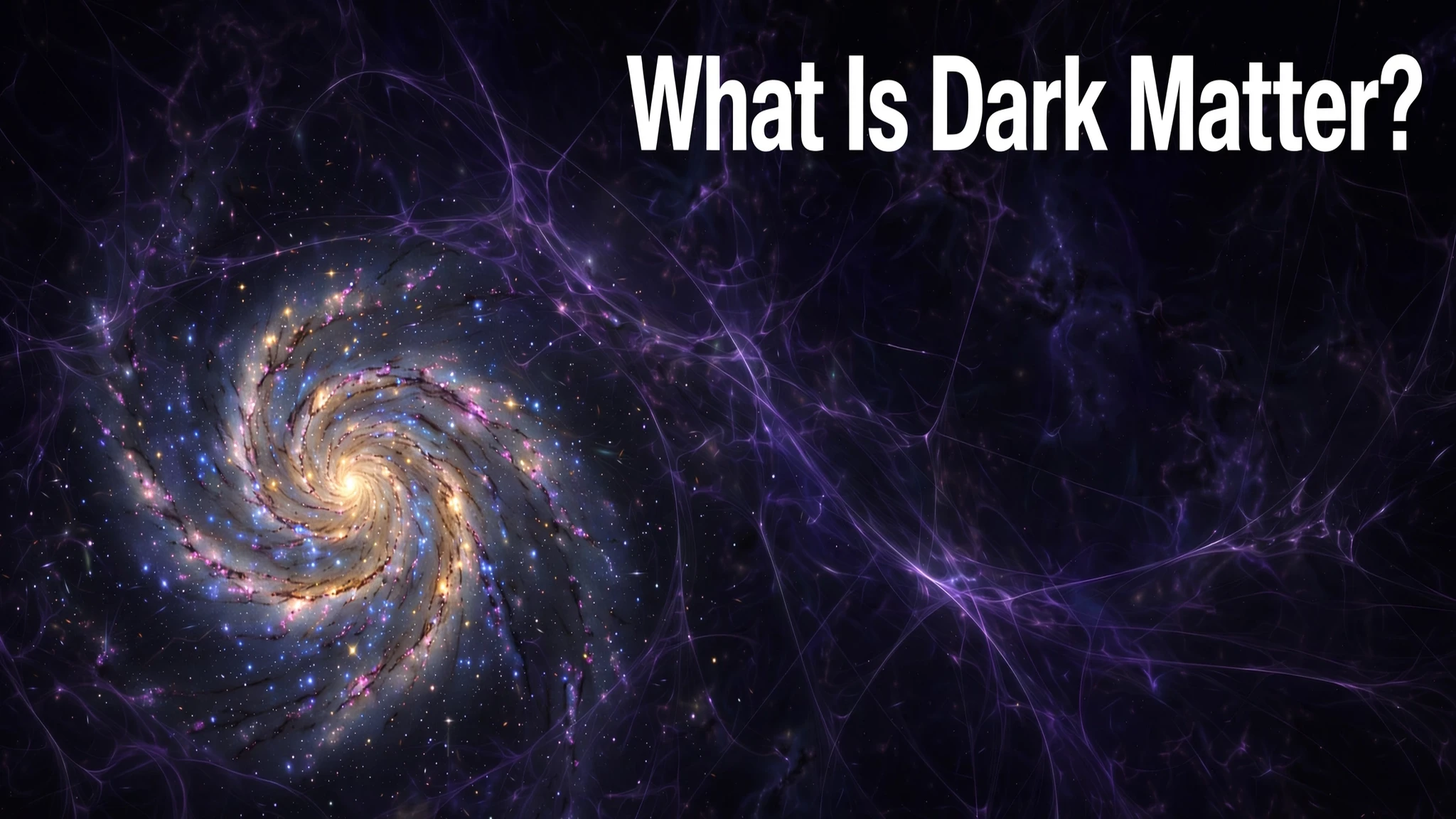
The Cosmic Web and the Baby Universe
A third clue comes from the earliest light we can see, the cosmic microwave background, the faint glow left over from when the universe was about 380,000 years old and first became transparent to light. Tiny temperature variations in that glow encode the density of matter at that time. By analysing those variations, scientists can measure how much ordinary matter, dark matter and dark energy the universe contains, in the standard model. The result is consistent: ordinary matter is only about five percent of the universe’s total energy content, dark matter is about twenty-seven percent, and dark energy makes up the rest. Those percentages are model-dependent estimates, not direct weighings, but they agree with other measurements, which is why they are widely quoted.
Dark matter also explains how galaxies formed as fast as they did. In the early universe, ordinary matter was coupled to light, and pressure from light prevented it from collapsing quickly into dense clumps. Dark matter, which does not interact with light in the same way, could start collapsing earlier, forming gravitational wells into which ordinary matter later fell. Without dark matter’s head start, the galaxies we see today, especially the early galaxies now observed by large telescopes, would be harder to form in the time available. Simulations of the universe with dark matter produce a web of filaments, clusters and voids that matches the observed distribution of galaxies far better than simulations without it.
This cosmic web is not a metaphor for a random pattern; it is a specific prediction. Dark matter halos form first along filaments, galaxies form inside halos, and clusters form where filaments meet. When astronomers survey millions of galaxies and map their positions, they find that web-like structure, with vast empty voids between filaments. The agreement between simulation and survey, across scales from single galaxies to the whole observable universe, is one of the strongest reasons scientists retain dark matter even while its particle identity remains unknown. A theory that only explained rotation curves would be interesting; a theory that also explains lensing, the microwave background and the web is much harder to replace.
What Could Dark Matter Be? Candidates and Searches
If dark matter is a particle, it must have unusual properties: it must be stable over cosmic time, it must interact very weakly with ordinary matter and light, it must be cold, meaning it moves slowly enough to clump into halos rather than streaming away, and it must be abundant enough to supply the observed gravity. Several candidate particles have been proposed. The most studied are WIMPs, weakly interacting massive particles, which would be heavier than a proton and interact only through gravity and the weak nuclear force. Another class is axions, extremely light particles proposed for a different reason in particle physics, which could also behave as cold dark matter if produced in the right way.
Searches for these particles take three broad forms. Direct detection experiments place sensitive detectors deep underground, shielded from cosmic rays, and wait for a dark matter particle to bump into an atomic nucleus and leave a tiny signal. Indirect detection looks in space for products of dark matter particles annihilating or decaying, such as gamma rays from the galactic centre or dwarf galaxies. Collider experiments, such as those at the Large Hadron Collider, try to create dark matter particles by smashing ordinary particles together and looking for missing energy carried away by something invisible. So far, none of these searches has produced a confirmed, repeatable detection, though there have been hints and claims that did not survive further testing.
The lack of a detection does not mean dark matter is disproved, but it does narrow the possibilities. As detectors become more sensitive and find nothing in a given mass range, that range becomes less likely, and theorists shift to other masses or other particle types. Some researchers explore alternative ideas, such as primordial black holes formed in the early universe, or modifications to gravity itself, which we will consider next. The honest position is that the particle search is ongoing, expensive and uncertain, and a discovery could come from any of the three search strategies, or from an entirely new idea.
Could Gravity Itself Be Wrong Instead?
A serious alternative to dark matter is that our theory of gravity is incomplete on galactic scales. Modified Newtonian Dynamics, known as MOND, proposes that gravity behaves differently at very low accelerations, such as those in the outer parts of galaxies, and that this change alone could explain flat rotation curves without extra mass. MOND fits many rotation curves remarkably well with few parameters, and its supporters argue that this success should not be ignored. It is a reminder that dark matter is an inference from gravity, and if gravity is wrong, the inference could be wrong too.
The challenge for modified gravity is to explain all the evidence at once. MOND was designed for galaxies, and it struggles with galaxy clusters, where it still seems to need extra mass, and with the cosmic microwave background and the cosmic web, which are naturally explained by dark matter in the standard model. Relativistic versions of modified gravity have been proposed to address these scales, but they are more complex and, so far, less successful as a complete package than the dark matter picture. The Bullet Cluster is again a difficulty, because a modification of gravity tied to visible matter would be expected to follow the gas, not the galaxies, unless additional unseen mass is added.
Most astronomers therefore keep dark matter as the leading explanation, while keeping modified gravity as a minority research programme worth pursuing. This is not dogma; it is a judgement about which theory currently explains the most data with the fewest extra assumptions. If a modified gravity theory one day explains rotation, lensing, clusters, the microwave background and the web as well as dark matter does, and makes a new prediction that is confirmed, scientists will adopt it. Until then, dark matter remains the best working hypothesis, and its particle identity remains the open question.
Why Dark Matter Matters for Ordinary Life
It is fair to ask why an invisible substance in distant galaxies should matter to anyone on Earth. The direct answer is that it does not affect daily life in any practical way: dark matter, if it passes through Earth, does so so weakly that it has no noticeable effect on weather, health or technology. Its importance is intellectual and long-term. Understanding dark matter means understanding what most of the matter in the universe is made of, how galaxies including our own formed, and whether our theories of particles and gravity are complete. Those are foundational questions, even if they do not change a commute or a grocery bill.
There is also a practical spin-off. The search for dark matter has driven advances in ultra-sensitive detectors, low-background materials, cryogenics and data analysis, which find uses in medical imaging, security and other fields. The cosmic surveys that map dark matter also map galaxies, supernovae and cosmic expansion, which test our understanding of the universe’s fate. None of this justifies the research on its own, but it shows that curiosity-driven science often produces tools that later prove useful in unexpected places. The history of physics is full of abstract discoveries, from electromagnetism to quantum mechanics, that eventually transformed everyday life.
Finally, dark matter matters because it reminds us how much we do not know. A century ago, astronomers thought the Milky Way was the whole universe. Today we know it is one galaxy among trillions, embedded in a halo of something we cannot see, in a universe whose expansion is accelerating for reasons we do not fully understand. That progression is humbling, and it is also exciting: it means the universe still has fundamental surprises left, and that a student today could be the person who finally detects dark matter or replaces it with a better theory.
My Take:
My take is that dark matter is a perfect example of science at its most honest: a placeholder name for a real puzzle, not a pretence of knowledge. When scientists say dark matter, they are not claiming to know what it is; they are saying that several independent measurements agree that something gravitating and invisible is there, and they are giving that something a name so they can study it. I respect that honesty, because it is the opposite of filling a gap with a story and calling the story a fact. Dark matter is a labelled gap, with edges measured carefully, and that is a respectable scientific position.
I also think the public debate about dark matter often misses the strength of the evidence. People hear that dark matter has never been seen and conclude it must be invented, but that misses how science works. We have never seen an electron directly either; we infer electrons from their effects, and we trust the inference because it predicts many different effects correctly. Dark matter is similar, though less settled: rotation curves, lensing, clusters, the microwave background and the cosmic web are different effects, measured by different teams with different instruments, and they converge. That convergence is the evidence. A single unexplained rotation curve could be a mistake; five independent lines pointing the same way are a puzzle worth taking seriously.
My worry is that the long search without a particle detection can breed two opposite errors. One error is to declare dark matter dead every time a detector finds nothing, forgetting that a null result in one mass range does not rule out other ranges. The other error is to treat dark matter as settled fact and stop testing alternatives, forgetting that modified gravity and other ideas deserve a fair hearing. I think the healthy position is in the middle: keep dark matter as the leading hypothesis, keep searching for its particle, and keep testing gravity, because the history of science shows that the winning theory is often the one that survives the hardest tests, not the one that is protected from them.
There is a personal reason I find dark matter moving. It suggests that most of the matter in the universe is not the stuff we are made of, and not the stuff we see in the night sky. The stars, planets and glowing gas that fill astronomy books are a minority, a bright froth on a dark ocean. That fact changes how I look at the night sky: the darkness between stars is not empty, it is full of something we do not yet understand, holding galaxies together. It is a reminder that the universe is not designed for our senses, and that our senses, however wonderful, are a narrow window on reality.
I also appreciate what dark matter teaches about patience. The search has run for decades, through generations of detectors, and it may run for decades more. That timescale is frustrating in a world that expects quick answers, but it is normal for fundamental science. The neutrino, the Higgs boson and gravitational waves all took decades from prediction to detection, and each required new technology that did not exist when the idea was born. Dark matter may follow the same path, or it may end with a different theory entirely. Either outcome would be a triumph, because both would mean we learned something true about the universe, even if it was not what we first guessed.
Finally, I think dark matter is a good story to tell a curious teenager, because it shows science as an open investigation rather than a finished textbook. The textbook says galaxies rotate, light bends, and the early universe glows, and then it asks: what explains all three at once? The student who tries to answer that question is doing real science, not memorising it. Whether that student becomes a physicist or not, they will have learned to weigh evidence, to distrust a single measurement, and to live with uncertainty without filling it with fantasy. That is a skill worth more than any single fact about dark matter, and it is why I hope the mystery stays in classrooms, honestly labelled as a mystery, until the day it is solved.
One more idea helps put dark matter in perspective: the history of invisible things in physics. Atoms were once invisible and doubted, neutrinos were once hypothetical and then detected, and gravitational waves were once a mathematical prediction and then measured. In each case, scientists first inferred something from its effects, then built instruments to detect it directly, and the gap between inference and detection lasted years or decades. Dark matter is currently in that gap, and the gap itself is not evidence against it; it is a normal stage in the life of a scientific idea. The question is not whether we can see dark matter today, but whether our inferences are strong enough to justify building the instruments to look for it, and I think the convergence of rotation, lensing, clusters and the early universe says yes.
I also want to address a common frustration: why do scientists not simply admit they do not know and move on? The answer is that not knowing is precisely why they continue. A labelled unknown, with measured edges, is a research programme: it tells experimenters what mass ranges to search, what signals to expect, and what observations would falsify it. An unlabelled shrug, by contrast, tells no one what to do next. Dark matter, as a name for a measured discrepancy, is therefore productive in a way that a shrug is not. It organises telescopes, detectors and simulations around a shared question, and even if the answer turns out to be modified gravity, the search will have produced better maps, better detectors and a better understanding of galaxies. That is not wasted effort; it is how science advances, by pursuing a good question until it yields an answer, even a surprising one.
That shared question also crosses disciplines in a way that is rare and valuable. Particle physicists build detectors, astronomers map galaxies, cosmologists simulate universes, and each group depends on the others to test the same idea. A detector result constrains a simulation, a simulation predicts a lensing map, and a lensing map tests a particle model. That loop, running across continents and decades, is science at its most collaborative, and it is why dark matter, despite being unseen, feels to me like a solid, living research field rather than a speculative fantasy.
Frequently Asked Questions
What is dark matter in simple words?
Dark matter is unseen mass whose gravity affects galaxies and light, but which does not emit or reflect light in a way telescopes can detect. Scientists infer it from galaxy rotation, lensing and cosmic structure.
How is dark matter different from dark energy?
Dark matter pulls matter together through gravity and helps galaxies form. Dark energy is a separate idea linked to the accelerating expansion of the universe, acting in the opposite direction on large scales.
Has anyone ever detected a dark matter particle?
No confirmed, repeatable detection of a dark matter particle has been reported. Underground detectors, space telescopes and colliders are searching, and null results so far narrow the possible particle properties.
What is the strongest evidence for dark matter?
No single piece is strongest alone. Flat galaxy rotation curves, gravitational lensing mass maps, the Bullet Cluster separation, the cosmic microwave background and the cosmic web together point to extra unseen mass.
Could modified gravity replace dark matter?
Modified gravity theories such as MOND explain many rotation curves, but they struggle to explain clusters, the microwave background and the cosmic web as completely as dark matter does. They remain an active minority research area.
Does dark matter affect life on Earth?
No noticeable effect has been found. If dark matter particles pass through Earth, they interact so weakly that they do not affect weather, health or everyday technology in any measurable way.