What Is the Milky Way Galaxy? Explained
In this post
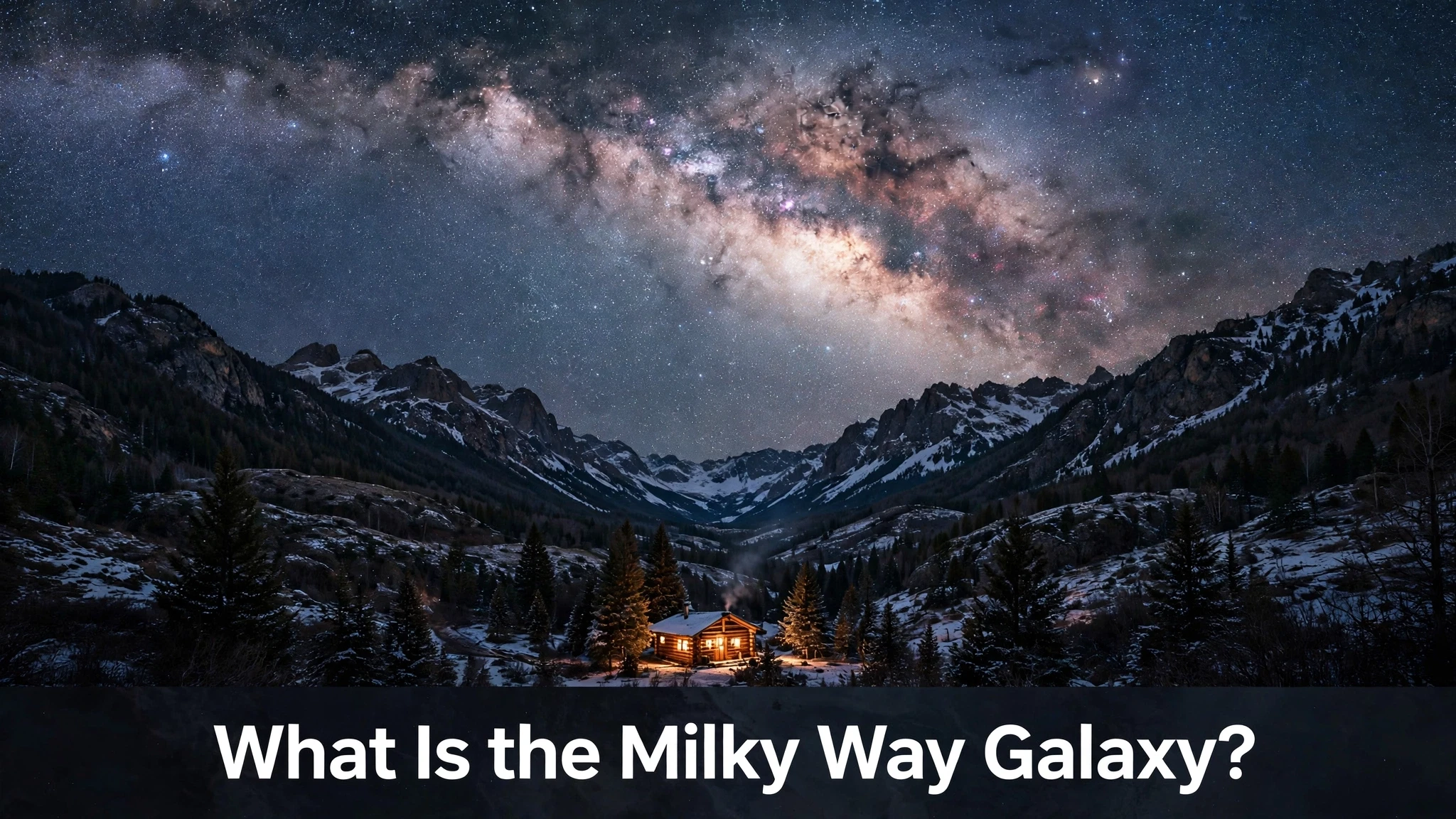
On a clear, dark night far from city lights, a pale, milky band stretches across the sky, made of countless stars too distant and faint to see individually. That band is the Milky Way, and it is not just a feature of our night sky; it is our home galaxy, a vast island of stars, gas, dust, and dark matter, containing our Sun, our solar system, and everything we have ever known. We live inside it, which makes it both familiar and strangely difficult to see in full, like trying to map a forest while standing among its trees.
This guide explains what the Milky Way galaxy is, how big it is, what shape it has, where our solar system sits inside it, what lies at its centre, and how you can see its band for yourself. It also looks at how astronomers, stuck inside the galaxy, managed to map it at all, and what will happen to it in the far future.
A galaxy, not just a band of light
A galaxy is a gravitationally bound system of stars, gas, dust, and dark matter, ranging from dwarf galaxies with a few million stars to giant galaxies with trillions. The Milky Way is a large spiral galaxy, estimated to contain between 100 and 400 billion stars, with most modern estimates clustering around 200 to 300 billion, although the exact number is uncertain because many stars are faint, obscured by dust, or too distant to count individually. It also contains vast clouds of gas and dust, from which new stars form, and a halo of dark matter, invisible material whose gravity holds the galaxy together and affects how stars move.
The name Milky Way comes from its appearance: to ancient observers, the band looked like spilled milk across the sky. The Greek word galaxias, meaning milky, is the root of the word galaxy itself, so our galaxy gave its name to the whole class of objects. Other cultures had different names and stories for the band, from a celestial river to a road of spirits, but the observation was the same: a luminous path across the heavens, brightest toward the constellation Sagittarius, where the galaxy’s centre lies, and fainter toward the opposite direction, where we look outward through fewer stars.
What we see as the Milky Way band is our edge-on view of the galaxy’s disc. Because our solar system sits inside that disc, looking along the disc shows many stars piled up in a band, while looking perpendicular to the disc, toward the galactic poles, shows far fewer stars. That simple geometry explains the band’s appearance, and it was one of the first clues that the Milky Way is a flattened disc, not a sphere of stars surrounding us evenly in all directions.
Size, shape, and spiral arms
The Milky Way’s disc is about 100,000 light-years across, meaning light, travelling at about 300,000 kilometres per second, would take 100,000 years to cross it. Its thickness varies: the disc is about 1,000 light-years thick in most places, but thicker toward the centre, where a central bulge of older stars rises above and below the disc. The galaxy’s total mass, including dark matter, is estimated at roughly one to two trillion times the mass of the Sun, although estimates vary depending on how far the dark matter halo extends and how its mass is measured.
The Milky Way is a barred spiral galaxy, meaning it has a central bar-shaped structure of stars, from which spiral arms wind outward. Astronomers have identified several major arms, including the Perseus Arm, the Scutum-Centaurus Arm, the Sagittarius Arm, and the Norma Arm, plus smaller spurs, including the Orion Spur, also called the Local Arm, where our solar system sits. The arms are not solid structures; they are regions of higher density where gas is compressed, new stars form, and bright, young stars and nebulae make the arm stand out, while stars themselves move in and out of arms as they orbit the centre.
Mapping those arms from inside the galaxy is a major challenge, comparable to mapping a city while standing on one of its streets. Astronomers use several methods: measuring distances to young, bright stars and star-forming regions, tracing radio emissions from gas clouds, using parallax measurements from space telescopes such as Gaia, which has measured positions and motions for billions of stars, and observing dust, which obscures visible light but is transparent to infrared and radio waves. Together, these methods have built a picture of a spiral with a bar, although details of arm numbers, shapes, and connections are still refined as new data arrive, and different studies sometimes disagree on the exact layout.
Where we live: the Orion Spur and the solar neighbourhood
Our Sun sits about 26,000 to 27,000 light-years from the galactic centre, roughly halfway out in the disc, in a minor arm or spur called the Orion Spur, between the larger Perseus and Sagittarius Arms. That location is relatively quiet by galactic standards: it is not in a major star-forming arm, where supernovae and intense radiation are more common, nor is it in the crowded, high-radiation centre. Some scientists have suggested that this quieter neighbourhood may have helped life on Earth survive long enough to evolve complexity, although that idea, sometimes called the galactic habitable zone, is debated and should not be overstated.
The Sun orbits the galactic centre once every roughly 225 to 250 million years, a period sometimes called a galactic year. Since the solar system formed about 4.6 billion years ago, it has completed roughly 18 to 20 galactic orbits, travelling at about 230 kilometres per second around the centre. That motion is imperceptible in daily life, because everything around us, including nearby stars, moves in a similar way, but it means that the night sky we see today is not the sky our distant ancestors saw, and not the sky our distant descendants will see, as stars drift and the Sun carries us around the galaxy.
Our solar neighbourhood, within a few hundred light-years, contains a mix of stars: bright, hot, short-lived stars, cooler, long-lived red dwarfs, which are the most common stars in the galaxy, and white dwarfs, the remnants of stars like the Sun. The nearest star system, Alpha Centauri, is about 4.37 light-years away, a distance that light takes more than four years to cross, and that our fastest spacecraft would take tens of thousands of years to cover. That scale puts interstellar travel into perspective: even our nearest neighbours are immensely far by human standards, and the galaxy as a whole is vastly larger still.
The centre: Sagittarius A* and a supermassive black hole
At the centre of the Milky Way lies a supermassive black hole called Sagittarius A*, pronounced Sagittarius A-star, with a mass of about 4.3 million times the mass of the Sun, confined to a region smaller than our solar system. Its presence was inferred over decades from the orbits of stars whipping around an unseen, massive object at the centre, and in 2022 the Event Horizon Telescope collaboration released the first direct image of its shadow, a glowing ring of hot gas around a dark centre, confirming its nature as a black hole.
Sagittarius A* is currently relatively quiet, accreting little material and emitting modestly compared with the brilliant active nuclei of some other galaxies, where supermassive black holes devour gas and shine across the universe. That quietness is fortunate for us: a highly active galactic centre would bathe the inner galaxy in intense radiation, although at our distance of 26,000 light-years, even a more active centre would be less threatening than it would be nearby. The black hole’s gravity dominates only the innermost region; the galaxy as a whole is held together by the combined gravity of stars, gas, and dark matter, not by the central black hole alone, a common misconception.
Around the black hole lies a dense nuclear star cluster, with stars packed far more tightly than in our neighbourhood, and a central bulge of older, redder stars, plus a bar that funnels gas toward the centre. The bulge is also where many of the galaxy’s oldest stars live, some nearly as old as the universe itself, providing clues to the Milky Way’s early formation, when smaller galaxies merged and gas collapsed to form the first stars. Studying the centre, despite dust that obscures visible light, has therefore become a window into the galaxy’s birth and growth.
How the Milky Way formed and grew
The Milky Way did not appear in its current form all at once; it grew over about 13.6 billion years, nearly the age of the universe, through a combination of gas collapse and mergers with smaller galaxies. In the early universe, gas gathered under gravity, formed the first stars, and those stars enriched the gas with heavier elements when they died, allowing later generations of stars, including our Sun, to form with planets. Smaller dwarf galaxies fell into the growing Milky Way, their stars becoming part of its halo, their gas fuelling new star formation, and their disruption leaving streams of stars that astronomers can still trace today.
Evidence for this merger history is written in the halo: streams of stars moving together, globular clusters, dense, ancient balls of stars orbiting the galaxy, that originated in captured dwarfs, and differences in chemical composition between halo stars and disc stars. The Gaia space telescope has been particularly important here, revealing a major ancient merger, sometimes called Gaia-Enceladus or the Gaia Sausage, in which a dwarf galaxy merged with the young Milky Way about 10 billion years ago, puffing up the disc and contributing many halo stars. That event is part of our galaxy’s family history, recorded in the motions and chemistry of stars we can still observe.
Star formation continues today, mainly in spiral arms, where gas clouds collapse under gravity to form clusters of new stars, often illuminating surrounding gas as glowing nebulae. The Orion Nebula, visible to the naked eye as a fuzzy patch in Orion’s sword, is one such nursery, about 1,344 light-years away, where new stars are forming now. At the same time, old stars die, returning gas to the interstellar medium, in a cycle that has sustained star formation for billions of years, although the overall rate has declined from its peak in the early universe, and the Milky Way is now a relatively calm, middle-aged galaxy by cosmic standards.
Neighbours, satellites, and the Local Group
The Milky Way is not alone; it is the second-largest galaxy in the Local Group, a small cluster of more than 50 galaxies, dominated by the Milky Way and the Andromeda Galaxy, which is slightly larger and contains perhaps a trillion stars. Andromeda, also called M31, lies about 2.5 million light-years away and is visible to the naked eye from dark sites as a faint smudge in the constellation Andromeda. It is approaching the Milky Way at about 110 kilometres per second, and in about 4 to 5 billion years the two galaxies are expected to merge, forming a new, larger elliptical galaxy, sometimes nicknamed Milkomeda, in a slow gravitational dance that will reshape both systems but is unlikely to cause direct collisions between individual stars, because stars are so far apart relative to their sizes.
The Milky Way also has many smaller satellite galaxies, including the Large and Small Magellanic Clouds, irregular dwarf galaxies visible from the Southern Hemisphere, which are interacting with the Milky Way and being slowly stripped of gas and stars. Other satellites, such as the Sagittarius Dwarf Spheroidal Galaxy, are being torn apart by the Milky Way’s gravity, their stars forming streams across the sky. These satellites are both neighbours and future meals: over billions of years, many will merge fully into the Milky Way, continuing the growth process that built it.
Beyond the Local Group lie larger structures: the Virgo Supercluster, and ultimately the observable universe, containing an estimated two trillion galaxies, each with billions of stars. That scale can be overwhelming, but it also puts our galaxy in context: the Milky Way is large, but it is one galaxy among trillions, and our Sun is one star among hundreds of billions in it, orbiting a black hole 26,000 light-years away, in a quiet spur of a barred spiral. That combination of vastness and ordinariness is, for many people, the most profound fact astronomy offers.
How to see the Milky Way yourself
Seeing the Milky Way band requires darkness, more than equipment. Light pollution from cities washes out the faint band, so the best views come from rural areas, mountains, or deserts, on moonless nights, away from artificial lights, after your eyes have adapted to darkness for at least 20 minutes. In the Northern Hemisphere, the brightest, most spectacular part of the band, toward the galactic centre in Sagittarius, is best seen in summer evenings, when Sagittarius is high in the south, while in the Southern Hemisphere, the centre passes almost overhead in winter, offering even more dramatic views.
No telescope is needed to see the band; in fact, binoculars or a telescope with a narrow field of view can make it harder to appreciate, because they show only a small patch. The naked eye, under dark skies, sees the band as a whole, with dark dust lanes cutting across it, star clouds glowing in Sagittarius and Cygnus, and the faint glow of millions of unresolved stars. A pair of binoculars, used after naked-eye viewing, can then resolve some of that glow into individual stars and reveal star clusters and nebulae along the band, such as the Wild Duck Cluster or the Lagoon Nebula, adding detail to the broad view.
Photography can capture the Milky Way with a modern camera, a tripod, and a long exposure, but it requires dark skies, a wide-angle lens, and care to avoid star trails from Earth’s rotation. For most people, however, the most rewarding approach is simply to lie back, let eyes adapt, and watch the band arc overhead, remembering that every star in it is part of our galaxy, and that the dark lanes are not empty space but clouds of dust blocking the light of stars behind them. That direct, naked-eye encounter with our galaxy is available to anyone willing to travel a little way from city lights, and it is one of the simplest and most profound astronomical experiences.
My Take:
My first judgement is that the Milky Way is badly named for public understanding, because the name suggests a single object in the sky, like a river or a road, rather than the galaxy we live inside. When people say they have “seen the Milky Way”, they usually mean they have seen its band, the edge-on view of its disc, not the galaxy as a whole, which no human has ever seen from outside. I think astronomy communication should make that distinction explicit every time: the band is a view from inside, not a picture of the galaxy. That single clarification prevents a host of misconceptions, including the idea that the Milky Way is a separate thing floating in our sky, rather than the structure containing our Sun.
My second judgement concerns our location, which I think is both fortunate and humbling. We live in a quiet spur, far from the crowded centre, in a galaxy that is large but not exceptional, orbiting a black hole that is currently quiet. That ordinariness is sometimes presented as disappointing, as if we deserved a more dramatic address, but I think it is the opposite: a quiet neighbourhood may be exactly what allowed complex life to evolve without frequent nearby supernovae or intense radiation. At the same time, ordinariness should humble any claim that Earth is cosmically special by location alone. We are special because life evolved here, not because our galactic address is unique; thousands of other stars in the Milky Way have planets, and many may have conditions suitable for life, even if we have not yet found it.
I also think the Gaia mission deserves more public celebration than it receives. Measuring positions and motions for billions of stars, from inside the galaxy, with enough precision to reconstruct ancient mergers, map spiral arms, and trace stellar streams, is one of the great technical achievements of modern astronomy, comparable to mapping a continent from ground level. Yet Gaia rarely makes headlines outside specialist circles, because its results arrive as catalogues and papers, not as single dramatic images. That is a failure of storytelling, not of science, and I think popular astronomy should do more to translate Gaia’s maps into narratives: this stream is a devoured galaxy, this cluster came from that merger, this is where our Sun has travelled over billions of years.
A further point is about the future merger with Andromeda, which is often reported with alarming headlines about a collision that will destroy Earth. The reality is slower, gentler, and far less threatening to individual stars, because galaxies are mostly empty space and stars are unlikely to collide directly. What will change is the overall shape: two spirals merging into an elliptical galaxy, with new star formation triggered by gas compression, and our Sun, if it still exists in anything like its current form, carried into a new orbit in a new galaxy. That event lies four to five billion years in the future, around the time the Sun itself will be swelling into a red giant and threatening Earth directly, so the merger is not the most pressing fate facing our planet. Reporting it as an imminent catastrophe distorts both timescales and risks.
I would also argue that seeing the Milky Way should be treated as a public good, like clean air or quiet, rather than as a specialist hobby. Light pollution has made the band invisible to most people in developed countries, and to a majority of the world’s population, who have never seen their own galaxy with the naked eye. That loss is cultural as well as scientific: for most of human history, the Milky Way was a nightly presence, inspiring myth, navigation, and art, and its disappearance from urban skies severs a connection that shaped how humans understood their place in the universe. Dark-sky reserves, sensible street lighting, and public viewing events are therefore not luxuries; they are ways of restoring a heritage that belongs to everyone.
My practical takeaway is to seek out dark skies at least once, and to do so with the knowledge in this guide in mind. When you see the band, remember that you are looking along the disc of your own galaxy, that the bright patch toward Sagittarius marks its centre, 26,000 light-years away, and that the dark lanes are dust clouds hiding stars behind them. That knowledge transforms a pretty sight into a map: you can point toward the centre, toward the outer edge, and toward the galactic poles, and know where you stand in a structure 100,000 light-years across. Few experiences combine beauty and scale so directly, and few are so accessible to anyone willing to drive an hour from city lights.
Another judgement concerns the search for life in the Milky Way, which I think should be framed more honestly. We have found thousands of exoplanets, many in habitable zones, and we have detected the chemical ingredients for life in interstellar clouds, but we have not found life beyond Earth, and the distance between “conditions suitable for life” and “life exists” remains vast. The Milky Way may be teeming with life, or Earth may be rare, or somewhere in between, and current data cannot decide among those options. I think that uncertainty should be stated plainly, rather than hidden behind exciting headlines about “Earth-like” planets that are, in reality, known only by size and orbit, not by atmosphere, water, or biology.
I would add a point about dark matter, which is often mentioned as a footnote but is actually central to the Milky Way’s existence. Without dark matter’s gravity, the galaxy’s stars would not move as they do, and the disc might not have held together in its current form. Yet dark matter has never been directly detected, and its nature remains one of physics’ greatest unsolved problems. That combination, a galaxy held together by something we cannot see and do not understand, should inspire awe rather than embarrassment. It is a reminder that our map of the Milky Way, impressive as it is, still contains a major unknown at its foundation, and that future discoveries may revise our picture substantially.
Finally, I think the Milky Way offers a useful perspective on human disputes and priorities. A galaxy 100,000 light-years across, containing hundreds of billions of stars, formed over 13.6 billion years, and destined to merge with Andromeda in billions more, makes human history look brief, which it is. That brevity can feel depressing, but I find it liberating: it suggests that our task is not to dominate the cosmos, which we cannot, but to care well for the small, habitable world we have, and to preserve the dark skies, the science, and the curiosity that let us understand our place in it. The Milky Way will go on long after us, with or without our attention. Paying attention to it now, while we can, is a choice that enriches the brief time we have inside it.
Frequently Asked Questions
How many stars are in the Milky Way? Estimates range from 100 to 400 billion, with most modern estimates around 200 to 300 billion, although the exact number is uncertain because many stars are faint or obscured by dust.
How big is the Milky Way? Its disc is about 100,000 light-years across and about 1,000 light-years thick in most places, with a central bulge and a dark matter halo extending far beyond the visible disc.
Where is our Sun in the Milky Way? About 26,000 to 27,000 light-years from the centre, in a minor spur called the Orion Spur, between the larger Perseus and Sagittarius Arms, orbiting the centre once every 225 to 250 million years.
What is Sagittarius A?* A supermassive black hole at the Milky Way’s centre, with about 4.3 million times the Sun’s mass, imaged directly by the Event Horizon Telescope collaboration in 2022.
Will the Milky Way collide with Andromeda? Yes, in about 4 to 5 billion years the two galaxies are expected to merge into a larger elliptical galaxy, but individual stars are very unlikely to collide because galaxies are mostly empty space.
When is the best time to see the Milky Way? On moonless nights far from city lights, after eyes adapt for 20 minutes. In the Northern Hemisphere, summer evenings show the bright centre toward Sagittarius best, while the Southern Hemisphere offers overhead views in winter.