Why Is the Moon Getting Farther From Earth
In this post
Yes, the Moon Is Moving Away, Slowly
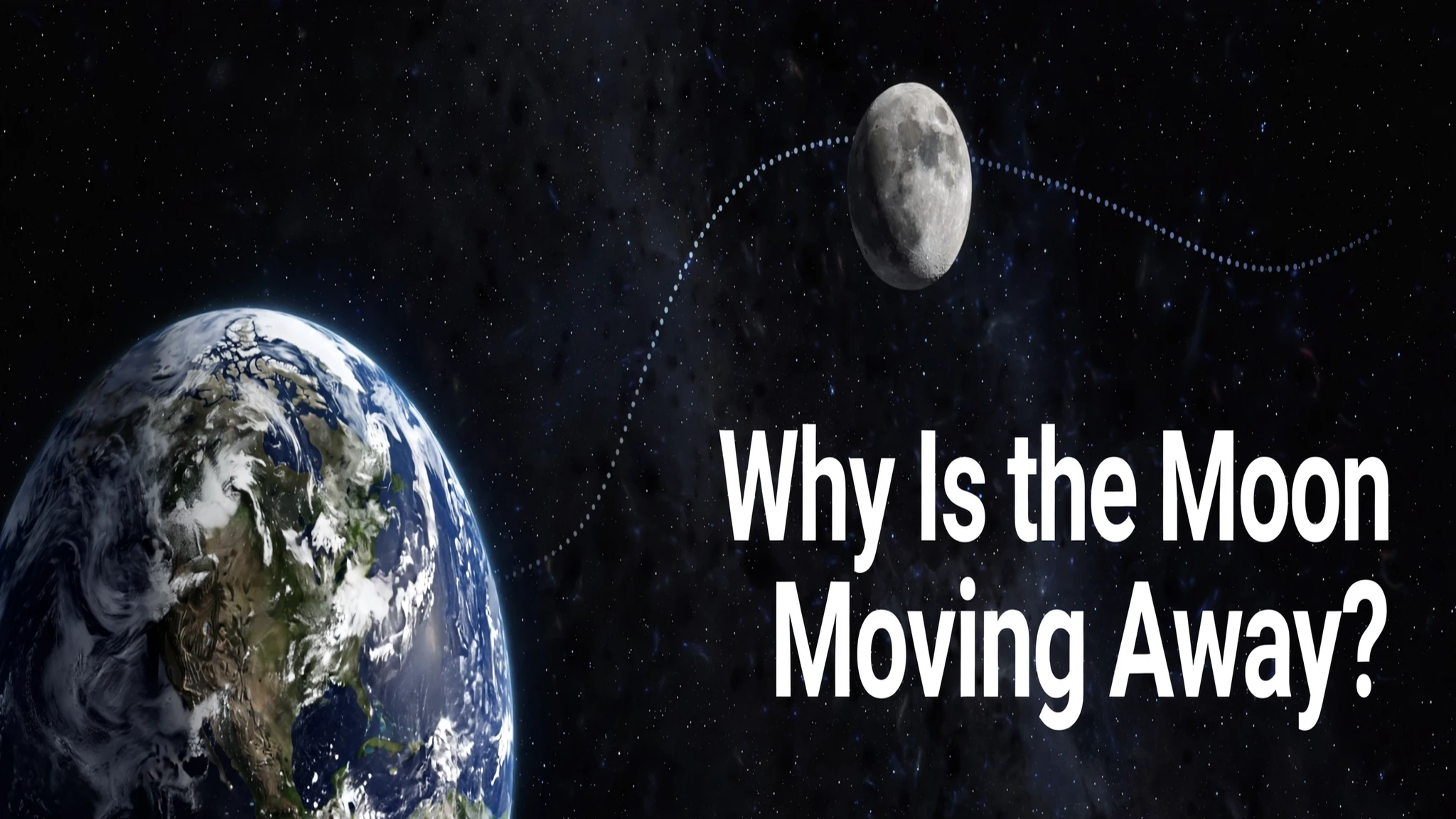
The Moon is getting farther from Earth, by a small amount each year, and this is a measured fact, not a guess. The rate is about 3.8 centimetres per year, roughly the speed at which human fingernails grow. That sounds tiny, and on human timescales it is, but over millions and billions of years it adds up to a large change in distance. The Moon was once much closer to Earth, and in the far future it will be farther away, with consequences for tides, Earth’s rotation and the length of a day. Understanding why requires understanding tides, not as a simple rise and fall of water, but as a transfer of energy and angular momentum between Earth and the Moon.
The measurement itself is remarkably precise. Since the Apollo missions left retroreflectors on the Moon, scientists have bounced laser pulses off them and timed the return trip, a technique called lunar laser ranging. By measuring the round-trip time to within a fraction of a nanosecond, they can determine the Earth-Moon distance to within centimetres, and track its change year by year. Soviet rovers also left reflectors, and modern ranging stations continue the work. The 3.8 centimetres per year figure is therefore not a theoretical prediction alone; it is a direct measurement, confirmed over decades, and it agrees with tidal theory.
It is worth noting that the Moon is not simply drifting away in a straight line, like a balloon released into the sky. It remains in orbit around Earth, held by gravity, but its orbit is slowly expanding. Think of a figure skater who spins more slowly as they extend their arms: the total spin, or angular momentum, is conserved, but it is redistributed. In the Earth-Moon system, angular momentum is transferred from Earth’s spin to the Moon’s orbit, so Earth spins more slowly and the Moon moves to a higher, slower orbit. That transfer is driven by tides, and tides are driven by the Moon’s gravity, so the Moon is, in a sense, pushing itself away by raising tides on Earth.
Tides: The Moon Pulls, Earth Drags, and Energy Moves
Tides are caused mainly by the difference in the Moon’s gravitational pull across Earth. The side of Earth facing the Moon feels a stronger pull than Earth’s centre, and the side facing away feels a weaker pull, so water, and to a lesser extent solid Earth, bulges outward on both sides, creating two tidal bulges. As Earth rotates beneath these bulges, a given coastline passes through a bulge twice a day, experiencing high tide, and through the regions between bulges, experiencing low tide. The Sun also raises tides, but its effect is smaller because, despite its greater mass, it is much farther away, and tidal force depends strongly on distance.
If Earth were a perfect, frictionless ocean world, the tidal bulges would align exactly with the Moon, and no energy would be transferred. In reality, friction between ocean water and the seafloor, and between water and coastlines, drags the bulges slightly ahead of the Moon, because Earth rotates faster than the Moon orbits. Earth completes a rotation in about a day, while the Moon takes about a month to orbit, so the bulge is carried forward by Earth’s spin, ahead of the line joining Earth and Moon. That offset bulge exerts a gravitational pull on the Moon, tugging it forward along its orbit, adding energy to the Moon and raising its orbit. At the same time, the Moon’s pull on the offset bulge acts as a brake on Earth’s rotation, slowing Earth’s spin.
This is the core mechanism, and it is worth pausing on because it is counterintuitive. Friction usually slows things down, and here it does slow Earth’s rotation, but the energy lost by Earth’s spin does not vanish; it is transferred to the Moon’s orbit, which grows. Total angular momentum is conserved, but it moves from spin to orbit. The process is slow because tidal friction is small compared with Earth’s total spin energy, but it is relentless, operating every day, in every ocean, for billions of years. The Moon’s recession is therefore not a mystery force or a sign that gravity is weakening; it is the everyday physics of tides, accumulated over geological time.
How We Know the Rate, and How It Has Changed
Lunar laser ranging gives the current rate, but geology gives the history. Ancient tidal rhythmites, layered sediments laid down by daily tides in shallow seas hundreds of millions of years ago, preserve a record of how many days were in a year and how many tides occurred per month at that time. By counting layers, geologists can infer Earth’s rotation rate in the past, and from that, the Moon’s distance. Fossil corals, which grow daily and annual bands, provide a similar record: a coral from 400 million years ago may show about 400 days per year, meaning Earth spun faster then, and days were shorter, consistent with a closer Moon and stronger tidal braking since.
These records show that the recession rate has not been constant. When continents were arranged differently, ocean basins had different shapes, and tidal friction was stronger or weaker, the Moon moved away faster or slower. In some periods, especially when shallow seas covered large areas and friction was high, the rate may have been several times today’s value. In other periods, with different ocean geometry, it may have been lower. The current rate of about 3.8 centimetres per year is therefore a snapshot, not a universal constant, and extrapolating it blindly back to the Moon’s formation would give a wrong age, a point that creationist arguments sometimes miss and that scientists explicitly account for with changing ocean models.
The Moon’s origin also fits this picture. The leading theory, the giant impact hypothesis, holds that about 4.5 billion years ago, a Mars-sized body collided with the early Earth, throwing debris into orbit that coalesced into the Moon. That Moon formed much closer to Earth, perhaps only a few Earth radii away, and has been receding ever since as tides transferred angular momentum. Early on, when the Moon was close, tides would have been enormous, and Earth’s day may have been only a few hours long. Over billions of years, the day lengthened to 24 hours, and the Moon moved to its current average distance of about 384,400 kilometres. The story is consistent across impact models, tidal theory and geological records, which is why it is widely accepted despite uncertainties in detail.
What Recession Means for Days, Tides and Eclipses
As the Moon moves away and Earth’s spin slows, the length of a day increases. The effect is tiny on human timescales, about 1.7 milliseconds per century in the long-term average, though short-term variations from earthquakes, winds and ocean currents can mask it year by year. Over millions of years, however, the change accumulates: days were shorter in the distant past, and they will be longer in the distant future. A day that is 25 hours long is not imminent; it would take hundreds of millions of years at current rates, and the rate itself will change as oceans and continents evolve. Still, the direction is clear, and it is a reminder that even the familiar 24-hour day is a temporary value in Earth’s history.
Tides will also weaken as the Moon recedes, because tidal force falls rapidly with distance. Weaker tides mean smaller differences between high and low water, and less tidal mixing in oceans, which could affect coastal ecosystems, nutrient transport and sediment movement over geological time. The change will be gradual, and other factors, such as sea-level rise and coastal shape, will matter far more on human timescales. For a coastal resident in the next century, the Moon’s recession will be imperceptible compared with storms, sea-level change and local geography. For a geologist thinking in millions of years, it is a major driver of ocean and climate evolution.
Eclipses provide a visible consequence. A total solar eclipse occurs when the Moon, seen from Earth, appears large enough to cover the Sun’s disc. Because the Moon is receding, its apparent size is slowly shrinking, while the Sun’s apparent size stays roughly the same. In the far future, perhaps 600 million years from now by some estimates, the Moon will be too far away to fully cover the Sun, and total solar eclipses will no longer occur; only annular eclipses, where a ring of sunlight remains, will be possible. That loss is far in the future, and it will not affect anyone alive today, but it gives the Moon’s recession a poetic deadline: total eclipses are a temporary privilege of this era, when the Moon happens to be at the right distance.
Will the Moon Ever Leave, or Will Earth Stop Spinning?
A natural question is whether the Moon will eventually escape Earth entirely, or whether Earth will become tidally locked to the Moon, always showing the same face to it, just as the Moon already shows the same face to Earth. The answer, in the standard tidal picture, is that the system is heading toward a double synchronous state, where Earth’s day equals the Moon’s orbital period, and both are much longer than today, perhaps about 47 days by some calculations. At that point, tidal bulges would align with the Moon, no further angular momentum would be transferred, and recession would stop. The Moon would not escape, because the system would have reached equilibrium.
That equilibrium, however, is so far in the future, billions of years away, that other events will intervene first. The Sun will evolve into a red giant in about five billion years, expanding and likely engulfing or severely disrupting Earth and the Moon, long before tidal equilibrium is reached. Even before that, the Sun’s brightening will warm Earth and alter oceans, changing tidal friction in ways that are hard to predict. The Moon’s recession is therefore not a runaway process that will fling it into space; it is a slow drift toward a state that the Sun’s evolution will prevent from ever being reached. The Moon is leaving, but it is not leaving home in the sense of escaping forever.
There is also a subtlety: the Moon’s orbit is not perfectly circular, and its distance varies between perigee, its closest point, and apogee, its farthest point, by tens of thousands of kilometres each month. The 3.8 centimetres per year is a change in the average distance, superimposed on this much larger monthly variation. A supermoon, which occurs when a full moon coincides with perigee, looks slightly larger than an average full moon, but the difference is small and the recession over a human lifetime, about three metres in a century, is far smaller than the monthly variation. Headlines that claim the Moon is visibly shrinking year by year are therefore misleading; the change is real, but it is measured by lasers, not by eyes.
Tides on Other Worlds and the Wider Lesson
The Earth-Moon tidal story is not unique. Many moons in the solar system are tidally locked, showing one face to their planet, because tides have already slowed their spin to match their orbit. Io, Europa and other moons of Jupiter, and Titan around Saturn, show tidal effects in different forms, including volcanic activity powered by tidal flexing. In some systems, tides push moons inward rather than outward, if the moon orbits faster than its planet spins, leading to eventual collision or breakup. Mars’ moon Phobos, for example, is spiralling inward and is expected to break apart in tens of millions of years, forming a ring. The direction of tidal evolution depends on the geometry, not on a universal rule that moons always move away.
Exoplanets provide further examples. Close-in planets around other stars are often tidally locked, with one side permanently facing the star, and their orbits evolve through tides raised on both planet and star. Studying these systems helps astronomers understand how tides shape planetary systems over time, and whether a tidally locked planet could still be habitable, perhaps in a terminator zone between day and night. The Earth-Moon system is thus a nearby laboratory for a universal process, and its lessons apply far beyond our own sky.
The wider lesson is about conservation laws. Angular momentum, like energy, is conserved in an isolated system, but it can move between spin and orbit, between planet and moon, in ways that are not obvious from a single snapshot. A student who learns that Earth is slowing down might ask where the spin goes, and the answer, to the Moon’s orbit, is a satisfying example of physics accounting for every bit. Science often works this way: a small, daily phenomenon, the tide, when followed carefully, explains a large, slow change, the Moon’s recession, and connects the beach to the cosmos.
My Take:
My take is that the Moon moving away is a beautiful example of a small cause with a huge, slow effect, and I wish more science stories were told that way. We tend to look for dramatic causes: an explosion, a collision, a sudden break. The Moon’s recession has none of those. It is caused by water rubbing against the seafloor, day after day, for billions of years. Friction, the most boring force in a school textbook, has moved the Moon tens of thousands of kilometres and lengthened our days from hours to 24. That should change how we think about gradual processes, from erosion to climate to habit formation: small, repeated effects, given enough time, are not small at all.
I also think the measurement itself deserves admiration. Bouncing a laser off a mirror left by Apollo astronauts, timing its return to a fraction of a billionth of a second, and using that timing to track a drift of centimetres per year is an extraordinary feat of patience and precision. It connects a human footprint on the Moon to a cosmic measurement still running today. When people ask what Apollo left behind, the usual answers are flags and photographs, but the retroreflectors are arguably more valuable: they are still working, still teaching us about tides, gravity and the Moon’s orbit, more than fifty years after they were placed. That is a legacy worth remembering when we debate the value of space exploration.
My worry is that headlines about the Moon leaving Earth can create unnecessary fear, as if the Moon might disappear in our lifetimes or tides might stop next year. They will not. The Moon will still be there for every child born today, for their grandchildren, and for thousands of generations after, looking almost exactly as it does now. The change over a human life is about the length of a hand, spread across a distance of hundreds of thousands of kilometres. I think science communicators, including me, have a duty to give scale with every such story: say the rate, say the human-lifetime change, and say the geological timescale, so that wonder does not turn into anxiety.
On a more personal note, I find comfort in the tidal lock story. The Moon already shows us one face, because tides slowed its spin long ago, and Earth is slowly following the same path, though it will never complete it before the Sun intervenes. There is a symmetry in that: the Moon locked to Earth, Earth slowly locking to the Moon, each shaping the other through gravity and friction. It is a reminder that relationships in nature are rarely one-way. Earth does not simply hold the Moon; the Moon shapes Earth’s days, tides and, through tides, its climate and coastlines. We live on a planet whose rhythm is set, in part, by a companion world.
Finally, I think the future loss of total solar eclipses, hundreds of millions of years from now, is a useful way to think about privilege and timing. We live in an era when the Moon’s apparent size matches the Sun’s almost exactly, a coincidence of distance and size that makes total eclipses possible. That coincidence will not last forever, but it lasts for us, and for far longer than any civilisation. It is a gift of timing, not a right, and it reminds me to appreciate phenomena that are temporary on cosmic scales but permanent on human scales. The Moon is moving away, slowly and measurably, and that movement tells a story of tides, friction and time. It is a story worth telling carefully, with numbers, with patience, and with wonder at how a daily tide can move a world.
There is one more angle I want to add, about how this story corrects a common intuition. Many people imagine gravity as a fixed pull, holding the Moon at a fixed distance, like a string holding a ball. The tidal story shows gravity as a dynamic exchange, where the pull itself creates bulges, friction, and a transfer that changes the orbit. The string, in this analogy, is not fixed; it is being lengthened by the very motion it constrains. That dynamic view applies to many systems, from binary stars to exoplanets, and it is a more truthful picture of the universe than a static one. The Moon is not on a fixed track; it is on a slowly expanding track, shaped by the same tides we see at the beach, and that connection between beach and Moon is, for me, the most satisfying part of the whole story.
One more consequence is worth noting, because it connects the Moon to Earth’s deep history in a way that is easy to overlook. When the Moon was closer and tides were stronger, tidal mixing in oceans would have been more vigorous, potentially affecting ocean circulation, nutrient distribution and even the evolution of early life in tidal pools and shallow seas. Some researchers have suggested that strong ancient tides helped mix chemicals and transport materials in ways that favoured the origin of life, though that idea remains debated and should not be overstated. What is clearer is that tides have shaped coastlines, sediments and ecosystems for billions of years, and that the Moon’s recession has gradually weakened that shaping force. The Moon is therefore not only a companion in the sky; it has been a geological and possibly biological influence on Earth since early times, and its slow departure marks a long change in Earth’s environment.
I also think the Moon’s story is a good antidote to the idea that the solar system is static. Planets and moons are often drawn as fixed orbits in textbooks, with neat circles and unchanging distances, but the real solar system is dynamic: moons drift, orbits evolve, planets migrate, and stars brighten. The Moon’s recession is a gentle, measurable example of that dynamism, accessible to anyone who learns about tides and lasers. It invites a different mental image: not a clockwork solar system, but a slowly evolving one, where even the familiar Moon is on a journey. That image is more truthful, and more interesting, than a fixed diagram, because it reminds us that the sky we see is a moment in a long story, not a permanent backdrop.
Frequently Asked Questions
How fast is the Moon moving away from Earth?
Lunar laser ranging measures the Moon receding at about 3.8 centimetres per year, roughly the rate of fingernail growth. Over a human lifetime that is only a few metres, compared with a distance of about 384,400 kilometres.
Why does the Moon move away instead of falling toward Earth?
Tidal friction drags Earth’s tidal bulges ahead of the Moon. The offset bulges pull the Moon forward along its orbit, adding energy and raising its orbit, while the Moon’s pull brakes Earth’s spin.
How do scientists measure the Moon’s distance so precisely?
Retroreflectors left on the Moon by Apollo astronauts and Soviet rovers reflect laser pulses sent from Earth. Timing the round trip to a fraction of a nanosecond gives the distance to within centimetres.
Will total solar eclipses disappear one day?
Yes, in the far future, perhaps around 600 million years from now by some estimates, the Moon will be too far away to fully cover the Sun’s disc, so total eclipses will give way to annular eclipses.
Was the Moon once much closer to Earth?
Yes. Under the giant impact hypothesis, the Moon formed much closer, perhaps only a few Earth radii away, with enormous tides and a much shorter Earth day, and it has receded ever since.
Will the Moon ever escape Earth’s gravity?
In the standard tidal picture, no. The system heads toward a double synchronous state where Earth’s day equals the Moon’s orbital period, but the Sun’s evolution into a red giant in about five billion years will intervene long before that state is reached.