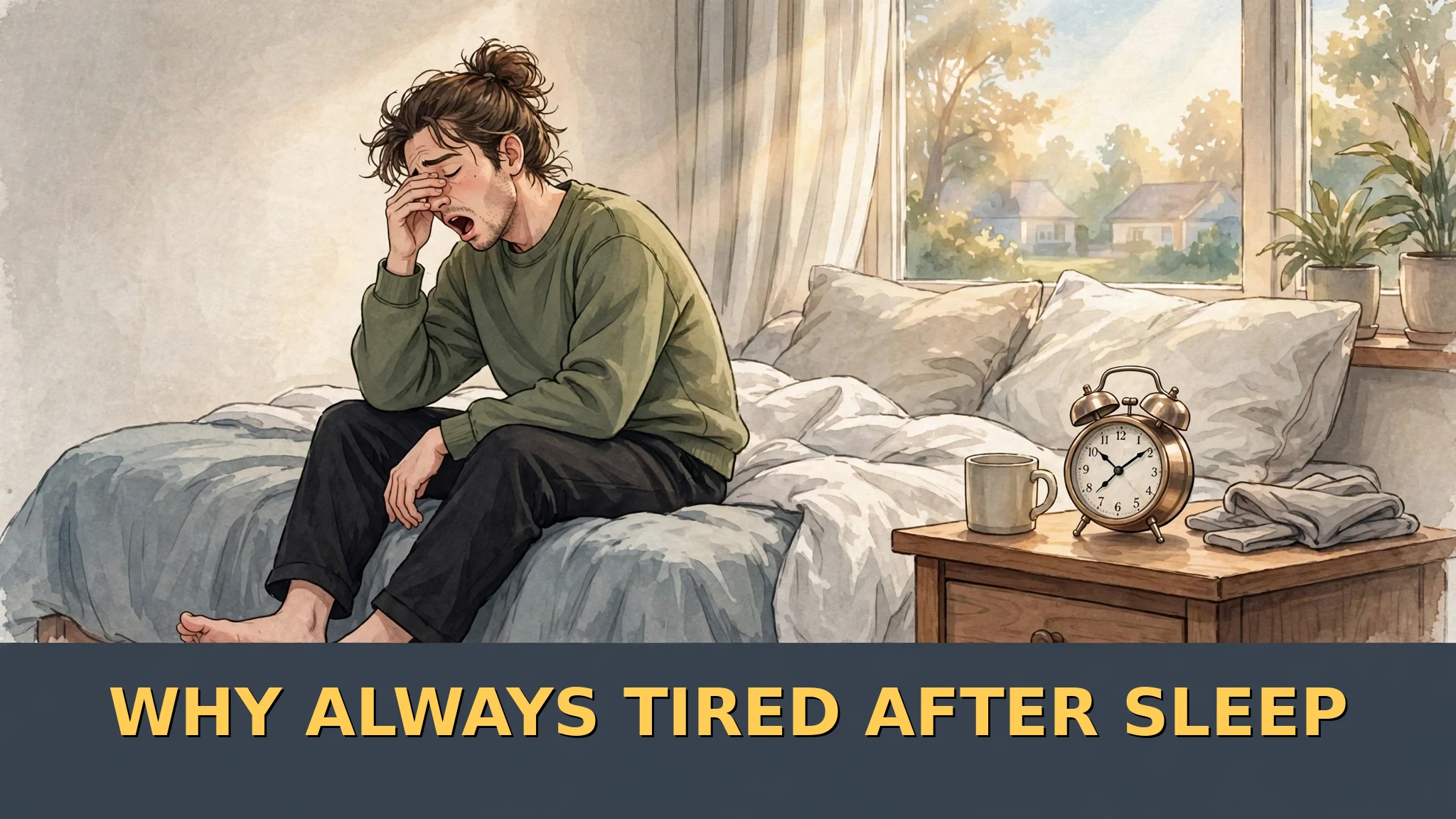
Why Always Tired After Sleep
In this post
- Why Am I Still Tired After Sleeping All Night?
- How Sleep Cycles Work During the Night
- What Happens When You Wake Up in Deep Sleep
- Why Sleep Quality Matters More Than Hours
- How Screens, Caffeine and Alcohol Break Your Sleep
- Snoring and Sleep Apnoea: The Hidden Night Thief
- Everyday Habits That Help You Wake Up Fresh
- Warning Signs: When Tiredness Needs a Doctor
- Sources
You went to bed on time. You slept the whole night. The alarm rings, you open your eyes — and you feel as if you never slept at all. Your head is heavy, your body is slow, and the first thought of the day is: why am I still so tired?
You are not lazy, and you are not alone. A full night in bed is not the same thing as a full night of good sleep. Let us look at what your body really does while you sleep — and what can quietly go wrong.
This post is general information only. It cannot tell you what is wrong with you personally. Only a doctor who knows you can do that.
Why Am I Still Tired After Sleeping All Night?
Sleep is not one long, flat rest. Your brain does not switch off at night and switch back on in the morning. It travels up and down through different levels of sleep, like a lift moving between floors. If something keeps disturbing that journey — noise, light, a restless mind, a blocked airway, a late-night phone — you can spend eight hours in bed and still miss the deep, repairing part of the night.
When you wake up matters almost as much as how long you slept. Waking at the wrong moment of the journey can leave you foggy for a long time, even after a long night.
And a simple third point: most adults need at least 7 hours of sleep a night, many need 7 to 9. The CDC gives 7 to 9 hours for adults up to 64, and 7 to 8 hours from 65 onwards. Sleeping less than your body needs builds a quiet debt that one long weekend lie-in cannot fully repay.
How Sleep Cycles Work During the Night
Doctors divide sleep into stages, and you move through them in rounds called sleep cycles. One average cycle lasts about 90 minutes, and most people need four to six cycles in a night to wake up feeling fresh:
- Light sleep, stage one. The dozing-off stage, lasting about five to ten minutes. Your body and brain slow down, and if someone wakes you now, you may feel you never fell asleep at all.
- Light sleep, stage two. Your muscles relax, your body temperature drops a little, and your heart rate and breathing slow down. Short bursts of brain activity help store memories and shut out small disturbances.
- Deep sleep, stage three. The body’s repair workshop. Here your body regrows tissue, builds bone and muscle, and strengthens the immune system. It is very hard to wake a person in this stage.
- REM sleep, the dreaming stage. REM means rapid eye movement. Your eyes move quickly, your brain becomes almost as active as when you are awake, and most dreaming happens here. Your muscles switch off for a while so you do not act out your dreams. The first REM period usually arrives about 90 minutes after you fall asleep, and REM periods grow longer towards morning.
Notice the pattern: deep, repairing sleep comes mostly in the earlier cycles, while long dreaming periods come near morning. Cut the night short, and you mainly lose dreaming sleep. Break the night into pieces, and you lose the deep sleep your body was counting on.
What Happens When You Wake Up in Deep Sleep
Have you ever woken from a nap feeling worse than before — confused, heavy, and annoyed at the whole world? That is usually deep sleep doing it. If an alarm pulls you out of stage three, you can feel disoriented and foggy for up to 30 minutes or even an hour afterwards, as Cleveland Clinic doctors describe. The brain was deep in repair work, and being dragged out suddenly is like being pulled off a ladder halfway up a wall.
This is why two people can sleep the same hours and feel completely different. The one whose alarm rang during light sleep wakes fairly clear. The one woken from deep sleep starts the day in fog. A regular sleep and wake time helps, because the body learns the rhythm and begins finishing its cycles before the alarm rings.
Why Sleep Quality Matters More Than Hours
Think of sleep like charging a phone. Eight hours on a weak, faulty charger leaves the battery half empty; a solid connection fills it properly. Broken, restless sleep is that weak charger.
Many small things keep sleep shallow: a room too bright, noisy or warm; worry running in circles; pain; a partner’s snoring; bedtimes that change every day. The NHS also lists wider causes working quietly in the background: an unhealthy diet, very little exercise, stress and low mood, hormonal changes such as pregnancy or menopause, illnesses like glandular fever or COVID-19, and some medicines that cause drowsiness. Tiredness is a signal, not a character flaw.
How Screens, Caffeine and Alcohol Break Your Sleep
Three common habits steal good sleep every night.
Screens before bed. The NHS advises not using smartphones or screens in the hour before sleep, and the CDC suggests avoiding artificial light in the hours before bedtime or using a blue light filter. Bright evening light tells the brain the day is still going on, so sleep comes later and lighter — and the content itself keeps the mind busy when it should be winding down. Cleveland Clinic experts suggest calm activities like reading or a warm bath instead.
Caffeine late in the day. Tea, coffee, cola and energy drinks are made to keep you alert, and taken late they can still be working when your head touches the pillow. The NHS advises avoiding caffeine in the couple of hours before sleep, and many people need a much longer gap than that.
Alcohol in the evening. A night drink can make a person fall asleep faster, which fools many into calling it a sleeping aid. But alcohol breaks sleep into lighter pieces later in the night. Both the NHS and the CDC advise keeping alcohol away from bedtime. Falling asleep quickly is not the same as sleeping well.
Snoring and Sleep Apnoea: The Hidden Night Thief
The most hidden cause of all is one the sufferer cannot see, because it happens while they sleep.
In sleep apnoea, the airway at the back of the throat becomes blocked again and again during the night, and each blockage stops breathing for a short time. The brain senses danger, pulls the sleeper up towards waking just enough to reopen the airway, and the cycle repeats — sometimes all night long. The CDC explains it in exactly these terms, and notes that it also reduces how much oxygen the body gets.
The sleeper may remember none of it, but the family often does. The NHS warning picture is clear: loud snoring, gasping, snorting or choking noises during the night, waking up at night, and then feeling tired during the day. If your partner says you snore loudly and sometimes seem to stop breathing, take it seriously. Sleep broken like this is never truly restful, however many hours it lasts.
Insomnia — trouble falling asleep, staying asleep, or both — is the other common sleep condition, and the CDC notes it is linked with higher blood pressure and heart problems over time. One more reason not to ignore months of bad nights.
Everyday Habits That Help You Wake Up Fresh
The good news: many causes of morning tiredness sit in daily habits, and habits can change. The NHS and the CDC suggest the same simple foundations:
- Keep the same sleep times. Bed and wake times roughly the same every day, including weekends, with the hours your age group needs.
- Make the bedroom a sleep room. Cool, dark and quiet works best — exactly the CDC’s advice.
- Get daylight early. A morning or lunchtime walk helps set your body clock, so sleepiness arrives at the right time in the evening.
- Move in the daytime. Regular exercise supports deeper sleep; just avoid hard exercise in the last few hours before bed.
- Protect the last hour. No screens, no heavy food, no caffeine, no alcohol near bedtime. Read, listen to something calm, relax.
Change one habit at a time and give it a week or two. Better sleep is usually a slope, not a switch.
Warning Signs: When Tiredness Needs a Doctor
Sometimes tiredness is a message about something deeper, and this is where you must stop guessing. The NHS advises: see a doctor if you have been feeling tired for a few weeks and you are not sure why, if tiredness is affecting your daily life, or if you have other symptoms along with it.
Watch especially for: tiredness that goes on for weeks without getting better; being told you make gasping, snorting or choking noises in your sleep; unexplained weight loss or big mood changes; lack of energy with pale skin, shortness of breath or a racing heartbeat, which can point to iron deficiency anaemia; or feeling very thirsty and passing urine more often, especially at night, which can point to diabetes. Extreme tiredness lasting months, making daily activities very hard, is also a sign to get checked.
A doctor may arrange simple tests, such as blood tests for anaemia, diabetes or thyroid problems. And the NHS is clear: do not try to diagnose yourself. This post can point you towards help, but it cannot name your condition. If your tiredness continues for weeks, please see a doctor — that visit is not a weakness, it is the smartest step a tired person can take.
Frequently Asked Questions
How many hours of sleep do adults really need? Most adults need at least 7 hours a night — 7 to 9 hours up to age 64, and 7 to 8 hours from 65 onwards, per the CDC. Children and teenagers need more.
Why do I feel worse after a long nap? You probably woke from deep sleep. Waking during the deep stage can leave you foggy for up to 30 minutes or an hour. Shorter rests ending in light sleep usually feel kinder.
Can snoring really make me tired all day? Yes. Loud snoring with gasping or choking noises can be a sign of sleep apnoea, where breathing stops for short moments again and again. Sleep broken into pieces leaves you tired after any number of hours.
Does evening coffee really affect sleep? It can. Caffeine is made to keep you alert, and its effect can still be present at bedtime. Guidance advises avoiding it in the hours before sleep; many people do better with a longer gap.
When should I see a doctor about being tired? If you have felt tired for a few weeks without knowing why, if it disturbs daily life, or if you have other symptoms like unexplained weight loss or gasping noises in your sleep. Simple tests can check common causes.
Sources
- NHS — Tiredness and fatigue: https://www.nhs.uk/symptoms/tiredness-and-fatigue/
- CDC — About Sleep and Your Heart Health: https://www.cdc.gov/heart-disease/about/sleep-and-heart-health.html
- Cleveland Clinic — Sleep: How Much You Need and Its 4 Stages: https://health.clevelandclinic.org/your-complete-guide-to-sleep
- NHLBI (National Institutes of Health) — Sleep Phases and Stages: https://www.nhlbi.nih.gov/health/sleep/stages-of-sleep
- The picture on this page is an original illustration made for Talha M Blog.