Why Do Penguins Survive in Antarctica
In this post
Not One Trick, But a Whole System
A penguin surviving in Antarctica is not the result of a single superpower. It is the result of many small adaptations working together: feathers that trap air, fat that stores energy, a body shape that loses little heat, behaviour that shares warmth, and a life cycle timed to the seasons. Remove any one of these, and survival becomes much harder. Together, they let emperor penguins breed through the Antarctic winter, when temperatures can fall far below freezing and darkness lasts for months. Other penguin species, such as Adélie, chinstrap and gentoo penguins, use a similar toolkit in less extreme, but still harsh, coastal conditions.
The first point to understand is that Antarctica is cold in two different ways. The air is cold, and the water is cold, and a penguin must survive in both. A land animal that only faced cold air could grow thick fur and stay dry. A penguin dives into water near freezing point, then stands in wind that can strip heat away in minutes. Its adaptations therefore have to work wet and dry, in motion and at rest. The feather system is the key to both, because it is not simply a coat; it is a waterproof shell over an insulating layer, and it can be adjusted by the bird’s posture and movement.
Timing matters as well. Emperor penguins breed in winter, which sounds backwards, but it has a logic: chicks hatch in spring, when food becomes more available and daylight returns, and they grow through summer before the next winter. Adults pay for this timing with months of fasting and cold, but the chick gains the best possible start. Adélie penguins, by contrast, breed in summer on ice-free coastal ground, and their chicks must grow fast before autumn. Different species solve the same Antarctic problem with different calendars, which is why no single penguin story fits all eighteen or so living penguin species, a number that varies slightly with classification.
Feathers: A Waterproof Coat Over Trapped Air
Penguin feathers are short, stiff and packed very densely, far more densely than the feathers of most flying birds. They overlap like roof tiles, shedding water so that the skin beneath stays dry. Under the outer feathers, a layer of soft down traps air close to the body. Still air is a poor conductor of heat, so this trapped layer acts like the insulation inside a winter jacket. When a penguin dives, the outer feathers keep water out, and the air layer remains, though it is compressed by pressure at depth. When the penguin returns to the surface, it shakes and preens, restoring the feather arrangement.
Penguins also oil their feathers. A gland near the tail produces oil that the bird spreads with its beak during preening. This oil helps waterproofing and keeps feathers flexible. A penguin that cannot preen, for example because it is coated in oil from a spill, loses this protection quickly: water reaches the skin, heat escapes, and the bird can die of cold even in water that a healthy penguin would tolerate. This is one reason oil spills are so dangerous for seabirds, and why rescue work focuses on cleaning and restoring feather condition, not only on feeding.
Moulting is the weak point in this system. Once a year, penguins replace their feathers, and during the moult they are not fully waterproof. They therefore stay on land, fast, and wait until the new coat is complete before returning to sea. An emperor penguin may lose a large share of its body weight during fasting periods, relying on stored fat. The moult is a reminder that even the best adaptation has a cost: the bird must plan its year around a period when its main defence is temporarily out of action, and it must enter that period with enough fat to survive it.
Fat, Shape and the Physics of Staying Warm
Under the skin, a thick layer of fat provides both insulation and fuel. Fat conducts heat slowly, so it slows heat loss to cold air and water, and it can be burned for energy when the bird is fasting. Emperor penguin males, which incubate the egg through winter while the female is at sea, rely heavily on this store. They may fast for months, losing a substantial part of their weight, while keeping the egg on their feet, covered by a fold of skin and feathers called a brood pouch. The egg must stay warm even when the air is tens of degrees below freezing, and the male’s fat is the fuel that makes that possible.
Body shape helps too. A penguin is compact, with short legs, a rounded body and small extremities compared with its volume. In physics, a smaller surface area relative to volume means less area through which heat can escape. Penguins also reduce heat loss from their feet and flippers by a system of blood vessels in which warm blood leaving the body passes close to cold blood returning from the extremities, warming it on the way back. This countercurrent exchange means the feet can stay cold enough to stand on ice without losing large amounts of body heat, while the core stays warm. It is an elegant solution, and it is found in other cold-adapted animals as well.
Behaviour adds a further layer. Penguins tuck their beaks, huddle, and reduce activity when wind is worst. They may face into the wind or turn their backs to it depending on conditions, and they shift position within a group. None of these actions alone would save a penguin, but together they reduce the energy the bird must burn to stay warm. In Antarctica, energy is the real currency: every calorie saved by good feathers, fat, shape or behaviour is a calorie that can go to breeding, moulting or surviving a storm.
Huddling: Warmth Shared, Not Just Borrowed
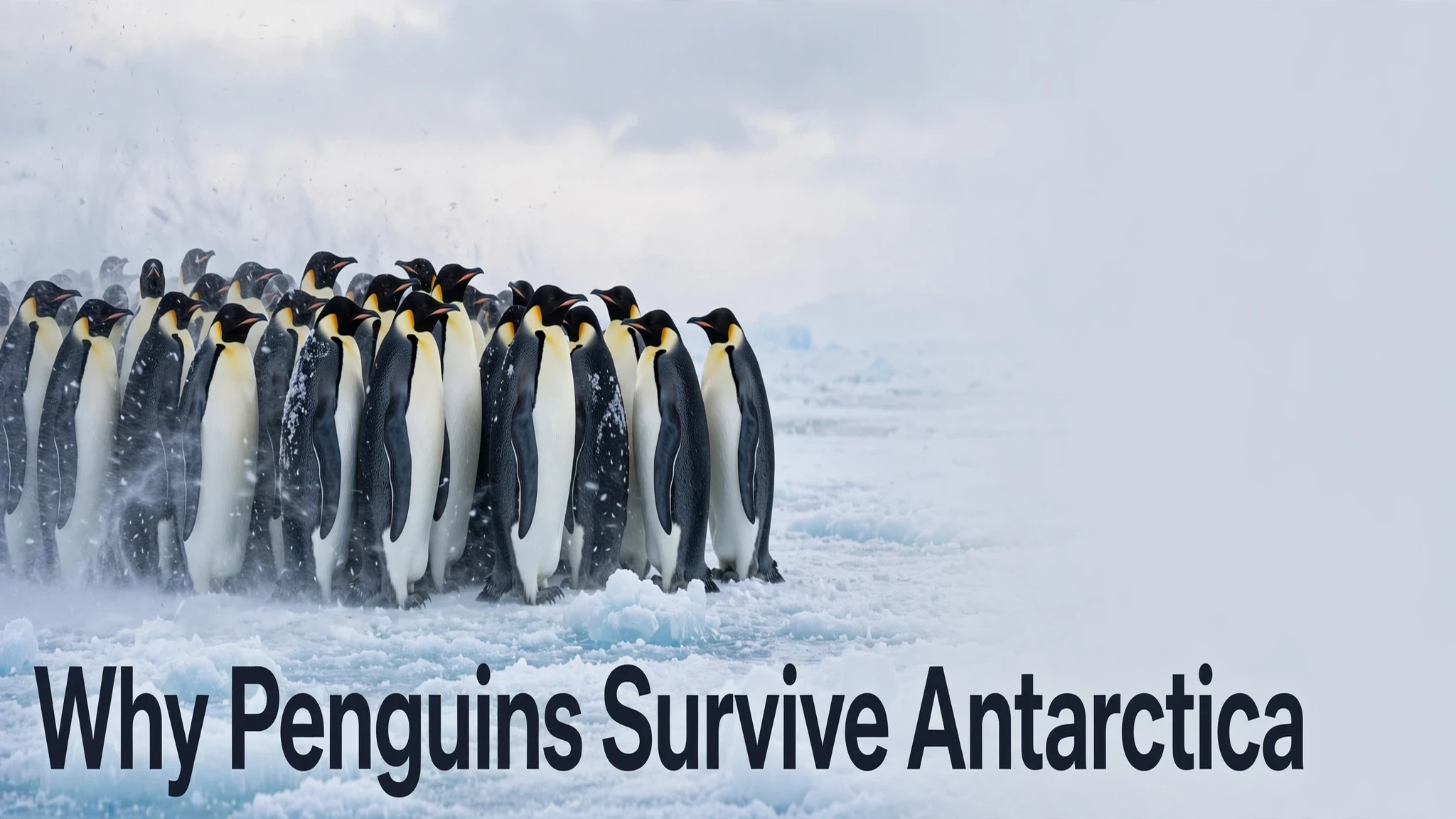
The emperor penguin huddle is famous, and it deserves its fame, but it is often misunderstood. Penguins in a huddle are not simply standing close together; they move slowly, like a fluid, with birds on the cold outer edge gradually working inward and warm birds moving outward. This rotation shares the burden of the cold edge, so no bird is left exposed for too long. Temperatures inside a large huddle can be far higher than the air outside, sometimes approaching comfortable levels, even while the wind outside is brutal. The huddle is therefore a social thermostat, not just a crowd.
Huddling also protects the egg and chick. A male incubating alone in open wind would lose heat faster and burn fat faster. In a huddle, the brood pouch and egg benefit from the warmth of neighbours, and the male’s energy lasts longer. When the female returns from sea, she takes over chick care, and the male, now thin, walks to the sea to feed. This handover must be timed carefully: if the female is late, the male may be forced to leave, and the chick may not survive. The system works because both parents play different roles at different times, not because one parent is tougher than the other.
Other penguin species huddle less dramatically, because their breeding seasons and sites are less extreme. Adélie penguins gather in large colonies on rocky ground, where the crowd offers some shelter and where neighbours help detect predators such as skuas. Gentoo penguins nest in smaller groups and rely more on site choice, such as sheltered beaches. The lesson is that social behaviour is tuned to local conditions: the colder and windier the breeding ground, the more important the group becomes. A penguin is a social animal not only for mating, but for warmth, defence and information about food.
Hunting in Freezing Water
Surviving the cold on land would be useless if a penguin could not eat. Antarctic penguins feed mainly on krill, fish and squid, with the balance varying by species and season. Krill, small shrimp-like animals, swarm in huge numbers in the Southern Ocean and support not only penguins but whales, seals and many fish. A penguin dives, chases prey with its flippers, and swallows it underwater or at the surface. Its streamlined body, stiff flippers and strong muscles make it an efficient swimmer, even though the same wings cannot fly in air. Evolution traded flight for swimming, and in the Southern Ocean that trade pays.
Diving in near-freezing water brings its own problems. A penguin must hold its breath, manage oxygen, and avoid losing too much heat while active. It does this by slowing its heart rate during dives, directing blood to essential organs, and using oxygen stored in blood and muscle. Dive depth and duration vary: emperor penguins can dive deeper and longer than most, reaching depths of hundreds of metres in search of fish and squid, while smaller species make shorter, shallower dives for krill near the surface. After feeding, a penguin returns to land or ice to rest, preen and warm up before the next trip.
Sea ice is central to this hunting life. It is a platform for resting and breeding, a shelter from some predators, and an edge where krill and fish gather. Too little sea ice can mean fewer resting places and changes in prey, while too much fast ice can mean a long walk to open water for feeding parents. Climate change is shifting sea ice patterns in different regions, with some areas losing ice and others seeing variable years, so penguin populations do not all move in the same direction. Scientists therefore study colonies one by one, rather than assuming that what happens to one species in one bay applies to all penguins everywhere.
Predators, Chicks and the Narrow Window of Growth
Adult emperor penguins have few land predators in Antarctica, but leopard seals and killer whales hunt them at sea, and skuas take eggs and small chicks in colonies. Adélie chicks face skuas, giant petrels and, in the water, seals. A chick’s survival depends on staying close to a parent, staying in the colony, and growing fast. Penguin chicks are covered in soft down that is warm on land but not waterproof, so a chick that falls into water too early can chill quickly. Parents therefore keep chicks on their feet or close beside them until their waterproof juvenile feathers grow.
Growth must fit a narrow seasonal window. A chick that hatches late, grows slowly because food is scarce, or loses a parent to predation or starvation may not reach independence before winter returns. This is why timing, fat stores and food availability are linked: a late female return, a long walk to open water, or a poor krill year can each reduce chick survival, even if the adults themselves survive. Penguin breeding success therefore varies greatly from year to year, and a single bad season does not necessarily mean a colony is doomed, just as a single good season does not guarantee recovery.
Human disturbance adds a further pressure. Research stations, tourism and fishing all operate in Antarctica under strict rules, including limits on approach distances and waste, precisely because colonies are sensitive during breeding. A frightened colony can scatter, exposing eggs and chicks to cold and predators. Responsible viewing from a distance, with no chasing, feeding or loud disturbance, protects the very behaviour that makes penguins fascinating. The Antarctic Treaty System, which governs the continent, treats wildlife protection as a shared duty, and visitors are expected to follow it even when no warden is watching.
Why Warming Hits Penguins Through Food and Ice
Climate warming does not usually kill a penguin directly by heat; it changes the ice and food the penguin depends on. Warmer water and changing winds can reduce sea ice in key breeding areas, shift krill distribution, and alter the timing of plankton blooms that krill feed on. If krill become scarcer or move farther from a colony, parents must travel farther, spend more energy, and return less often, and chicks grow more slowly. Some colonies may benefit in the short term from more open water, but the overall trend for ice-dependent species is a concern, because their life cycle evolved around predictable ice.
Fishing adds a second pressure. The krill fishery in the Southern Ocean is managed, but it operates in the same waters where penguins, whales and seals feed. If fishing concentrates in feeding areas during breeding season, it can compete directly with penguins. Management therefore includes catch limits and area closures, and scientists argue for precaution: because krill support so much life, leaving a generous margin for wildlife is safer than fishing to the maximum the stock might allow. This is an example of ecosystem-based management, where the goal is not only a sustainable catch for humans, but enough food left for the animals that have no alternative.
The future of penguins will therefore depend on two scales at once: global emissions, which drive long-term ice and ocean change, and local management, which decides fishing, tourism and research rules around colonies today. Neither scale alone is enough. A well-managed colony in a warming ocean still faces shrinking ice, and a stable climate will not save a colony disturbed daily or fished out of food. Protecting penguins means holding both scales in mind, and acting on the local one while the global one is negotiated.
My Take:
My take is that penguins survive Antarctica not because they are tough in a heroic sense, but because they are well organised. The huddle is the clearest proof: no single penguin could stand through an Antarctic winter night alone, but a group that rotates, shares warmth and takes turns on the cold edge can. I think there is a lesson in that for how we talk about survival in general. We love stories of a lone hero enduring the cold, but the real Antarctic story is a story of parents trading places, neighbours sharing heat, and colonies timing their lives to the season. Toughness, in this case, is mostly cooperation and good timing.
I also think the emperor penguin’s winter breeding is one of the boldest gambles in nature, and it only makes sense when you see the whole year at once. Breeding in darkness and cold looks foolish until you realise the chick must be ready for the next winter, and the only way to achieve that is to start early and pay the price as adults. That trade-off reminds me that adaptation is never free. Every advantage has a cost: flight was traded for swimming, summer comfort was traded for a spring chick, and fat was traded for months of fasting. When we admire a penguin, we should admire the bargain as much as the bird.
My worry is that we will judge penguin success by the wrong measure. A photograph of a large, noisy colony looks healthy, but colony size alone can hide falling chick survival, longer feeding trips and thinner adults. The numbers that matter are quieter: how many chicks fledge, how far parents travel, how much krill remains after fishing, and how sea ice changes over a decade. I would rather read a careful colony report than a viral photograph, because the photograph tells me penguins were there on one day, while the report tells me whether they can still be there in ten years.
Finally, I think penguins give us a fair test of our own claims about protecting nature. Antarctica is governed by treaty, not owned by one country, and its rules are stricter than in most places. If we cannot protect penguins there, where human presence is small and rules are clear, what hope is there for wildlife in crowded, contested places? The encouraging side is that the treaty system shows cooperation is possible when countries agree that a place is special. Penguins do not need us to make Antarctica warmer or colder for them; they need us to keep their ice, their krill and their quiet breeding ground intact. That is a modest ask compared with what they endure every winter, and it is one we can meet if we treat the Southern Ocean as a shared nursery rather than a shared pantry.
There is also a personal reason I find penguins compelling. They look comical on land, waddling and slipping, yet they are superb athletes in water, diving deep and hunting in darkness. That contrast breaks a lazy habit of judging animals by how they look in one setting. A penguin is not a failed flying bird; it is a successful swimming bird that happens to walk awkwardly. I think we make the same mistake with people and places, judging them by a single awkward moment instead of the environment where they excel. Penguins remind me to ask a better question: not whether something looks graceful, but whether it works where it actually lives.
And that brings me back to the huddle. When I picture an Antarctic storm, I no longer picture a single bird braving it. I picture a slow, rotating mass of birds, each taking a turn in the wind so that the eggs in the middle stay warm. It is not dramatic, it is not loud, and it does not photograph as well as a lone bird against a blizzard. But it is the reason the next generation exists. If there is a moral in the penguin story, it is not about enduring alone; it is about enduring together, sharing the cold edge, and trusting that the group will rotate you back inside before you freeze. That is a survival strategy worth remembering far beyond Antarctica.
One more angle deserves attention: the way penguin research itself has changed, and why that matters for trust. Early Antarctic exploration was heroic, dangerous and often anecdotal, with stories carried home by exhausted men. Modern penguin science is slower and more systematic: satellite counts of colonies, automated cameras that photograph nests through winter, tags that record dives and journeys, and genetic samples that track populations over decades. That shift from anecdote to measurement is why we can now say, with confidence, which colonies are growing, which are shrinking, and how far parents travel for food. It is also why a single photograph of a crowded colony should not override a decade of counts.
I also think about the responsibility that comes with visiting Antarctica, even virtually. Tourists who follow strict distance rules, researchers who minimise disturbance, and readers who share accurate information all protect penguins in ways that are invisible but real. Conversely, a viral video of someone chasing a penguin for a close photograph can inspire copycats who do real harm, even if the original video looked harmless. The lesson is that our attention has consequences, and that respecting a wild animal sometimes means keeping our distance, even when closeness feels like love. Penguins do not need our hugs; they need our restraint, our quiet, and our willingness to let a colony be a colony rather than a backdrop.
Finally, I want to stress the long view. Penguin colonies have survived ice ages, volcanic eruptions and centuries of sealing and whaling in the Southern Ocean, though not without losses. Their current challenge is different because it is faster and more global: warming water, shifting ice and industrial fishing operating at a scale no previous century saw. That speed is why local protection alone, however good, cannot save every colony, and why global climate action matters alongside local rules. A penguin that survives a winter storm through huddling still needs krill in spring, ice in summer and quiet in breeding season, and those needs now depend on decisions made far from Antarctica, in parliaments, boardrooms and fishing fleets. The huddle teaches cooperation; the climate challenge asks humans to learn the same lesson.
Frequently Asked Questions
How do emperor penguins keep their eggs warm in winter?
The male holds the egg on his feet under a brood pouch of skin and feathers, and stands in a huddle with other males, sharing warmth while fasting until the female returns from sea.
Why are penguin feathers waterproof?
Penguin feathers are short, dense and overlapping, and the bird spreads oil from a tail gland during preening. This keeps water from reaching the skin and preserves the insulating air layer beneath.
What do Antarctic penguins mainly eat?
Most Antarctic penguins eat krill, fish and squid, with the balance depending on species, location and season. Krill are especially important because they support many Southern Ocean animals.
Do all penguins live in Antarctica?
No. Only a few species breed on Antarctica itself, while others live on sub-Antarctic islands, South America, Africa, Australia and New Zealand, and one species lives near the equator in the Galápagos.
Why does sea ice matter so much to penguins?
Sea ice provides breeding and resting platforms, shelters prey such as krill, and marks the edge where feeding is often best. Changes in ice extent or timing can lengthen feeding trips and reduce chick survival.
How does huddling actually help penguins survive?
Huddling traps warm air between birds and shields them from wind. Birds rotate slowly from the cold outer edge to the warmer centre, so the cost of exposure is shared rather than borne by a few individuals.