Why Do We Have Seasons? Explained
In this post
- The tilt: Earth’s 23.5-degree lean
- Angle and duration: two ways sunlight changes
- Solstices and equinoxes: the year’s turning points
- Why seasons are opposite, mild, or missing
- The distance myth and what really varies
- How seasons shape plants, animals, and farming
- Seasons, climate change, and shifting calendars
- How to see the seasons in your own sky
- My Take:
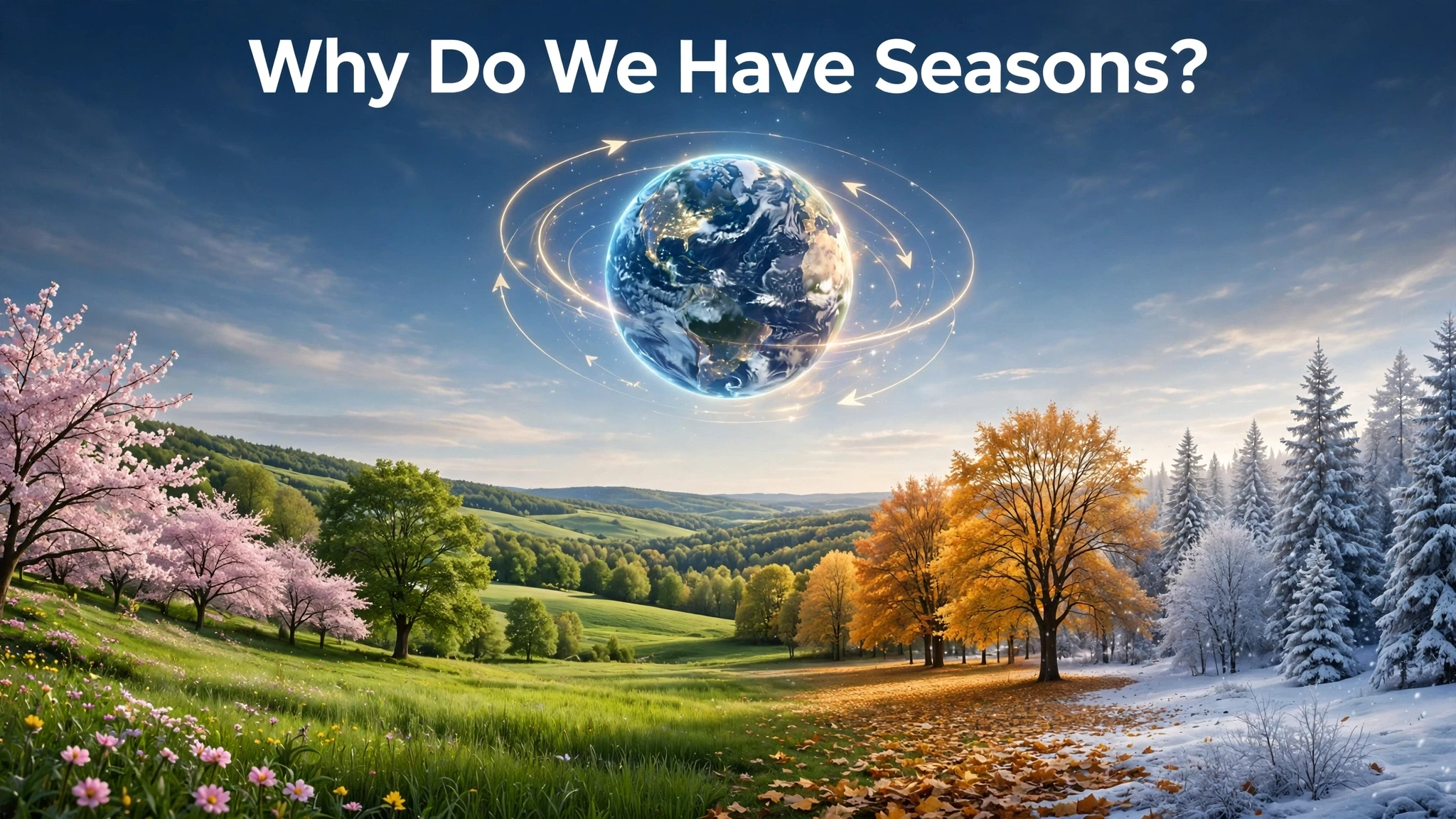
It is one of the first science questions children ask, and one of the most commonly misunderstood: why do we have seasons? Many people assume summer happens because Earth is closer to the Sun, and winter because it is farther away. That explanation sounds sensible, but it is wrong. In fact, Earth is slightly closest to the Sun in early January, during the Northern Hemisphere’s winter. The real cause is subtler and more elegant: Earth’s axis is tilted, and as Earth orbits the Sun, that tilt points different hemispheres toward or away from sunlight at different times of year.
This guide explains that tilt, how it changes the angle and duration of sunlight, why seasons are opposite in the Northern and Southern Hemispheres, and why some places have almost no seasons at all. It also clears up common myths, explains solstices and equinoxes, and looks at how seasons shape life, farming, and culture around the world.
The tilt: Earth’s 23.5-degree lean
Earth spins on an axis, an imaginary line through its North and South Poles. That axis is not upright relative to Earth’s orbit around the Sun; it is tilted by about 23.5 degrees. Crucially, the axis keeps pointing in the same direction in space as Earth orbits, toward the star Polaris in the north, rather than wobbling to follow the Sun. That fixed tilt is the whole secret of the seasons.
Imagine walking around a lamp while leaning slightly to one side and always leaning in the same direction. For half your walk, your lean points you toward the lamp; for the other half, it points you away. Earth does the same. In June, the Northern Hemisphere is tilted toward the Sun, receiving more direct sunlight and longer days: northern summer. In December, the Northern Hemisphere is tilted away, receiving more slanted sunlight and shorter days: northern winter. The Southern Hemisphere experiences the opposite at each moment, which is why Christmas in Australia falls in summer, and why July is winter in Argentina.
The tilt also explains why the change is gradual. Earth does not flip from summer to winter overnight; it moves slowly around its orbit, and the tilt’s effect on sunlight changes day by day. Days lengthen or shorten by minutes, shadows grow longer or shorter, and temperatures follow, lagging behind the sunlight because land and oceans take time to warm up and cool down. That lag is why the hottest days often come weeks after the longest day, and the coldest days weeks after the shortest day.
Angle and duration: two ways sunlight changes
Tilt affects seasons through two mechanisms working together: the angle of sunlight and the length of daylight. When sunlight strikes Earth more directly, its energy is concentrated on a smaller area, like a torch held straight above a table. When sunlight strikes at a slant, the same energy is spread over a larger area, like a torch held at an angle, and it also passes through more atmosphere, losing energy on the way. Direct summer sunlight is therefore more heating than slanted winter sunlight, even before day length is considered.
Day length amplifies the effect. In summer, the Sun rises earlier, sets later, and stays up longer, giving the ground more hours to absorb heat. In winter, days are short, nights are long, and the ground has many hours to radiate heat away. At high latitudes, this effect becomes extreme: in midsummer, places inside the Arctic Circle experience 24-hour daylight, the midnight sun, while in midwinter they experience polar night, with the Sun not rising at all for weeks. At the equator, by contrast, day length stays close to 12 hours all year, and the Sun’s angle changes only slightly, which is why equatorial regions have little seasonal temperature change.
Together, angle and duration explain most seasonal weather. A summer day is warmer not just because the Sun is higher, but because it is up longer, and a winter day is colder not just because the Sun is lower, but because night lasts longer. Either mechanism alone would produce seasons, but together they produce the strong contrast familiar in temperate regions, where summer and winter can differ by 20 degrees Celsius or more in average temperature.
Solstices and equinoxes: the year’s turning points
Four dates mark the seasonal cycle in each hemisphere. The June solstice, around 21 June, is the Northern Hemisphere’s longest day and the Southern Hemisphere’s shortest day. The December solstice, around 21 December, reverses that: the Northern Hemisphere’s shortest day and the Southern Hemisphere’s longest. The word solstice comes from Latin words meaning “Sun stands still”, because around a solstice, the Sun’s noon height changes very little from day to day, as if it pauses before reversing direction.
Between the solstices come the equinoxes, around 20 March and 22 September, when day and night are approximately equal all over the world, and the Sun rises due east and sets due west. The March equinox marks the start of spring in the Northern Hemisphere and autumn in the Southern Hemisphere, while the September equinox does the opposite. The word equinox comes from Latin for “equal night”, although in practice day and night are not exactly equal on the equinox itself, because of atmospheric refraction and the way sunrise and sunset are defined.
These dates are also cultural markers. Many festivals, from ancient stone circles aligned to solstice sunrises to modern celebrations of spring and harvest, cluster around them. Stonehenge in England, for example, is famously aligned to the summer solstice sunrise, and many other ancient monuments around the world show similar alignments. Whether those alignments were practical calendars, religious symbols, or both, they show that humans have tracked the Sun’s seasonal movement for thousands of years, long before the tilt explanation was understood.
Why seasons are opposite, mild, or missing
The most striking consequence of tilt is that seasons are opposite in the two hemispheres. When it is summer in London, it is winter in Sydney, and when New York shivers in January, Cape Town enjoys summer warmth. This is not because the Southern Hemisphere is a different planet; it is the same tilt, seen from the other side. A globe and a lamp demonstrate it instantly, and it is one of the easiest ways to test whether someone understands seasons: if they think summer is global, they have missed the tilt.
Some places have mild seasons, and some have almost none. Near the equator, the Sun’s angle stays high all year, so temperatures vary little, and seasons are often described by rainfall rather than temperature: a wet season and a dry season, driven by shifting wind and rain belts rather than by tilt alone. In tropical monsoon regions, the difference between wet and dry months can be dramatic for farming and water, even though temperatures stay warm throughout.
At the other extreme, polar regions have extreme seasons of light and dark but relatively modest temperature ranges in summer, because even 24-hour daylight at a low Sun angle delivers limited heat, and snow and ice reflect much of it away. Temperate regions, between the tropics and the poles, experience the classic four seasons, with the strongest contrast in temperature and day length, and it is in those regions that seasonal change most shapes daily life, from clothing and heating to school holidays and farming calendars.
The distance myth and what really varies
The idea that seasons are caused by Earth’s changing distance from the Sun is persistent because it feels intuitive: closer should mean warmer. Earth’s orbit is slightly elliptical, so distance does vary, from about 147 million kilometres at perihelion in early January to about 152 million kilometres at aphelion in early July, a difference of about 3 percent. That variation does affect the total sunlight Earth receives by about 7 percent, but it affects the whole planet at once, so it cannot explain opposite seasons in opposite hemispheres.
In fact, the distance effect slightly moderates Northern Hemisphere seasons and slightly intensifies Southern Hemisphere seasons, because the Southern Hemisphere’s summer occurs near perihelion, when Earth is closest to the Sun. However, the Southern Hemisphere has far more ocean than the Northern Hemisphere, and oceans buffer temperature changes, so its seasons are not dramatically more extreme in practice. Geography, ocean currents, and altitude often matter more than the small distance effect for local climate.
Another common myth is that the tilt itself changes with the seasons, wobbling back and forth during the year. It does not, at least not on a seasonal timescale. Earth’s tilt does vary slowly over tens of thousands of years, between about 22 and 24.5 degrees, as part of long-term Milankovitch cycles that help drive ice ages, but that slow variation is not what causes this year’s summer and winter. This year’s seasons are caused by a fixed tilt carried around the Sun, not by a tilt that changes with the calendar.
How seasons shape plants, animals, and farming
Seasons are not just weather; they are the rhythm of life. Plants use day length and temperature as cues for growth, flowering, and dormancy. Deciduous trees drop their leaves in autumn to survive winter cold and water shortage, then burst into leaf in spring when light and warmth return. Many flowers bloom in response to lengthening days, ensuring pollinators are active when they open. Farmers have built calendars around these cues for millennia, planting in spring, tending through summer, harvesting in autumn, and resting or planning in winter, although modern greenhouses and global trade now soften that rhythm in some places.
Animals also follow seasonal cues. Birds migrate to breed where food is abundant in summer and to escape winter cold, a journey covered in more detail in our guide to bird migration. Mammals may grow thicker coats, store fat, hibernate, or change colour for camouflage in snow. Insects may enter a dormant state, called diapause, to survive winter, emerging when temperatures rise. Even humans, despite heating, lighting, and air conditioning, show seasonal patterns in mood, activity, and health, although modern life buffers us more than it buffers wildlife.
In the oceans, seasons affect plankton blooms, fish movements, and the timing of breeding for many marine species. Spring sunlight and nutrient mixing trigger massive plankton growth in temperate seas, feeding a food web that supports fish, seabirds, and whales. Disruptions to seasonal timing, whether from climate change or other causes, can therefore ripple through ecosystems: if flowers bloom before pollinators emerge, or if migratory birds arrive after their food peak has passed, the mismatch can reduce breeding success, a phenomenon scientists call phenological mismatch.
Seasons, climate change, and shifting calendars
Climate change is not abolishing seasons, but it is shifting them in measurable ways. In many temperate regions, spring is arriving earlier, autumn is lasting longer, and the growing season has lengthened by days or weeks over recent decades. That sounds pleasant, but it brings problems: early blossom can be damaged by a late frost, pests may survive milder winters and emerge earlier, and water demand in a longer, hotter summer can strain supplies. The seasonal calendar that farmers, gardeners, and wildlife evolved with is becoming less reliable.
Winter warming is particularly noticeable in high latitudes, where Arctic temperatures have risen faster than the global average, a pattern called Arctic amplification. That warming reduces snow and ice cover, which in turn reduces reflection of sunlight and causes further warming, a feedback loop. It also affects the jet stream and storm tracks, although scientists are still working out exactly how Arctic change influences mid-latitude weather, and claims about specific cold snaps should be treated with care. The broad trend, however, is clear: winters are becoming milder on average, even though cold days still occur.
Understanding seasons through tilt helps keep climate change in perspective. The tilt has not changed in any way that explains recent warming, and Earth’s distance from the Sun has not shifted to cause it. The seasons still follow their ancient rhythm, but the temperatures within each season are rising, and the timing of spring and autumn is shifting. That distinction, between the cause of seasons and the cause of warming within seasons, is essential for honest discussion, because confusing the two leads to false claims that warming is just a natural seasonal effect.
How to see the seasons in your own sky
You do not need a telescope or a textbook to observe the cause of the seasons; you need only a window, a notebook, and patience across a year. Start by noting where the Sun rises and sets on the same date each month, relative to a fixed landmark such as a tree, a building, or a hill. In the Northern Hemisphere, sunrise moves northward from winter to summer and southward from summer to winter, while sunset follows a similar pattern, and the arc the Sun traces across the sky grows higher and longer in summer and lower and shorter in winter. In the Southern Hemisphere, the pattern is mirrored, with the Sun’s arc shifting in the opposite direction at the same times of year.
A second simple observation is your shadow at noon. Stand in the same spot at midday once a month and mark where your shadow falls and how long it is. Around the summer solstice, the noon shadow will be at its shortest, because the Sun is highest; around the winter solstice, it will be at its longest, because the Sun is lowest. Near the equinoxes, the shadow length will be in between, changing most rapidly from week to week. These two observations, sunrise position and noon shadow, together demonstrate tilt more convincingly than any diagram, because they are made in your own place, with your own eyes, over a full cycle.
A third observation is the stars. The constellations visible at night change with the seasons, not because the stars move, but because Earth moves around the Sun and the night side of Earth faces different parts of the sky at different times of year. That is why Orion dominates winter evenings in the Northern Hemisphere and summer evenings in the Southern Hemisphere, while Scorpius does the opposite. Watching that slow parade of constellations is a reminder that seasons are not just about weather; they are about Earth’s position in its orbit, written across the whole sky.
My Take:
My first judgement is that the distance myth persists because it is a good story badly taught. Textbooks often show Earth’s orbit as a strongly stretched ellipse, making it look as if distance must matter a great deal, when in reality the orbit is almost circular and the distance variation is only about 3 percent. Add a diagram that exaggerates the ellipse for clarity, without saying it is exaggerated, and students naturally conclude that summer means closer. I think science teaching should label exaggerated diagrams clearly and test understanding with the Southern Hemisphere question: if distance caused seasons, why is it summer in Australia when it is winter in Britain? A single question like that exposes the myth faster than a page of explanation.
My second judgement concerns the value of a globe and a lamp as a teaching tool, which I think is underrated in an age of animations and videos. A physical demonstration, where a learner tilts a globe, walks around a light, and watches the same hemisphere move into and out of direct light, creates a bodily understanding that a screen animation rarely matches. The learner can stop, reverse, and repeat the motion, and can see for themselves why the equator stays warm and why the poles experience midnight sun. Digital tools have their place, but for seasons, the oldest model in the classroom is still the best, because it makes an abstract orbit tangible.
I also think seasons deserve more respect as a cultural force, not just a weather pattern. Harvest festivals, new year celebrations, school terms, holiday seasons, and even fashion cycles are built around seasonal change. When climate change shifts spring earlier or extends summer, it does not just change temperatures; it disrupts festivals, farming traditions, and the shared calendar by which communities mark time. That cultural disruption is often missing from climate discussions, which focus on degrees and centimetres, but it is how ordinary people actually experience change: the blossom festival that now misses the blossom, or the ski season that now starts late and ends early.
A further point is about equatorial seasons, which are too often dismissed as “no seasons” by temperate writers. Tropical regions do have seasons, but they are seasons of rain, not temperature, and for farmers depending on monsoon or wet-season rains, the difference between wet and dry months is a matter of survival, not a curiosity. Describing the tropics as seasonless reveals a temperate bias, as if temperature were the only seasonal variable that counts. A fuller account recognises wet and dry, flood and drought, and the wind shifts that bring them, as seasons in their own right, with their own calendars, festivals, and risks.
I would also argue that understanding seasons helps people read weather forecasts more wisely. A forecast that says tomorrow will be warmer than today is not a sign of climate change, and a cold snap in winter is not proof against it. Seasons provide the baseline: what is normal for this place at this time of year, given tilt, day length, and geography. Only against that baseline can we judge whether a particular week is unusual, and whether a long-term trend is emerging. Without that baseline, every hot day becomes a crisis and every cold day becomes a rebuttal, and public discussion swings wildly instead of learning steadily.
Finally, my practical advice is to watch the Sun for a year, even casually. Note where it rises and sets in summer versus winter, how long your shadow is at noon in June versus December, and how the light in your home changes with the months. Those observations, made from your own window, will teach you more about tilt than any diagram, because they connect an astronomical cause to a personal effect. Seasons are not something that happens in textbooks; they happen in your garden, your street, and your daily light. Once you see the tilt at work in your own shadow, you will never again believe that summer is simply about being closer to the Sun.
Another judgement concerns how seasons are taught alongside climate, because the two are often confused in public debate. A cold winter is sometimes presented as evidence against warming, and a hot summer as proof of it, but neither single season proves or disproves a long-term trend. The correct comparison is not this winter versus last winter, but the average of many winters now versus the average of many winters decades ago, in the same place, at the same time of year. Teaching seasons properly, with their baseline of tilt-driven change, gives people the mental tool to make that comparison, instead of reacting to each season as if it were a verdict on its own.
I also think urban life has dulled our seasonal senses, and that loss has consequences. When food is available year-round from global trade, when heating and cooling keep indoor temperatures constant, and when artificial light extends the day, it is easy to forget that seasons ever mattered. Yet our bodies, our moods, and our energy use still follow seasonal rhythms, and our food, water, and energy systems still depend on seasonal rain, snowmelt, and sunlight. Reconnecting with seasons, through gardening, walking, or simply noting sunrise times, is therefore not nostalgia; it is a practical way to understand the systems we depend on, and to notice when those systems shift.
A final point is about other planets, which make Earth’s seasons look almost gentle by comparison. Mars has seasons too, driven by a similar tilt of about 25 degrees, but its more elliptical orbit makes its seasons more uneven, and its thin atmosphere produces dramatic dust storms in some seasons. Uranus, tilted on its side by about 98 degrees, has seasons lasting more than twenty years each, with each pole spending decades in sunlight and then decades in darkness. Compared with those extremes, Earth’s moderate tilt and nearly circular orbit give us a stable, liveable cycle of four seasons in temperate regions, a balance that has supported agriculture and civilisation for thousands of years. That stability is not guaranteed forever, and it is worth appreciating while we still have it, and protecting the climate that keeps it within familiar bounds.
Frequently Asked Questions
What causes the seasons? Earth’s axial tilt of about 23.5 degrees, combined with its orbit around the Sun, causes different hemispheres to receive more direct sunlight and longer days at different times of year.
Is Earth closer to the Sun in summer? Not in the way most people think. Earth is closest to the Sun in early January, during Northern Hemisphere winter. Distance varies by only about 3 percent and affects the whole planet at once, so it cannot explain opposite seasons.
Why are seasons opposite in Australia and Britain? Because of tilt: when the Northern Hemisphere leans toward the Sun, the Southern Hemisphere leans away, and vice versa. The same tilt therefore produces summer in one hemisphere and winter in the other.
What is a solstice? A solstice is the year’s longest or shortest day, around 21 June and 21 December. The word means the Sun appears to stand still, because its noon height changes very little for a few days around the solstice.
What is an equinox? An equinox, around 20 March and 22 September, is when day and night are approximately equal worldwide, and the Sun rises due east and sets due west.
Why do places near the equator have little temperature change? Near the equator, day length stays close to 12 hours all year and the Sun’s angle stays high, so heating varies little. Seasons there are often marked by wet and dry periods rather than temperature.