Why Do We Cry When Happy?
In this post
- Tears Are Not Only for Sadness
- The Brain, Arousal, and Emotional Overload
- Memory, Meaning, and Why Milestones Trigger Tears
- Social Bonding: What Happy Tears Communicate
- Happy Crying, Relief, and Gratitude
- Is Crying When Happy Normal or a Concern?
- How to Respond When You or Others Cry With Joy
- Happy Tears in Different Cultures and Life Stages
- Tears of Joy and Mental Health
- Happy Tears at Work, School, and Public Events
- Happy Tears, Music, Art, and Awe
- My Take:
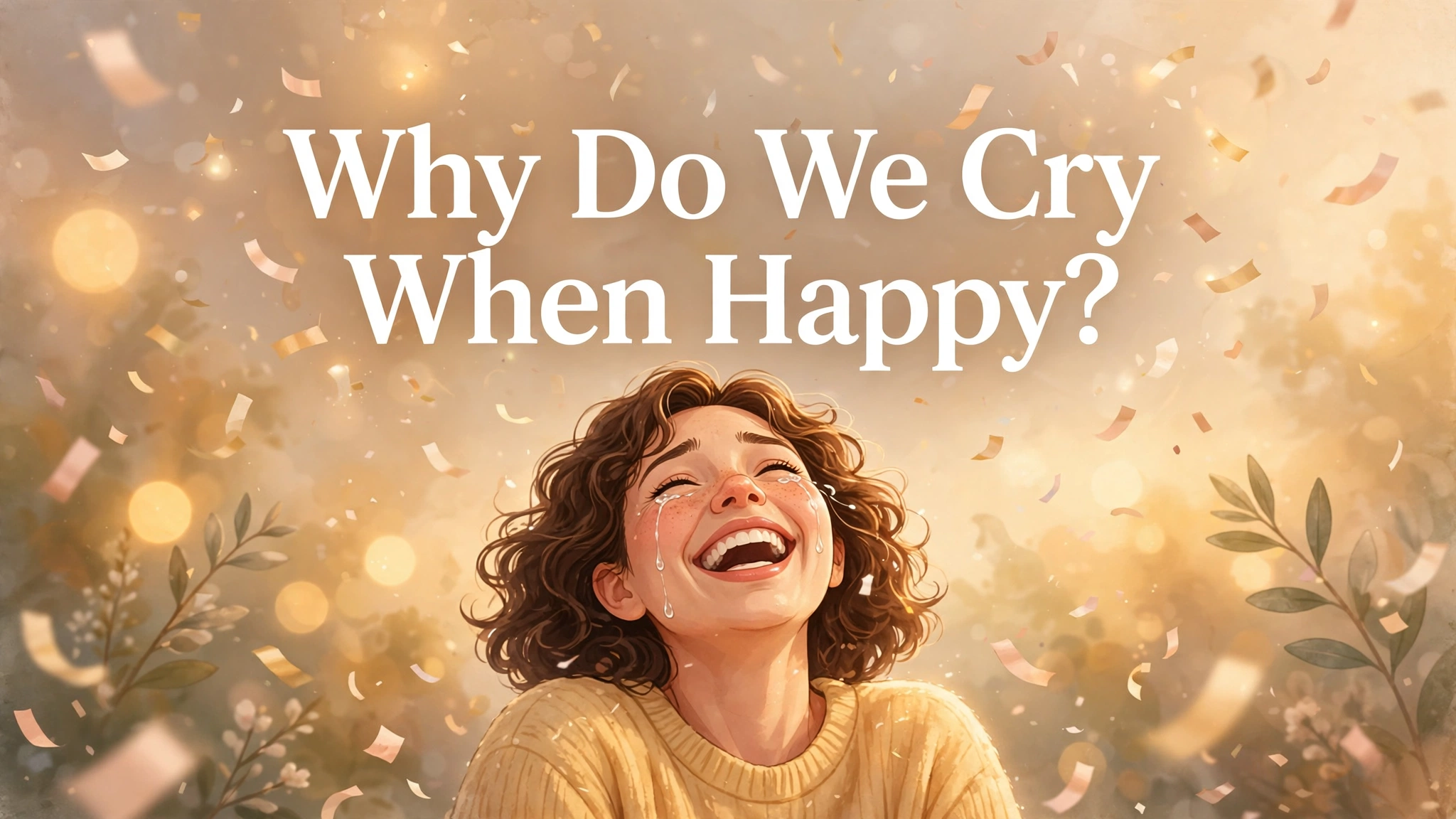
Crying when happy can feel confusing. You receive good news, watch a wedding, hold a newborn, reunite with someone you love, or achieve something you worked for for years, and instead of only smiling, tears appear. People around you may ask why you are sad, when in fact you feel overwhelmed with joy. Tears of joy are common across ages and cultures, and they are not a sign that happiness has gone wrong. They show that emotion is not a simple switch between happy and sad. Strong feelings, whether positive or negative, can activate the same tear system, the same body arousal, and the same need to release and restore balance. Understanding happy crying helps normalise it, explains why it happens at weddings, graduations, reunions, and victories, and shows why it often brings people closer rather than pushing them apart.
Tears Are Not Only for Sadness
Humans produce different kinds of tears. Basal tears keep the eyes moist. Reflex tears respond to irritants such as smoke or onion fumes. Emotional tears respond to feelings, and they can appear in grief, frustration, awe, gratitude, love, relief, and joy. The tear glands do not distinguish neatly between positive and negative emotion; they respond to intensity and to shifts in emotional state. When emotion becomes strong enough, the body seeks a way to process and regulate it, and crying is one such mechanism. Tears also contain stress hormones and other substances in small amounts, though the popular idea that crying simply “flushes out toxins” is oversimplified. More importantly, crying changes breathing, facial expression, and social signalling. It tells others that something meaningful is happening, even when words are hard to find. That is why tears of joy often appear at moments that are hard to describe: the feeling is too large, too sudden, or too important for a smile alone to carry. The tear is not a contradiction of happiness. It is happiness expressed at full intensity.
The Brain, Arousal, and Emotional Overload
Psychologists explain happy crying partly through arousal and regulation. A joyful event can raise emotional arousal sharply: heart rate increases, attention narrows, and the body prepares for action. If that arousal rises too fast or too high, the brain may use an opposite response to restore balance. This idea, sometimes called dimorphous expression, means that a positive emotion can be expressed through a seemingly negative display, such as crying, and a negative emotion can be expressed through laughter. The opposite expression helps bring arousal back toward a manageable level, so the person can think, speak, and act more clearly. For example, a person who receives life-changing good news may laugh, cry, shake, and struggle to speak all at once. That mixture is not confusion; it is regulation in action. The brain is trying to handle a sudden, important change. Tears may also be linked to the release of tension after a long period of effort, worry, or waiting. When a long-awaited result finally arrives, relief and joy combine, and the body releases the stored tension through tears. This pattern explains why happy crying is common after exams, births, reunions, and long separations.
Memory, Meaning, and Why Milestones Trigger Tears
Milestones carry meaning beyond the moment itself. A graduation is not only a ceremony; it represents years of study, sacrifice, family support, and personal growth. A wedding is not only a celebration; it represents commitment, family history, and a future imagined together. A reunion after years apart carries memories of childhood, loss, distance, and love that survived time. When these layers of meaning arrive at once, emotion can overflow. Happy tears often involve nostalgia, gratitude, and awareness of time passing. You may cry because you remember how hard the journey was, because you see your parents ageing, because a loved one is absent, or because you realise a chapter is ending even as a new one begins. This bittersweet quality does not make the joy less real. It makes it deeper. The tear holds both the happiness of the present and the memory of the past. That is why songs, photographs, and familiar places can trigger happy tears years later: they reconnect you to a meaningful moment and to the people who shaped it, and the body responds before the mind can fully explain why.
Social Bonding: What Happy Tears Communicate
Tears are also social signals. When you cry at a joyful event, you communicate vulnerability, sincerity, and emotional investment to others. Observers often respond with empathy, hugs, and support, which strengthens bonds. Research on crying suggests that visible tears can elicit caregiving and closeness, because they signal that the person needs connection and is open to it. At a wedding, a parent crying with joy signals deep love and pride. At a reunion, tears signal that the relationship matters and that absence was felt. At a victory, tears signal how much effort and meaning lay behind the result. In each case, tears invite others in rather than pushing them away. This social function may explain why happy crying is more common in group settings than alone. Being witnessed matters. The tear is not only a private release; it is a shared moment. Even when people feel embarrassed by crying in public, others often remember the tears fondly, as proof that the moment was genuine. Suppressing tears completely can sometimes make a joyful moment feel less connected, because the visible emotion that invites closeness is hidden.
Happy Crying, Relief, and Gratitude
Relief and gratitude are powerful triggers for happy tears. Relief arrives when a feared outcome does not happen: a loved one recovers, a danger passes, a long wait ends, or a difficult problem is solved. The body, which may have held tension for days, weeks, or months, finally relaxes, and tears can accompany that release. Gratitude works similarly. When someone helps you in a way you did not expect, forgives you, believes in you, or sacrifices for you, the emotion can feel too large for words. Tears become a way of saying thank you without a speech. Many people cry when they receive kindness after hardship, because the contrast between past struggle and present support is sharp. This is also why surprise celebrations, unexpected gifts, and public recognition often cause tears: the person did not prepare an emotional defence, and the sudden kindness overwhelms their usual composure. These tears are not weakness. They reflect sensitivity to care, effort, and connection, qualities that support healthy relationships and resilience over time.
Is Crying When Happy Normal or a Concern?
For most people, crying when happy is normal and healthy. It becomes worth discussing with a clinician only if crying is frequent, uncontrollable, and interferes with daily life, or if it is accompanied by persistent low mood, anxiety, panic, or difficulty functioning. Some neurological and mood conditions can affect emotional expression, and some medicines can influence tearfulness, so persistent changes are worth checking. This article is general information, not individual medical advice. It is also normal for some people to rarely cry when happy. Emotional expression varies by personality, culture, family upbringing, and life experience. A person who smiles quietly at good news is not less happy than a person who cries openly. Cultural norms shape whether tears are encouraged, accepted, or discouraged, especially for men in some societies where crying is unfairly treated as weakness. That stigma can make happy crying feel shameful, even though the underlying response is common. Normalising tears of joy, without pressuring anyone to cry, helps people express emotion in ways that feel authentic to them.
How to Respond When You or Others Cry With Joy
If you cry when happy, allow the moment rather than fighting it. Take slow breaths, accept a tissue or hug if offered, and let the tears pass naturally. You do not need to explain or apologise. A simple phrase such as “These are happy tears” can reassure others. If you feel overwhelmed, stepping aside briefly, drinking water, and breathing slowly can help you regain composure without suppressing the emotion entirely. If someone else cries with joy, respond with warmth, not confusion or jokes that minimise the moment. Offer presence, eye contact, and a hug if appropriate, and avoid asking “Why are you crying?” in a worried tone that implies something is wrong. Instead, you might say, “This is a beautiful moment,” or simply stay close. Avoid filming or drawing excessive attention unless the person welcomes it. Afterward, do not tease them about crying, especially in front of others. Respecting happy tears strengthens trust and makes future celebrations feel safer. Joy, like grief, deserves space to be expressed fully, without embarrassment or explanation.
Happy Tears in Different Cultures and Life Stages
Happy tears appear across cultures, but how openly they are shown varies. In some cultures, crying at weddings, births, and reunions is expected and celebrated as proof of deep feeling. In others, especially where emotional restraint is valued, tears may be hidden, wiped away quickly, or expressed privately afterwards. Gender norms also shape expression: in many societies, women are given more permission to cry openly, while men may suppress tears to appear strong, even at joyful events. Children often cry with joy more freely, because they have not yet learned to edit emotion for social approval. Teenagers may hide happy tears to avoid teasing, while older adults may cry more easily at milestones because they carry longer memories and a sharper awareness of time. These differences do not mean some cultures or genders feel joy less deeply. They mean expression is filtered through learned rules. Understanding this helps avoid judging others for crying or for not crying. Joy can be genuine in both cases; only its visible form changes with culture, age, and personal history.
Tears of Joy and Mental Health
Happy crying can also support mental health by allowing emotional processing and connection. Suppressing strong emotion repeatedly can increase tension, while expressing it in safe settings can bring relief and closeness. Tears at a joyful event often mark a moment when a person feels seen, loved, or accomplished after difficulty, and that recognition can strengthen resilience. For people recovering from grief, illness, or hardship, happy tears may signal a return of hope: the ability to feel joy again after a period when joy felt distant. That return is meaningful and worth noticing. However, tears that appear with persistent sadness, anxiety, or emotional numbness, or tears that feel uncontrollable and distressing, deserve attention rather than dismissal as “just happiness.” Mental health is rarely about a single tearful moment; it is about patterns over time. If joyful moments consistently trigger overwhelming distress, or if joy itself feels unreachable, talking to a trusted person or clinician can help. In most cases, though, happy tears are a healthy sign that emotion, memory, and connection are working together as they should.
Happy Tears at Work, School, and Public Events
Happy tears are not limited to private family moments. They appear at work when a long project succeeds, at school when a student graduates against odds, at sports events when a team wins after years of effort, and at public ceremonies honouring service or achievement. In these settings, tears can feel more exposing, because colleagues or strangers are watching and professional composure is expected. Yet public happy tears often strengthen group bonds, because they show that the achievement mattered beyond a task or result. A teacher crying at a student’s graduation signals investment in that student’s future. A colleague crying at a retirement signals years of shared work and respect. A winner crying on a podium signals the effort behind the medal. In each case, tears humanise success and remind onlookers that achievement involves people, sacrifice, and emotion, not only performance. Organisations that allow such emotion, without mocking it, tend to feel warmer and more supportive, because people learn that genuine feeling is safe to show, even in formal settings.
Happy Tears, Music, Art, and Awe
Music, art, nature, and awe can also trigger happy tears, even without a personal milestone. A song that recalls a loved one, a film that portrays sacrifice and reunion, a sunset over mountains, or a piece of music that builds to a powerful climax can overwhelm emotion and bring tears. Psychologists link these experiences to awe, beauty, and a sense of connection to something larger than oneself. Awe can make personal worries feel smaller, increase feelings of gratitude, and strengthen social bonds, even when experienced alone. Tears in response to beauty are not sadness; they are a sign that the experience touched something deep, such as memory, hope, or love. People sometimes feel embarrassed crying at a concert or in a gallery, but such tears are common and often shared silently by others in the room. Art and nature move us precisely because they bypass rational explanation and speak directly to emotion. Allowing those tears, rather than suppressing them, can deepen appreciation and leave a lasting, meaningful memory of the experience.
My Take:
My view is that tears of joy are one of the most honest things humans do. In a world where people often perform happiness for photos, posts, and applause, a tear that arrives unplanned is hard to fake. It shows that something actually mattered. I have seen people try to hold back happy tears because they feared looking weak, emotional, or out of control, especially in formal settings. Yet the moments people remember most are often the ones where someone could not hold it together: a father crying at a graduation, a friend crying at a reunion, a winner crying after years of quiet work. Those tears do not spoil the moment. They prove it. They tell everyone present that this was not just another event, but a turning point, a return, a fulfilment, or a love that survived difficulty. That proof is precious, because so much of modern life is polished and rehearsed.
I also think happy crying teaches us something important about emotion itself. We are taught to sort feelings into neat boxes: happy means smiling, sad means crying, angry means shouting. Real life refuses those boxes. Joy can bring tears, grief can bring laughter, and relief can bring shaking hands. That mixture is not a flaw in our emotional system. It is the system working as it should, balancing intensity, releasing tension, and inviting connection. When we accept that mixture, we become kinder to ourselves and to others. We stop asking people to explain their tears, and we start accepting that a person can be joyful and overwhelmed at the same time. That acceptance matters, especially for men and boys who are often told not to cry at all. A boy who learns that happy tears are normal grows into a man who can express love, gratitude, and pride without shame, and that emotional freedom strengthens families, friendships, and marriages.
Finally, I would say: do not be embarrassed by your happy tears, and do not embarrass others for theirs. If good news moves you to tears, let it. It means you cared deeply, waited long, loved strongly, or appreciated something fully. Those are not weaknesses to hide. They are strengths to honour. Life offers fewer truly joyful milestones than we expect, and each one deserves to be felt completely, not edited for appearance. So the next time tears arrive with happiness, do not apologise for them. Smile through them, accept the hug, and remember the moment for what it was: proof that joy, when it is real and deep, is sometimes too large for a smile alone, and needs tears to carry it.
There is another side to happy tears that deserves attention: they often arrive when we realise how much we have been given, not only what we have achieved. A person who cries when a child graduates may be crying for the teachers, grandparents, and friends who helped along the way. A person who cries at a wedding may be crying for a parent who is no longer alive to witness it. A person who cries at a reunion may be crying for years that cannot be recovered, even while celebrating the present. That mixture of gratitude and loss does not spoil joy; it deepens it, because it connects the present moment to a larger story. Joy that remembers its cost, its helpers, and its history feels more grounded than joy that only celebrates the surface. Tears, in that sense, are a form of remembering, and remembering is part of loving well.
I also think we should protect joyful moments from being turned into performances. When every wedding, birth, and achievement is filmed, posted, and judged online, people may feel pressure to cry beautifully, smile perfectly, or react in a way that looks good on camera. Real emotion rarely looks perfect. It involves red eyes, shaky voices, and awkward laughter, and that imperfection is precisely what makes it trustworthy. If you are present at a joyful moment, put the camera down sometimes, be fully there, and let the person cry without making their tears content for others. The memory you carry in your heart, unfiltered and unposted, will often last longer than any video. Joy deserves privacy as well as celebration, and happy tears deserve to be felt first and shared only if the person wishes.
Finally, I want to say something simple to anyone who has ever apologised for crying when happy: you do not need to apologise. Your tears did not ruin the moment, embarrass your family, or show weakness. They showed that you were fully present for something that mattered, and that presence is a gift to everyone around you. The people who love you will remember your tears with tenderness, not judgement, because they know what those tears meant. So let joy move you, let gratitude overflow, and let tears come when they need to. A life with happy tears is a life where love, effort, and meaning are still alive, and that is something to celebrate, not to hide.
I also believe happy tears can teach us to slow down. Modern life rushes from one achievement to the next, often without pausing to feel the moment fully. A graduation is followed by job hunting, a wedding by honeymoon planning, a birth by sleepless nights and endless tasks. Tears interrupt that rush, forcing a pause where emotion can be felt, even if only for seconds. That pause is valuable. It allows gratitude to register, memories to form, and relationships to deepen. If you notice happy tears arriving, treat them as a signal to pause, breathe, look around, and notice who is with you and what has been achieved. That mindful pause, brief as it is, can turn a fleeting event into a lasting memory, and a lasting memory into a source of strength during harder times ahead.
Finally, I want to end with encouragement for people who cry easily at joyful moments. Your sensitivity is not a flaw to be fixed. It is a capacity to feel deeply, to notice meaning, and to connect with others, and those capacities are rare and precious in a world that often rewards numbness and cynicism. Protect that sensitivity, express it safely, and do not let embarrassment silence it. At the same time, remember that others may express joy differently, quietly or privately, and that difference does not make their joy less real. Joy has many faces, tears are only one of them, and all of them deserve respect. Whether you cry openly or smile quietly, what matters is that you allow joy to be felt, remembered, and shared in a way that is true to you.
Frequently Asked Questions
Why do we cry when we are happy?
Strong joy raises emotional arousal sharply. Crying can help regulate that arousal, release tension after waiting or effort, and express meaning, gratitude, and connection that a smile alone cannot carry.
Are tears of joy normal?
Yes. Tears of joy are common at weddings, births, reunions, graduations, and victories, and they occur across ages and cultures. They are not a sign that happiness has gone wrong.
Why do I cry at weddings or emotional movies?
Milestones and stories carry layered meaning, memory, and empathy. When many meaningful associations arrive at once, emotion can overflow into tears even when the overall feeling is positive.
Is crying when happy a sign of weakness?
No. Emotional expression varies by person and culture. Tears of joy often signal sincerity, gratitude, and deep investment, and observers frequently respond with empathy and closeness.
Can happy crying be a medical concern?
Usually not. Seek advice if crying is frequent, uncontrollable, interferes with daily life, or occurs with persistent low mood, anxiety, or other concerning changes.
Why do some people never cry when happy?
Personality, upbringing, culture, and emotional style all affect expression. Quiet smiling at good news is not less genuine than open tears.
Sources
- Cleveland Clinic: https://my.clevelandclinic.org
- Mayo Clinic: https://www.mayoclinic.org
- National Institutes of Health: https://www.nih.gov
- NHS: https://www.nhs.uk
- American Psychological Association: https://www.apa.org