Why Do We Get Hiccups? The Science
In this post
- The Hiccup Reflex: Nerves, Brainstem, and Muscle
- Common Triggers: Food, Drink, Air, and Emotion
- Why Hiccups Sound the Way They Do
- Home Remedies: What Might Help and Why
- When Hiccups Last Too Long
- Hiccups in Babies, Pregnancy, and Older Adults
- Myths, Surprising Facts, and What Science Still Does Not Know
- My Take:
Almost everyone has hiccupped at an awkward moment: during a meal, in a quiet room, or in the middle of a sentence. A hiccup feels small and silly, yet it reveals a surprisingly complex piece of human wiring. It is not a stomach problem alone, nor a throat problem alone. It is a reflex, a loop that runs from nerves in the chest and neck, through the brainstem, and back to a large breathing muscle called the diaphragm. When that loop misfires, the diaphragm jerks, air rushes in suddenly, and the vocal cords snap shut. The result is the familiar “hic” sound. Most hiccups end within minutes and need no treatment, but understanding why they start helps you judge which home remedies make sense, which are myths, and when a hiccup that will not stop deserves medical attention.
The word hiccup describes both the sound and the event. Doctors sometimes use the term singultus, from a Latin word for sobbing or gasping. A hiccup begins as an involuntary spasm of the diaphragm, the dome-shaped muscle that separates the chest from the abdomen and drives breathing. Normally the diaphragm contracts smoothly when you inhale and relaxes when you exhale. During a hiccup, it contracts suddenly and repeatedly, out of rhythm. At almost the same instant, the vocal cords close, briefly blocking the airway. That sudden stop is what turns a normal sharp breath into a sound. The whole event takes a fraction of a second, but when it repeats every few seconds, it becomes impossible to ignore.
The Hiccup Reflex: Nerves, Brainstem, and Muscle
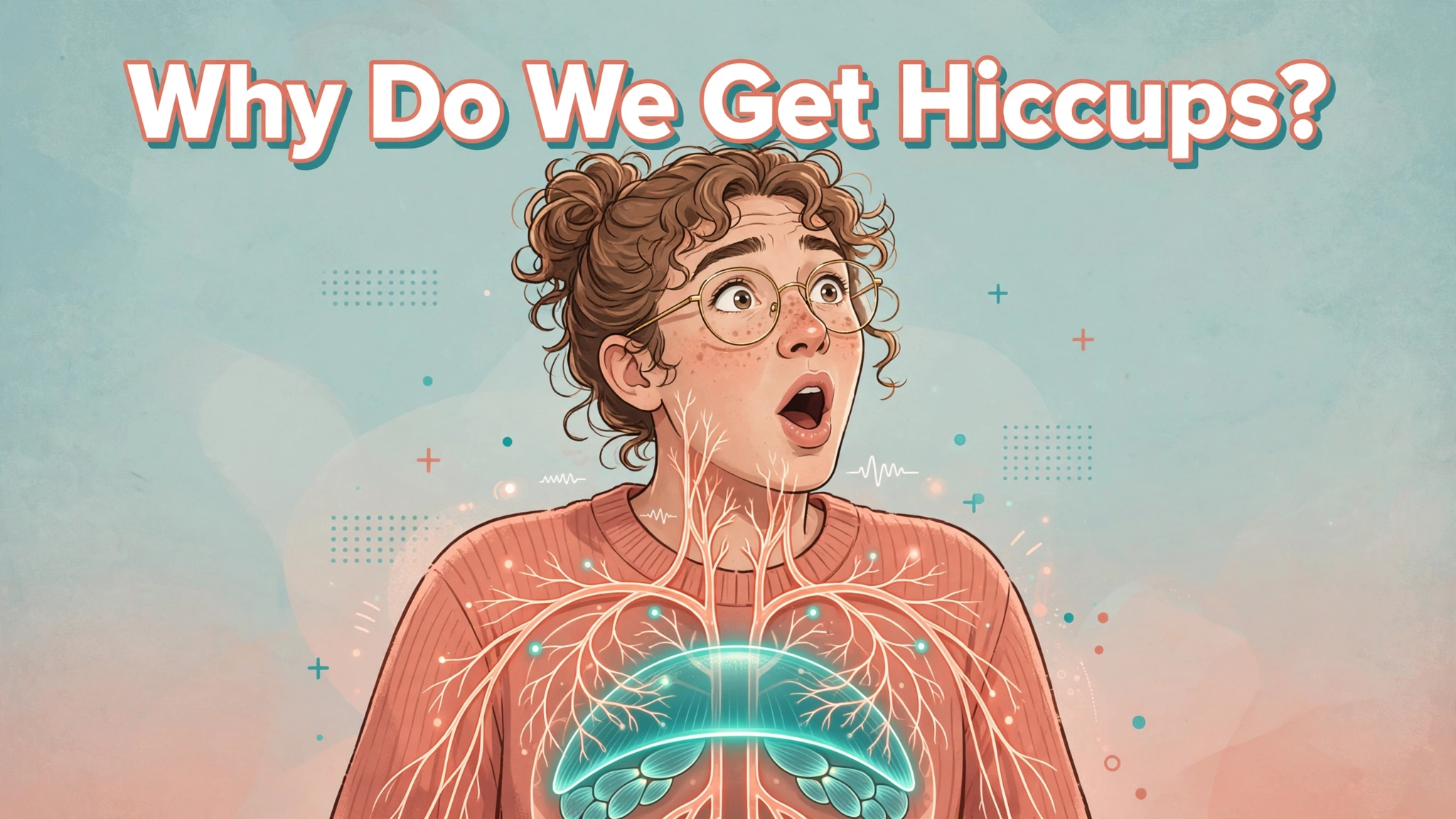
The hiccup reflex has three parts, and a fault in any part can trigger it. The first part is the input pathway, carried mainly by the phrenic nerve, which controls the diaphragm, the vagus nerve, which runs from the brain through the neck and chest to the abdomen, and sympathetic nerves from the chest. These nerves report irritation from the stomach, oesophagus, chest, ears, or throat. The second part is a processing centre in the brainstem, the lower part of the brain that controls automatic functions such as breathing and swallowing. The third part is the output pathway, which sends signals back through the phrenic nerve to the diaphragm and to the muscles that close the vocal cords. When this loop is working normally, it stays quiet. When it is irritated or overexcited, it fires again and again, and each firing is one hiccup.
This reflex probably exists because the body needs a way to protect the airway and clear irritation. Some researchers suggest hiccups are a leftover from early development, related to the way young mammals learn to breathe and swallow without choking. Others link them to a reflex in amphibians that moves water over gills. Neither explanation is fully proven, and the honest scientific position is that the exact original purpose of hiccups in humans remains uncertain. What is well established is the wiring itself: damage or irritation along the vagus or phrenic nerves, or in the brainstem, can produce hiccups that last far longer than ordinary ones. That is why doctors take long-lasting hiccups seriously, even though short hiccups are almost always harmless.
A useful way to think of it is a faulty alarm. A normal alarm rings once when there is smoke. A hiccup reflex that has been sensitised rings repeatedly after a small trigger, such as a full stomach or a sudden change in temperature. The trigger itself may be minor, but once the loop starts firing, it can sustain itself for minutes. That self-sustaining quality explains why hiccups sometimes continue after the original cause, such as a spicy meal, has passed. It also explains why remedies that interrupt the loop, by changing breathing, swallowing, or vagus nerve stimulation, sometimes work: they do not remove the trigger, they reset the circuit.
Common Triggers: Food, Drink, Air, and Emotion
Most everyday hiccups follow a clear trigger, even if it seems trivial. Eating too much or too quickly stretches the stomach, and a stretched stomach can irritate the nearby vagus and phrenic nerves. Spicy food, hot food, alcohol, and fizzy drinks can irritate the stomach lining or the oesophagus, or increase gas and pressure. Drinking a cold drink after hot food, or stepping into cold air, can cause a sudden temperature change that excites the same nerves. Swallowing air while eating fast, chewing gum, or drinking through a straw can add pressure. Sudden excitement, laughing hard, or stress can also set hiccups off, because emotion changes breathing patterns and muscle tension.
Children and babies hiccup often, and that is usually normal. Babies may hiccup after feeding because their stomachs fill quickly and their reflexes are still maturing. In adults, a single episode after a large meal, a carbonated drink, or a bout of laughter is not a sign of disease. The pattern matters more than any single episode. Hiccups that appear regularly after eating, for example, may point to acid reflux irritating the oesophagus. Hiccups that follow alcohol use may reflect stomach irritation. Keeping a simple mental note of what came just before the hiccups, food, drink, temperature, emotion, or a new medicine, is more useful than searching for a single hidden cause, because ordinary hiccups usually have an ordinary trigger close in time.
Some medicines and conditions increase the chance of hiccups, though they are less common causes. Steroids, some sedatives, and certain drugs used in anaesthesia are reported to trigger hiccups in some people. Diabetes, kidney problems, and electrolyte imbalances can irritate nerves in rarer cases. These causes matter mainly when hiccups are frequent, long-lasting, or accompanied by other symptoms. For a healthy person with a brief episode, the simplest explanation, a full stomach, a fizzy drink, or a sudden laugh, is usually the right one, and no investigation is needed.
Why Hiccups Sound the Way They Do
The “hic” is not produced by the stomach. It is produced at the top of the airway. When the diaphragm jerks downward, air is pulled into the lungs faster than usual. Within milliseconds, the glottis, the opening between the vocal cords, closes abruptly. That sudden closure stops the incoming air and creates the sharp sound. If the vocal cords closed a little later, the event would feel like a sharp breath rather than a hiccup. If the diaphragm spasm were weaker, there might be no sound at all, only a small abdominal jerk.
The rhythm of hiccups also tells a story. Most hiccups repeat at a fairly steady rate, often several times a minute, because the reflex loop fires in a cycle. The rate can speed up or slow down, and the sound can vary with how much air was inhaled and how tightly the cords closed. That is why hiccups sometimes sound loud and sometimes soft, and why they can feel stronger after a deep breath. The steadiness is also why hiccups are so distracting: the brain notices repeating, unpredictable interruptions more than a single event. A hiccup that arrives every four seconds breaks speech, eating, and concentration in a way that a single cough does not.
There is no single “normal” hiccup rate, and variation alone is not a warning sign. What matters is duration and context. A brief, rhythmic bout after a meal is ordinary. A bout that changes in character, becomes painful, or is joined by difficulty breathing, chest pain, or vomiting, needs a different response. The sound itself is harmless; it is the company it keeps that decides whether to seek care.
Home Remedies: What Might Help and Why
Hundreds of hiccup remedies exist, from holding your breath to drinking water upside down, and their popularity says more about desperation than proof. Most have never been tested in large trials, because hiccups usually stop on their own, which makes it hard to tell whether a remedy worked or time simply passed. Still, remedies fall into a few sensible groups. The first group changes breathing: holding the breath, breathing slowly into a paper bag, or taking slow deep breaths raises carbon dioxide levels in the blood slightly, which can calm the diaphragm. Breathing into a paper bag should be done briefly and cautiously, and never by someone with breathing problems, because it reduces oxygen intake.
The second group stimulates the vagus nerve or changes swallowing: sipping cold water slowly, swallowing a spoonful of sugar or honey, biting a lemon, or gargling cold water. These actions send strong signals through the throat and oesophagus that may interrupt the reflex loop. The third group increases pressure in the chest: bearing down gently as if having a bowel movement, known as the Valsalva manoeuvre, or pulling the knees to the chest. For children, gentle distraction, a slow drink of water, or a change of activity often works as well as any trick. The honest rule is simple: try one calm method for a minute or two, and if it fails, try another. Avoid remedies that involve choking risk, excessive water drinking, or startling a child, and never try to scare a baby out of hiccups.
One popular idea deserves a warning. Drinking a large amount of water quickly, especially while holding the breath or bending over, can cause choking or vomiting, particularly in older adults or people with swallowing problems. A slow, controlled sip is safer than a hurried gulp. Similarly, remedies that involve alcohol, strong spices, or forcing vomit are not sensible. If hiccups stop after a remedy, it may be coincidence; if they do not, that does not mean something is seriously wrong, only that this bout is stubborn. Patience is itself a remedy, since most bouts end within minutes without any intervention.
When Hiccups Last Too Long
Doctors divide hiccups by duration because duration changes the meaning. Acute hiccups last minutes to hours and are almost always benign. Persistent hiccups last more than 48 hours. Intractable hiccups last more than a month. Those longer forms are uncommon, but they can disrupt eating, sleeping, breathing, and mood, and they can signal an underlying problem. Causes reported for persistent hiccups include nerve irritation from reflux, diabetes-related nerve damage, kidney failure, brainstem injury or tumour, meningitis, and irritation of the diaphragm by chest or abdominal disease. This list is not a reason to panic about a ten-minute bout; it is the reason a two-day bout should be checked.
The most famous long case, that of Charles Osborne, an American farmer reported to have hiccupped for decades in the twentieth century, is often cited as an extreme example. Reports describe his hiccups beginning after a fall and continuing for most of his life, with brief remissions. His case is exceptional and should not be used to predict an ordinary bout. It does illustrate, however, that a hiccup reflex, once damaged or sensitised, can in rare cases become extraordinarily persistent. Modern medicine would investigate such a case with imaging and nerve assessment, which were far more limited in his era.
If hiccups last more than 48 hours, return very frequently, or come with weight loss, persistent vomiting, difficulty swallowing, chest or abdominal pain, fever, breathlessness, or new weakness or numbness, seek medical care promptly. A doctor will typically review medicines, check for reflux, diabetes, kidney function, and electrolyte problems, and examine the nerves and brainstem. Treatment, when needed, may address the underlying cause, or use medicines that calm the reflex, such as certain muscle relaxants or anti-seizure drugs, under medical supervision. These medicines are not for ordinary hiccups and should not be taken without a doctor’s advice.
Hiccups in Babies, Pregnancy, and Older Adults
Babies hiccup frequently, often after feeds, and parents often worry more than the baby does. In most cases, baby hiccups are harmless and pass within minutes. Feeding more slowly, burping during and after feeds, and keeping the baby upright for a short time after feeding can reduce them. If a baby hiccups very often, vomits forcefully, feeds poorly, or fails to gain weight, a health professional should be asked, because reflux or another feeding problem may be involved. Never give a baby water, sugar, or a remedy meant for adults, and never try to startle a baby out of hiccups.
During pregnancy, hiccups are common and usually related to hormonal changes, pressure from the growing uterus on the diaphragm, and increased reflux. They are generally not a sign of danger on their own. Eating smaller meals, avoiding known reflux triggers, and staying upright after eating can help. Hiccups that are persistent, painful, or joined by other concerning symptoms in pregnancy should still be discussed with a clinician, as with any new persistent symptom.
Older adults deserve particular attention because swallowing becomes less efficient with age, reflux is more common, and medicines that can trigger hiccups are more often used. A persistent hiccup in an older adult should not be dismissed as “just a hiccup” if it interferes with eating or sleep, or if it follows a stroke, a new medicine, or a chest infection. At the same time, most brief hiccups in older adults are just as benign as in younger people. The distinction, again, is duration, frequency, and accompanying symptoms, not age alone.
Myths, Surprising Facts, and What Science Still Does Not Know
Hiccup folklore is rich, and most of it is wrong. There is no evidence that hiccups mean someone is thinking about you, that a fright reliably cures them, or that a specific food works for everyone. Fright can change breathing and sometimes interrupts a bout, but it is not a treatment and can distress a child or a person with a heart condition. Similarly, the idea that hiccups are caused by the stomach “being upset” is only partly true: the stomach can trigger them, but the mechanism is nerve irritation, not simply indigestion.
Several facts are genuinely surprising. Hiccups can occur before birth; ultrasound studies have shown foetuses hiccupping in the womb, which supports the idea that the reflex develops early. Hiccups can also occur during sleep, though people often do not notice them. Animals hiccup too, and veterinary reports describe hiccups in dogs, cats, and horses, which suggests the reflex is widely shared among mammals. Another surprise is that hiccups are not always audible: a diaphragmatic flutter without vocal cord closure can cause a repetitive abdominal movement with little sound, and it can be mistaken for something else.
Science still has open questions. Researchers do not fully agree on why humans retain this reflex, why some people are far more prone to hiccups than others, or why a particular remedy works for one person and not another. Treatment for persistent hiccups remains partly trial and error, because the reflex involves several nerves and brain regions, and blocking one pathway may not stop another. That uncertainty is not a failure of science; it is a reminder that a simple sound can hide a complex circuit. For ordinary hiccups, the practical knowledge is already enough: know the common triggers, try a safe interruption method, and know the duration threshold that turns a nuisance into a medical question.
My Take:
My view on hiccups is that we treat them as a joke because they sound funny, and that makes us miss what they actually teach us about the body. A hiccup is a small, visible proof that breathing is not something we fully control. We can hold our breath for a few seconds, we can breathe fast or slow on purpose, but underneath that voluntary control sits an automatic system that can take over without permission. When it misfires, we cannot simply decide it away. That humbling fact applies far beyond hiccups. Much of health works the same way: the body runs on reflexes, rhythms, and feedback loops that we influence but do not command. People who understand that tend to be calmer patients. They do not panic at every twitch, and they do not ignore a signal that persists. They learn the difference between a brief misfire and a pattern, and that difference is the core skill of looking after yourself.
I also think our obsession with a single miracle cure for hiccups reveals a habit that hurts us in bigger health questions. We want one trick, one food, one posture that works every time, and we get frustrated when a remedy that helped a friend does nothing for us. But a reflex loop with several entry points will not have one universal switch. Cold water works when the trigger is in the throat. Breath-holding works when the trigger is a breathing rhythm problem. Nothing works reliably when the loop has become self-sustaining, and that is when patience, not another trick, is the honest answer. If we accepted that variation, we would waste less time cycling through ten remedies in a panic, and we would be more willing to accept the same truth about diets, sleep aids, and pain relief: bodies differ, causes differ, and a remedy is a hypothesis to test gently, not a promise.
There is a second lesson in how we treat other people’s hiccups. We laugh, we offer a fright, we tell someone to drink water upside down while they are already embarrassed and struggling to speak. That is a small cruelty we excuse as humour. A person hiccupping in a meeting, a classroom, or a job interview is not performing; they are dealing with an involuntary event they cannot stop on command. The kind response is the simplest one: wait, offer water normally, change the subject, and let the bout pass without making it a performance. I think that kindness generalises. Many bodily events, a cough, a tremor, a stammer, a hot flush, are involuntary and embarrassing precisely because other people treat them as interruptions to be fixed. Patience is not just politeness; it is the recognition that control has limits, and that dignity matters more than efficiency.
I am also struck by how hiccups expose the gap between feeling and danger. A loud, frequent bout feels alarming, yet it is usually harmless. A silent, persistent bout that barely makes a sound can be the one that matters, because it may signal nerve irritation or disease. Our instincts judge by drama, not by duration, and drama misleads us. That is why I value simple thresholds so much: forty-eight hours, repeated return, or a new symptom alongside. Thresholds are boring, they are not dramatic, but they protect us from both panic and complacency. If more health advice were framed as clear thresholds, when to wait, when to call, when to go now, people would make better decisions than they do from lists of scary possibilities. Hiccups are a perfect training case for that skill, because the stakes are low while you learn it.
Finally, I think hiccups deserve a little respect as a scientific puzzle. We still do not fully know why we have them, and that uncertainty is honest and interesting. It reminds us that medicine does not know everything, and that “we do not know yet” is a valid, even admirable, answer. Too much health content pretends to certainty, selling a cause and a cure for every symptom. Hiccups resist that sales pitch. They are common, well described, and still partly mysterious, and that combination should teach humility to writers as much as to readers. My advice, then, is practical and modest: eat a little slower, notice your triggers, try one safe remedy calmly, laugh at the sound when it is your own, be kind when it is someone else’s, and if it lasts more than two days, ask a doctor without embarrassment. That is not a dramatic conclusion, but for a reflex that has puzzled doctors for centuries, a modest conclusion is the honest one, and honesty is worth more than a clever trick that works once and fails the next ten times.
The deeper point I keep returning to is that hiccups teach us to live with imperfection in a system we depend on every second. Breathing must work while we sleep, eat, speak, laugh, and run, and it must switch between those jobs without our attention. Any system that complex will glitch, and a glitch that lasts a minute is not a design failure, it is the price of complexity. We accept glitches in phones and cars without moral panic, yet we treat a bodily glitch as a personal failure or a hidden disease. That double standard creates anxiety that makes the glitch worse, because anxiety changes breathing, tightens muscles, and sensitises nerves, which can prolong the very hiccups we are anxious about. Breaking that cycle starts with a calmer story: this is a known reflex, it usually passes, here is what I will try, and here is when I will seek help. A calm story is not denial; it is a tool, and for hiccups it is often the most effective tool we have.
One more practical habit is worth adopting: notice, do not obsess. If you hiccup after every large, rushed lunch, that is information you can act on by eating slower and pausing between bites. If you hiccup once after a cold drink on a hot day, that is not a pattern, it is a moment, and chasing a cause for every single moment will only create worry where none is needed. Health wisdom is largely this balance: pay attention to patterns, forgive single events, and act early when a pattern crosses a clear line. Hiccups reward that balance more than most symptoms, because they are frequent enough to practise on and harmless enough that a mistake in either direction rarely costs much. Learn the skill here, and you will use it everywhere else.
Frequently Asked Questions
Why do I get hiccups after eating? Eating quickly, eating a large meal, or drinking fizzy or spicy food or drink can stretch or irritate the stomach and nearby nerves, which can trigger the diaphragm reflex. Eating more slowly and in smaller portions often reduces this pattern.
How can I stop hiccups quickly? Try one calm method at a time, such as sipping cold water slowly, holding your breath briefly, or breathing slowly and steadily. If one method does not work within a couple of minutes, try another, and remember most bouts stop on their own.
Are hiccups dangerous? Brief hiccups are almost always harmless. Hiccups lasting more than 48 hours, returning very often, or occurring with pain, vomiting, difficulty swallowing, or breathlessness should be checked by a doctor.
Why do babies get hiccups so often? Babies hiccup often after feeding because their stomachs fill quickly and their reflexes are still maturing. In most cases this is normal and passes within minutes, and slow feeding with burping can help.
Can stress cause hiccups? Yes, sudden excitement, laughing hard, or stress can change breathing patterns and muscle tension, which may trigger hiccups in some people. Slow, steady breathing often helps in this situation.
What causes hiccups that last for days? Persistent hiccups can be caused by nerve irritation, acid reflux, diabetes-related nerve damage, kidney problems, electrolyte imbalance, or brainstem or diaphragm disease. Because the causes vary, a doctor’s assessment is needed rather than self-treatment.